

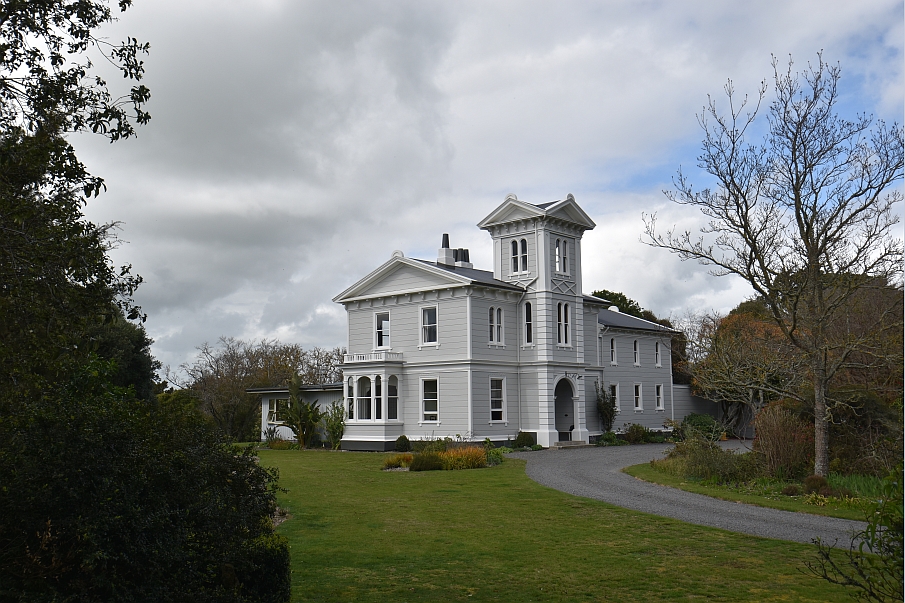
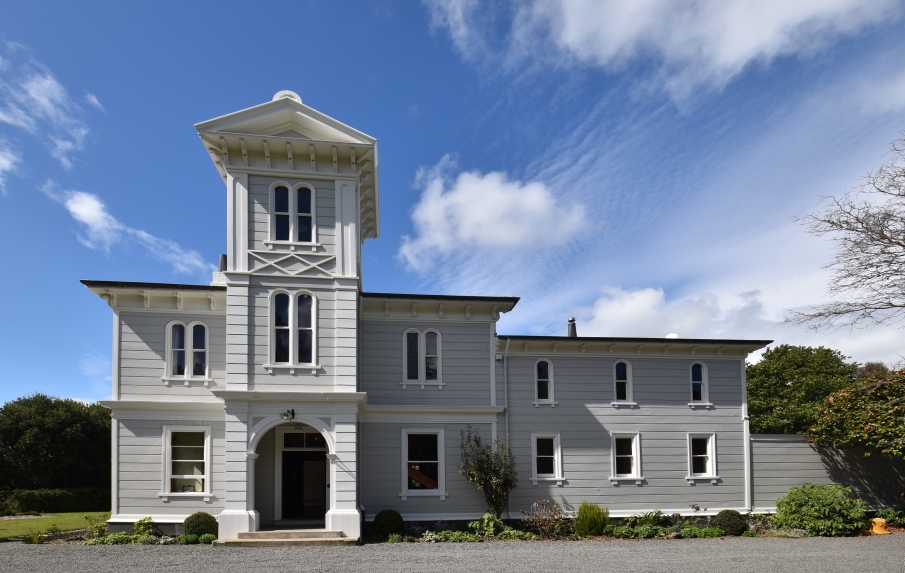
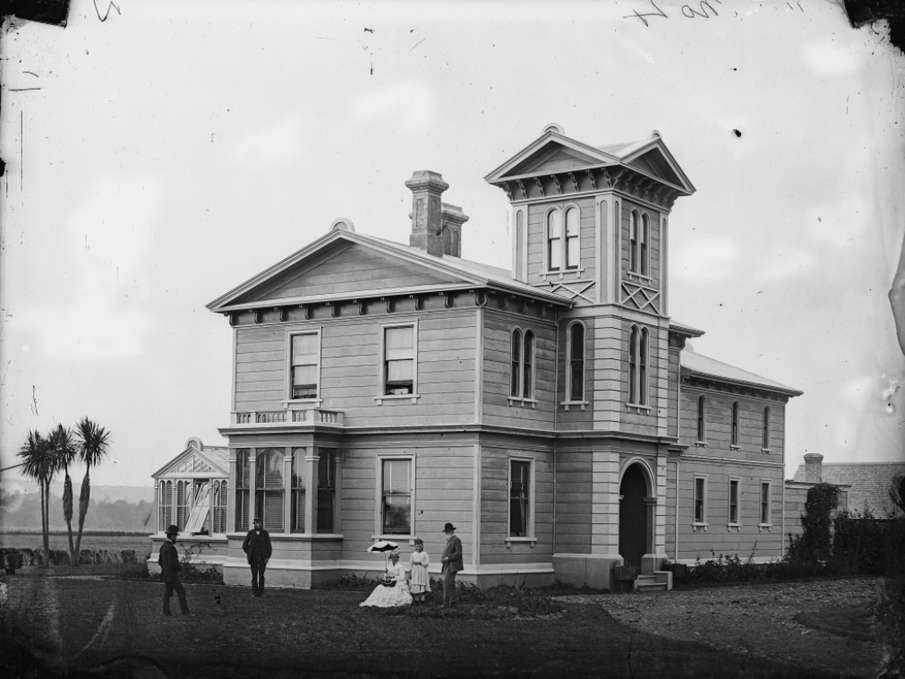
Fox acquired 5000 acres of the original Rangitikei block in about 1849 (confirmed by a Crown grant in 1858). Fox was later to subdivide a portion of this land for the proposed town of Marsden. The settlement proved unpopular due to Fox's stipulation that liquor should not be sold from any of the buildings erected there. The early Pakeha settlers eventually chose to settle further north at what is now the town of Marton. Fox named his own property Westoe after the town in Durham County, England, where he was born. He built his first house in the early 1850s on river flats. Unfortunately the location proved to be prone to flooding and, when the opportunity arose to build a new house, the decision was made to locate it on the flat above the original homestead. Designed by Charles Tringham, the new house was built in 1874, and the carpenter was probably H. Austin of Halcombe. It is said that Tringham was inspired by Osborne House, the home of Queen Victoria on the Isle of Wright, and parallels can be seen with the Italianate tower which is a central feature of the house. The Westoe tower was never completed and remains unlined inside. Fox was a keen amateur horticulturist and created a substantial park and garden surrounding Westoe. Fox sold Westoe in 1885 and moved to Auckland. A few months later the house and lands were acquired by James Howard.
Westoe, in its splendid setting, is significant as the house of William Fox, a noted politician, artist, and social advocate, and is a fine example of a Victorian country house.
List Entry Information
Status
Listed
List Entry Status
Historic Place Category 1
Access
Private/No Public Access
List Number
156
Date Entered
29th November 1985
Date of Effect
29th November 1985
City/District Council
Rangitīkei District
Region
Horizons (Manawatū-Whanganui) Region
Legal description
Lot 1 DP 11632 Blk III Rangitoto SD
Status
Listed
List Entry Status
Historic Place Category 1
Access
Private/No Public Access
List Number
156
Date Entered
29th November 1985
Date of Effect
29th November 1985
City/District Council
Rangitīkei District
Region
Horizons (Manawatū-Whanganui) Region
Legal description
Lot 1 DP 11632 Blk III Rangitoto SD
Construction Professional
Name
Tringham, Charles
Type
Architect
Biography
Charles Tringham was born at Winforton in Hertfordshire, England, in 1841. Little is known of his education but it is thought that he acquired woodworking skills. Tringham arrived in New Zealand at Auckland in December 1864 and the passenger list records his occupation as a carpenter. Tringham moved to Wellington and established a partnership with a builder named William Lawes. At the end of December 1866 he left the partnership to establish himself as a builder and undertaker. Within a year he was advertising himself as an architect and gaining a considerable number of contracts for houses, churches, hotels and a variety of other commercial premises. Tringham married Margaret Hunter Bennett in April 1868, the daughter of Dr John Bennett, the first New Zealand Registrar-General, and this may have helped his social status in Wellington. Lucrative contracts followed, including the Italianate house ‘Westoe’ (1874) near Marton for Sir William Fox, and the extensions to William Clayton’s former home in Hobson Street (now the nucleus of Queen Margaret College). Tringham was nearing the end of his architectural career in the 1890s and was elected President of the Wellington Association of Architects in 1895. He retired to the Wairarapa to farm and remained there until his death in 1916.
Construction Details
Start Year
1874
Type
Original Construction
Start Year
1900
Type
Modification
Description
Large scullery turned into a small kitchen and the kitchen was made into a sewing room. Ceilings in the main living room and bedroom were panelled. Hall and stair walls also panelled
Start Year
1920
startYearCirca
Finish Year
1930
finishYearCirca
Type
Modification
Description
Verandah on the east side built
Start Year
1966
Type
Modification
Description
Double bedrooms and a bathroom built on the area formerly occupied by a third of the verandah and the 'old conservatory'
Construction Materials
The construction throughout is of totara with matai flooring and interior linings.
Construction Professional
Name
Tringham, Charles
Type
Architect
Biography
Charles Tringham was born at Winforton in Hertfordshire, England, in 1841. Little is known of his education but it is thought that he acquired woodworking skills. Tringham arrived in New Zealand at Auckland in December 1864 and the passenger list records his occupation as a carpenter. Tringham moved to Wellington and established a partnership with a builder named William Lawes. At the end of December 1866 he left the partnership to establish himself as a builder and undertaker. Within a year he was advertising himself as an architect and gaining a considerable number of contracts for houses, churches, hotels and a variety of other commercial premises. Tringham married Margaret Hunter Bennett in April 1868, the daughter of Dr John Bennett, the first New Zealand Registrar-General, and this may have helped his social status in Wellington. Lucrative contracts followed, including the Italianate house ‘Westoe’ (1874) near Marton for Sir William Fox, and the extensions to William Clayton’s former home in Hobson Street (now the nucleus of Queen Margaret College). Tringham was nearing the end of his architectural career in the 1890s and was elected President of the Wellington Association of Architects in 1895. He retired to the Wairarapa to farm and remained there until his death in 1916.
Construction Details
Start Year
1874
Type
Original Construction
Start Year
1900
Type
Modification
Description
Large scullery turned into a small kitchen and the kitchen was made into a sewing room. Ceilings in the main living room and bedroom were panelled. Hall and stair walls also panelled
Start Year
1920
startYearCirca
Finish Year
1930
finishYearCirca
Type
Modification
Description
Verandah on the east side built
Start Year
1966
Type
Modification
Description
Double bedrooms and a bathroom built on the area formerly occupied by a third of the verandah and the 'old conservatory'
Construction Materials
The construction throughout is of totara with matai flooring and interior linings.
Historical and Associated Iwi / Hapū / Whānau
Completion Date
11th September 2001
Report Written By
Helen McCracken
Information Sources
Beaglehole, nd
A Beaglehole, 'Buildings Classification Committee - Research Report Westoe Homestead, Kakariki', nd. Held on file at NZHPT, Wellington.
Dictionary of New Zealand Biography
Dictionary of New Zealand Biography
Ministry of Works and Development
Ministry of Works and Development
Other Information
This place was identified as significant under previous legislation with different information requirements. It remains significant under the current legislation. There is opportunity under our legislation and policies to add to this information. Further information about this place may be available from the Central Regional Office of Heritage New Zealand Pouhere Taonga. Please note that entry on the New Zealand Heritage List/Rarangi Korero identifies only the heritage values of the property concerned, and should not be construed as advice on the state of the property, or as a comment of its soundness or safety, including in regard to earthquake risk, safety in the event of fire, or insanitary conditions.
Historical and Associated Iwi / Hapū / Whānau
Completion Date
11th September 2001
Report Written By
Helen McCracken
Information Sources
Beaglehole, nd
A Beaglehole, 'Buildings Classification Committee - Research Report Westoe Homestead, Kakariki', nd. Held on file at NZHPT, Wellington.
Dictionary of New Zealand Biography
Dictionary of New Zealand Biography
Ministry of Works and Development
Ministry of Works and Development
Other Information
This place was identified as significant under previous legislation with different information requirements. It remains significant under the current legislation. There is opportunity under our legislation and policies to add to this information. Further information about this place may be available from the Central Regional Office of Heritage New Zealand Pouhere Taonga. Please note that entry on the New Zealand Heritage List/Rarangi Korero identifies only the heritage values of the property concerned, and should not be construed as advice on the state of the property, or as a comment of its soundness or safety, including in regard to earthquake risk, safety in the event of fire, or insanitary conditions.
Current Usages
Uses: Accommodation
Specific Usage: House
Former Usages
General Usage: Accommodation
Specific Usage: House
Current Usages
Uses: Accommodation
Specific Usage: House
Former Usages
General Usage: Accommodation
Specific Usage: House
Location
Sign up to hear more
Get the latest heritage news, features and events delivered
straight to your inbox.
