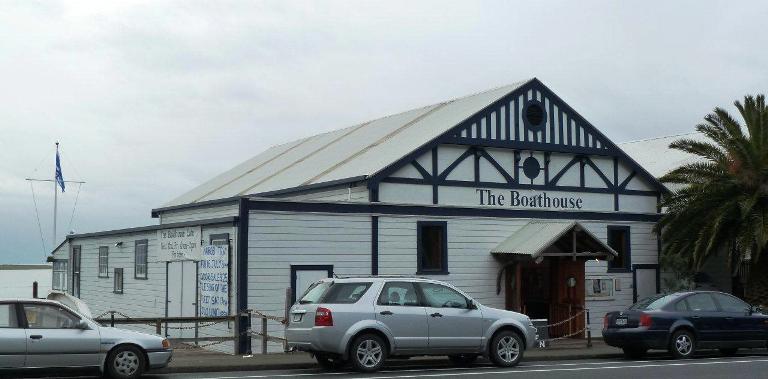
The Boathouse, on Wakefield Quay, Nelson, was purpose-built in 1906 for the Nelson Rowing Club. It was designed by Nelson architect William Houlker and built on wharf piles over the sea. The building is historically and socially significant as an important part of Nelson community life for over a century while acting as a rowing clubhouse, scout hall, community venue and dancehall. Since the 1980s a strikingly successful community ownership model has ensured it has continued its contribution to the city. As its owners note, the Boathouse continues to hold ‘a special place in the heart of many a Nelsonian’. The building’s ornamental half-timbered effect, on the gable ends facing both the street and the sea, makes a significant aesthetic contribution to Nelson’s historic Wakefield Quay.
The rowing club’s new building was considered ‘a building worthy of the club and city and an ornament to the foreshore of the harbour’. Its opening was celebrated with a fancy dress ball. The building, built of native timber, had a gabled main hall, opening onto a tarred slipway leading to the sea, with two flat-roofed sections on either side, used for storage for about twenty boats and changing rooms.
The Rowing Club went into decline after the First World War, and the building and boats were purchased by the Iron Duke Sea Scouts troop in 1924, on the condition that the Scouts continued to foster outrigger rowing. The Sea Scouts had been formed in Nelson three years earlier, and were named for Viscount Jellicoe (1859–1935), who was both New Zealand’s Governor-General and Chief Scout from 1920-24. The Rowing Club revived a few years later and from the 1920s to the 1960s the building was a hive of activity as it was used by both groups for regattas, scout activity, and many public dances, and became an important part of the culture of Nelson.
In the late 1970s the two clubs shifted to new premises and the building was under threat of demolition. To save it, 25 Nelson residents purchased the building, to make it a shared family-friendly cultural and recreational space in 1986. The group carried out a major restoration in 1992-94 including replacing piles, rebuilding the front wall, constructing a new deck and kitchen, and removing the boat ramp. Where possible the original timber and fittings were reused.
The building has continued to be used both by its members and as a community function and meeting space, café, and venue for weddings and live music; in 2017 it was used by 500 people a week. In 2018, Cyclone Fehi severely damaged the building, lifting floorboards and damaging external fixtures. The owners, by then numbering over 280, rapidly raised the funds for its restoration, supported by music and local communities. The floor was completely replaced, the deck repaired, gangways installed, and a new kitchen installed. The building reopened in the same year and took up its place again in the social and community life of the city.
The rowing club’s new building was considered ‘a building worthy of the club and city and an ornament to the foreshore of the harbour’. Its opening was celebrated with a fancy dress ball. The building, built of native timber, had a gabled main hall, opening onto a tarred slipway leading to the sea, with two flat-roofed sections on either side, used for storage for about twenty boats and changing rooms.
The Rowing Club went into decline after the First World War, and the building and boats were purchased by the Iron Duke Sea Scouts troop in 1924, on the condition that the Scouts continued to foster outrigger rowing. The Sea Scouts had been formed in Nelson three years earlier, and were named for Viscount Jellicoe (1859–1935), who was both New Zealand’s Governor-General and Chief Scout from 1920-24. The Rowing Club revived a few years later and from the 1920s to the 1960s the building was a hive of activity as it was used by both groups for regattas, scout activity, and many public dances, and became an important part of the culture of Nelson.
In the late 1970s the two clubs shifted to new premises and the building was under threat of demolition. To save it, 25 Nelson residents purchased the building, to make it a shared family-friendly cultural and recreational space in 1986. The group carried out a major restoration in 1992-94 including replacing piles, rebuilding the front wall, constructing a new deck and kitchen, and removing the boat ramp. Where possible the original timber and fittings were reused.
The building has continued to be used both by its members and as a community function and meeting space, café, and venue for weddings and live music; in 2017 it was used by 500 people a week. In 2018, Cyclone Fehi severely damaged the building, lifting floorboards and damaging external fixtures. The owners, by then numbering over 280, rapidly raised the funds for its restoration, supported by music and local communities. The floor was completely replaced, the deck repaired, gangways installed, and a new kitchen installed. The building reopened in the same year and took up its place again in the social and community life of the city.