

Despite the decline Hokitika retained a harbourmaster until the 1920s and remained an official port until the 1950s. As with many other customhouses throughout New Zealand Hokitika's was rebuilt during the 1890s, as part of the Liberal government's building programme initiated by Premier and West Coast politician Richard Seddon (1845-1906). The Hokitika Customhouse was designed by John Campbell (1857-1942), then a draughtsman in the Public Works Department. Campbell was eventually appointed to be Government Architect in 1909. Erected for £400, the Customhouse was a small single-storey building clad in weatherboard with a gabled porch over the entrance.
In design the customhouse is one of Campbell's standardised government buildings, which were typified by a rectangular plan, a hipped roof with a gabled porch over the entrance, the use of vertical and horizontal battens to subdivide the walls, and shingles above the windows. The latter reflects Campbell's interest in the American Stick and Shingle style. Other similar buildings include the former customhouse in Napier (1895) and the courthouse at Hunterville (1895), both of which are also registered by the New Zealand Historic Places Trust Pouhere Taonga.
After the harbourmaster was removed from Hokitika the customhouse was taken over by the Ministry of Works and used as a depot. It was threatened with demolition during the 1980s but was eventually preserved and moved onto a site across the road by the river. A lean-to addition at the rear of the building was removed and the interior returned to its original layout of three rooms. However, the public counter and one fireplace was removed during this work. A trust was established to look after the building and it has been used by community groups over the years.
The Customhouse at Hokitika is one of the last remaining links to Hokitika's heyday as a busy and prosperous port. The establishment of Hokitika as a port-of-entry with a customs officer was a direct result of the West Coast gold rush, and the customhouse stands as a physical link to the history of extractive industries on the West Coast. The building is one of Campbell's earlier designs and part of an attempt by the government to standardise public buildings for ease and quickness of construction. As Campbell preferred to design and build in brick, the customhouse at Hokitika is an interesting example of his timber buildings, which formed a very small part of his work. Today the Customhouse stands as a prominent landmark close to its original site.
List Entry Information
Status
Listed
List Entry Status
Historic Place Category 1
Access
Private/No Public Access
List Number
1700
Date Entered
28th June 1990
Date of Effect
28th June 1990
City/District Council
Westland District
Region
West Coast Region
Extent of List Entry
Extent includes part of the land described as Sec 1 SO Plan 11764, Westland Land District, and the building known as Customhouse (Former) thereon. Refer to the extent map tabled at the Heritage List/ Rārangi Kōrero Committee meeting on 30 July 2020.
Legal description
Sec 1 SO Plan 11764, Westland Land District
Status
Listed
List Entry Status
Historic Place Category 1
Access
Private/No Public Access
List Number
1700
Date Entered
28th June 1990
Date of Effect
28th June 1990
City/District Council
Westland District
Region
West Coast Region
Extent of List Entry
Extent includes part of the land described as Sec 1 SO Plan 11764, Westland Land District, and the building known as Customhouse (Former) thereon. Refer to the extent map tabled at the Heritage List/ Rārangi Kōrero Committee meeting on 30 July 2020.
Legal description
Sec 1 SO Plan 11764, Westland Land District
Why is this place significant?
Historic Significance
Historical Significance or Value The Custom House is one of the few tangible reminders of Hokitika's heyday when it had its own resident Customs Officer and the West Coast was one of New Zealand's most important regional economies. From the gold rush of the mid-1860s through to the early twentieth century, Hokitika was one of the country's busiest ports, but gradually went into decline and finally closed in 1954.
Physical Significance
ARCHITECTURAL QUALITY: The Custom House is a modest building which has nevertheless been carefully designed and well built. It is a fine example of the buildings erected by the Public Works Department under John Campbell all over New Zealand for a multitude of government purposes ranging from custom houses to courthouses, and post offices to police stations. In style it represents a successful local adaptation of features of the English 'Queen Anne' to a small wooden public building. TOWNSCAPE/LANDMARK VALUE: Standing on Gibson's Quay near its original site, the Custom House is a prominent landmark within the township of Hokitika and one which will gain further prominence when the new Hokitika River Bridge has been completed.
Why is this place significant?
Historic Significance
Historical Significance or Value The Custom House is one of the few tangible reminders of Hokitika's heyday when it had its own resident Customs Officer and the West Coast was one of New Zealand's most important regional economies. From the gold rush of the mid-1860s through to the early twentieth century, Hokitika was one of the country's busiest ports, but gradually went into decline and finally closed in 1954.
Physical Significance
ARCHITECTURAL QUALITY: The Custom House is a modest building which has nevertheless been carefully designed and well built. It is a fine example of the buildings erected by the Public Works Department under John Campbell all over New Zealand for a multitude of government purposes ranging from custom houses to courthouses, and post offices to police stations. In style it represents a successful local adaptation of features of the English 'Queen Anne' to a small wooden public building. TOWNSCAPE/LANDMARK VALUE: Standing on Gibson's Quay near its original site, the Custom House is a prominent landmark within the township of Hokitika and one which will gain further prominence when the new Hokitika River Bridge has been completed.
Construction Professional
Name
Campbell, John
Type
Architect
Biography
John Campbell (1857-1942) served his articles under John Gordon (c1835-1912) in Glasgow. He arrived in Dunedin in 1882 and after a brief period as a draughtsman with Mason and Wales joined the Dunedin branch of the Public Works Department in 1883. His first known work, an unbuilt design for the Dunedin Railway Station, reveals an early interest in Baroque architecture. In November 1888 Campbell was transferred to Wellington where in 1889 he took up the position of draughtsman in charge of the Public Buildings Division of the Public Works Department. He remained in charge of the design of government buildings throughout New Zealand until his retirement in 1922, becoming in 1909 the first person to hold the position of Government Architect. Government architecture designed under his aegis evidences a change in style from Queen Anne to Edwardian Baroque. His best-known Queen Anne design is the Dunedin Police Station (1895-8), modelled on Richard Norman Shaw's New Scotland Yard (1887-90). Among his most exuberant Edwardian Baroque buildings is the Public Trust Office, Wellington (1905-09). Although Campbell designed the Dunedin Law Courts (1899-1902) in the Gothic style with a Scottish Baronial inflection, he established Edwardian Baroque as the government style for police stations, courthouses and post offices throughout New Zealand. In 1911 Campbell won the nation-wide architectural competition for the design of Parliament Buildings, Wellington. Although only partially completed, Parliament House is the crowning achievement of Campbell's career.
Construction Details
Start Year
1896
Finish Year
1897
Type
Original Construction
Start Year
1984
Finish Year
1985
Type
Relocation
Description
Moved in two stages to its current site on Gibson Quay. Officially reopened 24 March 1990
Start Year
1989
Type
Modification
Description
Interior rooms altered. Rear window replaced by door giving access to toilet. Counter removed. Former passage removed
Type
Modification
Description
Original cresting from roof removed
Period
pre-1984
Construction Materials
Framing and weatherboards of rimu. Corrugated iron roof.
Construction Professional
Name
Campbell, John
Type
Architect
Biography
John Campbell (1857-1942) served his articles under John Gordon (c1835-1912) in Glasgow. He arrived in Dunedin in 1882 and after a brief period as a draughtsman with Mason and Wales joined the Dunedin branch of the Public Works Department in 1883. His first known work, an unbuilt design for the Dunedin Railway Station, reveals an early interest in Baroque architecture. In November 1888 Campbell was transferred to Wellington where in 1889 he took up the position of draughtsman in charge of the Public Buildings Division of the Public Works Department. He remained in charge of the design of government buildings throughout New Zealand until his retirement in 1922, becoming in 1909 the first person to hold the position of Government Architect. Government architecture designed under his aegis evidences a change in style from Queen Anne to Edwardian Baroque. His best-known Queen Anne design is the Dunedin Police Station (1895-8), modelled on Richard Norman Shaw's New Scotland Yard (1887-90). Among his most exuberant Edwardian Baroque buildings is the Public Trust Office, Wellington (1905-09). Although Campbell designed the Dunedin Law Courts (1899-1902) in the Gothic style with a Scottish Baronial inflection, he established Edwardian Baroque as the government style for police stations, courthouses and post offices throughout New Zealand. In 1911 Campbell won the nation-wide architectural competition for the design of Parliament Buildings, Wellington. Although only partially completed, Parliament House is the crowning achievement of Campbell's career.
Construction Details
Start Year
1896
Finish Year
1897
Type
Original Construction
Start Year
1984
Finish Year
1985
Type
Relocation
Description
Moved in two stages to its current site on Gibson Quay. Officially reopened 24 March 1990
Start Year
1989
Type
Modification
Description
Interior rooms altered. Rear window replaced by door giving access to toilet. Counter removed. Former passage removed
Type
Modification
Description
Original cresting from roof removed
Period
pre-1984
Construction Materials
Framing and weatherboards of rimu. Corrugated iron roof.
Following Hokitika's establishment in 1864 as a major port and town for the West Coast gold rush, the first Custom House was built in July 1865 and enlarged in the following year. It stood on Gibson's Quay where the Department of Conservation annex now stands. The present building was erected by Edward Gibson and William Goodrich on the same site in 1897 at a cost of £400. After it had ceased to be used as a custom house the building was occupied by the Ministry of Works. In 1985 it was taken over by the local borough council who shifted it to its present site.
Following Hokitika's establishment in 1864 as a major port and town for the West Coast gold rush, the first Custom House was built in July 1865 and enlarged in the following year. It stood on Gibson's Quay where the Department of Conservation annex now stands. The present building was erected by Edward Gibson and William Goodrich on the same site in 1897 at a cost of £400. After it had ceased to be used as a custom house the building was occupied by the Ministry of Works. In 1985 it was taken over by the local borough council who shifted it to its present site.
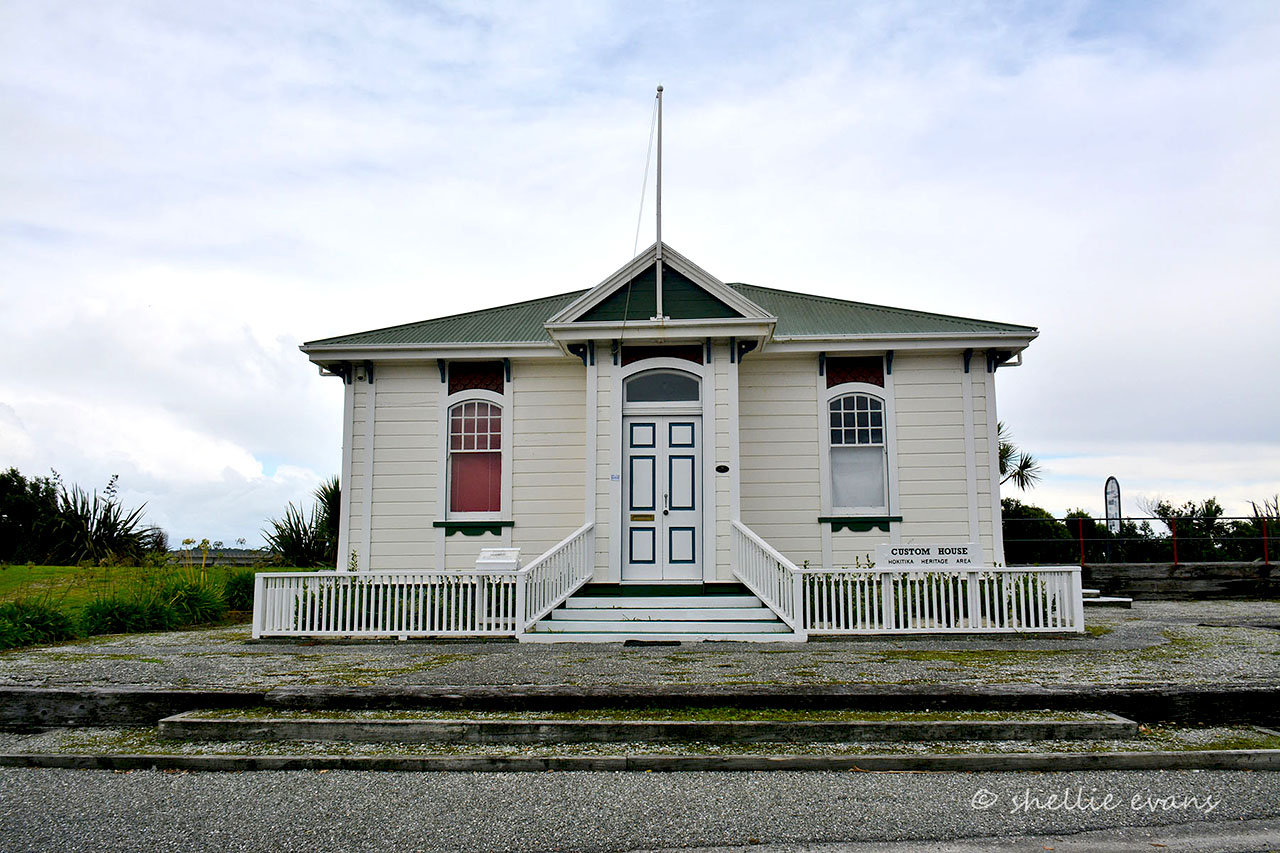
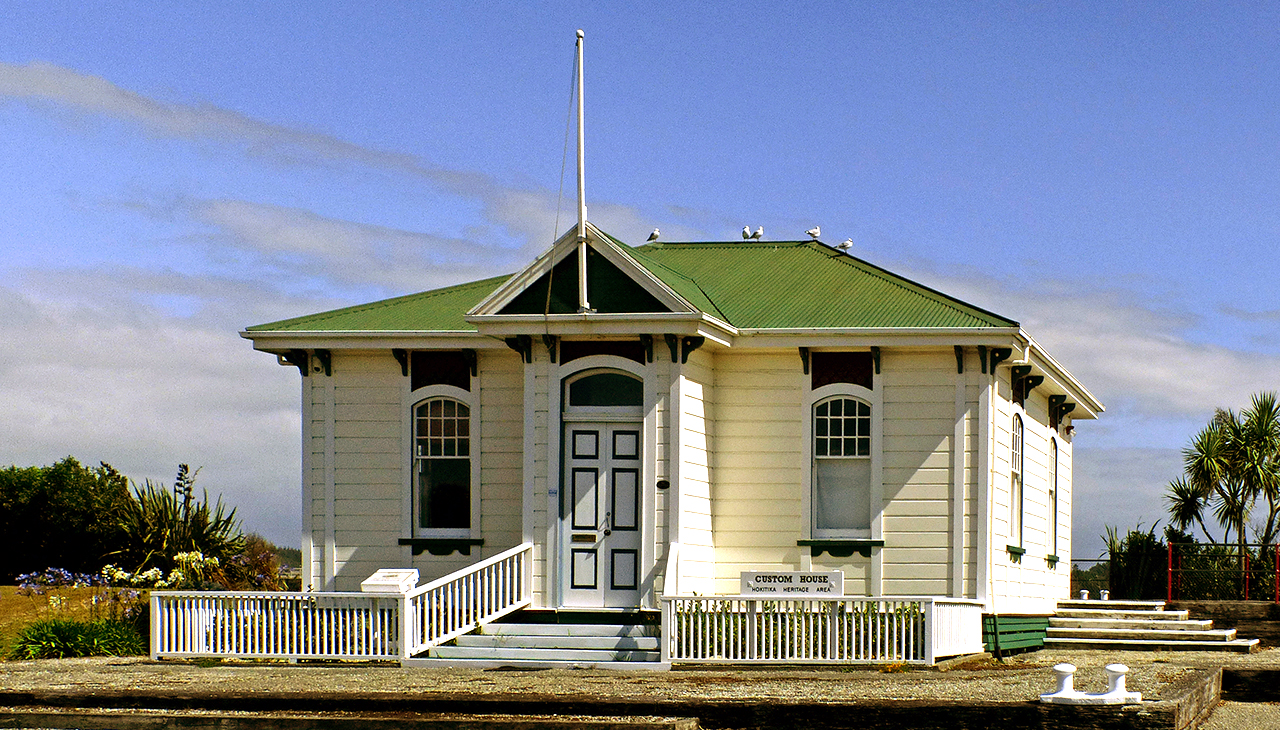
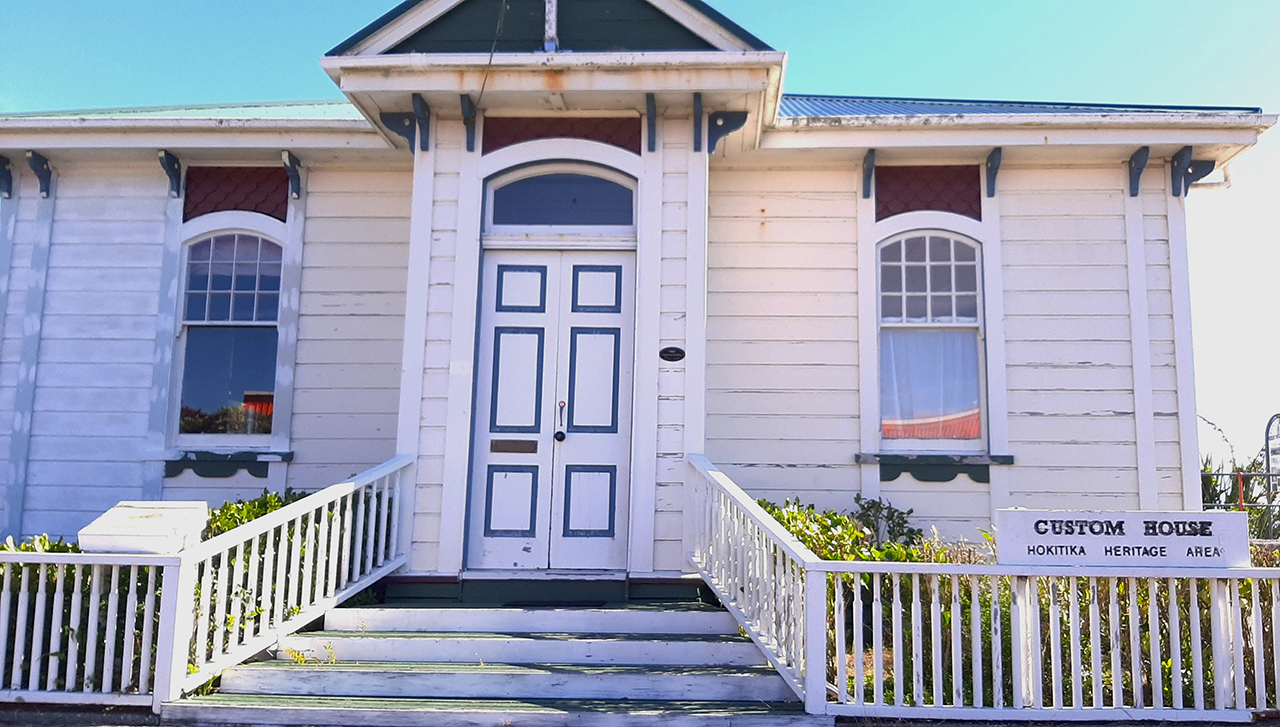
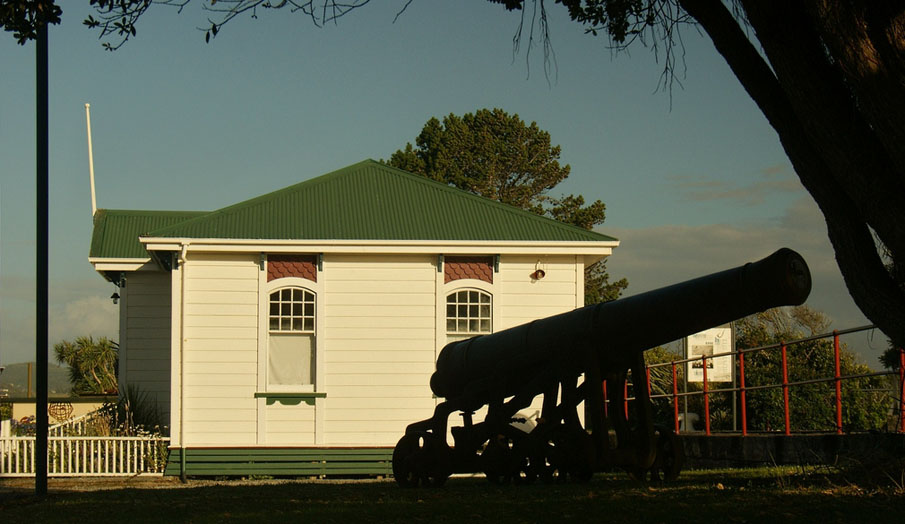
ARCHITECTURAL DESCRIPTION: The Custom House is a small symmetrical building with a hipped roof and gabled entrance porch. Clad in rusticated weatherboards, the building is approached by four concrete steps. Post and rail fences extend from the entrance to the corners of the custom house, thereby emphasising the symmetry which is established by the fenestration. Ornamentation is kept to a minimum both inside and outside the building, but the treatment of the entrance porch, windows and eaves does suggest the influence of Queen Anne architecture. Wide battens extending the full height of the walls frame the exterior doors and windows, as well as the boxed corners on the principal elevation. Brackets rising from these battens appear to support the eaves but they are purely ornamental and only feature on the front and side walls. Shingles enliven the surface texture of the building above the window heads and the fanlight of the main door. The upper sash of each window has an arched head and is divided into sixteen panes. The shape of the window heads is echoed by that of the fanlight. Beneath each window is a scalloped apron. Inside the custom house are two rooms lined with horizontal tongue- and-groove panelling. The larger of the two features a fireplace standing against the rear wall. At the rear of the smaller room is a toilet with external access only. MODIFICATIONS: Date Unknown: Cast iron roof cresting and chimneys removed. Built in units either side of long room fireplace constructed. 1989: Interior rooms altered. Rear window replaced by door giving access to new toilet.
ARCHITECTURAL DESCRIPTION: The Custom House is a small symmetrical building with a hipped roof and gabled entrance porch. Clad in rusticated weatherboards, the building is approached by four concrete steps. Post and rail fences extend from the entrance to the corners of the custom house, thereby emphasising the symmetry which is established by the fenestration. Ornamentation is kept to a minimum both inside and outside the building, but the treatment of the entrance porch, windows and eaves does suggest the influence of Queen Anne architecture. Wide battens extending the full height of the walls frame the exterior doors and windows, as well as the boxed corners on the principal elevation. Brackets rising from these battens appear to support the eaves but they are purely ornamental and only feature on the front and side walls. Shingles enliven the surface texture of the building above the window heads and the fanlight of the main door. The upper sash of each window has an arched head and is divided into sixteen panes. The shape of the window heads is echoed by that of the fanlight. Beneath each window is a scalloped apron. Inside the custom house are two rooms lined with horizontal tongue- and-groove panelling. The larger of the two features a fireplace standing against the rear wall. At the rear of the smaller room is a toilet with external access only. MODIFICATIONS: Date Unknown: Cast iron roof cresting and chimneys removed. Built in units either side of long room fireplace constructed. 1989: Interior rooms altered. Rear window replaced by door giving access to new toilet.
Historical and Associated Iwi / Hapū / Whānau
Completion Date
3rd September 2002
Report Written By
Melanie Lovell-Smith
Information Sources
Archives New Zealand (Chch)
Archives New Zealand (Christchurch)
Christchurch Press
Cyclopedia of New Zealand, 1906
Cyclopedia Company, Industrial, descriptive, historical, biographical facts, figures, illustrations, Wellington, N.Z, 1897-1908, Vol. 5, Nelson, Marlborough, Westland, 1906
Department of Conservation
Department of Conservation
West Coast Times
West Coast Times
McGill, 1991
David McGill, The Guardians at the Gate: The History of the New Zealand Customs Department, Wellington, Silver Owl Press for the New Zealand Customs Dept., 1991
McLean, 2001
Gavin McLean, Captain's Log: New Zealand's Maritime History, Auckland, 2001
Richardson, 1988
Peter Richardson, 'An Architecture of Empire: The Government Buildings of John Campbell in New Zealand', MA Thesis, University of Canterbury, 1988
Richardson, 1997
Peter Richardson, 'Building the Dominion: Government Architecture in New Zealand 1840-1922', PhD thesis, University of Canterbury, 1997
Ross, 1977
John Ross, Pride in Their Ports: The Story of the Minor Ports. Dunmore Press, Palmerston North, 1977
Historic Places in New Zealand
Historic Places in New Zealand
West Coast Historical Museum
West Coast Historical Museum
Ministry of Works and Development
Ministry of Works and Development
Other Information
This historic place was registered under the Historic Places Act 1980. This report includes the text from the original Building Classification Committee report considered by the NZHPT Board at the time of registration. Please note that entry on the New Zealand Heritage List/Rarangi Korero identifies only the heritage values of the property concerned, and should not be construed as advice on the state of the property, or as a comment of its soundness or safety, including in regard to earthquake risk, safety in the event of fire, or insanitary conditions.
Historical and Associated Iwi / Hapū / Whānau
Completion Date
3rd September 2002
Report Written By
Melanie Lovell-Smith
Information Sources
Archives New Zealand (Chch)
Archives New Zealand (Christchurch)
Christchurch Press
Cyclopedia of New Zealand, 1906
Cyclopedia Company, Industrial, descriptive, historical, biographical facts, figures, illustrations, Wellington, N.Z, 1897-1908, Vol. 5, Nelson, Marlborough, Westland, 1906
Department of Conservation
Department of Conservation
West Coast Times
West Coast Times
McGill, 1991
David McGill, The Guardians at the Gate: The History of the New Zealand Customs Department, Wellington, Silver Owl Press for the New Zealand Customs Dept., 1991
McLean, 2001
Gavin McLean, Captain's Log: New Zealand's Maritime History, Auckland, 2001
Richardson, 1988
Peter Richardson, 'An Architecture of Empire: The Government Buildings of John Campbell in New Zealand', MA Thesis, University of Canterbury, 1988
Richardson, 1997
Peter Richardson, 'Building the Dominion: Government Architecture in New Zealand 1840-1922', PhD thesis, University of Canterbury, 1997
Ross, 1977
John Ross, Pride in Their Ports: The Story of the Minor Ports. Dunmore Press, Palmerston North, 1977
Historic Places in New Zealand
Historic Places in New Zealand
West Coast Historical Museum
West Coast Historical Museum
Ministry of Works and Development
Ministry of Works and Development
Other Information
This historic place was registered under the Historic Places Act 1980. This report includes the text from the original Building Classification Committee report considered by the NZHPT Board at the time of registration. Please note that entry on the New Zealand Heritage List/Rarangi Korero identifies only the heritage values of the property concerned, and should not be construed as advice on the state of the property, or as a comment of its soundness or safety, including in regard to earthquake risk, safety in the event of fire, or insanitary conditions.
Current Usages
Uses: Civic Facilities
Specific Usage: Historic Property
Former Usages
General Usage: Government
Specific Usage: Customs House
Current Usages
Uses: Civic Facilities
Specific Usage: Historic Property
Former Usages
General Usage: Government
Specific Usage: Customs House
Location
Stay up to date with Heritage this month
