Quick links


Quick links
Quick links
Quick links
Quick links
Quick links
901 Tower Road , Turangaomoana, MATAMATA
Historic Place Category 1
List No. 1783
List Entry Information
Status
Listed
List Entry Status
Historic Place Category 1
Access
Unknown
List Number
1783
Date Entered
20th February 2025
Date of Effect
12th March 2025
City/District Council
Matamata-Piako District
Region
Waikato Region
Extent of List Entry
Extent includes part of the land described as Lot 2 DP 430406 (RT 518454), South Auckland Land District, and the buildings known as Sanigar thereon, and the following chattels: grain and fertiliser drill, wool table, wool press, wool scales and bale stencils. The extent excludes modern fencing, concrete electricity pylons and current trees or plantings. (Refer to map in Appendix 1 of the List entry report for further information).
Legal description
Lot 2 DP 430406 (RT 518454), South Auckland Land District
Location Description
NZTM Easting: 1848410.5 NZTM Northing: 5818576.6
Status
Listed
List Entry Status
Historic Place Category 1
Access
Unknown
List Number
1783
Date Entered
20th February 2025
Date of Effect
12th March 2025
City/District Council
Matamata-Piako District
Region
Waikato Region
Extent of List Entry
Extent includes part of the land described as Lot 2 DP 430406 (RT 518454), South Auckland Land District, and the buildings known as Sanigar thereon, and the following chattels: grain and fertiliser drill, wool table, wool press, wool scales and bale stencils. The extent excludes modern fencing, concrete electricity pylons and current trees or plantings. (Refer to map in Appendix 1 of the List entry report for further information).
Legal description
Lot 2 DP 430406 (RT 518454), South Auckland Land District
Location Description
NZTM Easting: 1848410.5 NZTM Northing: 5818576.6
Why is this place significant?
Historic Significance
Historical Significance or Value Sanigar is historically significant for its connections with the transformation of the rural landscape and economy in twentieth-century New Zealand. The country’s shift in focus from extractive industries to farm-based produce for export within the British imperial network has been considered one of the most notable developments in New Zealand history. Sanigar has particularly close associations with the breaking up of large landed estates by the First Liberal Government (1891-1912), and the expansion and intensification of European-style farming through the creation family-run farms, mostly of medium size. It is directly connected with the subdivision of the Matamata Estate, an important example of a large colonial, agricultural holding in the Waikato and Hauraki. Sanigar has historical value for its long and close associations with the production of meat, dairy and wool - items that consistently accounted for over 90 percent of New Zealand’s annual exports during extended periods of the twentieth century. Fuelled by superphosphate fertiliser and related pastoral improvements, medium-size farm production - as at Sanigar - made an unusually important contribution to such exports by international standards. In its dairying activities, Sanigar is also specifically linked with the importance of the Matamata area to New Zealand’s twentieth-century pastoral development. In the 1920s, when dairying was being undertaken at Sanigar, Matamata contained what were considered some of the largest dairy factories in the world, serviced by surrounding farms. The place has associations with the relocation of farmers from earlier dairying districts in Taranaki to Matamata, a wider feature of European settlement in Waikato and Hauraki during the early twentieth century. Its historical significance is enhanced through remaining part of a working farm. Sanigar is additionally important for its associations with rural Māori communities, and notably employment opportunities for Māori workers after the Second World War. The 1950s and 1960s have been considered key decades in twentieth-century Māori history, when rural communities experienced an exodus to New Zealand’s cities and remaining individuals often took up work on European farms. Shearing formed a particularly important industry for Māori. Sanigar is historically significant both for its direct associations with whānau-based shearing activity, and the employment of Māori labour for general farmwork. These formed part of a longer tradition of Māori engagement with European-style agriculture in the Matamata area, which included kāinga-grown crops for the Auckland market in the 1840s and the involvement of local Māori communities in farming on the Matamata Estate.
Physical Significance
Archaeological Significance or Value Sanigar has high archaeological significance for its capacity to provide information about activities connected with important aspects of New Zealand’s twentieth-century development, economy and everyday life for rural families and workers. It can supply particular knowledge about farm-based wool production and dairying, mainstays of the country’s agricultural life and export market for much of this period. The place can provide specific insights about matters linked with shearing, wool sorting, pressing and baling; mechanised and hygienic approaches to milk production in the early twentieth century; and the evolution of vernacular structures to cope with changing farm requirements. It has particular capacity to supply knowledge about such activities on a family-run farm of typical scale to many created during the intensification of New Zealand agriculture in the early twentieth century. The place’s archaeological significance is enhanced by the survival of associated equipment as well as chattels; and in-ground features such as an associated well and artefacts connected with the everyday use of the place. Sanigar is additionally important for its ability to provide information about individuals and communities who laboured in and utilised the buildings. Extensive graffiti survives, especially in the woolshed, which provides knowledge about farming networks involving neighbours and friends in the 1930s, and later whānau-based approaches linked with shearing and rousie activities from at least the early 1950s. Also incorporating a significant example of small-scale workers’ accommodation, Sanigar can provide knowledge about everyday working conditions, particularly for Māori rural communities in the 1950s and 1960s. The experiences of such communities have often previously been under-represented in historical enquiry about the past.
Why is this place Category 1 / Category 2?
Detail Of Assessed Criteria
This place was assessed against the Section 66(3) criteria and found to qualify under the following criteria a, b, c and k. The assessment concludes that this place should be listed as a Category 1 historic place. (a) The extent to which the place reflects important or representative aspects of New Zealand history In its creation and evolution, Sanigar reflects the emergence and development of small and medium-sized farms that fuelled the country’s agricultural and pastoral economy for much of the twentieth century. Its surviving outbuildings and associated features demonstrate the scale and a range of activities undertaken on these holdings, particularly those connected with dairy and wool production. These include farm-based milk separation and machine milking; hygienic requirements in early twentieth-century cowsheds; and a range of processes linked with shearing and rousie duties. Small and medium size farms played an unusually prominent role in the production of meat, dairy and wool in New Zealand - assisting the country to achieve the world’s fifth-highest per capita income by 1950. In the date and means of its creation as a farmholding, Sanigar has strong and specific connections to policies promoted by the First Liberal Government, and especially those connected with the breaking up of large colonial-era estates. As well as reflecting family-based enterprise, Sanigar also demonstrates the contributions of rural Māori communities in farming activity and development. Graffiti in the woolshed directly reflects the activities of Māori shearing and rousie gangs, who played an important role in the evolution of New Zealand shearing and differed from other traditions by frequently incorporating both male and female whānau-based labour. Sanigar also retains an identified example of accommodation for Māori shearers and farmworkers, which reflects day to day conditions for such employees. This and the other surviving structures on the site demonstrate vernacular approaches to farm-building construction and use that were created and developed outside of formal architectural practice. (b) The association of the place with events, persons, or ideas of importance in New Zealand history Sanigar has connections with events of significance in New Zealand history, notably global conflicts that stimulated wool purchase and price. Conversion and extensions to the woolshed at Sanigar likely occurred during or in the immediate aftermath of the First World War, when New Zealand wool was commandeered for British military use and prices fixed at a comparatively advantageous rate. The farm owner at this time, Harry Harding, was involved in patriotic events linked with this war, including donating surplus wool to the British Seamen’s fund. Construction of the workers’ accommodation or whare at Sanigar similarly appears to have coincided with the Korean War, when American military demand for wool caused prices to boom and also exacerbate a pre-existing shortage of shearing labour, itself caused by the Second World War. (c) The potential of the place to provide knowledge of New Zealand history Sanigar has special significance for the extent to which it can provide additional knowledge about New Zealand’s farming history. This is due to the range and authenticity of fabric that survives in the form of buildings, associated equipment, graffiti, chattels, in-ground features and artefacts; the extent of associated documentary and oral history about the place that would assist interpretation; and the relative lack of archaeological enquiry relating to twentieth-century farm buildings of this type and meaning. Its potential is also enhanced by the importance of the history involved. Specific knowledge that future investigation can provide includes information about processes and activities linked with dairying and wool production; worker accommodation and shearing gang composition; and evolving farming priorities and practices through the early and mid-twentieth century. The whare and extensive graffiti in the woolshed linked with whānau-based shearing gangs can be considered particularly significant for their capacity to advance knowledge about the experiences and contributions of Māori communities in agricultural work, especially in the mid-twentieth century. The cowshed similarly has high significance for being able to provide evidence about early twentieth-century dairying in the Waikato, a region that played a major role in this industry’s development at this time. The place can also provide extensive additional evidence about vernacular approaches to farm building design, construction and use, as well as expand knowledge about the nature and origins of vernacular materials. Regarding the latter, the place incorporates an unusual variety of trademarked corrugated iron, including numerous sheets from what may have been the only manufactory in 1920s New Zealand, as well as other brands that appear uncommon or unusual. Further investigation of these sheets can provide information about the manufacture, distribution and use of such brands. Corrugated iron formed an important material in vernacular construction, particularly in rural areas where the ease of transport of this material was an advantage. (k) The extent to which the place forms part of a wider historical and cultural area The place forms part of a wider area within the immediately surrounding Matamata Plains associated with notable developments in New Zealand agricultural production. The area incorporates recorded archaeological components linked with Ngāti Hauā’s adoption of European crops to supplement traditional gardening in the vicinity of Matamata. It also encompasses surviving places linked with later creation and use of the Matamata Estate, including the Firth Tower, McCaw Homestead, Stanley Landing and position of Tower Road. Some of these structures are situated in the Firth Tower Museum, advertised as one of the largest agricultural museums in the country. Sanigar articulates ongoing developments in agriculture and rural life into the early and mid-twentieth centuries linked with the intensification of agriculture and rural settlement. All of these aspects have close and significant connections with the history of Māori communities in the area and their contribution to the area’s agricultural development. Summary of Significance or Values Sanigar has special significance for the for the extent to which it can provide knowledge about New Zealand’s twentieth-century farming history. Incorporating a wide range of fabric including buildings of differing use along with associated equipment, chattels, in-ground features and artefacts, the place can supply additional information about numerous of matters of value, including dairying and wool production; worker accommodation and shearing gang composition; and vernacular farm-building design, construction, materials and use. It can also advance knowledge about the experiences and contributions of Māori communities in agricultural work. Its value is enhanced by factors that include the current under-investigation of such matters and the importance of the history involved. Sanigar is historically significant for its connections with the transformation of the rural landscape and economy in twentieth-century New Zealand. It is especially linked with the breaking up of large, landed estates by the First Liberal Government (1891-1912), and the intensification of European-style farming through the creation family-run farms, mostly of medium size, for producing meat, dairy and wool exports. Sanigar is also historically important for its connections with and ability to reflect the contributions and experiences of rural Māori workers, especially during the 1950s and 1960s - decades of key significance in twentieth-century Māori history. The place forms part of a wider area with capacity to articulate evolving developments in New Zealand agriculture, including the contributions of Māori communities.
Why is this place significant?
Historic Significance
Historical Significance or Value Sanigar is historically significant for its connections with the transformation of the rural landscape and economy in twentieth-century New Zealand. The country’s shift in focus from extractive industries to farm-based produce for export within the British imperial network has been considered one of the most notable developments in New Zealand history. Sanigar has particularly close associations with the breaking up of large landed estates by the First Liberal Government (1891-1912), and the expansion and intensification of European-style farming through the creation family-run farms, mostly of medium size. It is directly connected with the subdivision of the Matamata Estate, an important example of a large colonial, agricultural holding in the Waikato and Hauraki. Sanigar has historical value for its long and close associations with the production of meat, dairy and wool - items that consistently accounted for over 90 percent of New Zealand’s annual exports during extended periods of the twentieth century. Fuelled by superphosphate fertiliser and related pastoral improvements, medium-size farm production - as at Sanigar - made an unusually important contribution to such exports by international standards. In its dairying activities, Sanigar is also specifically linked with the importance of the Matamata area to New Zealand’s twentieth-century pastoral development. In the 1920s, when dairying was being undertaken at Sanigar, Matamata contained what were considered some of the largest dairy factories in the world, serviced by surrounding farms. The place has associations with the relocation of farmers from earlier dairying districts in Taranaki to Matamata, a wider feature of European settlement in Waikato and Hauraki during the early twentieth century. Its historical significance is enhanced through remaining part of a working farm. Sanigar is additionally important for its associations with rural Māori communities, and notably employment opportunities for Māori workers after the Second World War. The 1950s and 1960s have been considered key decades in twentieth-century Māori history, when rural communities experienced an exodus to New Zealand’s cities and remaining individuals often took up work on European farms. Shearing formed a particularly important industry for Māori. Sanigar is historically significant both for its direct associations with whānau-based shearing activity, and the employment of Māori labour for general farmwork. These formed part of a longer tradition of Māori engagement with European-style agriculture in the Matamata area, which included kāinga-grown crops for the Auckland market in the 1840s and the involvement of local Māori communities in farming on the Matamata Estate.
Physical Significance
Archaeological Significance or Value Sanigar has high archaeological significance for its capacity to provide information about activities connected with important aspects of New Zealand’s twentieth-century development, economy and everyday life for rural families and workers. It can supply particular knowledge about farm-based wool production and dairying, mainstays of the country’s agricultural life and export market for much of this period. The place can provide specific insights about matters linked with shearing, wool sorting, pressing and baling; mechanised and hygienic approaches to milk production in the early twentieth century; and the evolution of vernacular structures to cope with changing farm requirements. It has particular capacity to supply knowledge about such activities on a family-run farm of typical scale to many created during the intensification of New Zealand agriculture in the early twentieth century. The place’s archaeological significance is enhanced by the survival of associated equipment as well as chattels; and in-ground features such as an associated well and artefacts connected with the everyday use of the place. Sanigar is additionally important for its ability to provide information about individuals and communities who laboured in and utilised the buildings. Extensive graffiti survives, especially in the woolshed, which provides knowledge about farming networks involving neighbours and friends in the 1930s, and later whānau-based approaches linked with shearing and rousie activities from at least the early 1950s. Also incorporating a significant example of small-scale workers’ accommodation, Sanigar can provide knowledge about everyday working conditions, particularly for Māori rural communities in the 1950s and 1960s. The experiences of such communities have often previously been under-represented in historical enquiry about the past.
Why is this place Category 1 / Category 2?
Detail Of Assessed Criteria
This place was assessed against the Section 66(3) criteria and found to qualify under the following criteria a, b, c and k. The assessment concludes that this place should be listed as a Category 1 historic place. (a) The extent to which the place reflects important or representative aspects of New Zealand history In its creation and evolution, Sanigar reflects the emergence and development of small and medium-sized farms that fuelled the country’s agricultural and pastoral economy for much of the twentieth century. Its surviving outbuildings and associated features demonstrate the scale and a range of activities undertaken on these holdings, particularly those connected with dairy and wool production. These include farm-based milk separation and machine milking; hygienic requirements in early twentieth-century cowsheds; and a range of processes linked with shearing and rousie duties. Small and medium size farms played an unusually prominent role in the production of meat, dairy and wool in New Zealand - assisting the country to achieve the world’s fifth-highest per capita income by 1950. In the date and means of its creation as a farmholding, Sanigar has strong and specific connections to policies promoted by the First Liberal Government, and especially those connected with the breaking up of large colonial-era estates. As well as reflecting family-based enterprise, Sanigar also demonstrates the contributions of rural Māori communities in farming activity and development. Graffiti in the woolshed directly reflects the activities of Māori shearing and rousie gangs, who played an important role in the evolution of New Zealand shearing and differed from other traditions by frequently incorporating both male and female whānau-based labour. Sanigar also retains an identified example of accommodation for Māori shearers and farmworkers, which reflects day to day conditions for such employees. This and the other surviving structures on the site demonstrate vernacular approaches to farm-building construction and use that were created and developed outside of formal architectural practice. (b) The association of the place with events, persons, or ideas of importance in New Zealand history Sanigar has connections with events of significance in New Zealand history, notably global conflicts that stimulated wool purchase and price. Conversion and extensions to the woolshed at Sanigar likely occurred during or in the immediate aftermath of the First World War, when New Zealand wool was commandeered for British military use and prices fixed at a comparatively advantageous rate. The farm owner at this time, Harry Harding, was involved in patriotic events linked with this war, including donating surplus wool to the British Seamen’s fund. Construction of the workers’ accommodation or whare at Sanigar similarly appears to have coincided with the Korean War, when American military demand for wool caused prices to boom and also exacerbate a pre-existing shortage of shearing labour, itself caused by the Second World War. (c) The potential of the place to provide knowledge of New Zealand history Sanigar has special significance for the extent to which it can provide additional knowledge about New Zealand’s farming history. This is due to the range and authenticity of fabric that survives in the form of buildings, associated equipment, graffiti, chattels, in-ground features and artefacts; the extent of associated documentary and oral history about the place that would assist interpretation; and the relative lack of archaeological enquiry relating to twentieth-century farm buildings of this type and meaning. Its potential is also enhanced by the importance of the history involved. Specific knowledge that future investigation can provide includes information about processes and activities linked with dairying and wool production; worker accommodation and shearing gang composition; and evolving farming priorities and practices through the early and mid-twentieth century. The whare and extensive graffiti in the woolshed linked with whānau-based shearing gangs can be considered particularly significant for their capacity to advance knowledge about the experiences and contributions of Māori communities in agricultural work, especially in the mid-twentieth century. The cowshed similarly has high significance for being able to provide evidence about early twentieth-century dairying in the Waikato, a region that played a major role in this industry’s development at this time. The place can also provide extensive additional evidence about vernacular approaches to farm building design, construction and use, as well as expand knowledge about the nature and origins of vernacular materials. Regarding the latter, the place incorporates an unusual variety of trademarked corrugated iron, including numerous sheets from what may have been the only manufactory in 1920s New Zealand, as well as other brands that appear uncommon or unusual. Further investigation of these sheets can provide information about the manufacture, distribution and use of such brands. Corrugated iron formed an important material in vernacular construction, particularly in rural areas where the ease of transport of this material was an advantage. (k) The extent to which the place forms part of a wider historical and cultural area The place forms part of a wider area within the immediately surrounding Matamata Plains associated with notable developments in New Zealand agricultural production. The area incorporates recorded archaeological components linked with Ngāti Hauā’s adoption of European crops to supplement traditional gardening in the vicinity of Matamata. It also encompasses surviving places linked with later creation and use of the Matamata Estate, including the Firth Tower, McCaw Homestead, Stanley Landing and position of Tower Road. Some of these structures are situated in the Firth Tower Museum, advertised as one of the largest agricultural museums in the country. Sanigar articulates ongoing developments in agriculture and rural life into the early and mid-twentieth centuries linked with the intensification of agriculture and rural settlement. All of these aspects have close and significant connections with the history of Māori communities in the area and their contribution to the area’s agricultural development. Summary of Significance or Values Sanigar has special significance for the for the extent to which it can provide knowledge about New Zealand’s twentieth-century farming history. Incorporating a wide range of fabric including buildings of differing use along with associated equipment, chattels, in-ground features and artefacts, the place can supply additional information about numerous of matters of value, including dairying and wool production; worker accommodation and shearing gang composition; and vernacular farm-building design, construction, materials and use. It can also advance knowledge about the experiences and contributions of Māori communities in agricultural work. Its value is enhanced by factors that include the current under-investigation of such matters and the importance of the history involved. Sanigar is historically significant for its connections with the transformation of the rural landscape and economy in twentieth-century New Zealand. It is especially linked with the breaking up of large, landed estates by the First Liberal Government (1891-1912), and the intensification of European-style farming through the creation family-run farms, mostly of medium size, for producing meat, dairy and wool exports. Sanigar is also historically important for its connections with and ability to reflect the contributions and experiences of rural Māori workers, especially during the 1950s and 1960s - decades of key significance in twentieth-century Māori history. The place forms part of a wider area with capacity to articulate evolving developments in New Zealand agriculture, including the contributions of Māori communities.
Construction Details
Start Year
1904
startYearCirca
Type
Original Construction
Description
Woolshed (initially used as stables and hay loft)
Type
Modification
Description
Woolshed: slatted floor and railed divisions for conversion to internal sheep pens
Period
pre-1920
Type
Addition
Description
Woolshed: south lean-to containing catching pens, shearing stands and wool room
Period
pre-1920
Type
Original Construction
Description
Cowshed
Period
pre-1920s
startYearCirca
Type
Addition
Description
Woolshed: east lean-to for wool pressing and bale storage
Period
early 1940s
Type
Original Construction
Description
Whare
Period
pre-1952
Type
Addition
Description
Woolshed: open loading porch added to south end of east lean-to
Period
pre-1966
Construction Materials
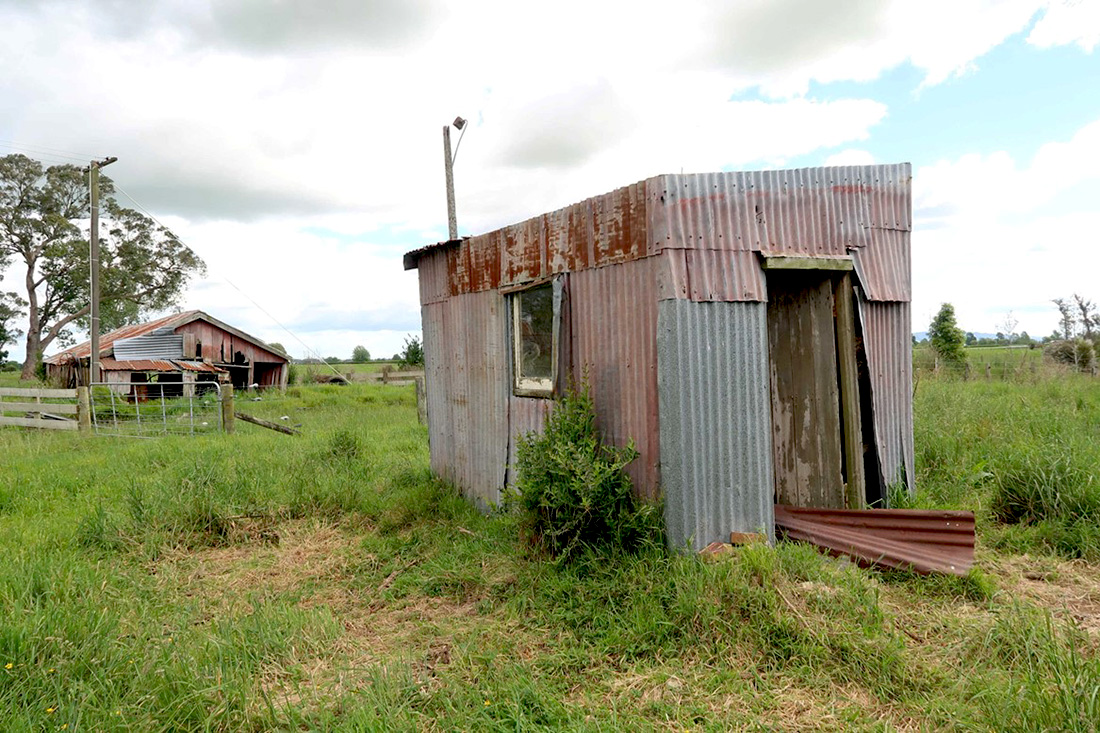
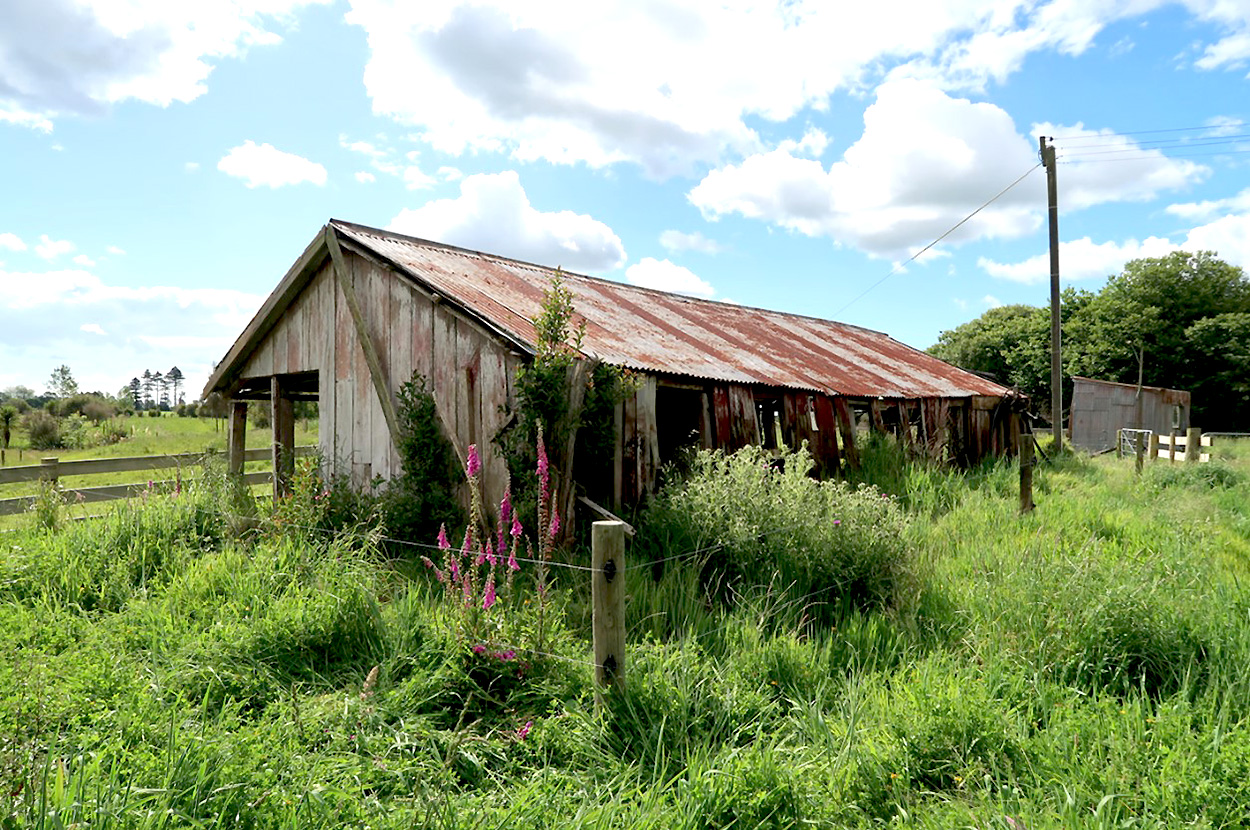
Woolshed: Timber with corrugated iron roof; concrete block footings for east addition Cowshed: Timber with corrugated iron roof Whare: Timber with corrugated iron walls, roof and chimney; mass concrete foundations for chimney
Construction Details
Start Year
1904
startYearCirca
Type
Original Construction
Description
Woolshed (initially used as stables and hay loft)
Type
Modification
Description
Woolshed: slatted floor and railed divisions for conversion to internal sheep pens
Period
pre-1920
Type
Addition
Description
Woolshed: south lean-to containing catching pens, shearing stands and wool room
Period
pre-1920
Type
Original Construction
Description
Cowshed
Period
pre-1920s
startYearCirca
Type
Addition
Description
Woolshed: east lean-to for wool pressing and bale storage
Period
early 1940s
Type
Original Construction
Description
Whare
Period
pre-1952
Type
Addition
Description
Woolshed: open loading porch added to south end of east lean-to
Period
pre-1966
Construction Materials
Woolshed: Timber with corrugated iron roof; concrete block footings for east addition Cowshed: Timber with corrugated iron roof Whare: Timber with corrugated iron walls, roof and chimney; mass concrete foundations for chimney
Early history Turangaomoana is situated in the Matamata plains, immediately beside the Waihou river to the west of the Kaimai ranges. The fertile, low-lying area has been associated with many iwi and hapū, including Ngāti Hauā, Ngāti Hinerangi and Waikato Tainui. For Māori communities this landscape was resource-rich, encompassing swamps for eel and waterfowl as well as being cultivable and enjoying proximity to bush and forest resources. Numerous pā were created overlooking the Waihou. During the early nineteenth century, Matamata pā to the west of Turangaomoana formed the principal settlement of Te Waharoa (?-1838), an important Ngāti Hauā rangatira. Te Waharoa’s son Tarapīpipi (?-1866), later christened Wiremu Tāmihana, was educated at a nearby Anglican mission station, briefly established in 1835-6. Succeeding to Te Waharoa’s leadership, Tāmihana founded Christian-influenced settlements at Te Tāpiri (1838) and later Pēria (1846), where whānau-based cultivation included European crops traded to the new colonial capital at Auckland. As concerns about Pākehā encroachment on Māori-held lands increased in the 1850s, Tāmihana played a key role in the emerging Kīngitanga movement, anointing Pōtatau Te Wherowhero as the movement’s first leader or kīngi. Following British military invasion of the Waikato in 1863-4, Ngāti Hauā suffered raupatu (confiscation) of various lands by the Crown, although whenua in the Matamata area - including Turangaomoana - was initially retained. Tāmihana died at Turangaomoana in 1866. From 1865, Josiah Clifton Firth (1826-1897), an Auckland businessman and industrialist, began leasing substantial tracts of land from Tāmihana. By the late nineteenth century, private interests had acquired major areas of Ngāti Hauā whenua. Firth obtained freehold title to over 55,000 acres, the largest private estate in the Waikato, developing it as an immense farm to support and expand his other business interests. Known as the Matamata Estate, this enterprise included the land later occupied by Sanigar. Matamata Estate Firth’s activities transformed the landscape into a prototype of high farming. Banks and ditches created an extensive complex of large fields in which to initially grow wheat, and subsequently also fatten sheep and cattle on a mixed farm model. Dairy farming was undertaken. A large farmstead near present-day Matamata was connected by a wide access route - now known as Tower Road - to a wharf at Stanley Landing on the Waihou for transporting produce and stock. Modern agricultural machinery, experimental scientific methods and other up-to-date approaches were adopted. According to historian D. B Waterson, ‘from telephones to windmills, beehives to a dairy factory, Matamata was the New Zealand showpiece of modern rural technology’. Both Māori and Pākehā workers were employed on this enterprise. The former included local, rangatira-led groups contracted to create roads, operate machinery and collect ‘rushes’ for thatching haystacks. After Firth became unable to repay mortgages on the estate during a nationwide economic depression in 1887, the Bank of New Zealand (BNZ) took ownership. A subsequent manager of the farm, John McCaw, continued earlier practices, contracting Māori for ploughing, harvesting and shearing. Throughout this period and subsequently, Ngāti Hauā occupied traditional lands in the Waharoa area, immediately outside the estate. In 1895, the First Liberal Government (1890-1920) intervened to save the BNZ from collapse and the bank’s farming assets were transferred to a specially-created Assets Realisation Board. Seven years later, the government compulsorily purchased the estate as part of nationwide attempts to bring more rural land into production. This policy followed the development of improved fertilisers, refrigeration for dairy and meat exports, and rising commodity prices. In addition to 2.3 million acres of Māori-owned land, the government acquired some 223 colonial estates between 1891 and 1912 - encompassing a further 1.3 million acres - for more intensively-settled farms, mostly of medium size (320-1000 acres). Matamata was the largest estate in the region south of Auckland to be broken up for farms under a lease-in-perpetuity system (999 years) introduced by the 1892 Land Act. In 1904, 117 farms were divided from the estate and made available to applicants. After interviews in Auckland one of these holdings, a 467-acre site occupying Section 24, was allocated to Henry (Harry) and Effie Harding and their young family. From farming families in rural Wairarapa and Manawatū, the couple qualified for the lease due to their prior experience of agricultural work, and by not holding other land. Taking possession in mid-1904, they named their new holding Sanigar - after a place in Gloucestershire, England, where Harry’s grandparents had farmed. Creation and early use of Sanigar (1904-30) Over the next two decades, the Hardings were to create an established family farm comprising a network of fields, a homestead and necessary outbuildings. Under the terms of their lease, they (and all other selectees at Matamata) were required to live continuously on the land and undertake substantial improvements, including cultivation, fencing and building construction. Other requirements encompassed applying bonedust and superphosphate fertiliser, and keeping at least half of each farm in permanent pasture. As well as helping transform the landscape into a network of more intensively used farms, such conditions contributed to the country’s ‘grasslands revolution’ which sustained New Zealand as a major exporter of farm produce within the British imperial network. By 1950, New Zealand had the fifth highest average per capita income in the world, based predominantly on its dairy, meat and wool exports. The development of large-scale ‘protein farming’, in particular, has been considered one of the most significant transformations in New Zealand history. In this, a new class of small to medium farmers - such as those at Sanigar - played an unusually important role. Sanigar occupied land defined initially as second and third class quality. It was allocated for a general farm rather than the dairy holdings specified for most neighbouring properties. Subdivided from part of an earlier estate field, it is likely to have been at least partly broken in and cleared for pastoral or agricultural use prior to the early 1900s. Aspects of the farm layout were influenced by pre-existing estate features, including the orientation of some boundaries and access via Tower Road. New buildings, probably including an initial farmhouse, were centrally erected within the farm. These lay at the junction of better-quality land occupying the eastern part of the holding and less fertile terrain to the west. Cultivation and higher-quality grazing probably focussed on newly-established fields in the front part of the holding, nearest Tower Road. Other grazing took place in more open, lower-lying land to the rear. The earliest outbuilding is believed to be a timber-built stables, constructed in a paddock immediately to the rear of the house that became known as the ‘courtyard’. Designed as a one-and-a-half storey, weatherboarded structure, this was of good-quality, balloon-frame construction. It appears to have contained divisions on the ground floor, and a storage loft above. The latter was covered by a relatively steep-pitched roof - which may have originally been shingled. Farm work, including conversion of the land for intensive production, required considerable input from horsepower. The Hardings owned horses, harness, wagons and three drays as well as stock in mid-1904. They subsequently also exhibited draught animals in agricultural shows. Horses were additionally important for local transport and recreation, helping to forge social bonds in what was a new farming community. By the 1920s, the Hardings were involved in both the Matamata Hunt and Matamata Racing Club. Farming at Sanigar appears to have been diverse from the outset. Both cattle and Merino sheep were likely being kept by 1906, the latter presumably for their wool. First prize for a sample of local chaff awarded to Harry Harding a few years later may indicate at least some grain production. Root crops such as turnips, field carrots and mangolds were also grown. Milk production occurred, with Shorthorn dairy cattle being displayed at shows and sold from as early as 1911. In 1922, Matamata was described as ‘the centre of one of the finest and largest dairying districts in the Province…[with] two of the largest dairy factories in the world.’ One of the latter, the Glaxo factory, opened in 1917. Historically, Waikato farming has played an important role in the development of dairying in New Zealand, being considered ideal in its climate and landscape for pasturing cows. A long, single-storey cowshed in the same paddock as the stables was likely built during this period. Of framed timber construction with vertical planking walls, the building was roofed with corrugated iron produced in Auckland between the late nineteenth century and the mid- to late 1920s. It also utilised electricity, reticulation of which was reported to be immediately imminent throughout the Matamata district in 1922, including for milking sheds. By 1920, approximately half of New Zealand’s cows were machine milked. In January 1926, Harry Harding advertised for an employee to machine milk a ‘small herd’. His equipment included a four-cow Unity Milking Plant, Massport engine and milk cans, catering to a 100-strong group of Shorthorn, Holstein and Jersey-cross cows. The building incorporated a separating room and engine room as well as a main space. In addition to being mechanised, it was hygienically equipped with a concrete floor and water from an adjacent well for cleaning purposes. Hygiene standards in New Zealand dairying are considered to have improved by about 1920 due to regular monitoring by government inspectors. Initial labour on the farm may have been predominantly provided by family members. Eldest son Sydney was injured while assisting seed-drilling for turnips aged six or seven, and Effie Harding is said to have helped break in the farm and bring it to a high state of fertility. Extended family assistance was also available after Harry Harding’s father and several brothers progressively arrived to take up other farms in the area, impressed by the easily worked nature of the land. Dairy farming was especially labour-intensive until the advent of mechanisation. The extent to which local Māori may have been engaged for work at Sanigar during this period is currently unclear. In the early 1900s, the Ngāti Hauā community at Waharoa continued to cultivate crops such as wheat and oats on its own land, and some undertook dairying. Heightened Māori concern about the ongoing loss of traditional lands in the region stimulated an increase in agricultural production on retained territory. In early 1909, a hui at Waharoa expressed a general desire ‘to go in for farming and cultivation of the land, and to endeavour, if possible, to prohibit the sale of any further areas’. In 1908-9, Ngāti Hauā cleared a large amount of ground to expand its commercial farming activities, although development was constrained due to a lack of finance. More generally, rural Māori relied considerably on seasonal employment on European-run farms, especially before more loan funding became accessible from the 1930s. Ngāti Hauā and other iwi within Kīngitanga raised issues linked with Te Tiriti o Waitangi / the Treaty of Waitangi to the Crown through this period, including presenting a petition to the Governor-General, Lord Plunket, at Waharoa in 1908. According to historian D. B. Waterson, ‘with rapidly rising prices, new techniques of grassland farming, better communications, milking machines, motor transport, equable climatic conditions and new factories, the farmers on the South Auckland Lands for Settlement farming estates became ardent supporters of the freehold and consequently of the rising rural Reform Party of W. F. Massey’. On the former Matamata Estate, the peak period of transfer from lease-in-perpetuity to private purchase by lessees occurred in 1916-19, stimulated by impacts of the First World War (1914-18) on the price of primary produce. In September 1918, the Hardings bought the freehold title to Sanigar. Probably subsequently, a house of California Bungalow design replaced or was converted from an earlier farmhouse. During the war and after, Harry Harding supported patriotic causes including donating surplus wool to the British Seamen’s fund. From 1919, he also joined the committee of the Matamata Agricultural and Pastoral Association. The grasslands revolution in New Zealand was assisted both by faster-growing varieties of plants and increasing reliance on superphosphate. By 1928, some sixty percent of grass in Matamata county was treated with the latter. Having decided to cease dairying in 1926, Harding offered his mechanical, Booth MacDonald topdresser for sale. In the late 1920s, greater focus may have been placed at Sanigar on meat and wool production, the latter by now involving Romney rather than Merino sheep. At some point during the Hardings’ tenure, probably before 1920, the initial stables was expanded in size and altered to a woolshed for more efficiently shearing sheep and sorting wool. Conversion may have occurred in the period 1916-20, when the Crown became the sole buyer and seller of wool in New Zealand, and Britain guaranteed to buy all such produce at a relatively high fixed price for military purposes, including uniforms. By 1930, Sanigar had at least 750 Romney Cross ewes in lamb to Southdown rams, as well as some 100 head of beef cattle. During economic headwinds linked with the Great Depression, the Hardings unsuccessfully attempted to sell Sanigar to the government for yet more intensive settlement. At this time, the holding and neighbouring land were said to be ‘practically all in grass and in a condition to allow of milking to be pursued by settlers the first season’. Deciding to retire, the Hardings were farewelled at the Turangaomoana Hall in mid-1930. By this time, they were one of few families on the former Matamata Estate that had remained on their initial farm. Later use of Sanigar (1930-present) Sanigar was subsequently owned and farmed by Samuel and Margaret Huston, who moved there from Taranaki. A feature of second-generation settlers on the former Matamata Estate was the number that had relocated from Taranaki, an older-established dairying area, reflecting a broader trend in early twentieth-century Waikato. In 1934, farms in the eastern Waikato ‘not only produced more butterfat per acre and per cow than any other area in New Zealand, but also carried more cows to the acre at a lower cost than in other parts of the country.’ The Hustons resumed dairying at Sanigar with Jersey and Jersey-cross cows. Beef and sheep farming were also retained. Enclosures in the ‘courtyard’ held cows and sheep respectively for milking and shearing. Between 1920 and 1950, dairy, meat and wool products continued to consistently generate more than 90 per cent of the country’s export income. While retaining strong connections with Taranaki, the Hustons engaged in local community activities. Samuel Huston became an elder of Matamata Presbyterian Church and the family hosted bible class evenings at their residence. Farm practices linked with Christian faith included not working on Sundays. Samuel Huston was also an advocate of temperance. Changes during the Second World War (1939-45) included disposal of the dairy herd. Two or three cows were retained for household use, milked by hand inside the cowshed. When son Elwyn Huston married Gwyneth Joll in 1944, a cottage to accommodate the new couple was erected on the farm. Elwyn was an accomplished worker, capable of shearing 300 sheep per day. Other accommodation was erected for seasonal shearing gangs and other farmworkers, probably in the late 1940s or early 1950s - and certainly by 1952. The post-war period was especially profitable for farmers, and competition for workers likely high due to low unemployment. The new quarters included a small, one-room residence of corrugated iron construction, a short distance from the cowshed. An adjacent building was perhaps similarly utilised until removal in 1962. Both were referred to as ‘whare’, like other on-farm workers’ accommodation in the North Island. From at least the early 1950s, many of the workers at Sanigar were Māori neighbours from the Waharoa community. Farm diaries record the extent to which they worked with Huston family members on general tasks including hedge-planting, topdressing and ensilage-making, as well as endeavours such as shearing, wool pressing and baling. Māori played an especially important role in the development of contract shearing in New Zealand, often working in extended family groups that included women and children - differing from all-male approaches promoted in colonial European society. A wool boom caused by American military demand during the Korean War of 1950-3 generated both an increasing number of sheep in New Zealand and exacerbated a pre-existing shortage of shearers. The 1950s and 1960s have been considered watershed decades for Māori employment, as large numbers from rural communities moved to New Zealand’s cities for work in the mainstream market economy. Those remaining often found advantage in waged employment on European farms. Shearing, in particular, has been seen as a key industry for Māori, both in the twentieth century and earlier. It became especially important for the Waharoa community after the Second World War, with many younger members learning skills by working alongside kaumātua, including at Sanigar. The single-room whare remained in regular use until at least the 1960s, possibly in conjunction with a small enclosure or garden. Occupants included John (Johnny) Wharawhara, who was permanently employed on the farm for lengthy periods, and his family. Jackie Paul was similarly a long-term employee. Although often basic, on-farm accommodation enabled whānau to remain together during the busy shearing season. Members of the local Māori community also assisted with droving sheep to the farm from the East Coast and Taumaranui for fattening, and from the farm to Waharoa train station for market; and collected firewood and puha from the farm. As a Justice of the Peace, Elwyn Huston provided assistance with land issues and other legal matters. A large store and loading porch were added to the woolshed before 1966, when wool prices suddenly fell. A third generation of the family became involved, with Elwyn and Gwyneth’s son Garth gradually taking over the farm with his wife Sue. Although rural Māori labour became especially vulnerable to unemployment as general economic growth slowed from the middle of the decade, Māori workers continued to be engaged at Sanigar. Garth Huston regularly contributed sheep or mutton for tangi and other events. During his tenure, Garth undertook contour-fencing to preserve wetland areas and utilised organic manures where possible. He also installed an improved water supply with new pumps and pump shed, and re-grassed pastures. Initially, seasonal shearing continued. In 1984, however, sheep farming at Sanigar ceased after Britain’s entry into the European Economic Community (EEC) affected exports, and government subsidies were removed. Most of the farm was subsequently leased out for cropping, although the family retained paddocks around the homestead. Increasingly, the earlier farm buildings were employed for storage. These remain in family ownership. Much of the rest of farm is currently (2024) leased out for dairy support, continuing Sanigar’s extensive connections with the practice and evolution of New Zealand farming. New Zealand remains the world’s third largest wool producer; and dairying forms this country’s largest export goods sector.
Early history Turangaomoana is situated in the Matamata plains, immediately beside the Waihou river to the west of the Kaimai ranges. The fertile, low-lying area has been associated with many iwi and hapū, including Ngāti Hauā, Ngāti Hinerangi and Waikato Tainui. For Māori communities this landscape was resource-rich, encompassing swamps for eel and waterfowl as well as being cultivable and enjoying proximity to bush and forest resources. Numerous pā were created overlooking the Waihou. During the early nineteenth century, Matamata pā to the west of Turangaomoana formed the principal settlement of Te Waharoa (?-1838), an important Ngāti Hauā rangatira. Te Waharoa’s son Tarapīpipi (?-1866), later christened Wiremu Tāmihana, was educated at a nearby Anglican mission station, briefly established in 1835-6. Succeeding to Te Waharoa’s leadership, Tāmihana founded Christian-influenced settlements at Te Tāpiri (1838) and later Pēria (1846), where whānau-based cultivation included European crops traded to the new colonial capital at Auckland. As concerns about Pākehā encroachment on Māori-held lands increased in the 1850s, Tāmihana played a key role in the emerging Kīngitanga movement, anointing Pōtatau Te Wherowhero as the movement’s first leader or kīngi. Following British military invasion of the Waikato in 1863-4, Ngāti Hauā suffered raupatu (confiscation) of various lands by the Crown, although whenua in the Matamata area - including Turangaomoana - was initially retained. Tāmihana died at Turangaomoana in 1866. From 1865, Josiah Clifton Firth (1826-1897), an Auckland businessman and industrialist, began leasing substantial tracts of land from Tāmihana. By the late nineteenth century, private interests had acquired major areas of Ngāti Hauā whenua. Firth obtained freehold title to over 55,000 acres, the largest private estate in the Waikato, developing it as an immense farm to support and expand his other business interests. Known as the Matamata Estate, this enterprise included the land later occupied by Sanigar. Matamata Estate Firth’s activities transformed the landscape into a prototype of high farming. Banks and ditches created an extensive complex of large fields in which to initially grow wheat, and subsequently also fatten sheep and cattle on a mixed farm model. Dairy farming was undertaken. A large farmstead near present-day Matamata was connected by a wide access route - now known as Tower Road - to a wharf at Stanley Landing on the Waihou for transporting produce and stock. Modern agricultural machinery, experimental scientific methods and other up-to-date approaches were adopted. According to historian D. B Waterson, ‘from telephones to windmills, beehives to a dairy factory, Matamata was the New Zealand showpiece of modern rural technology’. Both Māori and Pākehā workers were employed on this enterprise. The former included local, rangatira-led groups contracted to create roads, operate machinery and collect ‘rushes’ for thatching haystacks. After Firth became unable to repay mortgages on the estate during a nationwide economic depression in 1887, the Bank of New Zealand (BNZ) took ownership. A subsequent manager of the farm, John McCaw, continued earlier practices, contracting Māori for ploughing, harvesting and shearing. Throughout this period and subsequently, Ngāti Hauā occupied traditional lands in the Waharoa area, immediately outside the estate. In 1895, the First Liberal Government (1890-1920) intervened to save the BNZ from collapse and the bank’s farming assets were transferred to a specially-created Assets Realisation Board. Seven years later, the government compulsorily purchased the estate as part of nationwide attempts to bring more rural land into production. This policy followed the development of improved fertilisers, refrigeration for dairy and meat exports, and rising commodity prices. In addition to 2.3 million acres of Māori-owned land, the government acquired some 223 colonial estates between 1891 and 1912 - encompassing a further 1.3 million acres - for more intensively-settled farms, mostly of medium size (320-1000 acres). Matamata was the largest estate in the region south of Auckland to be broken up for farms under a lease-in-perpetuity system (999 years) introduced by the 1892 Land Act. In 1904, 117 farms were divided from the estate and made available to applicants. After interviews in Auckland one of these holdings, a 467-acre site occupying Section 24, was allocated to Henry (Harry) and Effie Harding and their young family. From farming families in rural Wairarapa and Manawatū, the couple qualified for the lease due to their prior experience of agricultural work, and by not holding other land. Taking possession in mid-1904, they named their new holding Sanigar - after a place in Gloucestershire, England, where Harry’s grandparents had farmed. Creation and early use of Sanigar (1904-30) Over the next two decades, the Hardings were to create an established family farm comprising a network of fields, a homestead and necessary outbuildings. Under the terms of their lease, they (and all other selectees at Matamata) were required to live continuously on the land and undertake substantial improvements, including cultivation, fencing and building construction. Other requirements encompassed applying bonedust and superphosphate fertiliser, and keeping at least half of each farm in permanent pasture. As well as helping transform the landscape into a network of more intensively used farms, such conditions contributed to the country’s ‘grasslands revolution’ which sustained New Zealand as a major exporter of farm produce within the British imperial network. By 1950, New Zealand had the fifth highest average per capita income in the world, based predominantly on its dairy, meat and wool exports. The development of large-scale ‘protein farming’, in particular, has been considered one of the most significant transformations in New Zealand history. In this, a new class of small to medium farmers - such as those at Sanigar - played an unusually important role. Sanigar occupied land defined initially as second and third class quality. It was allocated for a general farm rather than the dairy holdings specified for most neighbouring properties. Subdivided from part of an earlier estate field, it is likely to have been at least partly broken in and cleared for pastoral or agricultural use prior to the early 1900s. Aspects of the farm layout were influenced by pre-existing estate features, including the orientation of some boundaries and access via Tower Road. New buildings, probably including an initial farmhouse, were centrally erected within the farm. These lay at the junction of better-quality land occupying the eastern part of the holding and less fertile terrain to the west. Cultivation and higher-quality grazing probably focussed on newly-established fields in the front part of the holding, nearest Tower Road. Other grazing took place in more open, lower-lying land to the rear. The earliest outbuilding is believed to be a timber-built stables, constructed in a paddock immediately to the rear of the house that became known as the ‘courtyard’. Designed as a one-and-a-half storey, weatherboarded structure, this was of good-quality, balloon-frame construction. It appears to have contained divisions on the ground floor, and a storage loft above. The latter was covered by a relatively steep-pitched roof - which may have originally been shingled. Farm work, including conversion of the land for intensive production, required considerable input from horsepower. The Hardings owned horses, harness, wagons and three drays as well as stock in mid-1904. They subsequently also exhibited draught animals in agricultural shows. Horses were additionally important for local transport and recreation, helping to forge social bonds in what was a new farming community. By the 1920s, the Hardings were involved in both the Matamata Hunt and Matamata Racing Club. Farming at Sanigar appears to have been diverse from the outset. Both cattle and Merino sheep were likely being kept by 1906, the latter presumably for their wool. First prize for a sample of local chaff awarded to Harry Harding a few years later may indicate at least some grain production. Root crops such as turnips, field carrots and mangolds were also grown. Milk production occurred, with Shorthorn dairy cattle being displayed at shows and sold from as early as 1911. In 1922, Matamata was described as ‘the centre of one of the finest and largest dairying districts in the Province…[with] two of the largest dairy factories in the world.’ One of the latter, the Glaxo factory, opened in 1917. Historically, Waikato farming has played an important role in the development of dairying in New Zealand, being considered ideal in its climate and landscape for pasturing cows. A long, single-storey cowshed in the same paddock as the stables was likely built during this period. Of framed timber construction with vertical planking walls, the building was roofed with corrugated iron produced in Auckland between the late nineteenth century and the mid- to late 1920s. It also utilised electricity, reticulation of which was reported to be immediately imminent throughout the Matamata district in 1922, including for milking sheds. By 1920, approximately half of New Zealand’s cows were machine milked. In January 1926, Harry Harding advertised for an employee to machine milk a ‘small herd’. His equipment included a four-cow Unity Milking Plant, Massport engine and milk cans, catering to a 100-strong group of Shorthorn, Holstein and Jersey-cross cows. The building incorporated a separating room and engine room as well as a main space. In addition to being mechanised, it was hygienically equipped with a concrete floor and water from an adjacent well for cleaning purposes. Hygiene standards in New Zealand dairying are considered to have improved by about 1920 due to regular monitoring by government inspectors. Initial labour on the farm may have been predominantly provided by family members. Eldest son Sydney was injured while assisting seed-drilling for turnips aged six or seven, and Effie Harding is said to have helped break in the farm and bring it to a high state of fertility. Extended family assistance was also available after Harry Harding’s father and several brothers progressively arrived to take up other farms in the area, impressed by the easily worked nature of the land. Dairy farming was especially labour-intensive until the advent of mechanisation. The extent to which local Māori may have been engaged for work at Sanigar during this period is currently unclear. In the early 1900s, the Ngāti Hauā community at Waharoa continued to cultivate crops such as wheat and oats on its own land, and some undertook dairying. Heightened Māori concern about the ongoing loss of traditional lands in the region stimulated an increase in agricultural production on retained territory. In early 1909, a hui at Waharoa expressed a general desire ‘to go in for farming and cultivation of the land, and to endeavour, if possible, to prohibit the sale of any further areas’. In 1908-9, Ngāti Hauā cleared a large amount of ground to expand its commercial farming activities, although development was constrained due to a lack of finance. More generally, rural Māori relied considerably on seasonal employment on European-run farms, especially before more loan funding became accessible from the 1930s. Ngāti Hauā and other iwi within Kīngitanga raised issues linked with Te Tiriti o Waitangi / the Treaty of Waitangi to the Crown through this period, including presenting a petition to the Governor-General, Lord Plunket, at Waharoa in 1908. According to historian D. B. Waterson, ‘with rapidly rising prices, new techniques of grassland farming, better communications, milking machines, motor transport, equable climatic conditions and new factories, the farmers on the South Auckland Lands for Settlement farming estates became ardent supporters of the freehold and consequently of the rising rural Reform Party of W. F. Massey’. On the former Matamata Estate, the peak period of transfer from lease-in-perpetuity to private purchase by lessees occurred in 1916-19, stimulated by impacts of the First World War (1914-18) on the price of primary produce. In September 1918, the Hardings bought the freehold title to Sanigar. Probably subsequently, a house of California Bungalow design replaced or was converted from an earlier farmhouse. During the war and after, Harry Harding supported patriotic causes including donating surplus wool to the British Seamen’s fund. From 1919, he also joined the committee of the Matamata Agricultural and Pastoral Association. The grasslands revolution in New Zealand was assisted both by faster-growing varieties of plants and increasing reliance on superphosphate. By 1928, some sixty percent of grass in Matamata county was treated with the latter. Having decided to cease dairying in 1926, Harding offered his mechanical, Booth MacDonald topdresser for sale. In the late 1920s, greater focus may have been placed at Sanigar on meat and wool production, the latter by now involving Romney rather than Merino sheep. At some point during the Hardings’ tenure, probably before 1920, the initial stables was expanded in size and altered to a woolshed for more efficiently shearing sheep and sorting wool. Conversion may have occurred in the period 1916-20, when the Crown became the sole buyer and seller of wool in New Zealand, and Britain guaranteed to buy all such produce at a relatively high fixed price for military purposes, including uniforms. By 1930, Sanigar had at least 750 Romney Cross ewes in lamb to Southdown rams, as well as some 100 head of beef cattle. During economic headwinds linked with the Great Depression, the Hardings unsuccessfully attempted to sell Sanigar to the government for yet more intensive settlement. At this time, the holding and neighbouring land were said to be ‘practically all in grass and in a condition to allow of milking to be pursued by settlers the first season’. Deciding to retire, the Hardings were farewelled at the Turangaomoana Hall in mid-1930. By this time, they were one of few families on the former Matamata Estate that had remained on their initial farm. Later use of Sanigar (1930-present) Sanigar was subsequently owned and farmed by Samuel and Margaret Huston, who moved there from Taranaki. A feature of second-generation settlers on the former Matamata Estate was the number that had relocated from Taranaki, an older-established dairying area, reflecting a broader trend in early twentieth-century Waikato. In 1934, farms in the eastern Waikato ‘not only produced more butterfat per acre and per cow than any other area in New Zealand, but also carried more cows to the acre at a lower cost than in other parts of the country.’ The Hustons resumed dairying at Sanigar with Jersey and Jersey-cross cows. Beef and sheep farming were also retained. Enclosures in the ‘courtyard’ held cows and sheep respectively for milking and shearing. Between 1920 and 1950, dairy, meat and wool products continued to consistently generate more than 90 per cent of the country’s export income. While retaining strong connections with Taranaki, the Hustons engaged in local community activities. Samuel Huston became an elder of Matamata Presbyterian Church and the family hosted bible class evenings at their residence. Farm practices linked with Christian faith included not working on Sundays. Samuel Huston was also an advocate of temperance. Changes during the Second World War (1939-45) included disposal of the dairy herd. Two or three cows were retained for household use, milked by hand inside the cowshed. When son Elwyn Huston married Gwyneth Joll in 1944, a cottage to accommodate the new couple was erected on the farm. Elwyn was an accomplished worker, capable of shearing 300 sheep per day. Other accommodation was erected for seasonal shearing gangs and other farmworkers, probably in the late 1940s or early 1950s - and certainly by 1952. The post-war period was especially profitable for farmers, and competition for workers likely high due to low unemployment. The new quarters included a small, one-room residence of corrugated iron construction, a short distance from the cowshed. An adjacent building was perhaps similarly utilised until removal in 1962. Both were referred to as ‘whare’, like other on-farm workers’ accommodation in the North Island. From at least the early 1950s, many of the workers at Sanigar were Māori neighbours from the Waharoa community. Farm diaries record the extent to which they worked with Huston family members on general tasks including hedge-planting, topdressing and ensilage-making, as well as endeavours such as shearing, wool pressing and baling. Māori played an especially important role in the development of contract shearing in New Zealand, often working in extended family groups that included women and children - differing from all-male approaches promoted in colonial European society. A wool boom caused by American military demand during the Korean War of 1950-3 generated both an increasing number of sheep in New Zealand and exacerbated a pre-existing shortage of shearers. The 1950s and 1960s have been considered watershed decades for Māori employment, as large numbers from rural communities moved to New Zealand’s cities for work in the mainstream market economy. Those remaining often found advantage in waged employment on European farms. Shearing, in particular, has been seen as a key industry for Māori, both in the twentieth century and earlier. It became especially important for the Waharoa community after the Second World War, with many younger members learning skills by working alongside kaumātua, including at Sanigar. The single-room whare remained in regular use until at least the 1960s, possibly in conjunction with a small enclosure or garden. Occupants included John (Johnny) Wharawhara, who was permanently employed on the farm for lengthy periods, and his family. Jackie Paul was similarly a long-term employee. Although often basic, on-farm accommodation enabled whānau to remain together during the busy shearing season. Members of the local Māori community also assisted with droving sheep to the farm from the East Coast and Taumaranui for fattening, and from the farm to Waharoa train station for market; and collected firewood and puha from the farm. As a Justice of the Peace, Elwyn Huston provided assistance with land issues and other legal matters. A large store and loading porch were added to the woolshed before 1966, when wool prices suddenly fell. A third generation of the family became involved, with Elwyn and Gwyneth’s son Garth gradually taking over the farm with his wife Sue. Although rural Māori labour became especially vulnerable to unemployment as general economic growth slowed from the middle of the decade, Māori workers continued to be engaged at Sanigar. Garth Huston regularly contributed sheep or mutton for tangi and other events. During his tenure, Garth undertook contour-fencing to preserve wetland areas and utilised organic manures where possible. He also installed an improved water supply with new pumps and pump shed, and re-grassed pastures. Initially, seasonal shearing continued. In 1984, however, sheep farming at Sanigar ceased after Britain’s entry into the European Economic Community (EEC) affected exports, and government subsidies were removed. Most of the farm was subsequently leased out for cropping, although the family retained paddocks around the homestead. Increasingly, the earlier farm buildings were employed for storage. These remain in family ownership. Much of the rest of farm is currently (2024) leased out for dairy support, continuing Sanigar’s extensive connections with the practice and evolution of New Zealand farming. New Zealand remains the world’s third largest wool producer; and dairying forms this country’s largest export goods sector.
Historical and Associated Iwi / Hapū / Whānau
Completion Date
13th January 2025
Report Written By
Martin Jones and Alexander Foster
Information Sources
Putaruru Press
Putaruru Press
Thornton, 1986
Geoffrey Thornton, The New Zealand Heritage of Farm Buildings, Auckland, 1986
Waikato Times
Carter, 2003
Bill Carter and John MacGibbon, Wool: A history of New Zealand's Wool Industry, Wellington, 2003
New Zealand Herald
New Zealand Herald, ‘Historic Hut is Preserved’, 25 March 1961
Heritage New Zealand Pouhere Taonga File
36007-788
Peden, 2008
Peden, Robert, 'Farm buildings', 24 Nov 2008, Te Ara - the Encyclopedia of New Zealand, http://www.TeAra.govt.nz/en/farm-buildings/print
King, 1983
King, Michael, Maori: A Photographic and Social History, Auckland, 1983.
Riseborough, 2010
Riseborough, Hazel, Shear Hard Work: A History of New Zealand Shearing, Auckland, 2010.
Stringleman and Scrimgeour, 2008
Stringleman, Hugh, and Frank Scrimgeour, 'Dairying and dairy products', 24 Nov 2008, Te Ara - the Encyclopedia of New Zealand, http://www.TeAra.govt.nz/en/dairying-and-dairy-products/print
Walrond, 2008
Walrond, Carl, 'Rural workers', 24 Nov 2008, Te Ara - the Encyclopedia of New Zealand, http://www.TeAra.govt.nz/en/rural-workers/print
Waterson, 1969
Waterson, D. B., ‘The Matamata Estate, 1904-1959: Land transfers and subdivision in the Waikato’, New Zealand Journal of History, Apr 1969, Vol.3, No.1, pp.32-51.
Other Information
A fully referenced copy of listing report is available from the Northern Regional Office of Heritage New Zealand Pouhere Taonga. Disclaimer Please note that entry on the New Zealand Heritage List/Rārangi Kōrero identifies only the heritage values of the property concerned, and should not be construed as advice on the state of the property, or as a comment of its soundness or safety, including in regard to earthquake risk, safety in the event of fire, or insanitary conditions. Archaeological sites are protected by the Heritage New Zealand Pouhere Taonga Act 2014, regardless of whether they are entered on the New Zealand Heritage List/Rārangi Kōrero or not. Archaeological sites include ‘places associated with pre-1900 human activity, where there may be evidence relating to the history of New Zealand’. This List entry report should not be read as a statement on whether or not the archaeological provisions of the Act apply to the property (s) concerned. Please contact your local Heritage New Zealand office for archaeological advice.
Historical and Associated Iwi / Hapū / Whānau
Completion Date
13th January 2025
Report Written By
Martin Jones and Alexander Foster
Information Sources
Putaruru Press
Putaruru Press
Thornton, 1986
Geoffrey Thornton, The New Zealand Heritage of Farm Buildings, Auckland, 1986
Waikato Times
Carter, 2003
Bill Carter and John MacGibbon, Wool: A history of New Zealand's Wool Industry, Wellington, 2003
New Zealand Herald
New Zealand Herald, ‘Historic Hut is Preserved’, 25 March 1961
Heritage New Zealand Pouhere Taonga File
36007-788
Peden, 2008
Peden, Robert, 'Farm buildings', 24 Nov 2008, Te Ara - the Encyclopedia of New Zealand, http://www.TeAra.govt.nz/en/farm-buildings/print
King, 1983
King, Michael, Maori: A Photographic and Social History, Auckland, 1983.
Riseborough, 2010
Riseborough, Hazel, Shear Hard Work: A History of New Zealand Shearing, Auckland, 2010.
Stringleman and Scrimgeour, 2008
Stringleman, Hugh, and Frank Scrimgeour, 'Dairying and dairy products', 24 Nov 2008, Te Ara - the Encyclopedia of New Zealand, http://www.TeAra.govt.nz/en/dairying-and-dairy-products/print
Walrond, 2008
Walrond, Carl, 'Rural workers', 24 Nov 2008, Te Ara - the Encyclopedia of New Zealand, http://www.TeAra.govt.nz/en/rural-workers/print
Waterson, 1969
Waterson, D. B., ‘The Matamata Estate, 1904-1959: Land transfers and subdivision in the Waikato’, New Zealand Journal of History, Apr 1969, Vol.3, No.1, pp.32-51.
Other Information
A fully referenced copy of listing report is available from the Northern Regional Office of Heritage New Zealand Pouhere Taonga. Disclaimer Please note that entry on the New Zealand Heritage List/Rārangi Kōrero identifies only the heritage values of the property concerned, and should not be construed as advice on the state of the property, or as a comment of its soundness or safety, including in regard to earthquake risk, safety in the event of fire, or insanitary conditions. Archaeological sites are protected by the Heritage New Zealand Pouhere Taonga Act 2014, regardless of whether they are entered on the New Zealand Heritage List/Rārangi Kōrero or not. Archaeological sites include ‘places associated with pre-1900 human activity, where there may be evidence relating to the history of New Zealand’. This List entry report should not be read as a statement on whether or not the archaeological provisions of the Act apply to the property (s) concerned. Please contact your local Heritage New Zealand office for archaeological advice.
Former Usages
General Usage: Agriculture
Specific Usage: Milking shed/ cowshed
General Usage: Agriculture
Specific Usage: Stables
General Usage: Agriculture
Specific Usage: Staff/ Workers' Quarters
General Usage: Agriculture
Specific Usage: Woolshed/Shearing Shed
General Usage: Utilities
Specific Usage: Well
Former Usages
General Usage: Agriculture
Specific Usage: Milking shed/ cowshed
General Usage: Agriculture
Specific Usage: Stables
General Usage: Agriculture
Specific Usage: Staff/ Workers' Quarters
General Usage: Agriculture
Specific Usage: Woolshed/Shearing Shed
General Usage: Utilities
Specific Usage: Well
Location
Get the latest heritage news, features and events delivered
straight to your inbox.
