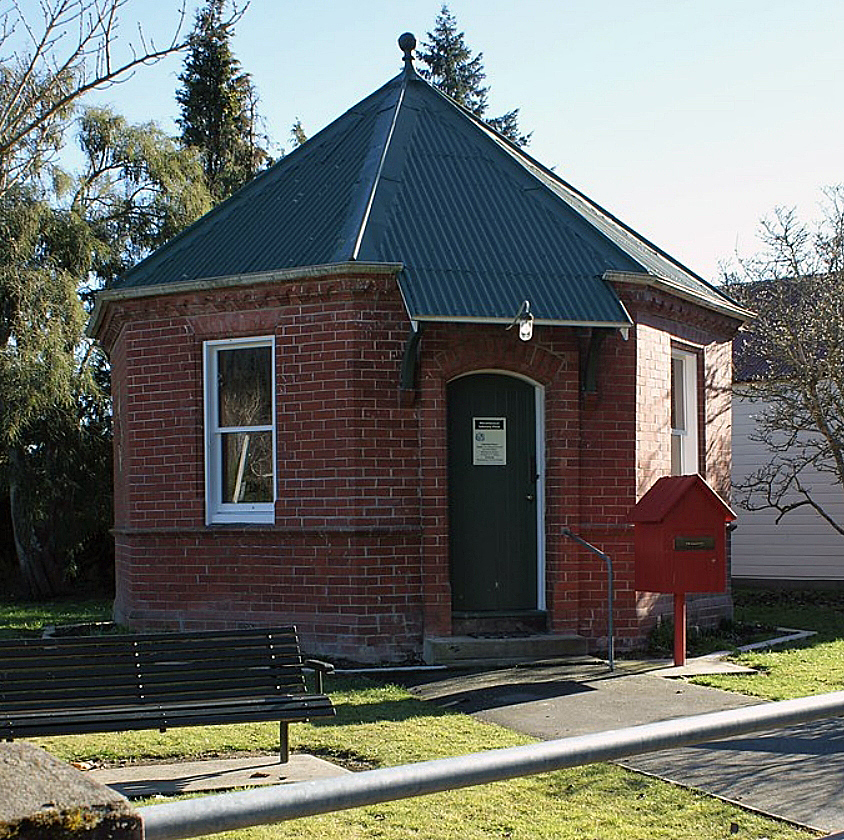
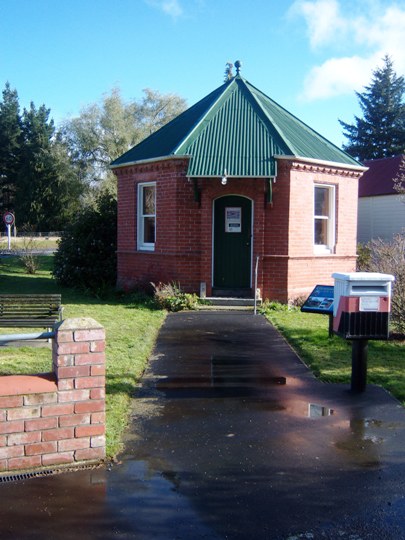
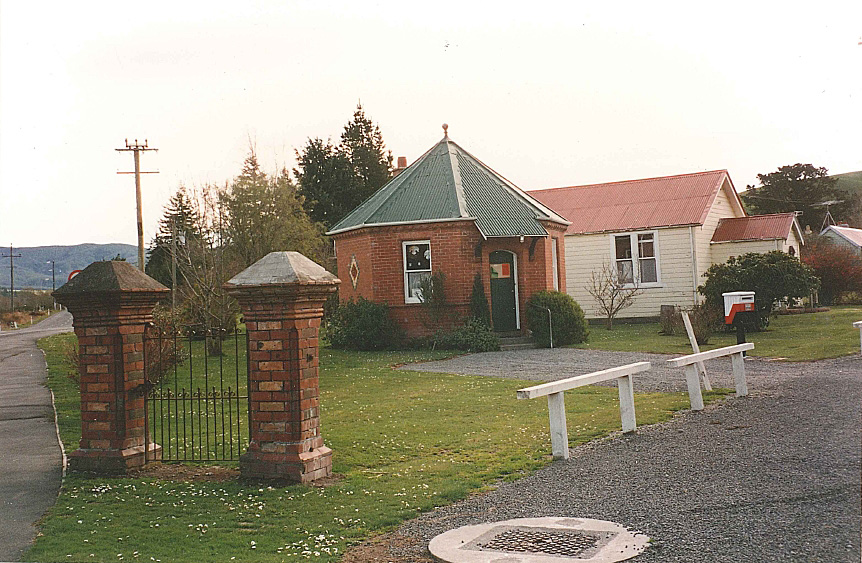
As a well-used public facility built on a corner pocket of land at 92 Homebush Road in Glentunnel, the small Glentunnel Library and Gateposts are historically and architecturally significant as a charming reminder of the township’s industrial past. The octagonal brick library building was designed in 1886 by notable Christchurch architect Samuel Hurst Seager to incorporate the various types of brick and terracotta tile then produced by the nearby Glentunnel Brick, Tile, Terra-Cotta and Pottery Works. Evidently built around 1887-8, it continues to have social value and is still used as a public library.
Glentunnel developed as a coalmining and pottery town in the 1870s. The Glentunnel/Homebush Brick, Tile, Terra-Cotta and Pottery Works provided wares used in construction throughout Canterbury and beyond. As the factory and nearby coal mine’s productivity increased, so did the township’s population, bringing with it small businesses, a public school, hotel, town hall and lodges. At the instigation of Glentunnel school master Mr Opie, in 1886 John Deans of nearby Homebush Station agreed to donate the corner parcel land to the citizens of Glentunnel on which to build a library. Money was raised by public subscription for a purpose-built library, and in September 1886 and again in October 1887 the Christchurch architect Samuel Hurst Seager advertised for tenders for the erection of the Glentunnel library in brick. Seager’s architectural career had recently launched with his winning competition design for the grand Christchurch Municipal Chambers in 1885 (erected 1886-87, also utilising Glentunnel brick and terracotta panels). Local man, Thomas Lamport, who had built the Homebush Stables in 1879, is understood to have built the library. The brick gateposts were built by William and James Tarling.
Polychrome brick gateposts with an iron gate mark the corner entry to the small land parcel. The library, set back approximately 15 metres from the gateposts, is a single-storeyed octagonal double-brick building with decorative cornice mouldings supporting an octagonal roof of corrugated steel, surmounted by a round finial. Its entrance door is on the south-east side and four of the eight elevations contain a sash window. The centrepiece of the remaining sides of the exterior incorporate coloured tiles and terracotta decorative features. The west side contains a chimney breast supporting a rebuilt brick chimney. With an open plan of less than five metres at its widest point, the interior of the library allows for easy access to the books on the rimu shelves that line much of the walls. Virtually all the interior is timber lined, including the double coved ceiling.
In 1984 a postal agency was established in the library, providing mail and postal services in addition to the free library service offered to all local residents. Small physical changes have occurred over time. The low brick wall running along much of the east and south sides of the land parcel was only built in circa 2000, but there would have been such a wall in earlier times. Following the Darfield earthquake of 4 September 2010, the chimney on the north-west side was taken down and was later rebuilt as part of a programme of repairs and strengthening of the library in 2014-15.