

Constructed in 1873-4, the ‘swing’ footbridge known as Mandeville Bridge has historical significance as the longest serving of all Waimakariri Bridges. Spanning the Kaiapoi River between Raven Quay and Charles Street, the bridge provides a practical safe passage to allow pedestrians to cross the river on the line of Black Street to the west and Davie Street at Trousselot Park to the east.
Kaiapoi and the surrounding area have a long and significant history of Māori settlement and occupation. From the mid nineteenth century, Pākehā missionaries and immigrants settled in Kaiapoi, many arriving as part of the Canterbury Association settlement programme. The Kaiapoi River was one of the main reasons for the town to be sited where it is. First named Gladstone by the planners, by 1854 the town had a wool store, general store and hotel. It became a flourishing port and ships could travel upstream to the woollen mills to load goods. In 1873, about 100 Kaiapoi residents petitioned the Canterbury Provincial Council for a footbridge over the Kaiapoi River. The main bridge in Kaiapoi, further down river, had been considered unreliable and unsafe especially in times of flood. The Mandeville footbridge was constructed in 1874 to allow school children to walk to the new Kaiapoi School. Construction began in late 1873 and in February 1874 the footbridge crossing the ‘north stream of the Waimakariri’, connecting Davie and Black Streets, was completed by contractor, William Stocks of Christchurch. The cost was £590, which included the earthwork formation of the approaches.
Constructed of timber and wire, the length of the bridge is approximately 66 metres. The suspension posts are 2.5 metres high. The posts carry wire ropes on iron pulleys and, from these, iron droppers carry the weight of the deck and its load. Piles bear suspension poles approximately 2.5 metres in height which connect above with timbers to form an archway. The bridge incorporates four curved lamp stands, the end one incorporating laser cut steel decoration and the words Mandeville Bridge.
The bridge is thought to have been named after Viscount Mandeville, Canterbury Association member, although initially it was simply referred to as the footbridge or the ‘swing’ footbridge. Originally the bridge had a total length of 360 feet (110 metres), but this was shortened by half when swampy ground, now part of Trousselot Park, was reclaimed. The bridge was repaired in 2011 following damage caused in the Canterbury earthquake of 4 September 2010.
Kaiapoi and the surrounding area have a long and significant history of Māori settlement and occupation. From the mid nineteenth century, Pākehā missionaries and immigrants settled in Kaiapoi, many arriving as part of the Canterbury Association settlement programme. The Kaiapoi River was one of the main reasons for the town to be sited where it is. First named Gladstone by the planners, by 1854 the town had a wool store, general store and hotel. It became a flourishing port and ships could travel upstream to the woollen mills to load goods. In 1873, about 100 Kaiapoi residents petitioned the Canterbury Provincial Council for a footbridge over the Kaiapoi River. The main bridge in Kaiapoi, further down river, had been considered unreliable and unsafe especially in times of flood. The Mandeville footbridge was constructed in 1874 to allow school children to walk to the new Kaiapoi School. Construction began in late 1873 and in February 1874 the footbridge crossing the ‘north stream of the Waimakariri’, connecting Davie and Black Streets, was completed by contractor, William Stocks of Christchurch. The cost was £590, which included the earthwork formation of the approaches.
Constructed of timber and wire, the length of the bridge is approximately 66 metres. The suspension posts are 2.5 metres high. The posts carry wire ropes on iron pulleys and, from these, iron droppers carry the weight of the deck and its load. Piles bear suspension poles approximately 2.5 metres in height which connect above with timbers to form an archway. The bridge incorporates four curved lamp stands, the end one incorporating laser cut steel decoration and the words Mandeville Bridge.
The bridge is thought to have been named after Viscount Mandeville, Canterbury Association member, although initially it was simply referred to as the footbridge or the ‘swing’ footbridge. Originally the bridge had a total length of 360 feet (110 metres), but this was shortened by half when swampy ground, now part of Trousselot Park, was reclaimed. The bridge was repaired in 2011 following damage caused in the Canterbury earthquake of 4 September 2010.
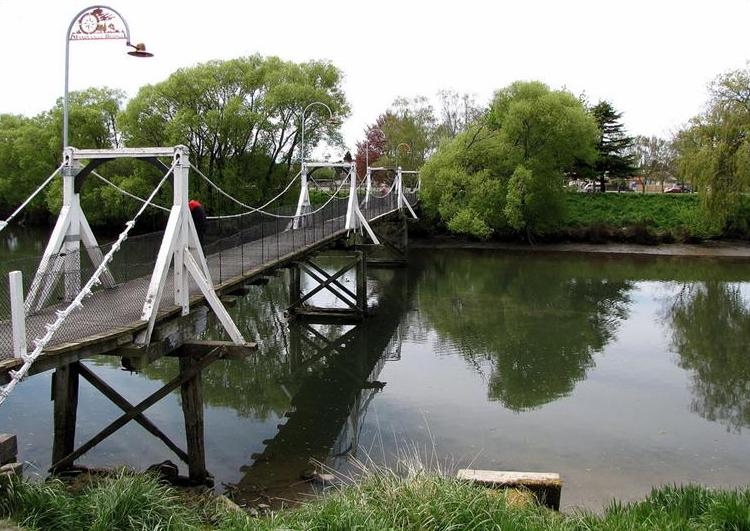
Mandeville Bridge, Kaiapoi | R Burgess | 04/05/2024 | Heritage New Zealand Pouhere Taonga
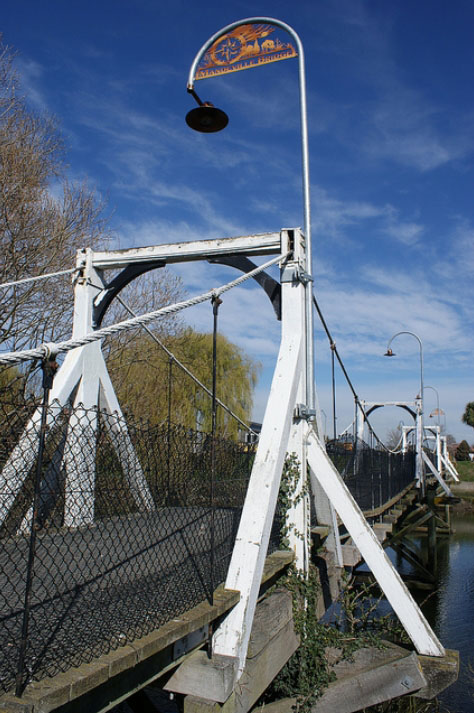
Mandeville Bridge, Kaiapoi | R Burgess | 04/05/2024 | Heritage New Zealand Pouhere Taonga
Mandeville Bridge, Kaiapoi | R Burgess | 04/05/2024 | Heritage New Zealand Pouhere Taonga
Mandeville Bridge, Kaiapoi | R Burgess | 04/05/2024 | Heritage New Zealand Pouhere Taonga
