Quick links


Quick links
Quick links
Quick links
Quick links
Quick links
Reservoir Road, Wainuiomata, LOWER HUTT
Private
Historic Place Category 2
List No. 1836
List Entry Information
Status
Listed
List Entry Status
Historic Place Category 2
Access
Private/No Public Access
List Number
1836
Date Entered
20th June 2024
Date of Effect
11th July 2024
City/District Council
Hutt City
Region
Wellington Region
Extent of List Entry
Extent includes part of the land described as Pt Secs 35 and 67 Wainuiomata Dist (RTs WN485/234, WN21D/577; NZ Gazette 2007 p.3707), Wellington Land District, and the structures known as Morton Dam thereon. (Refer to map in Appendix 1 of the List entry report for further information).
Legal description
Pt Secs 35 and 67 Wainuiomata Dist (RTs WN485/234, WN21D/577; NZ Gazette 2007 p.3707), Wellington Land District.
Location Description
Morton Dam is located within the Wainuiomata / Orongorongo Water Collection Area and general public access is restricted to guided tours. GPS information: 174.995945, -41.263307
Status
Listed
List Entry Status
Historic Place Category 2
Access
Private/No Public Access
List Number
1836
Date Entered
20th June 2024
Date of Effect
11th July 2024
City/District Council
Hutt City
Region
Wellington Region
Extent of List Entry
Extent includes part of the land described as Pt Secs 35 and 67 Wainuiomata Dist (RTs WN485/234, WN21D/577; NZ Gazette 2007 p.3707), Wellington Land District, and the structures known as Morton Dam thereon. (Refer to map in Appendix 1 of the List entry report for further information).
Legal description
Pt Secs 35 and 67 Wainuiomata Dist (RTs WN485/234, WN21D/577; NZ Gazette 2007 p.3707), Wellington Land District.
Location Description
Morton Dam is located within the Wainuiomata / Orongorongo Water Collection Area and general public access is restricted to guided tours. GPS information: 174.995945, -41.263307
Why is this place significant?
Cultural Significance
Archaeological Significance or Value The Morton Dam has archaeological significance as a unique example of a reinforced concrete flat slab buttress dam. The preservation efforts and limited accessibility of the site has contributed to its near intact physical fabric, allowing the possibility of archaeological investigation to provide valuable insights into the design, construction and use of Ambursen-type dams during the early 1900s.
Historic Significance
Historical Significance or Value The Morton Dam has historical significance as a milestone in New Zealand’s early twentieth-century engineering history. Its completion marked a notable advancement in engineering practices and played a vital role in the development of New Zealand’s public infrastructure, reflecting the changes in urban growth and social needs of the time. The dam’s success highlighted the expertise of City Engineer William Hobbard Morton and his contribution to New Zealand’s engineering landscape and the capital city’s development from 1904 to 1923.
Physical Significance
Technological Significance or Value The Morton Dam has technological significance as a rare example of a reinforced concrete flat slab buttress dam. The structure showcases innovation in its distinctive Ambursen-type design, which is recognised as the first of its kind in Australasia. Despite its relatively early decommissioning and the subsequent removal of part of its spillway, the dam provides sufficient evidence and valuable insights into the development of reinforced concrete dams in New Zealand.
Why is this place Category 1 / Category 2?
Detail Of Assessed Criteria
This place was assessed against the Section 66(3) criteria and found to qualify under the following criteria a, b, c, g. The assessment concludes that this place should be listed as a Category 2 historic place. (a) The extent to which the place reflects important or representative aspects of New Zealand history. The Morton Dam represents an important moment in New Zealand’s engineering history, exemplifying the nation’s capacity to provide innovative solutions to water supply challenges amid rapid changes during the late nineteenth and early twentieth century. The success of Morton Dam, as one of the first Ambursen-type dams in Australasia, reflects New Zealand’s involvement in the international engineering field. (b) The association of the place with events, persons, or ideas of importance in New Zealand history The Morton Dam is a testament to the engineering expertise of William Hobbard Morton. His success with the dam and subsequent contributions to public infrastructure positioned him as a pioneering figure in shaping New Zealand’s early engineering history. Morton’s commemoration with a memorial plaque for his years of service, solidified his status as a key figure in New Zealand’s history. (c) The potential of the place to provide knowledge of New Zealand history. The Morton Dam stands as a tangible, intact structure with the ability to provide insights into engineering practices, urban growth, and societal needs during the early twentieth century. (g) The technical accomplishment, value, or design of the place The Morton Dam represents a remarkable technical achievement as a rare example of a New Zealand reinforced concrete flat slab buttress dam and pioneering engineering practices. Despite its inherent structural vulnerabilities, it showcases the innovative engineering design of the Ambursen-type dam, marking a distinctive milestone in New Zealand’s dam construction history. Summary of Significance or Values The Morton Dam has historical and technological significance as an early Ambursen-type dam constructed during the early twentieth century. Its completion marked a significant advancement in engineering practices, influencing early municipal development to meet the evolving needs of the New Zealand’s capital city. City Engineer William Hobbard Morton’s expertise, demonstrated through the dam’s initial success, contributes to his notable role in shaping New Zealand’s engineering landscape. The Morton Dam is a rare instance of a reinforced concrete flat slab buttress dam. This coupled with its enduring integrity and protection, offers significant potential for archaeological investigation to provide evidence and insight into the history of dam construction in New Zealand.
Why is this place significant?
Cultural Significance
Archaeological Significance or Value The Morton Dam has archaeological significance as a unique example of a reinforced concrete flat slab buttress dam. The preservation efforts and limited accessibility of the site has contributed to its near intact physical fabric, allowing the possibility of archaeological investigation to provide valuable insights into the design, construction and use of Ambursen-type dams during the early 1900s.
Historic Significance
Historical Significance or Value The Morton Dam has historical significance as a milestone in New Zealand’s early twentieth-century engineering history. Its completion marked a notable advancement in engineering practices and played a vital role in the development of New Zealand’s public infrastructure, reflecting the changes in urban growth and social needs of the time. The dam’s success highlighted the expertise of City Engineer William Hobbard Morton and his contribution to New Zealand’s engineering landscape and the capital city’s development from 1904 to 1923.
Physical Significance
Technological Significance or Value The Morton Dam has technological significance as a rare example of a reinforced concrete flat slab buttress dam. The structure showcases innovation in its distinctive Ambursen-type design, which is recognised as the first of its kind in Australasia. Despite its relatively early decommissioning and the subsequent removal of part of its spillway, the dam provides sufficient evidence and valuable insights into the development of reinforced concrete dams in New Zealand.
Why is this place Category 1 / Category 2?
Detail Of Assessed Criteria
This place was assessed against the Section 66(3) criteria and found to qualify under the following criteria a, b, c, g. The assessment concludes that this place should be listed as a Category 2 historic place. (a) The extent to which the place reflects important or representative aspects of New Zealand history. The Morton Dam represents an important moment in New Zealand’s engineering history, exemplifying the nation’s capacity to provide innovative solutions to water supply challenges amid rapid changes during the late nineteenth and early twentieth century. The success of Morton Dam, as one of the first Ambursen-type dams in Australasia, reflects New Zealand’s involvement in the international engineering field. (b) The association of the place with events, persons, or ideas of importance in New Zealand history The Morton Dam is a testament to the engineering expertise of William Hobbard Morton. His success with the dam and subsequent contributions to public infrastructure positioned him as a pioneering figure in shaping New Zealand’s early engineering history. Morton’s commemoration with a memorial plaque for his years of service, solidified his status as a key figure in New Zealand’s history. (c) The potential of the place to provide knowledge of New Zealand history. The Morton Dam stands as a tangible, intact structure with the ability to provide insights into engineering practices, urban growth, and societal needs during the early twentieth century. (g) The technical accomplishment, value, or design of the place The Morton Dam represents a remarkable technical achievement as a rare example of a New Zealand reinforced concrete flat slab buttress dam and pioneering engineering practices. Despite its inherent structural vulnerabilities, it showcases the innovative engineering design of the Ambursen-type dam, marking a distinctive milestone in New Zealand’s dam construction history. Summary of Significance or Values The Morton Dam has historical and technological significance as an early Ambursen-type dam constructed during the early twentieth century. Its completion marked a significant advancement in engineering practices, influencing early municipal development to meet the evolving needs of the New Zealand’s capital city. City Engineer William Hobbard Morton’s expertise, demonstrated through the dam’s initial success, contributes to his notable role in shaping New Zealand’s engineering landscape. The Morton Dam is a rare instance of a reinforced concrete flat slab buttress dam. This coupled with its enduring integrity and protection, offers significant potential for archaeological investigation to provide evidence and insight into the history of dam construction in New Zealand.
Construction Details
Start Year
1908
Finish Year
1911
Type
Original Construction
Description
Construction begins November 1908. Foundations completed late 1909. Construction complete September 1911.
Start Year
1912
Type
Addition
Description
Duplicate water main complete.
Start Year
1940
Type
Maintenance/repairs
Description
Repairs on spillway apron completed. Parapet added.
Start Year
1988
Type
Other
Description
Dam decommissioned; part of spillway removed.
Construction Materials
Reinforced concrete.
Construction Details
Start Year
1908
Finish Year
1911
Type
Original Construction
Description
Construction begins November 1908. Foundations completed late 1909. Construction complete September 1911.
Start Year
1912
Type
Addition
Description
Duplicate water main complete.
Start Year
1940
Type
Maintenance/repairs
Description
Repairs on spillway apron completed. Parapet added.
Start Year
1988
Type
Other
Description
Dam decommissioned; part of spillway removed.
Construction Materials
Reinforced concrete.
Tangata whenua in Te Upoko o Te Ika a Māui Te Whanganui a Tara has a rich history of Māori occupation, dating back to the arrival of the Polynesian explorer Kupe. Originating from Hawaiki, Kupe and his people were the earliest known group to navigate Aotearoa, exploring Te Ika a Māui and portions of Te Wai Pounamu. Kupe’s exploration focused on South Wairarapa, Raukawa Moana, Te Tai ō Aorere and Te Tai Tokerau, leaving traces of his journey in placenames such as Te Aroaro o Kupe. After Kupe’s return to Hawaiki, the arrival of the Kurahaupō waka on the Māhia Peninsula marked the beginning of the subsequent migration of Māori south into Te Upoko o Te Ika a Māui. Whātonga, a Kurahaupō captain, journeyed south to Raukawa Moana, reaching Te Whanganui a Tara before continuing his travels up the west coast towards Manawatū. There, he met his second wife, Reretua, and had their son Tautoki, later returning to his wife Hotuwaipara and son Tarataraika (also known as Tara) in Heretaunga. Following Whātonga’s instruction, Tarataraika and Tautoki explored both the east and west coast of the southern regions of Te Ika a Māui. Tautoki settled at Parangāhau (Fitzroy Bay), with his son Tānenui-ā-rangi (also known as Rangitāne, Rangitānenui-a-rangi and Rangitānenui) becoming the eponymous ancestor of the iwi Rangitāne. Tarataraika and his descendants became Ngāi Tara and settled in Te Upoko o Te Ika a Māui. Before 1820, Ngāi Tara, Rangitāne, Ngāti Apa and Muaūpoko were the primary inhabitants of Te Whanganui a Tara, while Rakaiwhakairi and Ngāti Kahukuraawhitia of Ngāti Kahungunu settled in Heretaunga (Hutt Valley). In the early seventeenth century, a second wave of migration led by Ngāti Ira moved south from Te Matau a Māui (Hawke’s Bay), intermarrying with Ngāi Tara and Rangitāne. Ngāti Ira established settlements from Waiwhetū to Turakirae, Matiu, Mākaro and Tapu Te Ranga, while Rakaiwhakairi and Ngāti Kahukuraawhitia continued to occupy Heretaunga. The introduction of European muskets in Aotearoa triggered a significant restructuring of iwi in Te Ika a Māui. Between 1819 and 1820, a large tauā (war party), including Ngāti Toa chief Te Rauparaha, moved through the island, reaching Te Whanganui a Tara before returning north. Recognising the advantage of Raukawa Moana for trade, Te Rauparaha returned to Kāwhia and initiated a series of heke (migrations) south to Taranaki in 1821 and then to Te Upoko o Te Ika a Māui in 1822. Te Āti Awa, Ngāti Mutunga, and Ngāti Tama joined Te Rauparaha on this second heke. By the late 1820s, Ngāti Raukawa had accepted an invitation from Ngāti Toa and migrated south from Maungatautari to the Kapiti Coast. During this time, Ngāti Ira remained the primary inhabitants in Te Whanganui a Tara, and Rakaiwhakairi and Ngāti Kahukuraawhitia in Heretaunga shared areas with Ngāti Mutunga and Ngāti Tama. However, this peaceful arrangement shifted in the late 1820s after Ngāti Mutunga attacked Ngāti Ira settlements between Waiwhetū and Turakirae. This conflict became the catalyst for ‘a series of short sharp clashes and consequent occupation readjustments as Ngāti Ira gradually conceded more territory’. In the late 1830s, Taranaki iwi had displaced Ngāti Ira, Rakaiwhakairi, and Ngāti Kahukuraawhitia from Te Upoko o Te Ika, initiating their migration over the Remutaka Ranges towards Wairarapa. Te Āti Awa, Taranaki, Ngāti Ruanui, Ngāti Tama and Ngāti Mutunga collectively became Taranaki Whānui ki Te Upoko o Te Ika and have retained ahi kā status from the Mukamuka stream to the east, across to Pipinui Point to the west, and down to the southern coastline of Te Upoko o Te Ika. Wai-nui-o-mata and environs Wai-nui-o-mata lies along the eastern boundary of the Taranaki Whānui ki Te Upoko o Te Ika takiwā, encompassing a valley once covered with dense forests and extensive swamplands. This landscape restricted Māori from establishing settlements however, the Wai-nui-o-mata River and nearby Orongorongo River 'were paths for Māori to go birding and fishing for eel/tuna’ and traditional Māori agriculture. The area, including the Orongorongo Valley, represented an agreed natural boundary between Te Āti Awa and Ngāti Kahungunu, also serving as an inland track between Te Whanganui a Tara and Wairarapa. In 1835 Te Āti Awa people living in Wairarapa under the leadership of Te Wharepōuri were attacked by a taua led by Nuku-Pewapewa of Ngāti Kahungunu and Hoeroa of Ngāi Te Upokoiri. Te Wharepōuri escaped but his wife Te Uamairangi and niece Te Kaipai were captured. In his grief he compared the great waters (wai-nui) streaming down his face (mata) to the river catchment and this became its name. Te Uamairangi was released, allowing for peace between the two peoples. The agreement was that Te Āti Awa would live on the Te Whanganui a Tara side of the Remutaka and Taraua ranges and Ngāti Kahungunu on the Wairarapa side. The peace was sealed with marriages. After the 1855 earthquake, the landscape in Wai-nui-o-mata and the wider region underwent significant changes, with raised swamplands exposing suitable land for settlement. By this time, the New Zealand Company had arrived in Te Whanganui a Tara, establishing British settlements first at Pito one (Petone) and then at Pipitea (Lambton Harbour). Te Whanganui a Tara became Wellington, named after Arthur Wellesley (1769-1852), the first Duke of Wellington, while Heretaunga became the Hutt Valley, named after the New Zealand Company director, Sir William Hutt (1801-1882). Following the government’s removal of ‘Ngāti Toa aligned Māori’ in 1846, the Hutt Valley shifted from a forested landscape to a heavy farming and horticultural district. This transformation extended into Wai-nui-o-mata until the 1950s, evolving into a residential suburb to accommodate young families after the Second World War. Since then, Wai-nui-o-mata has remained a residential suburb. Wellington’s water supply In 1865, New Zealand's Parliament relocated to Wellington, establishing the city as the country's third and final capital. In 1870, the Wellington City Corporation replaced the Borough and Provincial Councils, establishing local government in the region. The late nineteenth century saw significant population growth, prompting a demand for improved municipal services. Councillors concentrated on enhancing infrastructure, prioritising water supply and wastewater management. In 1867, the Wellington Town Board, operating under the former Provincial Council, initiated the Lower Karori Dam (List no. 7750) scheme to cater to public water needs. Completed in 1878, the scheme faced challenges with water demand surpassing supply due to dry summers, population growth, and higher-than-anticipated usage. This led to city-wide restrictions and water shortages. Responding to the crisis, the Wellington City Council tasked Chief Engineer William Clark and City Engineer James Daniel Baird (1840-1908) with developing a ‘report on the best available means of extending and augmenting the water supply’ for the city. Following a thorough investigation of regional water sources, Baird, guided by Clark’s recommendations, presented two schemes utilising the Karori Stream and Wai-nui-o-mata River. After a thorough examination, Baird selected the Wai-nui-o-mata River due to the catchment receiving 1,900 millimetres of rainfall annually, compared to the 1,200 millimetres in Karori. In 1880, the Council approved the construction of a 10-meter-high embankment dam across the Wai-nui-o-mata River. Although completed in January 1884, consistent water supply to Wellington was delayed until mid-1884 due to successive flooding events, causing substantial structural damage and expensive repairs. By 1900, the influx of European immigrants to Wellington led to the expansion of boroughs around the city centre. The growth strained the city’s water supply, forcing the Council to seek alternative solutions. Newly appointed City Engineer Richard Septimus Rounthwaite (1854-1932) investigated the cause, presenting a report to the City Council on 31 May 1900. In his report, he expressed concerns about the public’s water use, noting the ‘unnecessarily large consumption that brings us at times within measurable distance of a water famine.’ Rounthwaite proposed a draft set of water regulations in 1901, suggesting the use of Venturi meters to monitor the quantity of water supplied. Rounthwaite recognised the advantages of the previously recommended Wai-nui-o-mata and Karori catchments and proposed new dams at both however, due to the cost of works and a lack of support from the city’s ratepayers, progress on these improvements were stalled. William Hobbard Morton In 1904, William Hobbard Morton (1866 – 1923) assumed the position of city engineer, succeeding Rounthwaite upon his arrival in New Zealand. Morton’s prior role as Chief Engineering Assistant and Assistant City Surveyor in Victoria, coupled with his experience in municipal activities, positioned him well to address the persisting water supply challenges in the region. Described as possessing ‘sterling ability, with a strong personality and character’, Morton successfully influenced ratepayers by proposing the extension of reticulation to the recently absorbed hilltop borough of Melrose. In 1905, with the newfound support of Melrose, ratepayers approved the loan for the Karori and Wai-nui-o-mata dams, pumping stations and required land purchase. Construction begins In 1906, the Wellington City Council acquired the Karori catchment and contracted Mitchell & King to complete the works. By March 1908, the Upper Karori Dam was complete, prompting Morton to shift the department’s focus to the Wai-nui-o-mata dam at Solomon’s Knob. In October 1908, tenders for the works opened, and Martin, Hurrell, and Snaddon won the bid with £46,000. Construction commenced the following month on a buttress dam, utilising reinforced concrete in a distinctive Ambursen-type style - a ‘first of its kind in Australasia’. By February 1909, extensive preparation work, such as felling dense bush, establishing a tramline, constructing a bridge, redirecting George’s Creek, and substantial earthworks, including the removal of the Solomon’s Knob spur, was complete. Initially, Martin, Hurrell and Snaddon engaged 48 men for the project, later increasing the workforce to approximately 70. These workers, often called ‘navvies’, were housed in tents and huts at a camp known as ‘Navy Town’, referencing their background as seamen. By August 1909, additional auxiliary works were finalised, incorporating an aerial ropeway across the valley and workshops and sheds for carpenters and blacksmiths. Following a January 1910 site visit, Assistant City Engineer James Murray Morice (1861-1930) reported that ‘practically all the difficult or risky work in connection with the construction of Solomon’s Knob has been finished’. Despite an estimated completion date around Christmas, construction extended into the following year due to remediation work on porous sections in the foundation wall. This work concluded by September 1911, and the reservoir was filled with heavy rain the following month, reaching a capacity of 120,000,000 gallons. The Renaming of Solomon’s Knob Dam On 14 November 1911, a delegation led by Mayor Thomas Mason Wilford (1870-1939), city councillors, and the engineering department visited the newly finished dam. After a tour and afternoon tea near the lower lake, Wilford congratulated Morton on the project’s success, proposing to ‘call the dam in the future the Morton dam, as a compliment to Mr. Morton, and a token of our appreciation of his work’. The suggestion was met with applause, confirming the renaming of Solomon’s Knob Dam to the Morton Dam. Wilford commended Martin, Hurrell, and Snaddon for their work, particularly noting Hurrell’s commitment shown by his residency on-site for the three years until completion. Connected in December 1911, the mains from the dam to the city’s reticulation boosted the supply by 1,075 million litres in the first year. The addition to the city’s existing infrastructure allowed for ‘the needs of a city four times the population of Wellington’, earning the capital city the title of ‘cleanest city in the Southern Hemisphere’. Concerns at Wai-nui-o-mata Although the Morton Dam experienced initial success, its effectiveness was questioned during Wellington’s driest three years on record when ‘the Wainui dams completely dried out for three days over Easter 1917’. In 1915, Morton gained approval to pipe water from the Orongorongo River to the dam. However, Morton revisited this scheme in 1919 and made adjustments to supply water directly to the lower Karori reservoir instead of Wai-nui-o-mata. The works were completed in 1926, including a weir, intake and the Orongorongo-to-Karori main. Unfortunately, Morton did not witness the completion of the Orongorongo scheme, passing away in June 1923. His funeral drew hundreds, with a procession described as ‘one of the longest that have been seen in Wellington for many years’. Throughout his tenure as Wellington City Engineer, Morton was pivotal in establishing vital infrastructure amid rapid city and suburban growth. Beyond the Upper Karori Dam and the Morton Dam, his contributions extended to significant enhancements in city transport infrastructure. As the General Manager of Tramways, he was described as ‘a man of great capacity and ability and…of inestimable value to the city’. Morton remained a member of the New Zealand Society of Civil Engineers until a few months before his death, having served as Honorary Secretary from 1920. His contributions were further commemorated in 1933 with a memorial plaque in the Town Hall, recognising his ‘outstanding city works’. The Decommissioning of the Morton Dam The Morton Dam is his most notable achievement, playing a crucial role in the city’s original municipal system. At its completion, the water supply was designed for a population of 75,000, however, by 1946, the city’s population had surged to 123,750, prompting the need for additional supplies. Despite its longstanding service, advancements in other water sources, including the Waiwhetū aquifer and Te Marua lakes, rendered the Morton Dam redundant. Concerns regarding earthquake risks, limited flood capacity, and silt accumulation further diminished its suitability as a backup water supply. Consequently, the Greater Wellington Regional Council, who has managed the site since 1980, explored options to decommission in 1987. To restore the river’s natural flow, mitigate structural risk, and preserve its engineering heritage values, the Council removed a section of the spillway, officially decommissioning the dam in 1988 and producing a memorial booklet to commemorate the dam’s contribution. Additional decommissioning works included creating artificial rapids and removing the strainer house and bridge to the valve tower. General public access to the dam (and Wainuomata/Orongorongo Water Collection Area) is closed, with only limited access available through seasonal guided tours and a permit system.
Tangata whenua in Te Upoko o Te Ika a Māui Te Whanganui a Tara has a rich history of Māori occupation, dating back to the arrival of the Polynesian explorer Kupe. Originating from Hawaiki, Kupe and his people were the earliest known group to navigate Aotearoa, exploring Te Ika a Māui and portions of Te Wai Pounamu. Kupe’s exploration focused on South Wairarapa, Raukawa Moana, Te Tai ō Aorere and Te Tai Tokerau, leaving traces of his journey in placenames such as Te Aroaro o Kupe. After Kupe’s return to Hawaiki, the arrival of the Kurahaupō waka on the Māhia Peninsula marked the beginning of the subsequent migration of Māori south into Te Upoko o Te Ika a Māui. Whātonga, a Kurahaupō captain, journeyed south to Raukawa Moana, reaching Te Whanganui a Tara before continuing his travels up the west coast towards Manawatū. There, he met his second wife, Reretua, and had their son Tautoki, later returning to his wife Hotuwaipara and son Tarataraika (also known as Tara) in Heretaunga. Following Whātonga’s instruction, Tarataraika and Tautoki explored both the east and west coast of the southern regions of Te Ika a Māui. Tautoki settled at Parangāhau (Fitzroy Bay), with his son Tānenui-ā-rangi (also known as Rangitāne, Rangitānenui-a-rangi and Rangitānenui) becoming the eponymous ancestor of the iwi Rangitāne. Tarataraika and his descendants became Ngāi Tara and settled in Te Upoko o Te Ika a Māui. Before 1820, Ngāi Tara, Rangitāne, Ngāti Apa and Muaūpoko were the primary inhabitants of Te Whanganui a Tara, while Rakaiwhakairi and Ngāti Kahukuraawhitia of Ngāti Kahungunu settled in Heretaunga (Hutt Valley). In the early seventeenth century, a second wave of migration led by Ngāti Ira moved south from Te Matau a Māui (Hawke’s Bay), intermarrying with Ngāi Tara and Rangitāne. Ngāti Ira established settlements from Waiwhetū to Turakirae, Matiu, Mākaro and Tapu Te Ranga, while Rakaiwhakairi and Ngāti Kahukuraawhitia continued to occupy Heretaunga. The introduction of European muskets in Aotearoa triggered a significant restructuring of iwi in Te Ika a Māui. Between 1819 and 1820, a large tauā (war party), including Ngāti Toa chief Te Rauparaha, moved through the island, reaching Te Whanganui a Tara before returning north. Recognising the advantage of Raukawa Moana for trade, Te Rauparaha returned to Kāwhia and initiated a series of heke (migrations) south to Taranaki in 1821 and then to Te Upoko o Te Ika a Māui in 1822. Te Āti Awa, Ngāti Mutunga, and Ngāti Tama joined Te Rauparaha on this second heke. By the late 1820s, Ngāti Raukawa had accepted an invitation from Ngāti Toa and migrated south from Maungatautari to the Kapiti Coast. During this time, Ngāti Ira remained the primary inhabitants in Te Whanganui a Tara, and Rakaiwhakairi and Ngāti Kahukuraawhitia in Heretaunga shared areas with Ngāti Mutunga and Ngāti Tama. However, this peaceful arrangement shifted in the late 1820s after Ngāti Mutunga attacked Ngāti Ira settlements between Waiwhetū and Turakirae. This conflict became the catalyst for ‘a series of short sharp clashes and consequent occupation readjustments as Ngāti Ira gradually conceded more territory’. In the late 1830s, Taranaki iwi had displaced Ngāti Ira, Rakaiwhakairi, and Ngāti Kahukuraawhitia from Te Upoko o Te Ika, initiating their migration over the Remutaka Ranges towards Wairarapa. Te Āti Awa, Taranaki, Ngāti Ruanui, Ngāti Tama and Ngāti Mutunga collectively became Taranaki Whānui ki Te Upoko o Te Ika and have retained ahi kā status from the Mukamuka stream to the east, across to Pipinui Point to the west, and down to the southern coastline of Te Upoko o Te Ika. Wai-nui-o-mata and environs Wai-nui-o-mata lies along the eastern boundary of the Taranaki Whānui ki Te Upoko o Te Ika takiwā, encompassing a valley once covered with dense forests and extensive swamplands. This landscape restricted Māori from establishing settlements however, the Wai-nui-o-mata River and nearby Orongorongo River 'were paths for Māori to go birding and fishing for eel/tuna’ and traditional Māori agriculture. The area, including the Orongorongo Valley, represented an agreed natural boundary between Te Āti Awa and Ngāti Kahungunu, also serving as an inland track between Te Whanganui a Tara and Wairarapa. In 1835 Te Āti Awa people living in Wairarapa under the leadership of Te Wharepōuri were attacked by a taua led by Nuku-Pewapewa of Ngāti Kahungunu and Hoeroa of Ngāi Te Upokoiri. Te Wharepōuri escaped but his wife Te Uamairangi and niece Te Kaipai were captured. In his grief he compared the great waters (wai-nui) streaming down his face (mata) to the river catchment and this became its name. Te Uamairangi was released, allowing for peace between the two peoples. The agreement was that Te Āti Awa would live on the Te Whanganui a Tara side of the Remutaka and Taraua ranges and Ngāti Kahungunu on the Wairarapa side. The peace was sealed with marriages. After the 1855 earthquake, the landscape in Wai-nui-o-mata and the wider region underwent significant changes, with raised swamplands exposing suitable land for settlement. By this time, the New Zealand Company had arrived in Te Whanganui a Tara, establishing British settlements first at Pito one (Petone) and then at Pipitea (Lambton Harbour). Te Whanganui a Tara became Wellington, named after Arthur Wellesley (1769-1852), the first Duke of Wellington, while Heretaunga became the Hutt Valley, named after the New Zealand Company director, Sir William Hutt (1801-1882). Following the government’s removal of ‘Ngāti Toa aligned Māori’ in 1846, the Hutt Valley shifted from a forested landscape to a heavy farming and horticultural district. This transformation extended into Wai-nui-o-mata until the 1950s, evolving into a residential suburb to accommodate young families after the Second World War. Since then, Wai-nui-o-mata has remained a residential suburb. Wellington’s water supply In 1865, New Zealand's Parliament relocated to Wellington, establishing the city as the country's third and final capital. In 1870, the Wellington City Corporation replaced the Borough and Provincial Councils, establishing local government in the region. The late nineteenth century saw significant population growth, prompting a demand for improved municipal services. Councillors concentrated on enhancing infrastructure, prioritising water supply and wastewater management. In 1867, the Wellington Town Board, operating under the former Provincial Council, initiated the Lower Karori Dam (List no. 7750) scheme to cater to public water needs. Completed in 1878, the scheme faced challenges with water demand surpassing supply due to dry summers, population growth, and higher-than-anticipated usage. This led to city-wide restrictions and water shortages. Responding to the crisis, the Wellington City Council tasked Chief Engineer William Clark and City Engineer James Daniel Baird (1840-1908) with developing a ‘report on the best available means of extending and augmenting the water supply’ for the city. Following a thorough investigation of regional water sources, Baird, guided by Clark’s recommendations, presented two schemes utilising the Karori Stream and Wai-nui-o-mata River. After a thorough examination, Baird selected the Wai-nui-o-mata River due to the catchment receiving 1,900 millimetres of rainfall annually, compared to the 1,200 millimetres in Karori. In 1880, the Council approved the construction of a 10-meter-high embankment dam across the Wai-nui-o-mata River. Although completed in January 1884, consistent water supply to Wellington was delayed until mid-1884 due to successive flooding events, causing substantial structural damage and expensive repairs. By 1900, the influx of European immigrants to Wellington led to the expansion of boroughs around the city centre. The growth strained the city’s water supply, forcing the Council to seek alternative solutions. Newly appointed City Engineer Richard Septimus Rounthwaite (1854-1932) investigated the cause, presenting a report to the City Council on 31 May 1900. In his report, he expressed concerns about the public’s water use, noting the ‘unnecessarily large consumption that brings us at times within measurable distance of a water famine.’ Rounthwaite proposed a draft set of water regulations in 1901, suggesting the use of Venturi meters to monitor the quantity of water supplied. Rounthwaite recognised the advantages of the previously recommended Wai-nui-o-mata and Karori catchments and proposed new dams at both however, due to the cost of works and a lack of support from the city’s ratepayers, progress on these improvements were stalled. William Hobbard Morton In 1904, William Hobbard Morton (1866 – 1923) assumed the position of city engineer, succeeding Rounthwaite upon his arrival in New Zealand. Morton’s prior role as Chief Engineering Assistant and Assistant City Surveyor in Victoria, coupled with his experience in municipal activities, positioned him well to address the persisting water supply challenges in the region. Described as possessing ‘sterling ability, with a strong personality and character’, Morton successfully influenced ratepayers by proposing the extension of reticulation to the recently absorbed hilltop borough of Melrose. In 1905, with the newfound support of Melrose, ratepayers approved the loan for the Karori and Wai-nui-o-mata dams, pumping stations and required land purchase. Construction begins In 1906, the Wellington City Council acquired the Karori catchment and contracted Mitchell & King to complete the works. By March 1908, the Upper Karori Dam was complete, prompting Morton to shift the department’s focus to the Wai-nui-o-mata dam at Solomon’s Knob. In October 1908, tenders for the works opened, and Martin, Hurrell, and Snaddon won the bid with £46,000. Construction commenced the following month on a buttress dam, utilising reinforced concrete in a distinctive Ambursen-type style - a ‘first of its kind in Australasia’. By February 1909, extensive preparation work, such as felling dense bush, establishing a tramline, constructing a bridge, redirecting George’s Creek, and substantial earthworks, including the removal of the Solomon’s Knob spur, was complete. Initially, Martin, Hurrell and Snaddon engaged 48 men for the project, later increasing the workforce to approximately 70. These workers, often called ‘navvies’, were housed in tents and huts at a camp known as ‘Navy Town’, referencing their background as seamen. By August 1909, additional auxiliary works were finalised, incorporating an aerial ropeway across the valley and workshops and sheds for carpenters and blacksmiths. Following a January 1910 site visit, Assistant City Engineer James Murray Morice (1861-1930) reported that ‘practically all the difficult or risky work in connection with the construction of Solomon’s Knob has been finished’. Despite an estimated completion date around Christmas, construction extended into the following year due to remediation work on porous sections in the foundation wall. This work concluded by September 1911, and the reservoir was filled with heavy rain the following month, reaching a capacity of 120,000,000 gallons. The Renaming of Solomon’s Knob Dam On 14 November 1911, a delegation led by Mayor Thomas Mason Wilford (1870-1939), city councillors, and the engineering department visited the newly finished dam. After a tour and afternoon tea near the lower lake, Wilford congratulated Morton on the project’s success, proposing to ‘call the dam in the future the Morton dam, as a compliment to Mr. Morton, and a token of our appreciation of his work’. The suggestion was met with applause, confirming the renaming of Solomon’s Knob Dam to the Morton Dam. Wilford commended Martin, Hurrell, and Snaddon for their work, particularly noting Hurrell’s commitment shown by his residency on-site for the three years until completion. Connected in December 1911, the mains from the dam to the city’s reticulation boosted the supply by 1,075 million litres in the first year. The addition to the city’s existing infrastructure allowed for ‘the needs of a city four times the population of Wellington’, earning the capital city the title of ‘cleanest city in the Southern Hemisphere’. Concerns at Wai-nui-o-mata Although the Morton Dam experienced initial success, its effectiveness was questioned during Wellington’s driest three years on record when ‘the Wainui dams completely dried out for three days over Easter 1917’. In 1915, Morton gained approval to pipe water from the Orongorongo River to the dam. However, Morton revisited this scheme in 1919 and made adjustments to supply water directly to the lower Karori reservoir instead of Wai-nui-o-mata. The works were completed in 1926, including a weir, intake and the Orongorongo-to-Karori main. Unfortunately, Morton did not witness the completion of the Orongorongo scheme, passing away in June 1923. His funeral drew hundreds, with a procession described as ‘one of the longest that have been seen in Wellington for many years’. Throughout his tenure as Wellington City Engineer, Morton was pivotal in establishing vital infrastructure amid rapid city and suburban growth. Beyond the Upper Karori Dam and the Morton Dam, his contributions extended to significant enhancements in city transport infrastructure. As the General Manager of Tramways, he was described as ‘a man of great capacity and ability and…of inestimable value to the city’. Morton remained a member of the New Zealand Society of Civil Engineers until a few months before his death, having served as Honorary Secretary from 1920. His contributions were further commemorated in 1933 with a memorial plaque in the Town Hall, recognising his ‘outstanding city works’. The Decommissioning of the Morton Dam The Morton Dam is his most notable achievement, playing a crucial role in the city’s original municipal system. At its completion, the water supply was designed for a population of 75,000, however, by 1946, the city’s population had surged to 123,750, prompting the need for additional supplies. Despite its longstanding service, advancements in other water sources, including the Waiwhetū aquifer and Te Marua lakes, rendered the Morton Dam redundant. Concerns regarding earthquake risks, limited flood capacity, and silt accumulation further diminished its suitability as a backup water supply. Consequently, the Greater Wellington Regional Council, who has managed the site since 1980, explored options to decommission in 1987. To restore the river’s natural flow, mitigate structural risk, and preserve its engineering heritage values, the Council removed a section of the spillway, officially decommissioning the dam in 1988 and producing a memorial booklet to commemorate the dam’s contribution. Additional decommissioning works included creating artificial rapids and removing the strainer house and bridge to the valve tower. General public access to the dam (and Wainuomata/Orongorongo Water Collection Area) is closed, with only limited access available through seasonal guided tours and a permit system.
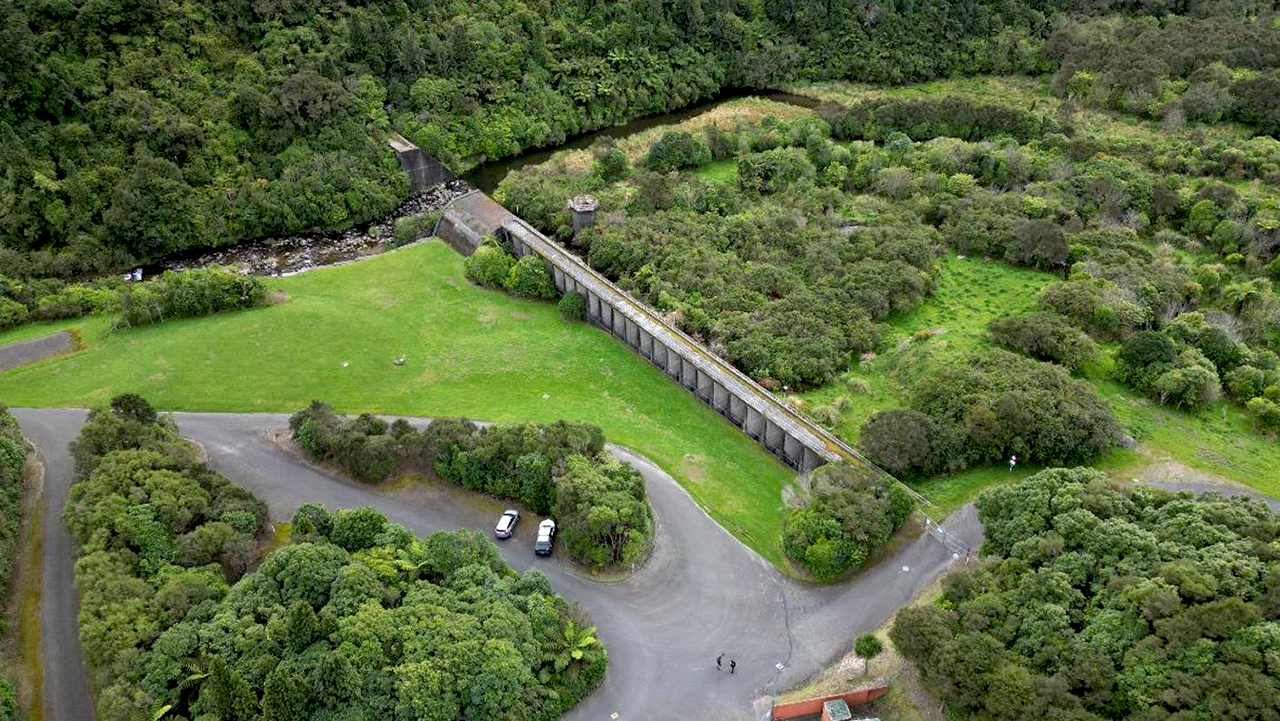
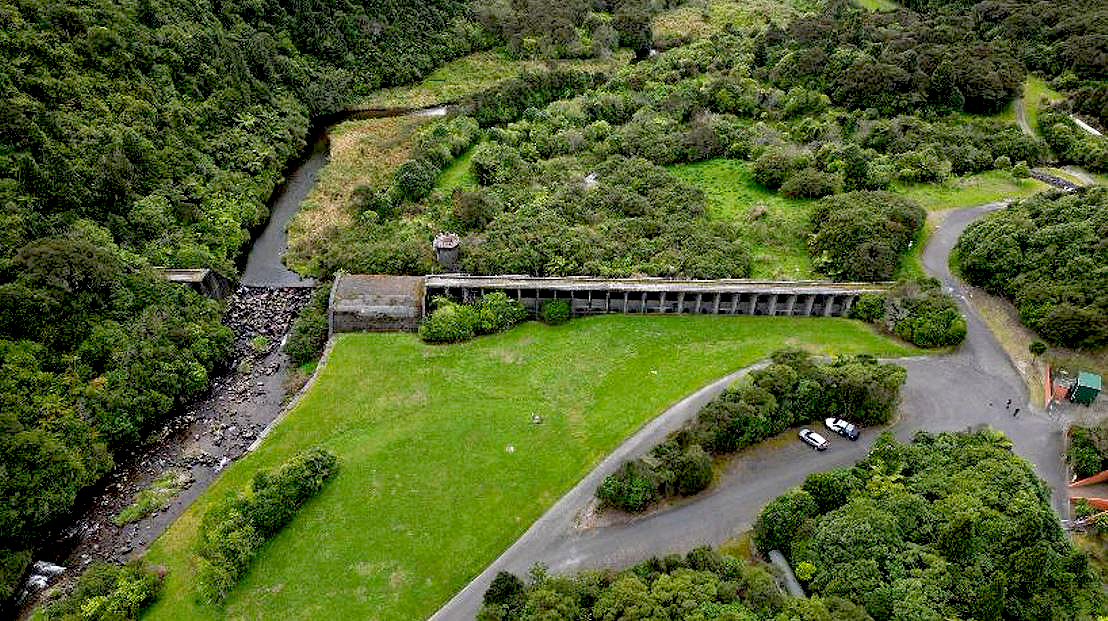
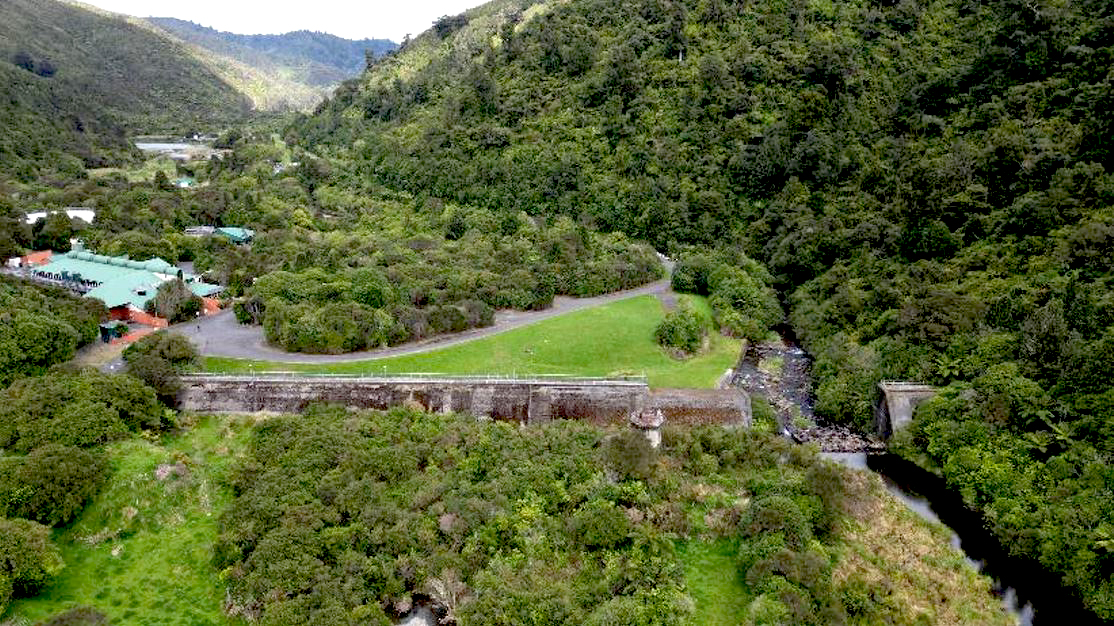
Construction Professionals Morton, William H Current Description The Morton Dam is located at the end of Reservoir Road in the Wainuiomata Water Collection Area, surrounded by regenerating native bush. The restricted access to the site preserves the areas tranquillity, allowing permitted visitors to appreciate the natural beauty. A well-maintained lawn leads to the downstream face of the dam, featuring forty-two 600 millimetre thick buttresses spaced 3 meters apart. Darkened with age, the buttresses extend 17 meters high from below ground level and end at the underside of the dam’s deck. Between each buttress is a subsurface open-front cell, joined by an internal walkway. The upstream face of the structure features a 45-degree angle facade with five shallow panels that protrude at 3 meter intervals, providing the only variation on an otherwise flat plane. Although the original materials are still structurally sound, a natural patina of moss and weed has developed on the concrete surface. To access the 4 meter wide deck, one must enter from the eastern end, which is bordered by a shallow parapet and a standard handrail fence. From this point, you can observe the native bush that stretches into the valley, witnessing the gradual reclamation of the site by the regenerating landscape. George’s Creek flows parallel to the upstream face, converging with the Wai-nui-o-mata River at the western end. The dam spans 128 meters across the channel of the river, allowing water to flow through its western end. Here, the dam’s deck is visibly truncated due to the removal of the spillway, with some parts remaining as a tribute to its original form. The internal passage walls are adorned with pre-cast concrete panels featuring a pattern of diagonal lines. At this point, the western end disappears into the bush-clad hillside. An Ambursen-type dam In the early 1900s, New Zealand dam construction shifted from using a puddled clay core technique to methods appropriate for concrete gravity and arch dams. During this time, reinforced concrete flat slab buttress dams became popular in North America, thanks to the Norwegian-American engineer Nils Fredrick Ambursen (1876–1958). Morton may have found inspiration from structures such as the Warrior Ridge Dam and Hydroelectric Plant in Huntingdon County, Pennsylvania, built in the Ambursen-type design and of similar dimension at 120 meters long and 8.2 meters high. As Astwood notes, Morton made ‘an effort to be well-versed in the latest international engineering and municipal developments and issues’, suggesting it was this technical literature where he discovered the Ambursen-type design. The benefits of Ambursen-type dams included stability during floods, adaptability to various foundations, the absence of upward water pressure, and efficient internal access for inspections. Notably, these dams offered a faster construction phase and cost less than other options. However, the global popularity of Ambursen’s patented design declined due to rising labour costs and concerns regarding lateral stability, especially in earthquake-prone regions. Comparative analysis The Morton Dam was considered ‘utterly different from all preconceived notions of what a dam should be’. Adopting a style present only in America at the time set the dam apart from other early twentieth-century dams in New Zealand. An earlier achievement of Morton’s, the Upper Karori Dam, is an example of a ‘traditional’ style completed during the same period in 1908. The Waitākere Dam provides another example of an ‘old style of dam’, completed in 1910 at a much larger scale. Despite these structures employing the older techniques of concrete gravity dam construction, their longevity surpassed the ‘modern’ technology of the Morton Dam, with the Waitākere Dam still in use and the Upper Karori Dam avoiding alterations during its decommissioning. The Upper Nihotupu Auxiliary Dam, completed in 1921, is the only other Ambursen-type dam built in New Zealand. Designed to relieve pressure during slow progress at the Upper Nihotupu Dam, the choice of the Ambursen-type style was likely due to its quick construction phase and cost-effectiveness. In 1986, the dam was decommissioned, and two sections of the dam’s central walls were removed. Although constructed on a smaller scale than the Morton Dam, it arguably provides a broader scope of analysis due to the retention of its original spillway. Nonetheless, the Morton Dam’s ‘original form substantively remains, providing sufficient evidence for the Morton Dam’s importance in New Zealand engineering history’.
Construction Professionals Morton, William H Current Description The Morton Dam is located at the end of Reservoir Road in the Wainuiomata Water Collection Area, surrounded by regenerating native bush. The restricted access to the site preserves the areas tranquillity, allowing permitted visitors to appreciate the natural beauty. A well-maintained lawn leads to the downstream face of the dam, featuring forty-two 600 millimetre thick buttresses spaced 3 meters apart. Darkened with age, the buttresses extend 17 meters high from below ground level and end at the underside of the dam’s deck. Between each buttress is a subsurface open-front cell, joined by an internal walkway. The upstream face of the structure features a 45-degree angle facade with five shallow panels that protrude at 3 meter intervals, providing the only variation on an otherwise flat plane. Although the original materials are still structurally sound, a natural patina of moss and weed has developed on the concrete surface. To access the 4 meter wide deck, one must enter from the eastern end, which is bordered by a shallow parapet and a standard handrail fence. From this point, you can observe the native bush that stretches into the valley, witnessing the gradual reclamation of the site by the regenerating landscape. George’s Creek flows parallel to the upstream face, converging with the Wai-nui-o-mata River at the western end. The dam spans 128 meters across the channel of the river, allowing water to flow through its western end. Here, the dam’s deck is visibly truncated due to the removal of the spillway, with some parts remaining as a tribute to its original form. The internal passage walls are adorned with pre-cast concrete panels featuring a pattern of diagonal lines. At this point, the western end disappears into the bush-clad hillside. An Ambursen-type dam In the early 1900s, New Zealand dam construction shifted from using a puddled clay core technique to methods appropriate for concrete gravity and arch dams. During this time, reinforced concrete flat slab buttress dams became popular in North America, thanks to the Norwegian-American engineer Nils Fredrick Ambursen (1876–1958). Morton may have found inspiration from structures such as the Warrior Ridge Dam and Hydroelectric Plant in Huntingdon County, Pennsylvania, built in the Ambursen-type design and of similar dimension at 120 meters long and 8.2 meters high. As Astwood notes, Morton made ‘an effort to be well-versed in the latest international engineering and municipal developments and issues’, suggesting it was this technical literature where he discovered the Ambursen-type design. The benefits of Ambursen-type dams included stability during floods, adaptability to various foundations, the absence of upward water pressure, and efficient internal access for inspections. Notably, these dams offered a faster construction phase and cost less than other options. However, the global popularity of Ambursen’s patented design declined due to rising labour costs and concerns regarding lateral stability, especially in earthquake-prone regions. Comparative analysis The Morton Dam was considered ‘utterly different from all preconceived notions of what a dam should be’. Adopting a style present only in America at the time set the dam apart from other early twentieth-century dams in New Zealand. An earlier achievement of Morton’s, the Upper Karori Dam, is an example of a ‘traditional’ style completed during the same period in 1908. The Waitākere Dam provides another example of an ‘old style of dam’, completed in 1910 at a much larger scale. Despite these structures employing the older techniques of concrete gravity dam construction, their longevity surpassed the ‘modern’ technology of the Morton Dam, with the Waitākere Dam still in use and the Upper Karori Dam avoiding alterations during its decommissioning. The Upper Nihotupu Auxiliary Dam, completed in 1921, is the only other Ambursen-type dam built in New Zealand. Designed to relieve pressure during slow progress at the Upper Nihotupu Dam, the choice of the Ambursen-type style was likely due to its quick construction phase and cost-effectiveness. In 1986, the dam was decommissioned, and two sections of the dam’s central walls were removed. Although constructed on a smaller scale than the Morton Dam, it arguably provides a broader scope of analysis due to the retention of its original spillway. Nonetheless, the Morton Dam’s ‘original form substantively remains, providing sufficient evidence for the Morton Dam’s importance in New Zealand engineering history’.
Historical and Associated Iwi / Hapū / Whānau
Completion Date
31st May 2024
Report Written By
Oriwia Mason and Karen Astwood
Information Sources
Cooke, 2007
Peter Cooke, Our Water History - On Tap, Water Supply in the Wellington Region 1867-2006, Greater Wellington Regional Council: Wellington, 2007.
Astwood and Botes, 2014
Astwood, Karen, and Helena Botes. Morton Dam, Wainuiomata. IPENZ (Engineering New Zealand), 2014, URL: https://www.engineeringnz.org/programmes/heritage/heritage-register/morton-buttress-dam/
Astwood, William Hobbard Morton (1866–1923).
Astwood, Karen. "William Hobbard Morton (1866–1923)." Engineering New Zealand Te Ao Rangahau, www.engineeringnz.org/programmes/heritage/engineering-hall-fame/william-hobbard-morton-18661923/. Accessed 13 Aug. 2023.
Greater Wellington Regional Council, 2016
Greater Wellington Regional Council, Hutt and Wainuiomata Orongorongo Water Collection Areas Management Plan, September 2016, https://www.gw.govt.nz/assets/Documents/2022/05/Approved-FINAL-Hutt-and-Wainuiomata-Orongorongo-Water-Collection-Areas-Management-Plan-September-2016.pdf
Other Information
A fully referenced copy of the Listing Report is available upon request from the Central Regional Office of Heritage New Zealand Pouhere Taonga Disclaimer Please note that entry on the New Zealand Heritage List/Rārangi Kōrero identifies only the heritage values of the property concerned and should not be construed as advice on the state of the property, or as a comment of its soundness or safety, including in regard to earthquake risk, safety in the event of fire, or insanitary conditions. Archaeological sites are protected by the Heritage New Zealand Pouhere Taonga Act 2014, regardless of whether they are entered on the New Zealand Heritage List/Rārangi Kōrero or not. Archaeological sites include ‘places associated with pre-1900 human activity, where there may be evidence relating to the history of New Zealand’. This List entry report should not be read as a statement on whether or not the archaeological provisions of the Act apply to the property (s) concerned. Please contact your local Heritage New Zealand office for archaeological advice.
Historical and Associated Iwi / Hapū / Whānau
Completion Date
31st May 2024
Report Written By
Oriwia Mason and Karen Astwood
Information Sources
Cooke, 2007
Peter Cooke, Our Water History - On Tap, Water Supply in the Wellington Region 1867-2006, Greater Wellington Regional Council: Wellington, 2007.
Astwood and Botes, 2014
Astwood, Karen, and Helena Botes. Morton Dam, Wainuiomata. IPENZ (Engineering New Zealand), 2014, URL: https://www.engineeringnz.org/programmes/heritage/heritage-register/morton-buttress-dam/
Astwood, William Hobbard Morton (1866–1923).
Astwood, Karen. "William Hobbard Morton (1866–1923)." Engineering New Zealand Te Ao Rangahau, www.engineeringnz.org/programmes/heritage/engineering-hall-fame/william-hobbard-morton-18661923/. Accessed 13 Aug. 2023.
Greater Wellington Regional Council, 2016
Greater Wellington Regional Council, Hutt and Wainuiomata Orongorongo Water Collection Areas Management Plan, September 2016, https://www.gw.govt.nz/assets/Documents/2022/05/Approved-FINAL-Hutt-and-Wainuiomata-Orongorongo-Water-Collection-Areas-Management-Plan-September-2016.pdf
Other Information
A fully referenced copy of the Listing Report is available upon request from the Central Regional Office of Heritage New Zealand Pouhere Taonga Disclaimer Please note that entry on the New Zealand Heritage List/Rārangi Kōrero identifies only the heritage values of the property concerned and should not be construed as advice on the state of the property, or as a comment of its soundness or safety, including in regard to earthquake risk, safety in the event of fire, or insanitary conditions. Archaeological sites are protected by the Heritage New Zealand Pouhere Taonga Act 2014, regardless of whether they are entered on the New Zealand Heritage List/Rārangi Kōrero or not. Archaeological sites include ‘places associated with pre-1900 human activity, where there may be evidence relating to the history of New Zealand’. This List entry report should not be read as a statement on whether or not the archaeological provisions of the Act apply to the property (s) concerned. Please contact your local Heritage New Zealand office for archaeological advice.
Location
Get the latest heritage news, features and events delivered
straight to your inbox.
