

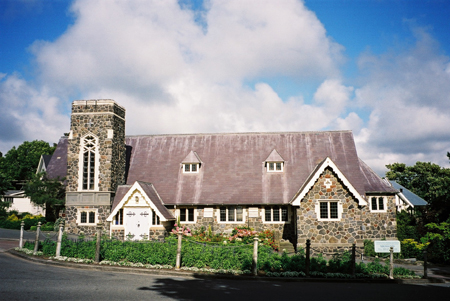
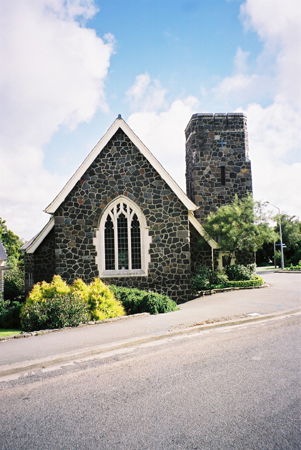
In 1924 a section was purchased in Cashmere to build a Presbyterian church in the hills. Cecil Wood (1878-1947), a Christchurch architect, was commissioned to design this building in 1926. However, the following year the project was taken over by his then partner, R. S. D. Harman (1896-1953), as Wood was travelling overseas. Harman oversaw the construction of the church and designed the woodwork for both the interior and exterior. The communion table and pulpit were carved by Frederick Gurnsey (1868-1953), a well-known Christchurch carver who also created the ornamental carvings on the Bridge of Remembrance. The exterior walls of the church were made from Port Hills basalt randomly interspersed with a mixture of coloured rock. This use of local materials is common to both Wood's and Harman's work. Officially opened in August 1929, it is still used as a church today.
Cashmere Hills Presbyterian Church is important as a fine example of an Arts and Crafts style church and as a centre of Presbyterian worship for almost 80 years.

List Entry Information
Status
Listed
List Entry Status
Historic Place Category 2
Access
Private/No Public Access
List Number
1842
Date Entered
26th November 1981
Date of Effect
26th November 1981
City/District Council
Christchurch City
Region
Canterbury Region
Legal description
Lots 31-36 DP 2668
Status
Listed
List Entry Status
Historic Place Category 2
Access
Private/No Public Access
List Number
1842
Date Entered
26th November 1981
Date of Effect
26th November 1981
City/District Council
Christchurch City
Region
Canterbury Region
Legal description
Lots 31-36 DP 2668
Construction Professional
Name
Gurnsey, Frederick George
Type
Carver
Biography
Frederick George Gurnsey (1868 - 1953) was born in Wales. He was apprenticed to Harry Hems and Company, a leading ecclesiastical carving firm in Exeter, and worked for them once his apprenticeship was complete. Gurnsey visited New Zealand in 1904-1905 and returned in 1907 when he was appointed as an instructor at the Canterbury College School of Art in Christchurch. At the School of Art he taught carving, modelling, casting, enamelling and metalwork, and was the acting director of the school from September 1917 to April 1920. He resigned in 1923 to become a full-time carver. Gurnsey executed thousands of carvings, in both wood and stone, for churches, civic buildings, public monuments and various private commissions. Some of his more prominent carvings include the reredos in the Christchurch cathedral, his work in the Chapel of St Michael and St George, the carvings on the Bridge of Remembrance in Christchurch (1924), those on the Massey Memorial in Wellington (1930), and those in the Church of the Good Shepherd at Tekapo.(1935). During the Depression Gurnsey diversified into making domestic furniture. He has been described as 'one of the greatest European carvers ever to have worked in New Zealand', although due to his personal modesty and the way in which carving falls somewhere between fine arts and craft, his achievements have, until recently, largely been unrecognised. Confident with carving in both wood and stone, Gurnsey was responsible for many beautiful works, particularly in the South Island.
Name
Wood, Cecil Walter
Type
Architect
Biography
Born in Christchurch, Wood (1878-1947) was articled to the local architect Frederick Strouts between 1894 and 1899. He worked for a short time as a draughtsman with the firm Clarkson and Ballantyne before travelling to England in 1901. Here Wood was exposed to a high quality of architectural design in the Edwardian Free Style, and was employed by two leading Edwardian architects Robert Weir Shultz and Leonard Stokes. In 1907 Wood returned to New Zealand to take up partnership with Samuel Hurst Seager. The partnership lasted for only one year for Wood set up his own practice in 1908. The years 1908-1915 were dominated by domestic commissions, but it was also during this time that he began his association with Christ's College, which included such commissions as Hare Memorial Library (1915), the Memorial Dining Hall (1923-5), Jacob's House (1931) and Open Air Classrooms (1932). During the 1920s Wood's practice began to expand and a Georgian influence can be seen in such works as Weston House Park Terrace (1923-4) and Bishopscourt (1926-7). A short lived partnership in 1927 with R S D Harman allowed Wood to travel to the United States while another in 1937 with Paul Pascoe allowed him to travel to England, Europe and the United States without neglecting his practice. During this second trip he made preparations for the design of St Paul's Anglican Cathedral in Wellington, which was erected after his death. During his life Wood had made a substantial contribution to the architecture of Christchurch, having an enthusiasm for both European and American styles.
Name
Harman, Richard Strachan De Renzy
Type
Architect
Biography
Not to be confused with his uncle R.D. Harman of Collins and Harman, Architects, R.S. Harman (1896-1953) was born and educated in Christchurch where he subsequently became one of the city's most competent ecclesiastical and residential architects. He served his articles with the local firm of Seager and Macleod (1914-16) and also attended classes at the Canterbury College School of Art during this time. After service in France during the First World War, he studied at the Royal College of Art, London before returning to New Zealand in 1920 to rejoin Seager's office. Between 1923 and 1926 Harman was once more in London undertaking further study as well as working for the Ancient Monuments Branch of His Majesty's Office of Works. On his return to Christchurch he entered into a short-lived partnership with Cecil Wood before establishing his own practice in 1928. Harman was closely associated with the Anglican Church throughout his career and almost all of his church designs were commissioned by the Anglican dioceses of Canterbury and Nelson. The Church of the Good Shepherd, Tekapo (1935) and St. John's Cathedral, Napier (1953) are among his most well-known ecclesiastical works, although the latter was not erected until after his death. During the late 1940s he worked as the consulting architect for Christchurch Cathedral, designing the Chapel of St Michael and St George in the south transept in 1949 and the reredos behind the High Altar in 1950. Harman was also an active member of the New Zealand Institute of Architects, becoming president of that organisation in 1949.
Construction Details
Start Year
1926
Finish Year
1929
finishYearCirca
Type
Original Construction
Start Year
1960
Finish Year
1961
Type
Addition
Description
West end of church extended and a tower constructed.
Construction Professional
Name
Gurnsey, Frederick George
Type
Carver
Biography
Frederick George Gurnsey (1868 - 1953) was born in Wales. He was apprenticed to Harry Hems and Company, a leading ecclesiastical carving firm in Exeter, and worked for them once his apprenticeship was complete. Gurnsey visited New Zealand in 1904-1905 and returned in 1907 when he was appointed as an instructor at the Canterbury College School of Art in Christchurch. At the School of Art he taught carving, modelling, casting, enamelling and metalwork, and was the acting director of the school from September 1917 to April 1920. He resigned in 1923 to become a full-time carver. Gurnsey executed thousands of carvings, in both wood and stone, for churches, civic buildings, public monuments and various private commissions. Some of his more prominent carvings include the reredos in the Christchurch cathedral, his work in the Chapel of St Michael and St George, the carvings on the Bridge of Remembrance in Christchurch (1924), those on the Massey Memorial in Wellington (1930), and those in the Church of the Good Shepherd at Tekapo.(1935). During the Depression Gurnsey diversified into making domestic furniture. He has been described as 'one of the greatest European carvers ever to have worked in New Zealand', although due to his personal modesty and the way in which carving falls somewhere between fine arts and craft, his achievements have, until recently, largely been unrecognised. Confident with carving in both wood and stone, Gurnsey was responsible for many beautiful works, particularly in the South Island.
Name
Wood, Cecil Walter
Type
Architect
Biography
Born in Christchurch, Wood (1878-1947) was articled to the local architect Frederick Strouts between 1894 and 1899. He worked for a short time as a draughtsman with the firm Clarkson and Ballantyne before travelling to England in 1901. Here Wood was exposed to a high quality of architectural design in the Edwardian Free Style, and was employed by two leading Edwardian architects Robert Weir Shultz and Leonard Stokes. In 1907 Wood returned to New Zealand to take up partnership with Samuel Hurst Seager. The partnership lasted for only one year for Wood set up his own practice in 1908. The years 1908-1915 were dominated by domestic commissions, but it was also during this time that he began his association with Christ's College, which included such commissions as Hare Memorial Library (1915), the Memorial Dining Hall (1923-5), Jacob's House (1931) and Open Air Classrooms (1932). During the 1920s Wood's practice began to expand and a Georgian influence can be seen in such works as Weston House Park Terrace (1923-4) and Bishopscourt (1926-7). A short lived partnership in 1927 with R S D Harman allowed Wood to travel to the United States while another in 1937 with Paul Pascoe allowed him to travel to England, Europe and the United States without neglecting his practice. During this second trip he made preparations for the design of St Paul's Anglican Cathedral in Wellington, which was erected after his death. During his life Wood had made a substantial contribution to the architecture of Christchurch, having an enthusiasm for both European and American styles.
Name
Harman, Richard Strachan De Renzy
Type
Architect
Biography
Not to be confused with his uncle R.D. Harman of Collins and Harman, Architects, R.S. Harman (1896-1953) was born and educated in Christchurch where he subsequently became one of the city's most competent ecclesiastical and residential architects. He served his articles with the local firm of Seager and Macleod (1914-16) and also attended classes at the Canterbury College School of Art during this time. After service in France during the First World War, he studied at the Royal College of Art, London before returning to New Zealand in 1920 to rejoin Seager's office. Between 1923 and 1926 Harman was once more in London undertaking further study as well as working for the Ancient Monuments Branch of His Majesty's Office of Works. On his return to Christchurch he entered into a short-lived partnership with Cecil Wood before establishing his own practice in 1928. Harman was closely associated with the Anglican Church throughout his career and almost all of his church designs were commissioned by the Anglican dioceses of Canterbury and Nelson. The Church of the Good Shepherd, Tekapo (1935) and St. John's Cathedral, Napier (1953) are among his most well-known ecclesiastical works, although the latter was not erected until after his death. During the late 1940s he worked as the consulting architect for Christchurch Cathedral, designing the Chapel of St Michael and St George in the south transept in 1949 and the reredos behind the High Altar in 1950. Harman was also an active member of the New Zealand Institute of Architects, becoming president of that organisation in 1949.
Construction Details
Start Year
1926
Finish Year
1929
finishYearCirca
Type
Original Construction
Start Year
1960
Finish Year
1961
Type
Addition
Description
West end of church extended and a tower constructed.
Historical and Associated Iwi / Hapū / Whānau
Completion Date
15th August 2001
Report Written By
Melanie Lovell-Smith
Information Sources
University of Canterbury
University of Canterbury
Other Information
This place was identified as significant under previous legislation with different information requirements. It remains significant under the current legislation. There is opportunity under our legislation and policies to add to this information. Further information about this place may be available from the Southern Regional Office of Heritage New Zealand Pouhere Taonga. Please note that entry on the New Zealand Heritage List/Rarangi Korero identifies only the heritage values of the property concerned, and should not be construed as advice on the state of the property, or as a comment of its soundness or safety, including in regard to earthquake risk, safety in the event of fire, or insanitary conditions.
Historical and Associated Iwi / Hapū / Whānau
Completion Date
15th August 2001
Report Written By
Melanie Lovell-Smith
Information Sources
University of Canterbury
University of Canterbury
Other Information
This place was identified as significant under previous legislation with different information requirements. It remains significant under the current legislation. There is opportunity under our legislation and policies to add to this information. Further information about this place may be available from the Southern Regional Office of Heritage New Zealand Pouhere Taonga. Please note that entry on the New Zealand Heritage List/Rarangi Korero identifies only the heritage values of the property concerned, and should not be construed as advice on the state of the property, or as a comment of its soundness or safety, including in regard to earthquake risk, safety in the event of fire, or insanitary conditions.
Current Usages
Uses: Religion
Specific Usage: Church
Former Usages
General Usage: Religion
Specific Usage: Church
Web Links
description:
Current Usages
Uses: Religion
Specific Usage: Church
Former Usages
General Usage: Religion
Specific Usage: Church
Web Links
description:
