DonateMembershipVisit Heritage
  • Tūrangawaewae
    Places
  • Tira Māori
    Māori Heritage
  • Poutairangahia
    Archaeology
  • Rauemi
    Resources
  • Mō Tātou
    About Us
  • New Zealand Heritage List
  • Nominate and submit
  • Explore the List
  • National Historic Landmarks
  • Plaques
  • Rainbow List Project
  • Lost heritage
  • Visit Heritage
  • Our properties
  • Turnbull House Project
  • Collections
  • Shop
  • Tohu Whenua
  • Tira Māori
  • Conserving Māori heritage
  • Marae built heritage
  • Māori heritage on the List
  • Hinemihi—Te Hokinga Mai
  • What is archaeology?
  • Is there a site on my property?
  • What are my legal requirements?
  • Affecting an archaeological site
  • Declaring an archaeological site
  • Archaeology FAQs
  • Archaeology Digital Library
  • Archaeology guidelines and templates
  • Resources
  • Funding
  • Publications
  • Sustainable management guides
  • Disaster recovery
  • Podcasts & digital resources
  • Education Hub
  • Conservation plans
  • About
  • Board
  • Māori Heritage Council
  • Senior Staff
  • Offices
  • Contact us
  • Careers
  • Covenants
  • Fast-track
  • Corporate documents
  • Currently consulting on
  • Our submissions
  • News
  • Covid-19 response
Quick links
Rārangi Kōrero | The List
Explore the List
National Historic Landmarks
Ngā Manawhenua o Aotearoa me ōna Kōrero Tūturu
Quick links
Tapuwae
A Vision for Places of Māori Heritage
Funding for Māori Heritage
Resources
Quick links
Archaeological Authority Portal
Applying for an archaeological authority
Archaeology FAQs
Browse the most frequently asked questions about archaeological authorities and the archaeological process.
Quick links
Quick links
News
News Keep up to date with Heritage New Zealand Pouhere Taonga
Membership
Membership Find out more and sign up today
DonateMembershipVisit Heritage
  • Tūrangawaewae
    Places
  • Tira Māori
    Māori Heritage
  • Poutairangahia
    Archaeology
  • Rauemi
    Resources
  • Mō Tātou
    About Us
  • New Zealand Heritage List
  • Nominate and submit
  • Explore the List
  • National Historic Landmarks
  • Plaques
  • Rainbow List Project
  • Lost heritage
  • Visit Heritage
  • Our properties
  • Turnbull House Project
  • Collections
  • Shop
  • Tohu Whenua
  • Tira Māori
  • Conserving Māori heritage
  • Marae built heritage
  • Māori heritage on the List
  • Hinemihi—Te Hokinga Mai
  • What is archaeology?
  • Is there a site on my property?
  • What are my legal requirements?
  • Affecting an archaeological site
  • Declaring an archaeological site
  • Archaeology FAQs
  • Archaeology Digital Library
  • Archaeology guidelines and templates
  • Resources
  • Funding
  • Publications
  • Sustainable management guides
  • Disaster recovery
  • Podcasts & digital resources
  • Education Hub
  • Conservation plans
  • About
  • Board
  • Māori Heritage Council
  • Senior Staff
  • Offices
  • Contact us
  • Careers
  • Covenants
  • Fast-track
  • Corporate documents
  • Currently consulting on
  • Our submissions
  • News
  • Covid-19 response
Quick links
Rārangi Kōrero | The List
Explore the List
National Historic Landmarks
Ngā Manawhenua o Aotearoa me ōna Kōrero Tūturu
Quick links
Tapuwae
A Vision for Places of Māori Heritage
Funding for Māori Heritage
Resources
Quick links
Archaeological Authority Portal
Applying for an archaeological authority
Archaeology FAQs
Browse the most frequently asked questions about archaeological authorities and the archaeological process.
Quick links
Quick links
News
News Keep up to date with Heritage New Zealand Pouhere Taonga
Membership
Membership Find out more and sign up today
  • Places
  • Nominate and submit
  • National Historic Landmarks
  • Places
  • Nominate and submit
  • National Historic Landmarks
  • Tira Māori
  • Conserving Māori heritage
  • Marae built heritage
  • Tira Māori
  • Conserving Māori heritage
  • Marae built heritage
  • Archaeological authorities
  • Archaeology Digital Library
  • Archaeological authorities
  • Archaeology Digital Library
  • All resources
  • Publications
  • Funding
  • All resources
  • Publications
  • Funding
  • FAQs
  • FAQs
Follow us on:
Places
  • Places
  • Nominate and submit
  • National Historic Landmarks
Tira Māori
  • Tira Māori
  • Conserving Māori heritage
  • Marae built heritage
Archaeology
  • Archaeological authorities
  • Archaeology Digital Library
Resources
  • All resources
  • Publications
  • Funding
FAQs
  • FAQs
Follow us on
HomePrivacyTerms and conditionsAbout this site
© Heritage New Zealand Pouhere Taonga 2026.
 
Queen Victoria Statue

Victoria Square, CHRISTCHURCH

Public

Historic Place Category 2

List No. 1916
Quick links:
List GalleryLocationDetails
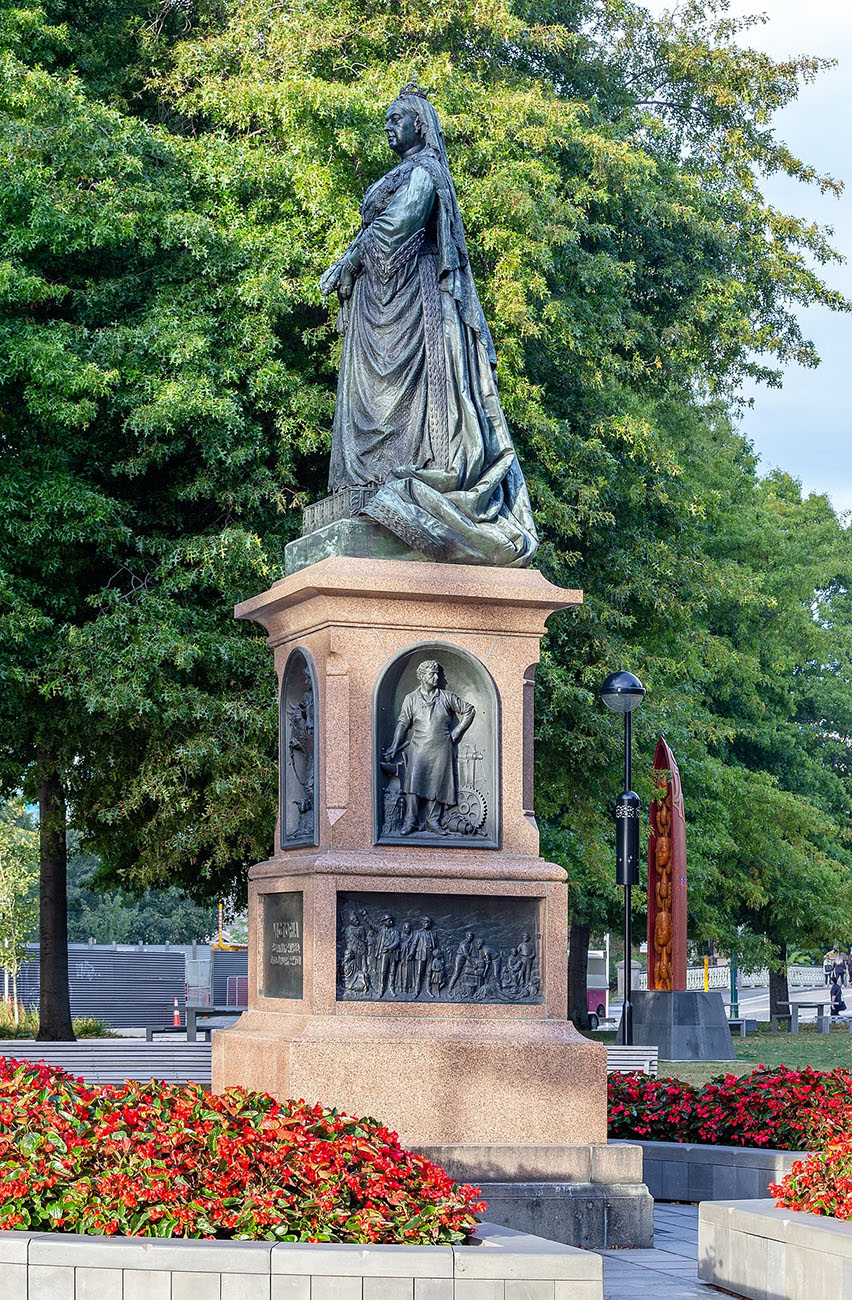
The idea of erecting a statue to Queen Victoria in Christchurch was first considered as part of Canterbury Province's jubilee celebrations of 1900. The Mayor of Christchurch, William Reece, called for a monument that would commemorate not just the Queen, but also the Pakeha settlement of Canterbury, local industries and the soldiers fighting in the South African (Boer) War. In August of 1900 it was agreed that the Jubilee Memorial Committee should commission such a monument and the committee began looking for a suitable sculptor.

The Jubilee Memorial Committee agreed, on 11 January 1901, that a statue should be commissioned from British sculptor Francis John Williamson (1833-1920). Williamson had recently completed a statue of Queen Victoria for the City of Auckland (erected in Albert Park) and his effigy of Bishop Harper, in ChristChurch Cathedral had been well received in Christchurch. Williamson promoted himself as 'the Queen's Sculptor'. His 1887 statue of Queen Victoria for the Royal College of Surgeons in London was described by the Prince of Wales as 'the best portrait ever executed' of her.

Twelve days after the Committee agreed to approach Williamson Queen Victoria died, an event which lent some urgency to the commission. As the chairman of the committee, Henry Wigram, pointed out, the Queen's death was likely to lead to a significant number of statues being ordered. It was decided, after some discussion, to erect the statue in Market Square, which would be renamed Victoria Square at the unveiling in 1903. The foundation stone was laid by the Duke of Cornwall and York in June 1901, but the statue did not arrive in New Zealand until January 1903. This delay was caused by the large number of statues, including many of Queen Victoria, awaiting casting in Britain. When the statue did arrive it only had one of its six bronze relief panels: the one giving the dates of Queen Victoria's birth and death.

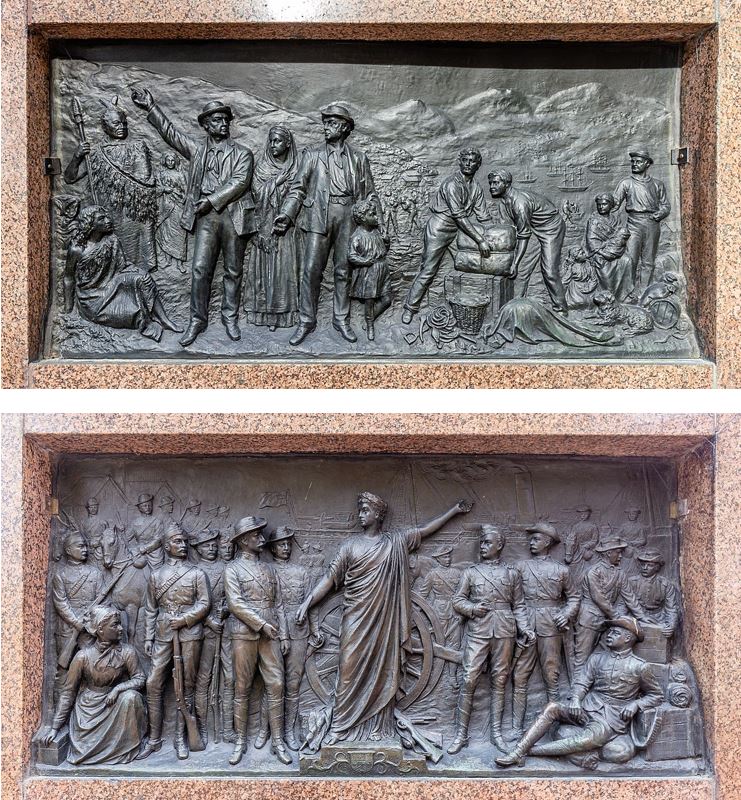
Despite the missing panels, speakers at the unveiling referred to the importance of the memorial as a example of colonial patriotism and as a tool to inform future generations about the struggles and successes of the early colonists, the importance of arts and industries and the 'grand free system of education' established in New Zealand. A second unveiling of the statue, complete with all six panels, took place the following year, 1904. At this time people's attention centred upon the roll of honour, which commemorated the Canterbury dead from the South African War.

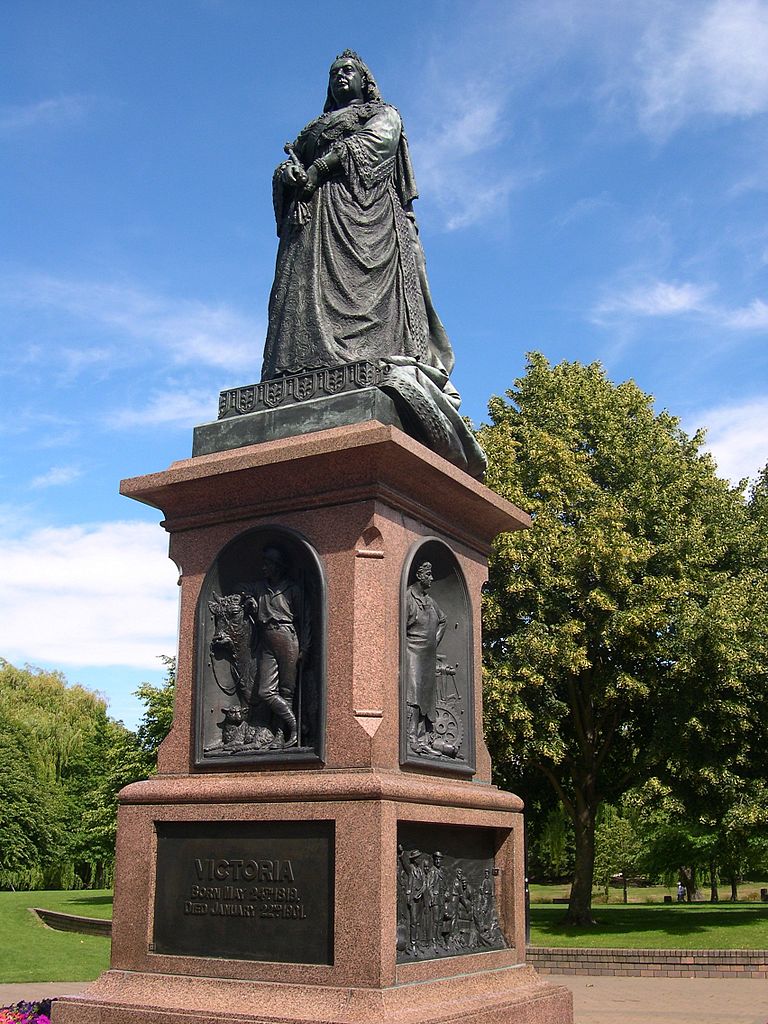
The Christchurch statue is very similar to the one Williamson sculpted for Auckland, apart from its size (it was considerably larger) and the fact that the Queen is portrayed holding a sceptre rather than a handkerchief and fan. Both the statues resemble Williamson's 1887 statue of Queen Victoria for the Royal College of Surgeons. The six bronze relief panels of the Christchurch statue were adapted by Williamson from earlier drawings by Charles Kidson, a teacher at the Canterbury College School of Art. Kidson's sketches had illustrated 'Typical Forms of Industries', 'The Pioneers', 'Canterbury Sending Forth her Rough Riders' and a roll of honour. Williamson separated the 'Typical Forms of Industries' into four separate relief panels: 'Manufacture', 'Education', 'Agriculture' and 'Pastoralism', and changed 'The Pioneers' to an illustration of the colonists arriving in Lyttelton.

The statue of Queen Victoria is one of four such erected in the four main centres in New Zealand, and the second to be commissioned. It is significant as a memorial to Queen Victoria and to the Pakeha settlers of Canterbury, and also as a South African War memorial. As a memorial to Queen Victoria it is part of an imperial phenomenon that resulted in statues of her being erected throughout the British Empire. It is locally important as one of the landmarks of Victoria Square. In terms of Williamson's work, the bronze reliefs show 'a robust late Victorian realism', which counters the general interpretation of his work as conservative and neo-classical in style.
Queen Victoria Statue, Christchurch. CC BY-SA 2.0 Image courtesy of commons.wikimedia.org | John Steedman | 27/12/2007 | John Steedman - Wikimedia Commons
Queen Victoria Statue, Christchurch. CC BY-SA 4.0 Image courtesy of commons.wikimedia.org | Michal Klajban | 28/02/2020 | Michal Klajban - Wikimedia Commons
Queen Victoria Statue, Christchurch. Plaques. CC BY-SA 4.0 Image courtesy of commons.wikimedia.org | Michal Klajban | 12/04/2020 | Michal Klajban - Wikimedia Commons
Queen Victoria Statue, Christchurch. CC BY-SA 2.0 Image courtesy of commons.wikimedia.org | John Steedman | 27/12/2007 | John Steedman - Wikimedia Commons
Queen Victoria Statue, Christchurch. CC BY-SA 4.0 Image courtesy of commons.wikimedia.org | Michal Klajban | 28/02/2020 | Michal Klajban - Wikimedia Commons
Queen Victoria Statue, Christchurch. Plaques. CC BY-SA 4.0 Image courtesy of commons.wikimedia.org | Michal Klajban | 12/04/2020 | Michal Klajban - Wikimedia Commons

List Entry Information

Overview

Status
Listed

List Entry Status
Historic Place Category 2

Access
Able to Visit

List Number
1916

Date Entered
26th November 1981

Date of Effect
26th November 1981

City/District Council
Christchurch City

Region
Canterbury Region

Legal description

Sec 1218 Town of Christchurch (RT CB29F/300), Canterbury Land District

Detailed List Entry

Construction Professional

Name

Williamson, Francis John

Type

Sculptor

Biography

Williamson (1833-1920) was educated at Hampstead, London. He became a pupil of the sculptor John Henry Foley (1818-74) and subsequently assisted Foley for some twenty years. He then returned to Surrey where he worked until his death in 1920. Williamson exhibited his sculpture in London's leading galleries, particularly the Royal Academy, from 1853 to 1897. He was renowned for his portrait studies and became the Queen's sculptor, and by command he sculpted ten statues of members of the Royal Family between 1878 and 1897. He generally worked in marble and was responsible for the design of the Sir George Grey statue at Albert Park, Auckland (1904).

Construction Details

Start Year

1901

Finish Year

1903

Type

Original Construction

Description

Unveiled 24 May 1903

Start Year

1903

Type

Other

Description

Unveiled again April 1904 with all six bronze panels in place

Start Year

1989

Type

Relocation

Description

Moved from near Armagh Street bridge to current position near the corner of Armagh and Colombo Streets, Christchurch

Reference

Completion Date

15th August 2001

Report Written By

Melanie Lovell-Smith

Information Sources

Bulletin of New Zealand Art History

Bulletin of New Zealand Art History

Report Written By

This place was identified as significant under previous legislation with different information requirements. It remains significant under the current legislation. There is opportunity under our legislation and policies to add to this information. Further information about this place may be available from the Southern Regional Office of Heritage New Zealand Pouhere Taonga. Please note that entry on the New Zealand Heritage List/Rarangi Korero identifies only the heritage values of the property concerned, and should not be construed as advice on the state of the property, or as a comment of its soundness or safety, including in regard to earthquake risk, safety in the event of fire, or insanitary conditions.

Further Information

Current Usages

Uses: Civic Facilities

Specific Usage: Statue/public art

Uses: Commemoration

Specific Usage: Memorial - Particular person or group

Uses: Commemoration

Specific Usage: Memorial - South African War

Former Usages

General Usage:: Civic Facilities

Specific Usage: Statue/public art

General Usage:: Commemoration

Specific Usage: Memorial - Particular person or group

General Usage:: Commemoration

Specific Usage: Memorial - South African War

Themes

War Memorial

Web Links

Overview

Status

Listed

List Entry Status

Historic Place Category 2

Access

Able to Visit

List Number

1916

Date Entered

26th November 1981

Date of Effect

26th November 1981

City/District Council

Christchurch City

Region

Canterbury Region

Legal description

Sec 1218 Town of Christchurch (RT CB29F/300), Canterbury Land District

Status

Listed

List Entry Status

Historic Place Category 2

Access

Able to Visit

List Number

1916

Date Entered

26th November 1981

Date of Effect

26th November 1981

City/District Council

Christchurch City

Region

Canterbury Region

Legal description

Sec 1218 Town of Christchurch (RT CB29F/300), Canterbury Land District

Construction Information

Construction Professional

Name

Williamson, Francis John

Type

Sculptor

Biography

Williamson (1833-1920) was educated at Hampstead, London. He became a pupil of the sculptor John Henry Foley (1818-74) and subsequently assisted Foley for some twenty years. He then returned to Surrey where he worked until his death in 1920. Williamson exhibited his sculpture in London's leading galleries, particularly the Royal Academy, from 1853 to 1897. He was renowned for his portrait studies and became the Queen's sculptor, and by command he sculpted ten statues of members of the Royal Family between 1878 and 1897. He generally worked in marble and was responsible for the design of the Sir George Grey statue at Albert Park, Auckland (1904).

Construction Details

Start Year

1901

Finish Year

1903

Type

Original Construction

Description

Unveiled 24 May 1903

Start Year

1903

Type

Other

Description

Unveiled again April 1904 with all six bronze panels in place

Start Year

1989

Type

Relocation

Description

Moved from near Armagh Street bridge to current position near the corner of Armagh and Colombo Streets, Christchurch

Construction Professional

Name

Williamson, Francis John

Type

Sculptor

Biography

Williamson (1833-1920) was educated at Hampstead, London. He became a pupil of the sculptor John Henry Foley (1818-74) and subsequently assisted Foley for some twenty years. He then returned to Surrey where he worked until his death in 1920. Williamson exhibited his sculpture in London's leading galleries, particularly the Royal Academy, from 1853 to 1897. He was renowned for his portrait studies and became the Queen's sculptor, and by command he sculpted ten statues of members of the Royal Family between 1878 and 1897. He generally worked in marble and was responsible for the design of the Sir George Grey statue at Albert Park, Auckland (1904).

Construction Details

Start Year

1901

Finish Year

1903

Type

Original Construction

Description

Unveiled 24 May 1903

Start Year

1903

Type

Other

Description

Unveiled again April 1904 with all six bronze panels in place

Start Year

1989

Type

Relocation

Description

Moved from near Armagh Street bridge to current position near the corner of Armagh and Colombo Streets, Christchurch

Reference

Historical and Associated Iwi / Hapū / Whānau

Completion Date

15th August 2001

Report Written By

Melanie Lovell-Smith

Information Sources

Bulletin of New Zealand Art History

Bulletin of New Zealand Art History

Other Information

This place was identified as significant under previous legislation with different information requirements. It remains significant under the current legislation. There is opportunity under our legislation and policies to add to this information. Further information about this place may be available from the Southern Regional Office of Heritage New Zealand Pouhere Taonga. Please note that entry on the New Zealand Heritage List/Rarangi Korero identifies only the heritage values of the property concerned, and should not be construed as advice on the state of the property, or as a comment of its soundness or safety, including in regard to earthquake risk, safety in the event of fire, or insanitary conditions.

Historical and Associated Iwi / Hapū / Whānau

Completion Date

15th August 2001

Report Written By

Melanie Lovell-Smith

Information Sources

Bulletin of New Zealand Art History

Bulletin of New Zealand Art History

Other Information

This place was identified as significant under previous legislation with different information requirements. It remains significant under the current legislation. There is opportunity under our legislation and policies to add to this information. Further information about this place may be available from the Southern Regional Office of Heritage New Zealand Pouhere Taonga. Please note that entry on the New Zealand Heritage List/Rarangi Korero identifies only the heritage values of the property concerned, and should not be construed as advice on the state of the property, or as a comment of its soundness or safety, including in regard to earthquake risk, safety in the event of fire, or insanitary conditions.

Further Information

Current Usages

Uses: Civic Facilities

Specific Usage: Statue/public art

Uses: Commemoration

Specific Usage: Memorial - Particular person or group

Uses: Commemoration

Specific Usage: Memorial - South African War

Former Usages

General Usage: Civic Facilities

Specific Usage: Statue/public art

General Usage: Commemoration

Specific Usage: Memorial - Particular person or group

General Usage: Commemoration

Specific Usage: Memorial - South African War

Themes

War Memorial

Current Usages

Uses: Civic Facilities

Specific Usage: Statue/public art

Uses: Commemoration

Specific Usage: Memorial - Particular person or group

Uses: Commemoration

Specific Usage: Memorial - South African War

Former Usages

General Usage: Civic Facilities

Specific Usage: Statue/public art

General Usage: Commemoration

Specific Usage: Memorial - Particular person or group

General Usage: Commemoration

Specific Usage: Memorial - South African War

Themes

War Memorial

Location

Loading
Related listings
Arthur's Stone, Waimate North Road, Kerikeri
Arthur's Stone
Arthur's Stone, Waimate North Road, Kerikeri
Arthur's Stone
Stay up to date with Heritage this month