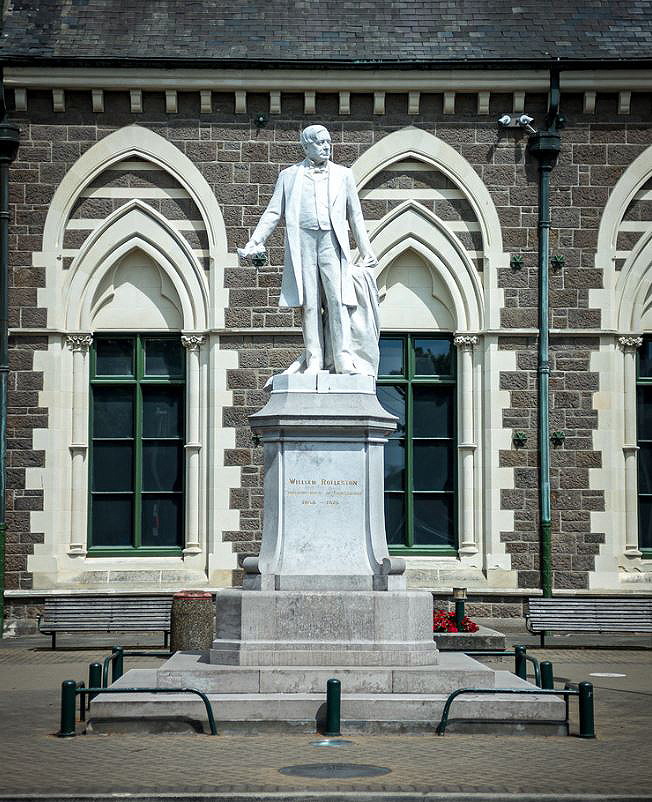
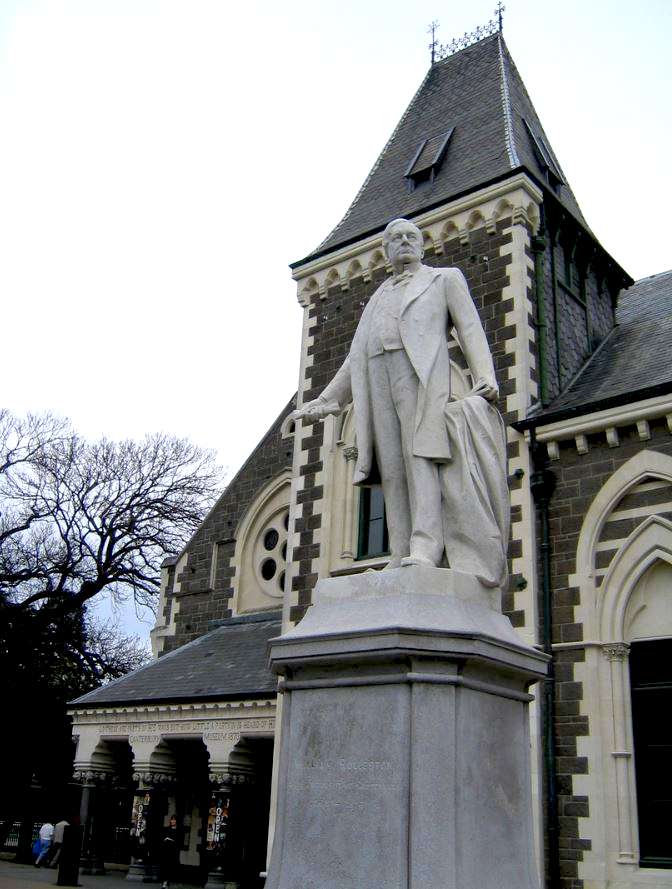
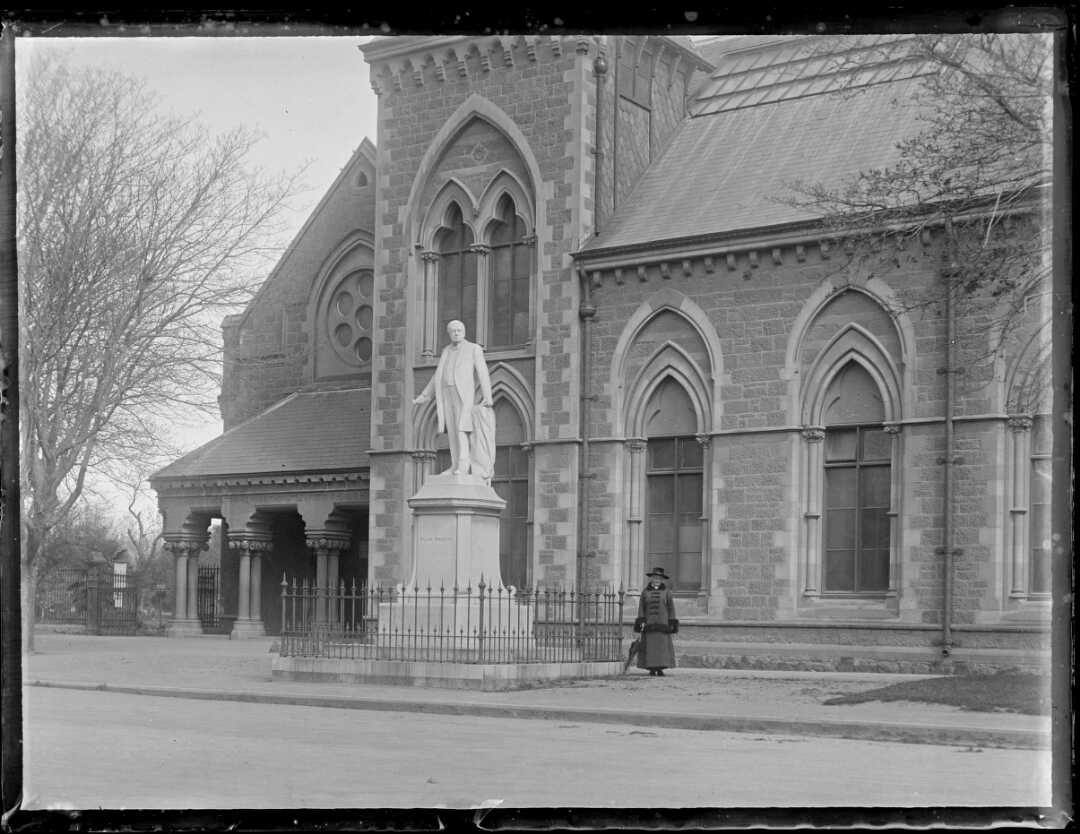
The statue of Rolleston was sculpted by an English sculptor, Herbert Hampton, and cost £1,000. Unveiled in May 1906, its position outside the Canterbury Museum acknowledges Rolleston's role in the museum's establishment.
This statue is one of three that commemorate superintendents of Canterbury. (The other two are the statues of J.F. Fitzgerald and William Moorhouse - both also in Rolleston Avenue.) It forms an important part of the historical townscape around the Museum and the Christchurch Arts Centre.
List Entry Information
Status
Listed
List Entry Status
Historic Place Category 2
Access
Private/No Public Access
List Number
1946
Date Entered
26th November 1981
Date of Effect
26th November 1981
City/District Council
Christchurch City
Region
Canterbury Region
Legal description
Road reserve adjacent to Pt Res 25, Canterbury Land District
Status
Listed
List Entry Status
Historic Place Category 2
Access
Private/No Public Access
List Number
1946
Date Entered
26th November 1981
Date of Effect
26th November 1981
City/District Council
Christchurch City
Region
Canterbury Region
Legal description
Road reserve adjacent to Pt Res 25, Canterbury Land District
Construction Professional
Name
Hampton, Herbert
Type
Sculptor
Biography
British sculptor and artist Herbert Hampton (1862-1929) was educated at Cardiff School of Art, Lambeth School of Art, Westminster School of Art, the Slade and then the Académies Julien and Colarossi, Paris. He exhibited 55 sculptures at the Royal Academy between 1889 and 1927. He was known as a successful creator of public memorials – he created six statues of Queen Victoria, one of Edward VII and one of King George. His two New Zealand works are the Queen Victoria statue in Dunedin, and the statue of William Rolleston (List No. 1946, Category 2) in Christchurch.
Construction Details
Start Year
1905
Finish Year
1906
Type
Original Construction
Construction Professional
Name
Hampton, Herbert
Type
Sculptor
Biography
British sculptor and artist Herbert Hampton (1862-1929) was educated at Cardiff School of Art, Lambeth School of Art, Westminster School of Art, the Slade and then the Académies Julien and Colarossi, Paris. He exhibited 55 sculptures at the Royal Academy between 1889 and 1927. He was known as a successful creator of public memorials – he created six statues of Queen Victoria, one of Edward VII and one of King George. His two New Zealand works are the Queen Victoria statue in Dunedin, and the statue of William Rolleston (List No. 1946, Category 2) in Christchurch.
Construction Details
Start Year
1905
Finish Year
1906
Type
Original Construction
Historical and Associated Iwi / Hapū / Whānau
Completion Date
15th August 2001
Report Written By
Melanie Lovell-Smith
Information Sources
Rice, 1999
Geoffrey W. Rice, Christchurch Changing: An Illustrated History, Christchurch, 1999
Other Information
This place was identified as significant under previous legislation with different information requirements. It remains significant under the current legislation. There is opportunity under our legislation and policies to add to this information. Further information about this place may be available from the Southern Regional Office of Heritage New Zealand Pouhere Taonga. Please note that entry on the New Zealand Heritage List/Rarangi Korero identifies only the heritage values of the property concerned, and should not be construed as advice on the state of the property, or as a comment of its soundness or safety, including in regard to earthquake risk, safety in the event of fire, or insanitary conditions.
Historical and Associated Iwi / Hapū / Whānau
Completion Date
15th August 2001
Report Written By
Melanie Lovell-Smith
Information Sources
Rice, 1999
Geoffrey W. Rice, Christchurch Changing: An Illustrated History, Christchurch, 1999
Other Information
This place was identified as significant under previous legislation with different information requirements. It remains significant under the current legislation. There is opportunity under our legislation and policies to add to this information. Further information about this place may be available from the Southern Regional Office of Heritage New Zealand Pouhere Taonga. Please note that entry on the New Zealand Heritage List/Rarangi Korero identifies only the heritage values of the property concerned, and should not be construed as advice on the state of the property, or as a comment of its soundness or safety, including in regard to earthquake risk, safety in the event of fire, or insanitary conditions.
Current Usages
Uses: Civic Facilities
Specific Usage: Statue/public art
Uses: Commemoration
Specific Usage: Memorial - Particular person or group
Former Usages
General Usage: Civic Facilities
Specific Usage: Statue/public art
General Usage: Commemoration
Specific Usage: Memorial - Particular person or group
Current Usages
Uses: Civic Facilities
Specific Usage: Statue/public art
Uses: Commemoration
Specific Usage: Memorial - Particular person or group
Former Usages
General Usage: Civic Facilities
Specific Usage: Statue/public art
General Usage: Commemoration
Specific Usage: Memorial - Particular person or group