

In 1916 the Parish Priest, Father James MacManus procured conceptual plans for a new church from J. T. Mannix, an architect based in New Plymouth. Mannix's plans, for which he would only accept £5, were unanimously adopted by the Parish Committee. By 1920 the Committee had raised the £7000 necessary to purchase the centrally placed site on which the Cathedral was to be erected. Formerly the property of a Mr Greer, the land was considered ideal as it came with a house suitable for use as a presbytery. Two years later Mannix completed more detailed plans of the Cathedral with the assistance of the Wellington-based architectural firm Clere & Williams, a firm established by eminent New Zealand architect Frederick de Jersey Clere (1856-1952). Trevor Bros Ltd won the tender to erect the church and construction commenced in 1923 in conjunction with Clere's new architectural firm Clere & Clere.
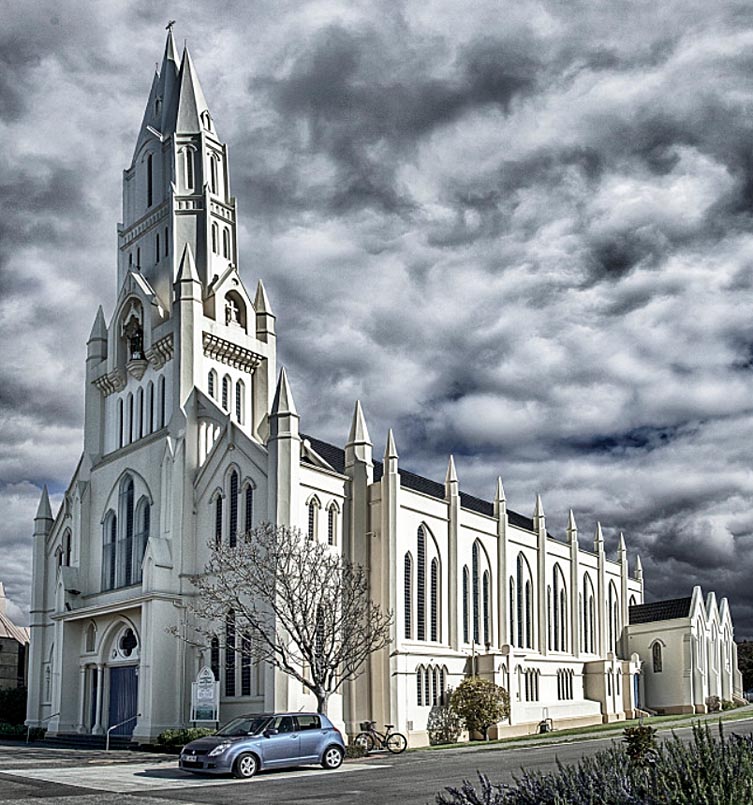
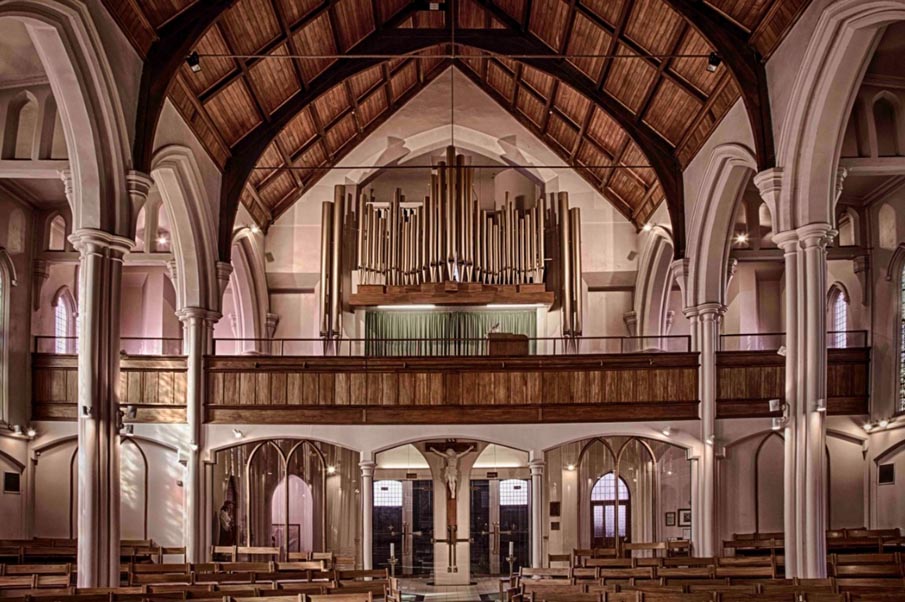
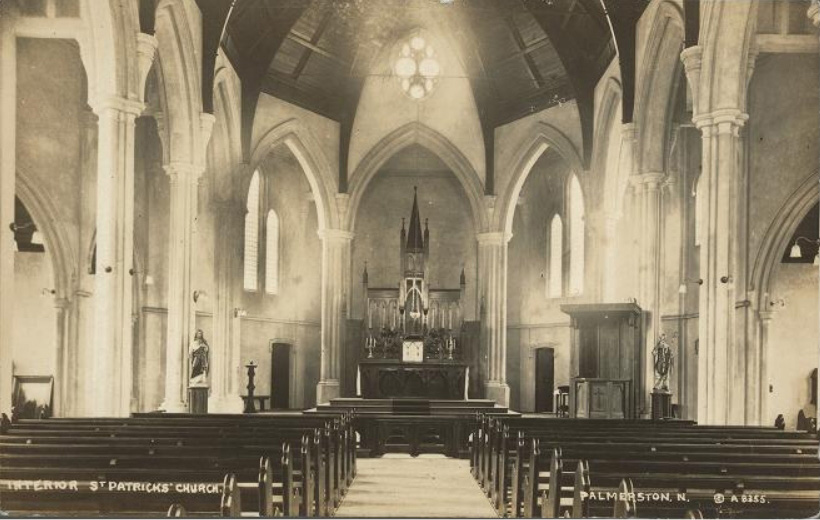
In 1925 Bishop Francis William Redwood (1839-1935) opened the new 'St Patrick's Church'. Completed at the cost of £43,845, the building was composed almost entirely from reinforced concrete, a material for whose use Frederick de Jersey Clere is renowned. Designed to seat between 1050 and 1100 persons, St Patrick's was 53 metres long (175 feet) and 19 metres wide (62 feet). A striking tower that rose 49 metres (159 feet) above the pavement dominated the front of the church. Incorporated into the tower was a painted, metal statue of St Patrick. The interior of the Gothic style church featured an arched roof supported by 14 fluted, white concrete columns designed to create an atmosphere of 'majesty and power'. The stark, white concrete finish of the walls was relieved overhead by polished timber panelling. Described as a 'magnificent building' by the local paper, the lofty structure was a mastery of structural engineering and design.
In 1980 a new Catholic diocese, the Diocese of Palmerston North was created. As was predicted 56 years earlier, St Patrick's Church was chosen as the seat for the Diocese's new Bishop, Peter Cullinane. Eight years later the interior layout of the building was altered to reflect the new status of the structure and to incorporate the changing approach taken to the liturgy after the Second Vatican Council (1963-1965). The building was then rededicated as the Cathedral of the Holy Spirit. It serves as the focal point of the Diocese and is designed to be an affirmation and reflection of the spiritual power of the bishop. The Cathedral remains a strong centre of the Catholic faith and is highly regarded by the local community.
The Cathedral of the Holy Spirit has strong spiritual significance as a long-standing place of worship and as the Cathedral of the Diocese of Palmerston North. It is the centre of Catholic worship in the area and is a continuing symbol of the strength of the Catholic faith in the Diocese. The building has architectural importance as an example of the work of the eminent New Zealand architect, Frederick de Jersey Clere, a noted expert and pioneer in the use of reinforced concrete. The building has significant technological value as an example of a reinforced, concrete building and exhibits the structural engineering skills of the firm Clere & Clere. The centrally-located structure has considerable aesthetic appeal and its spire is a landmark in the flat, urban area of Palmerston North.
List Entry Information
Status
Listed
List Entry Status
Historic Place Category 1
Access
Private/No Public Access
List Number
195
Date Entered
28th June 1990
Date of Effect
28th June 1990
City/District Council
Palmerston North City
Region
Horizons (Manawatū-Whanganui) Region
Legal description
Pt Lot 3 DP 2334 (RT WN23B/989), Wellington Land District
Status
Listed
List Entry Status
Historic Place Category 1
Access
Private/No Public Access
List Number
195
Date Entered
28th June 1990
Date of Effect
28th June 1990
City/District Council
Palmerston North City
Region
Horizons (Manawatū-Whanganui) Region
Legal description
Pt Lot 3 DP 2334 (RT WN23B/989), Wellington Land District
Why is this place significant?
Historic Significance
Historical Significance or Value The Cathedral of the Holy Spirit has historical associations with Palmerston North dating back to 1875 when the Parish of St Patrick was established. While the former St Patrick's Church (1890-1925) was important at a local level, the present building has regional significance because of its status as the Cathedral of the Diocese of Palmerston North.
Physical Significance
ARCHITECTURAL QUALITY: The Cathedral of the Holy Spirit is a late product of Gothic Revival architecture and shows the continuing vitality of that movement well into the twentieth century. With Clere's other famous late Gothic design, St Mary of the Angels, Wellington (1922), it is a technically important and significant example of the adaptation of modern building techniques to a traditional design. It remains a striking landmark in Palmerston North. TOWNSCAPE/LANDMARK VALUE: Situated a short distance from the city centre, the Cathedral spire is a landmark from all directions. Its height and its Gothic form dominate the flat, surrounding townscape.
Why is this place significant?
Historic Significance
Historical Significance or Value The Cathedral of the Holy Spirit has historical associations with Palmerston North dating back to 1875 when the Parish of St Patrick was established. While the former St Patrick's Church (1890-1925) was important at a local level, the present building has regional significance because of its status as the Cathedral of the Diocese of Palmerston North.
Physical Significance
ARCHITECTURAL QUALITY: The Cathedral of the Holy Spirit is a late product of Gothic Revival architecture and shows the continuing vitality of that movement well into the twentieth century. With Clere's other famous late Gothic design, St Mary of the Angels, Wellington (1922), it is a technically important and significant example of the adaptation of modern building techniques to a traditional design. It remains a striking landmark in Palmerston North. TOWNSCAPE/LANDMARK VALUE: Situated a short distance from the city centre, the Cathedral spire is a landmark from all directions. Its height and its Gothic form dominate the flat, surrounding townscape.
Construction Professional
Name
Clere, Frederick De Jersey
Type
Architect
Biography
Clere (1856-1952) was born in Lancashire, the son of an Anglican clergyman, and was articled to Edmund Scott, an ecclesiastical architect of Brighton. He then became chief assistant to R J Withers, a London architect. Clere came to New Zealand in 1877, practising first in Feilding and then in Wanganui. He later came to Wellington and practised there for 58 years. He was elected a Fellow of the Royal Institute of British Architects in 1886 and held office for 50 years as one of four honorary secretaries in the Empire. In 1883 he was appointed Diocesan Architect of the Anglican Church; he designed more than 100 churches while he held this position. Clere was a pioneer in reinforced concrete construction; the outstanding example of his work with this material is the Church of St Mary of the Angels (1922), Wellington. As well as being pre-eminent in church design, Clere was responsible for many domestic and commercial buildings including Wellington's Harbour Board Offices and Bond Store (1891) and Overton in Marton. Clere was also involved in the design of large woolsheds in Hawkes Bay and Wairarapa. He was active in the formation of the New Zealand Institute of Architects and served on their council for many years. He was a member of the Wellington City Council until 1895, and from 1900 a member of the Wellington Diocesan Synod and the General Synod. He was also a member of the New Zealand Academy of Fine Arts.
Construction Details
Start Year
1923
Finish Year
1925
Type
Original Construction
Description
May 1923 - March 1925
Start Year
1931
Type
Addition
Description
Organ installed
Start Year
1935
Type
Other
Description
Organ destroyed during a storm
Start Year
1962
Type
Other
Description
Exterior of the church weatherproofed; minor changes to pulpit and confessionals
Start Year
1963
Type
Addition
Description
Foundation strengthened; marble altar installed
Start Year
1978
Type
Modification
Description
New pipe organ installed
Start Year
1988
Type
Modification
Description
Memorial altar moved forward and day chapel created in space behind altar; alterations to seating arrangements
Start Year
1991
Type
Other
Description
Organ rebuilt and expanded
Start Year
2001
Type
Addition
Description
Gathering area and lounge constructed adjacent to the Cathedral
Construction Materials
Constructed from reinforced concrete, the building features a decramastic-tiled roof and interior panelling in polished timber.
Notable Features
James MacManus Memorial Altar 25 carvings by Maori from the 6 iwi in the diocese The 10 stained glass windows in the nave walls depicting the 10 parables of Jesus that were designed by F. X. Zettler, Munich The stained glass windows in the day chapel depicting Christ the King and Mary Queen of Heaven that were designed by Harry Clark Studios, Dublin -
Construction Professional
Name
Clere, Frederick De Jersey
Type
Architect
Biography
Clere (1856-1952) was born in Lancashire, the son of an Anglican clergyman, and was articled to Edmund Scott, an ecclesiastical architect of Brighton. He then became chief assistant to R J Withers, a London architect. Clere came to New Zealand in 1877, practising first in Feilding and then in Wanganui. He later came to Wellington and practised there for 58 years. He was elected a Fellow of the Royal Institute of British Architects in 1886 and held office for 50 years as one of four honorary secretaries in the Empire. In 1883 he was appointed Diocesan Architect of the Anglican Church; he designed more than 100 churches while he held this position. Clere was a pioneer in reinforced concrete construction; the outstanding example of his work with this material is the Church of St Mary of the Angels (1922), Wellington. As well as being pre-eminent in church design, Clere was responsible for many domestic and commercial buildings including Wellington's Harbour Board Offices and Bond Store (1891) and Overton in Marton. Clere was also involved in the design of large woolsheds in Hawkes Bay and Wairarapa. He was active in the formation of the New Zealand Institute of Architects and served on their council for many years. He was a member of the Wellington City Council until 1895, and from 1900 a member of the Wellington Diocesan Synod and the General Synod. He was also a member of the New Zealand Academy of Fine Arts.
Construction Details
Start Year
1923
Finish Year
1925
Type
Original Construction
Description
May 1923 - March 1925
Start Year
1931
Type
Addition
Description
Organ installed
Start Year
1935
Type
Other
Description
Organ destroyed during a storm
Start Year
1962
Type
Other
Description
Exterior of the church weatherproofed; minor changes to pulpit and confessionals
Start Year
1963
Type
Addition
Description
Foundation strengthened; marble altar installed
Start Year
1978
Type
Modification
Description
New pipe organ installed
Start Year
1988
Type
Modification
Description
Memorial altar moved forward and day chapel created in space behind altar; alterations to seating arrangements
Start Year
1991
Type
Other
Description
Organ rebuilt and expanded
Start Year
2001
Type
Addition
Description
Gathering area and lounge constructed adjacent to the Cathedral
Construction Materials
Constructed from reinforced concrete, the building features a decramastic-tiled roof and interior panelling in polished timber.
Notable Features
James MacManus Memorial Altar 25 carvings by Maori from the 6 iwi in the diocese The 10 stained glass windows in the nave walls depicting the 10 parables of Jesus that were designed by F. X. Zettler, Munich The stained glass windows in the day chapel depicting Christ the King and Mary Queen of Heaven that were designed by Harry Clark Studios, Dublin -
The first Catholic Mass in Palmerston North was celebrated in a surveyor's office, St Patrick's Day 1872. The congregation grew rapidly and in 1875 a small building was erected to serve as a schoolroom and church. The second Catholic Church to serve Palmerston North was known as St Patrick's Church and was built in 1890. By 1913 a larger Church was needed and fundraising began. The first design for the new Church was put forward in 1914 and in June 1916 J.T. Mannix submitted a conceptual design which was accepted by the parish committee. While the contract drawings (November 1922) denote Clere and Williams as being joint architects with J.T. Mannix, the tender notices (March 1923) specify Clere and Clere. The site in Broad Street (Broadway Avenue) was purchased in 1920 and work began in May 1923. The parish priest from 1913-62, Father J.F. MacManus, was a driving force behind the building of the Church and was appointed Clerk of Works in that year. The foundation stone was laid by Archbishop Redwood on 17 February 1924 and the opening ceremony was performed, also by Archbishop Redwood, on 22 March 1925. Palmerston North became a diocese on 23 April 1980 and the Church was elevated to cathedral status. Following recent reordering and renovation, the cathedral was dedicated on 9 December 1988 and renamed the Cathedral of the Holy Spirit.
The first Catholic Mass in Palmerston North was celebrated in a surveyor's office, St Patrick's Day 1872. The congregation grew rapidly and in 1875 a small building was erected to serve as a schoolroom and church. The second Catholic Church to serve Palmerston North was known as St Patrick's Church and was built in 1890. By 1913 a larger Church was needed and fundraising began. The first design for the new Church was put forward in 1914 and in June 1916 J.T. Mannix submitted a conceptual design which was accepted by the parish committee. While the contract drawings (November 1922) denote Clere and Williams as being joint architects with J.T. Mannix, the tender notices (March 1923) specify Clere and Clere. The site in Broad Street (Broadway Avenue) was purchased in 1920 and work began in May 1923. The parish priest from 1913-62, Father J.F. MacManus, was a driving force behind the building of the Church and was appointed Clerk of Works in that year. The foundation stone was laid by Archbishop Redwood on 17 February 1924 and the opening ceremony was performed, also by Archbishop Redwood, on 22 March 1925. Palmerston North became a diocese on 23 April 1980 and the Church was elevated to cathedral status. Following recent reordering and renovation, the cathedral was dedicated on 9 December 1988 and renamed the Cathedral of the Holy Spirit.
ARCHITECTURAL DESCRIPTION: The Cathedral of the Holy Spirit is a large building in the style of the Gothic Revival. It is dominated by a highly decorative, tall spire which has three terminals near its apex. Constructed in reinforced concrete, Gothic elements in the building are purely ornamental and relatively abstracted and include the lancet window, the pointed arch and the pinnacle. The east and west facades are symmetrical about the central axis. The north and south facades have six similar bays, each with three lancet windows set within a pointed arch. There are transepts at the east end with three small gables incorporating a confessional, a private chapel, a lady chapel and other spaces for small gatherings. The nave features a series of fourteen structural columns attached to members which have the appearance of flying buttresses. The columns support pointed arches. The arch form is repeated in the timber rafters of the roof structure. MODIFICATIONS: 1963 - Foundations strengthened to support a new marble altar. 1960s - Weatherproofing of exterior. Alterations to pulpit and confessionals. 1988 - Reordering and complete renovation. (Sanctuary moved forward (west) and a morning chapel built behind (east of) the marble altar. Pews placed diagonally to create a centralised plan).
ARCHITECTURAL DESCRIPTION: The Cathedral of the Holy Spirit is a large building in the style of the Gothic Revival. It is dominated by a highly decorative, tall spire which has three terminals near its apex. Constructed in reinforced concrete, Gothic elements in the building are purely ornamental and relatively abstracted and include the lancet window, the pointed arch and the pinnacle. The east and west facades are symmetrical about the central axis. The north and south facades have six similar bays, each with three lancet windows set within a pointed arch. There are transepts at the east end with three small gables incorporating a confessional, a private chapel, a lady chapel and other spaces for small gatherings. The nave features a series of fourteen structural columns attached to members which have the appearance of flying buttresses. The columns support pointed arches. The arch form is repeated in the timber rafters of the roof structure. MODIFICATIONS: 1963 - Foundations strengthened to support a new marble altar. 1960s - Weatherproofing of exterior. Alterations to pulpit and confessionals. 1988 - Reordering and complete renovation. (Sanctuary moved forward (west) and a morning chapel built behind (east of) the marble altar. Pews placed diagonally to create a centralised plan).
Historical and Associated Iwi / Hapū / Whānau
Completion Date
1st May 2003
Report Written By
Rebecca O'Brien
Information Sources
Evening Standard
Evening Standard
Manawatu Evening Standard
Manawatu Evening Standard
St Patrick's Parish, 1923
St Patrick's Parish Church Minute Book 1906-1923, St Patrick's Parish Office, Palmerston North
St Patrick's Parish, 1975
St Patrick's Parish, The Centenary, St Patrick's Parish, Palmerston North 1875-1975, Palmerston North, 1975
St Patrick's Parish, 1993
St Patrick's Parish, Cathedral of the Holy Spirit, Palmerston North, 1993
Other Information
A fully referenced registration report is available from the NZHPT Central Region office. This historic place was registered under the Historic Places Act 1980. This report includes the text from the original Building Classification Committee report considered by the NZHPT Board at the time of registration. Please note that entry on the New Zealand Heritage List/Rarangi Korero identifies only the heritage values of the property concerned, and should not be construed as advice on the state of the property, or as a comment of its soundness or safety, including in regard to earthquake risk, safety in the event of fire, or insanitary conditions.
Historical and Associated Iwi / Hapū / Whānau
Completion Date
1st May 2003
Report Written By
Rebecca O'Brien
Information Sources
Evening Standard
Evening Standard
Manawatu Evening Standard
Manawatu Evening Standard
St Patrick's Parish, 1923
St Patrick's Parish Church Minute Book 1906-1923, St Patrick's Parish Office, Palmerston North
St Patrick's Parish, 1975
St Patrick's Parish, The Centenary, St Patrick's Parish, Palmerston North 1875-1975, Palmerston North, 1975
St Patrick's Parish, 1993
St Patrick's Parish, Cathedral of the Holy Spirit, Palmerston North, 1993
Other Information
A fully referenced registration report is available from the NZHPT Central Region office. This historic place was registered under the Historic Places Act 1980. This report includes the text from the original Building Classification Committee report considered by the NZHPT Board at the time of registration. Please note that entry on the New Zealand Heritage List/Rarangi Korero identifies only the heritage values of the property concerned, and should not be construed as advice on the state of the property, or as a comment of its soundness or safety, including in regard to earthquake risk, safety in the event of fire, or insanitary conditions.
Current Usages
Uses: Religion
Specific Usage: Church
Former Usages
General Usage: Religion
Specific Usage: Church
Current Usages
Uses: Religion
Specific Usage: Church
Former Usages
General Usage: Religion
Specific Usage: Church
Location
Sign up to hear more
Get the latest heritage news, features and events delivered
straight to your inbox.
