DonateMembershipVisit Heritage
  • Tūrangawaewae
    Places
  • Tira Māori
    Māori Heritage
  • Poutairangahia
    Archaeology
  • Rauemi
    Resources
  • Mō Tātou
    About Us
  • New Zealand Heritage List
  • Nominate and submit
  • Explore the List
  • National Historic Landmarks
  • Plaques
  • Rainbow List Project
  • Lost heritage
  • Visit Heritage
  • Our properties
  • Turnbull House Project
  • Collections
  • Shop
  • Tohu Whenua
  • Tira Māori
  • Conserving Māori heritage
  • Marae built heritage
  • Māori heritage on the List
  • Hinemihi—Te Hokinga Mai
  • What is archaeology?
  • Is there a site on my property?
  • What are my legal requirements?
  • Affecting an archaeological site
  • Declaring an archaeological site
  • Archaeology FAQs
  • Archaeology Digital Library
  • Archaeology guidelines and templates
  • Resources
  • Funding
  • Publications
  • Sustainable management guides
  • Disaster recovery
  • Podcasts & digital resources
  • Education Hub
  • Conservation plans
  • About
  • Board
  • Māori Heritage Council
  • Senior Staff
  • Offices
  • Contact us
  • Careers
  • Covenants
  • Fast-track
  • Corporate documents
  • Currently consulting on
  • Our submissions
  • News
  • Covid-19 response
Quick links
Rārangi Kōrero | The List
Explore the List
National Historic Landmarks
Ngā Manawhenua o Aotearoa me ōna Kōrero Tūturu
Quick links
Tapuwae
A Vision for Places of Māori Heritage
Funding for Māori Heritage
Resources
Quick links
Archaeological Authority Portal
Applying for an archaeological authority
Archaeology FAQs
Browse the most frequently asked questions about archaeological authorities and the archaeological process.
Quick links
Quick links
News
News Keep up to date with Heritage New Zealand Pouhere Taonga
Membership
Membership Find out more and sign up today
DonateMembershipVisit Heritage
  • Tūrangawaewae
    Places
  • Tira Māori
    Māori Heritage
  • Poutairangahia
    Archaeology
  • Rauemi
    Resources
  • Mō Tātou
    About Us
  • New Zealand Heritage List
  • Nominate and submit
  • Explore the List
  • National Historic Landmarks
  • Plaques
  • Rainbow List Project
  • Lost heritage
  • Visit Heritage
  • Our properties
  • Turnbull House Project
  • Collections
  • Shop
  • Tohu Whenua
  • Tira Māori
  • Conserving Māori heritage
  • Marae built heritage
  • Māori heritage on the List
  • Hinemihi—Te Hokinga Mai
  • What is archaeology?
  • Is there a site on my property?
  • What are my legal requirements?
  • Affecting an archaeological site
  • Declaring an archaeological site
  • Archaeology FAQs
  • Archaeology Digital Library
  • Archaeology guidelines and templates
  • Resources
  • Funding
  • Publications
  • Sustainable management guides
  • Disaster recovery
  • Podcasts & digital resources
  • Education Hub
  • Conservation plans
  • About
  • Board
  • Māori Heritage Council
  • Senior Staff
  • Offices
  • Contact us
  • Careers
  • Covenants
  • Fast-track
  • Corporate documents
  • Currently consulting on
  • Our submissions
  • News
  • Covid-19 response
Quick links
Rārangi Kōrero | The List
Explore the List
National Historic Landmarks
Ngā Manawhenua o Aotearoa me ōna Kōrero Tūturu
Quick links
Tapuwae
A Vision for Places of Māori Heritage
Funding for Māori Heritage
Resources
Quick links
Archaeological Authority Portal
Applying for an archaeological authority
Archaeology FAQs
Browse the most frequently asked questions about archaeological authorities and the archaeological process.
Quick links
Quick links
News
News Keep up to date with Heritage New Zealand Pouhere Taonga
Membership
Membership Find out more and sign up today
  • Places
  • Nominate and submit
  • National Historic Landmarks
  • Places
  • Nominate and submit
  • National Historic Landmarks
  • Tira Māori
  • Conserving Māori heritage
  • Marae built heritage
  • Tira Māori
  • Conserving Māori heritage
  • Marae built heritage
  • Archaeological authorities
  • Archaeology Digital Library
  • Archaeological authorities
  • Archaeology Digital Library
  • All resources
  • Publications
  • Funding
  • All resources
  • Publications
  • Funding
  • FAQs
  • FAQs
Follow us on:
Places
  • Places
  • Nominate and submit
  • National Historic Landmarks
Tira Māori
  • Tira Māori
  • Conserving Māori heritage
  • Marae built heritage
Archaeology
  • Archaeological authorities
  • Archaeology Digital Library
Resources
  • All resources
  • Publications
  • Funding
FAQs
  • FAQs
Follow us on
HomePrivacyTerms and conditionsAbout this site
© Heritage New Zealand Pouhere Taonga 2026.
 
Arowhenua Station Cow Byre

269 Station Road, TEMUKA

Private

Historic Place Category 2

List No. 1954

Quick links:
List GalleryLocationDetails
Arowhenua Station was the second run taken up in South Canterbury. Originally consisting of 31,000 acres, it was taken up by Major Alfred Hornbrook in 1853, and managed by his brother William for 10 years. The station cow byre was apparently constructed shortly after the neighbouring woolshed, which was erected in 1854. In 1863 the station was sold to Alfred Cox, then in 1878 to J. T. Ford and Co, from whom it was taken over in 1883 by the Bank of New Zealand. The bank's estate company assumed control in 1890, subdividing the station in 1897. The homestead block containing the cow byre and woolshed was drawn in ballot by Robert McCallum, who in turn sold the block to John Lyon in 1919. The Lyon family still own the property, though it is leased to a neighbouring farmer.

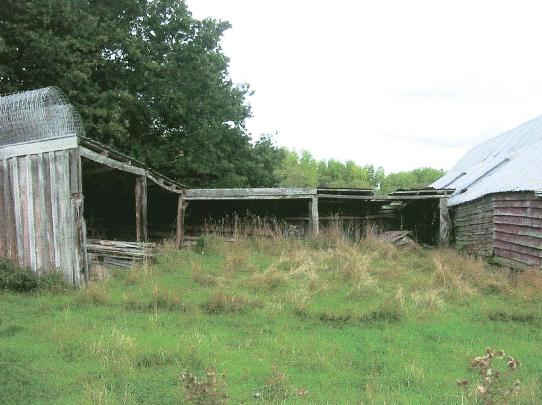
The cow byre is of substantial size but is a simple structure providing basic shelter and facilities for hand milking the cows. The floor was "cobbled" with river stones set into the earth to provide a reasonably clean and firm surface. It may have initially been simply a fenced and roofed set of bails and then the rear wall was later clad with split slabs of timber to provide greater enclosure, or the slabs may have been added at the time of construction. Later, as the slabs decayed, corrugated iron sheets were used to clad the rear walls. For many years the building has just been used for storage.

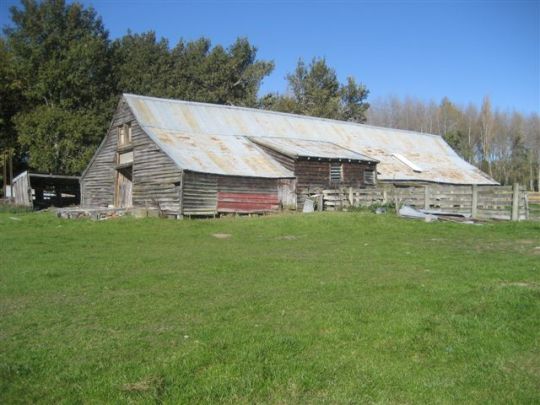
Because of its age and the rarity of this type of farm building, the Arowhenua Station cow byre is an historic building in its own right. However, it also gains from its physical and historical associations with the nearby station woolshed (Category II), one of the oldest in New Zealand.
Arowhenua Station Cow Byre | NZ Historic Places Trust

List Entry Information

Overview

Status
Listed

List Entry Status
Historic Place Category 2

Access
Private/No Public Access

List Number
1954

Date Entered
25th June 2004

Date of Effect
25th June 2004

City/District Council
Timaru District

Region
Canterbury Region

Extent of List Entry

Extent includes part of the land described as Lot 1 DP 23188 (RT CB3D/1239), Canterbury Land District, and the structure known as Arowhenua Station Cow Byre thereon, and its fittings and fixtures.

Legal description

Lot 1 DP 23188 (RT CB3D/1239), Canterbury Land District

Location Description

Arowhenua is located near Temuka.

Detailed List Entry
Significance

Historic Significance

Historical Significance or Value The Arowhenua Cow Byre has historical value because it is one of the oldest remaining cow byres in New Zealand and because of its associations with this very early South Canterbury property.

Physical Significance

It is of technological significance in the construction techniques which were used.

Detail Of Assessed Criteria

(a) an early extant example of a cow byre representing the establishment of pastoralism in South Canterbury by one of the first settlers. The size of the byre indicates the number of cows being milked to supply the needs of the work force on this large property. (g) The system of construction is of value in illustrating methods and materials used by the first settlers. (i) Cow byres dating from the 1850s are rare survivors. (k) The cow byre forms part of an historical complex with the adjacent woolshed (Cat.II)

Construction Professional

Name

Hornbrook

Type

Builder

Biography

No biography is currently available for this construction professional

Construction Details

Start Year

1854

Type

Original Construction

Construction Materials

Timber with a corrugated iron roof.

Physical Description

The cow byre is an L shaped building with one wing extending from the side of the woolshed. It has a simple lean-to roof and is enclosed only along the rear and at each end. Constructed of pit sawn timber milled on the property, it was built initially with just a post and rail wall and then with vertical slabs of timber added to provide greater weather protection. Evidence of the floor laid with river stones can still be seen in some sections. The old bails were still evident some 20 years ago but the building is now in very poor condition with much of the timber decayed or collapsing.

Reference

Completion Date

2nd September 2004

Report Written By

Pam Wilson

Information Sources

Wilson, 1991 (2)

J. Wilson, South Canterbury historical guide : including the towns of Timaru, Temuka, Geraldine, Pleasant Point, Fairlie and Waimate, their surrounding country districts, and the Mackenzie Country, Timaru, 1991.

Thornton, 1986

Geoffrey Thornton, The New Zealand Heritage of Farm Buildings, Auckland, 1986

Thornton, 1982

Geoffrey G. Thornton, New Zealand's Industrial Heritage, A.H. & A.W. Reed, Wellington, 1982

Report Written By

A fully referenced version of this report is available from the NZHPT Southern Region Office. Please note that entry on the New Zealand Heritage List/Rarangi Korero identifies only the heritage values of the property concerned, and should not be construed as advice on the state of the property, or as a comment of its soundness or safety, including in regard to earthquake risk, safety in the event of fire, or insanitary conditions.

Further Information

Current Usages

Uses: Agriculture

Specific Usage: Cow byre

Former Usages

Themes

Web Links

Overview

Status

Listed

List Entry Status

Historic Place Category 2

Access

Private/No Public Access

List Number

1954

Date Entered

25th June 2004

Date of Effect

25th June 2004

City/District Council

Timaru District

Region

Canterbury Region

Extent of List Entry

Extent includes part of the land described as Lot 1 DP 23188 (RT CB3D/1239), Canterbury Land District, and the structure known as Arowhenua Station Cow Byre thereon, and its fittings and fixtures.

Legal description

Lot 1 DP 23188 (RT CB3D/1239), Canterbury Land District

Location Description

Arowhenua is located near Temuka.

Status

Listed

List Entry Status

Historic Place Category 2

Access

Private/No Public Access

List Number

1954

Date Entered

25th June 2004

Date of Effect

25th June 2004

City/District Council

Timaru District

Region

Canterbury Region

Extent of List Entry

Extent includes part of the land described as Lot 1 DP 23188 (RT CB3D/1239), Canterbury Land District, and the structure known as Arowhenua Station Cow Byre thereon, and its fittings and fixtures.

Legal description

Lot 1 DP 23188 (RT CB3D/1239), Canterbury Land District

Location Description

Arowhenua is located near Temuka.

Significance

Why is this place significant?

Historic Significance

Historical Significance or Value The Arowhenua Cow Byre has historical value because it is one of the oldest remaining cow byres in New Zealand and because of its associations with this very early South Canterbury property.

Physical Significance

It is of technological significance in the construction techniques which were used.

Why is this place Category 1 / Category 2?

Detail Of Assessed Criteria

(a) an early extant example of a cow byre representing the establishment of pastoralism in South Canterbury by one of the first settlers. The size of the byre indicates the number of cows being milked to supply the needs of the work force on this large property. (g) The system of construction is of value in illustrating methods and materials used by the first settlers. (i) Cow byres dating from the 1850s are rare survivors. (k) The cow byre forms part of an historical complex with the adjacent woolshed (Cat.II)

Why is this place significant?

Historic Significance

Historical Significance or Value The Arowhenua Cow Byre has historical value because it is one of the oldest remaining cow byres in New Zealand and because of its associations with this very early South Canterbury property.

Physical Significance

It is of technological significance in the construction techniques which were used.

Why is this place Category 1 / Category 2?

Detail Of Assessed Criteria

(a) an early extant example of a cow byre representing the establishment of pastoralism in South Canterbury by one of the first settlers. The size of the byre indicates the number of cows being milked to supply the needs of the work force on this large property. (g) The system of construction is of value in illustrating methods and materials used by the first settlers. (i) Cow byres dating from the 1850s are rare survivors. (k) The cow byre forms part of an historical complex with the adjacent woolshed (Cat.II)

Construction Information

Construction Professional

Name

Hornbrook

Type

Builder

Biography

No biography is currently available for this construction professional

Construction Details

Start Year

1854

startYearCirca

Type

Original Construction

Construction Materials

Timber with a corrugated iron roof.

Construction Professional

Name

Hornbrook

Type

Builder

Biography

No biography is currently available for this construction professional

Construction Details

Start Year

1854

startYearCirca

Type

Original Construction

Construction Materials

Timber with a corrugated iron roof.

Physical Description

The cow byre is an L shaped building with one wing extending from the side of the woolshed. It has a simple lean-to roof and is enclosed only along the rear and at each end. Constructed of pit sawn timber milled on the property, it was built initially with just a post and rail wall and then with vertical slabs of timber added to provide greater weather protection. Evidence of the floor laid with river stones can still be seen in some sections. The old bails were still evident some 20 years ago but the building is now in very poor condition with much of the timber decayed or collapsing.

The cow byre is an L shaped building with one wing extending from the side of the woolshed. It has a simple lean-to roof and is enclosed only along the rear and at each end. Constructed of pit sawn timber milled on the property, it was built initially with just a post and rail wall and then with vertical slabs of timber added to provide greater weather protection. Evidence of the floor laid with river stones can still be seen in some sections. The old bails were still evident some 20 years ago but the building is now in very poor condition with much of the timber decayed or collapsing.

Reference

Historical and Associated Iwi / Hapū / Whānau

Completion Date

2nd September 2004

Report Written By

Pam Wilson

Information Sources

Wilson, 1991 (2)

J. Wilson, South Canterbury historical guide : including the towns of Timaru, Temuka, Geraldine, Pleasant Point, Fairlie and Waimate, their surrounding country districts, and the Mackenzie Country, Timaru, 1991.

Thornton, 1986

Geoffrey Thornton, The New Zealand Heritage of Farm Buildings, Auckland, 1986

Thornton, 1982

Geoffrey G. Thornton, New Zealand's Industrial Heritage, A.H. & A.W. Reed, Wellington, 1982

Other Information

A fully referenced version of this report is available from the NZHPT Southern Region Office. Please note that entry on the New Zealand Heritage List/Rarangi Korero identifies only the heritage values of the property concerned, and should not be construed as advice on the state of the property, or as a comment of its soundness or safety, including in regard to earthquake risk, safety in the event of fire, or insanitary conditions.

Historical and Associated Iwi / Hapū / Whānau

Completion Date

2nd September 2004

Report Written By

Pam Wilson

Information Sources

Wilson, 1991 (2)

J. Wilson, South Canterbury historical guide : including the towns of Timaru, Temuka, Geraldine, Pleasant Point, Fairlie and Waimate, their surrounding country districts, and the Mackenzie Country, Timaru, 1991.

Thornton, 1986

Geoffrey Thornton, The New Zealand Heritage of Farm Buildings, Auckland, 1986

Thornton, 1982

Geoffrey G. Thornton, New Zealand's Industrial Heritage, A.H. & A.W. Reed, Wellington, 1982

Other Information

A fully referenced version of this report is available from the NZHPT Southern Region Office. Please note that entry on the New Zealand Heritage List/Rarangi Korero identifies only the heritage values of the property concerned, and should not be construed as advice on the state of the property, or as a comment of its soundness or safety, including in regard to earthquake risk, safety in the event of fire, or insanitary conditions.

Further Information

Current Usages

Uses: Agriculture

Specific Usage: Cow byre

Current Usages

Uses: Agriculture

Specific Usage: Cow byre

Location
Loading
Related listings
Arowhenua Station Woolshed
Stay up to date with Heritage this month
