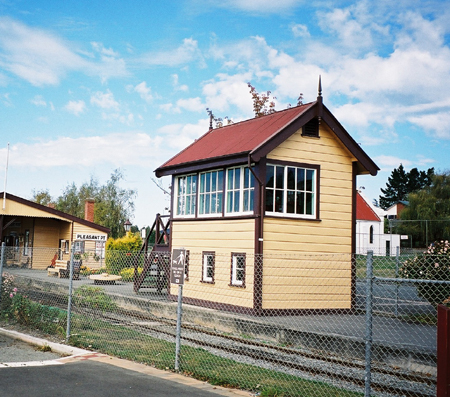
In 1872 the Canterbury Provincial Government decided to establish a branch line from Washdyke to Pleasant Point to serve the large agricultural hinterland. A contract was signed in December 1873 for £22, 040, and work commenced in February 1874. The line, including fencing and buildings, was finished in early December 1875 and opened for traffic on 24 December that year. By 1884 it had been extended inland to Fairlie. There were plans to continue across Burke's Pass into the Mackenzie Country, but this did not eventuate.
The supervision of Provincial Government public works in South Canterbury was delegated to the semi- autonomous Timaru and Gladstone Board of Works between 1867 and 1876. On 4 August 1875, the Board accepted the £1, 268/12 tender of Ashton and Peters for the construction of a Fourth Class station and a goods shed at Pleasant Point. The standard Vogel period (1870s-80s) Class Four station was a simple pitched roof structure with an open lobby located between an office and the ladies waiting room. However the Pleasant Point station took this form only until 1882, when it was moved to its present location a block further west, closer to the centre of township, and extended to provide for a telegraph office. The Post and Telegraph Office gained an additional twelve feet when further alterations were made in 1900. The station served as the Pleasant Point Post office from 1875 until a stand-alone building was built in 1913.
The Fairlie branch line transported wool, grain, livestock, passengers and mail until its closure in 1968. Pleasant Point station and a short section of track were taken over by the Pleasant Point Railway and Historical Society in 1970, and have since been run as a railway and historical museum. The museum complex is enhanced by the retention of a section of the line towards the coast, along which vintage railway carriages are hauled by steam engines to provide passenger excursions. The old Signal Box (Reg. # 1997, Cat. II) near the station adds to the classic rail era atmosphere.
The Pleasant Point Station is significant as one of few remaining Vogel period Class Four stations. None of the class survives unmodified; the most complete is considered to be Waverley Station in Taranaki. The Pleasant Point structure is also significant as the second oldest extant station building in New Zealand, and the only historic station building in South Canterbury.
The supervision of Provincial Government public works in South Canterbury was delegated to the semi- autonomous Timaru and Gladstone Board of Works between 1867 and 1876. On 4 August 1875, the Board accepted the £1, 268/12 tender of Ashton and Peters for the construction of a Fourth Class station and a goods shed at Pleasant Point. The standard Vogel period (1870s-80s) Class Four station was a simple pitched roof structure with an open lobby located between an office and the ladies waiting room. However the Pleasant Point station took this form only until 1882, when it was moved to its present location a block further west, closer to the centre of township, and extended to provide for a telegraph office. The Post and Telegraph Office gained an additional twelve feet when further alterations were made in 1900. The station served as the Pleasant Point Post office from 1875 until a stand-alone building was built in 1913.
The Fairlie branch line transported wool, grain, livestock, passengers and mail until its closure in 1968. Pleasant Point station and a short section of track were taken over by the Pleasant Point Railway and Historical Society in 1970, and have since been run as a railway and historical museum. The museum complex is enhanced by the retention of a section of the line towards the coast, along which vintage railway carriages are hauled by steam engines to provide passenger excursions. The old Signal Box (Reg. # 1997, Cat. II) near the station adds to the classic rail era atmosphere.
The Pleasant Point Station is significant as one of few remaining Vogel period Class Four stations. None of the class survives unmodified; the most complete is considered to be Waverley Station in Taranaki. The Pleasant Point structure is also significant as the second oldest extant station building in New Zealand, and the only historic station building in South Canterbury.
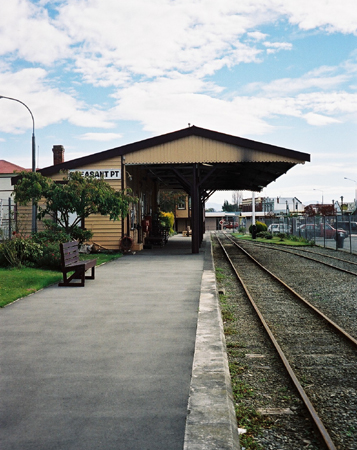
Pleasant Point Railway Station. CC BY-NC-ND 2.0 Image courtesy of www.flickr.com | Shellie Evans – flyingkiwigirl | 19/04/2025 | Shellie Evans
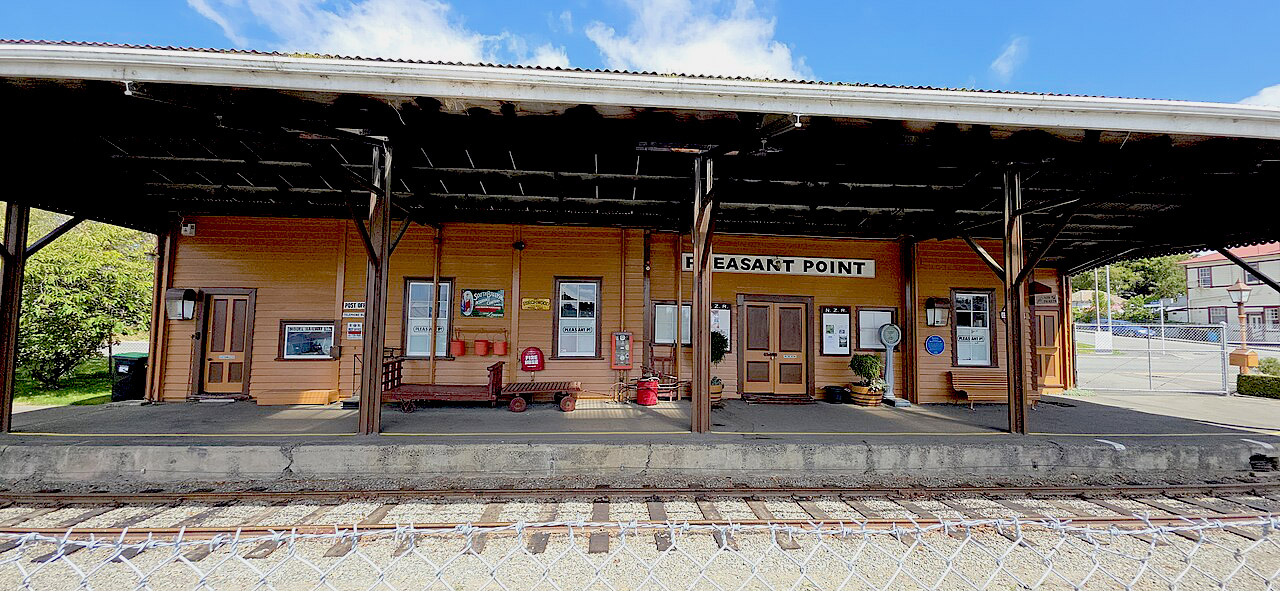
Pleasant Point Railway Station. Station and Platform. CC BY-SA 3.0 Image courtesy of commons.wikimedia.org | GenesisNZ | 26/02/2025 | GenesisNZ - Wikimedia Commons
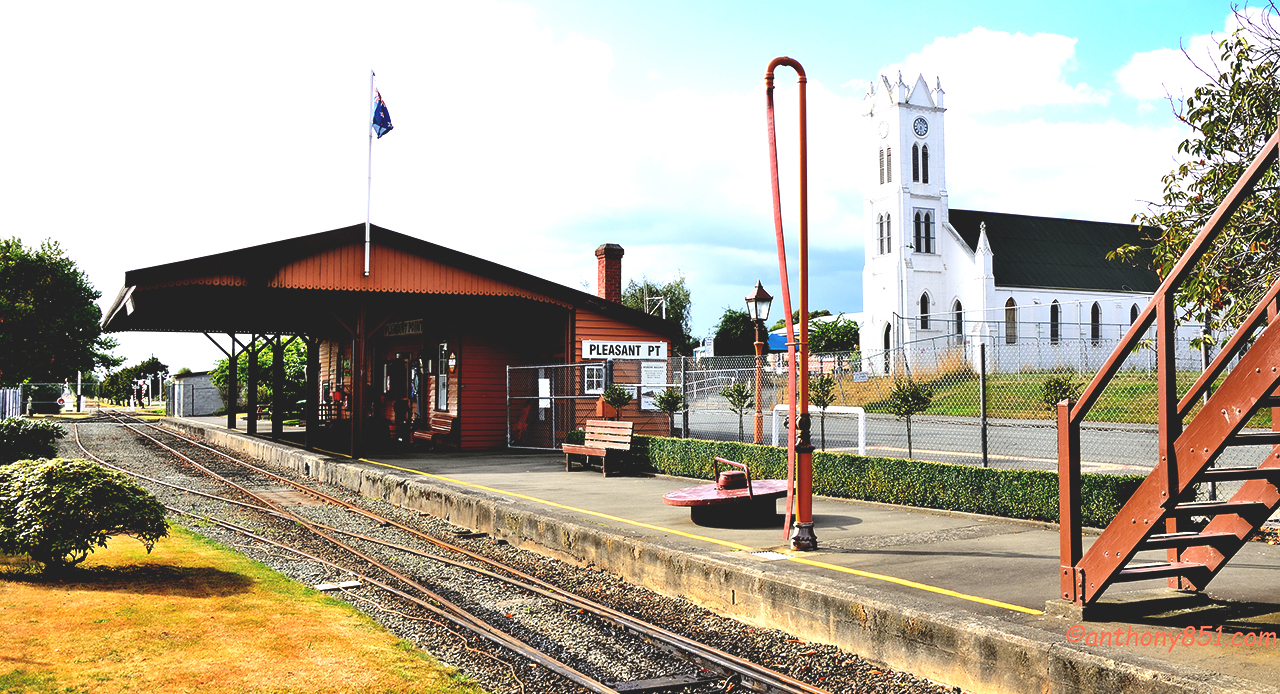
Pleasant Point Railway Station. Image courtesy of www.flickr.com | Anthony 851 | 23/01/2019 | Anthony 851
Pleasant Point Railway Station. CC BY-NC-ND 2.0 Image courtesy of www.flickr.com | Shellie Evans – flyingkiwigirl | 19/04/2025 | Shellie Evans
Pleasant Point Railway Station. Station and Platform. CC BY-SA 3.0 Image courtesy of commons.wikimedia.org | GenesisNZ | 26/02/2025 | GenesisNZ - Wikimedia Commons
Pleasant Point Railway Station. Image courtesy of www.flickr.com | Anthony 851 | 23/01/2019 | Anthony 851