DonateSupporterVisit Heritage
  • Tūrangawaewae
    Places
  • Tira Māori
    Māori Heritage
  • Poutairangahia
    Archaeology
  • Rauemi
    Resources
  • Mō Tātou
    About Us
  • New Zealand Heritage List
  • Nominate and submit
  • Explore the List
  • National Historic Landmarks
  • Plaques
  • Rainbow List Project
  • Lost heritage
  • Visit Heritage
  • Our properties
  • Turnbull House Project
  • Collections
  • Shop
  • Tohu Whenua
  • Tira Māori
  • Conserving Māori heritage
  • Marae built heritage
  • Māori heritage on the List
  • Hinemihi—Te Hokinga Mai
  • What is archaeology?
  • Is there a site on my property?
  • What are my legal requirements?
  • Affecting an archaeological site
  • Declaring an archaeological site
  • Archaeology FAQs
  • Archaeology Digital Library
  • Archaeology guidelines and templates
  • Resources
  • Funding
  • Publications
  • Sustainable management guides
  • Disaster recovery
  • Podcasts & digital resources
  • Education Hub
  • Conservation plans
  • About
  • Board
  • Māori Heritage Council
  • Senior Staff
  • Offices
  • Contact us
  • Careers
  • Covenants
  • Fast-track
  • Corporate documents
  • Currently consulting on
  • Our submissions
  • News
Quick links
Rārangi Kōrero | The List
Explore the List
National Historic Landmarks
Ngā Manawhenua o Aotearoa me ōna Kōrero Tūturu
Quick links
Tapuwae
A Vision for Places of Māori Heritage
Funding for Māori Heritage
Resources
Quick links
Archaeological Authority Portal
Applying for an archaeological authority
Archaeology FAQs
Browse the most frequently asked questions about archaeological authorities and the archaeological process.
Quick links
Quick links
Contact us
Offices
DonateSupporterVisit Heritage
  • Tūrangawaewae
    Places
  • Tira Māori
    Māori Heritage
  • Poutairangahia
    Archaeology
  • Rauemi
    Resources
  • Mō Tātou
    About Us
  • New Zealand Heritage List
  • Nominate and submit
  • Explore the List
  • National Historic Landmarks
  • Plaques
  • Rainbow List Project
  • Lost heritage
  • Visit Heritage
  • Our properties
  • Turnbull House Project
  • Collections
  • Shop
  • Tohu Whenua
  • Tira Māori
  • Conserving Māori heritage
  • Marae built heritage
  • Māori heritage on the List
  • Hinemihi—Te Hokinga Mai
  • What is archaeology?
  • Is there a site on my property?
  • What are my legal requirements?
  • Affecting an archaeological site
  • Declaring an archaeological site
  • Archaeology FAQs
  • Archaeology Digital Library
  • Archaeology guidelines and templates
  • Resources
  • Funding
  • Publications
  • Sustainable management guides
  • Disaster recovery
  • Podcasts & digital resources
  • Education Hub
  • Conservation plans
  • About
  • Board
  • Māori Heritage Council
  • Senior Staff
  • Offices
  • Contact us
  • Careers
  • Covenants
  • Fast-track
  • Corporate documents
  • Currently consulting on
  • Our submissions
  • News
Quick links
Rārangi Kōrero | The List
Explore the List
National Historic Landmarks
Ngā Manawhenua o Aotearoa me ōna Kōrero Tūturu
Quick links
Tapuwae
A Vision for Places of Māori Heritage
Funding for Māori Heritage
Resources
Quick links
Archaeological Authority Portal
Applying for an archaeological authority
Archaeology FAQs
Browse the most frequently asked questions about archaeological authorities and the archaeological process.
Quick links
Quick links
Contact us
Offices
  • Places
  • Nominate and submit
  • National Historic Landmarks
  • Places
  • Nominate and submit
  • National Historic Landmarks
  • Tira Māori
  • Conserving Māori heritage
  • Marae built heritage
  • Tira Māori
  • Conserving Māori heritage
  • Marae built heritage
  • Archaeological authorities
  • Archaeology Digital Library
  • Archaeological authorities
  • Archaeology Digital Library
  • All resources
  • Publications
  • Funding
  • All resources
  • Publications
  • Funding
  • FAQs
  • FAQs
Follow us on:
Places
  • Places
  • Nominate and submit
  • National Historic Landmarks
Tira Māori
  • Tira Māori
  • Conserving Māori heritage
  • Marae built heritage
Archaeology
  • Archaeological authorities
  • Archaeology Digital Library
Resources
  • All resources
  • Publications
  • Funding
FAQs
  • FAQs
Follow us on
HomePrivacyTerms and conditionsAbout this site
© Heritage New Zealand Pouhere Taonga 2026.
 
Temuka Library (Former)

53 King Street, TEMUKA

Private

Historic Place Category 2

List No. 2035

Quick links:
List GalleryLocationDetails
The classically styled former Temuka Library makes a significant contribution to the main street of Temuka, complementing the earlier buildings which line the main street.

"Temuka's main street is an archetype of small town New Zealand, with Victorian and Edwardian frontages above street verandas...great bulk of the frontages date from the first two decades of this century, making King Street one of the best preserved small town main streets of Edwardian times in New Zealand." (Wilson: 1991, p 20).

A Mechanics' Institute was formed in Temuka in 1871. In 1873 a small timber building was constructed at the southern end of the township and this served as library for over 40 years. By 1922 it was felt that a new, more fitting building was required and some debate occurred about the best location and the means of funding. For a period it was thought that the need for an updated Fire Station as well as the library might be combined, but instead the final choice was for a new library on the site of the existing building and for Plunket Rooms and a Ladies' Restrooms to be built alongside.

The promise of a £500 donation from local M.P. [Mr T.D. Burnett] encouraged the provision of further funds from local government, the Plunket Society the W.C.T.U [Women's Christian Temperance Union] and other citizens. Plans were prepared by prominent Timaru architects Turnbull and Rule. James S Turnbull (1864-1947) had acquired a fine reputation through the wide variety of notable buildings he designed in and around Timaru, including Chalmers Presbyterian Church, 1903-4, Category II. He was joined in partnership in 1920 by Percy Watts Rule and one of their best known designs was St James Anglican Church at Franz Joseph, 1928-31, Category I. The partnership's design for the Temuka complex was greatly appreciated by the local community as its conservative but noble styling related well to its environs.

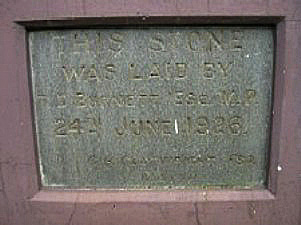
On 25th June, 1926 the foundation stone was laid and on 14th February, 1927 the building was formally opened, both occasions conducted with due ceremony by Mr Burnett. The complex was opened free of debt which greatly pleased Mr Burnett, the key benefactor who expressed his pleasure that there had been no need for assistance from the late Mr Andrew Carnegies' foundation because, "Carnegie Libraries were apt to pauperise literary taste." (Timaru Herald, 26/6/26.) The final cost of the completed and furnished complex was £3,106.

The library was planned with the vestibule at the entrance opening directly into to a large public reading room, containing newspapers, magazines etc. The initial 2,500 volumes were housed in an adjoining room, there was a designated members room and an office for the librarian. The librarian's residence could be accessed from the library as well as from an entranceway at the side of the complex. The residence extended towards the rear of the spacious section of 1535 square metres. Adjoining the library block's rear corner was the Plunket Room/Ladies' Rest Room which had a separate entrance and no internal connection.

Until the 1990s the library served the Temuka community. By then it was no longer able to meet present day requirements and it was replaced by a new facility combining the Timaru District Council's Service Centre with the library in a central position on the opposite side of King Street.
In 2001 there was a proposal which fell through, for the complex to be converted for use as a residence and office. Subsequently the property was sold and altered to become a restaurant/bar, but this enterprise did not operate for long and it was sold again. Current owners have made no alterations and use the complex as a residence.
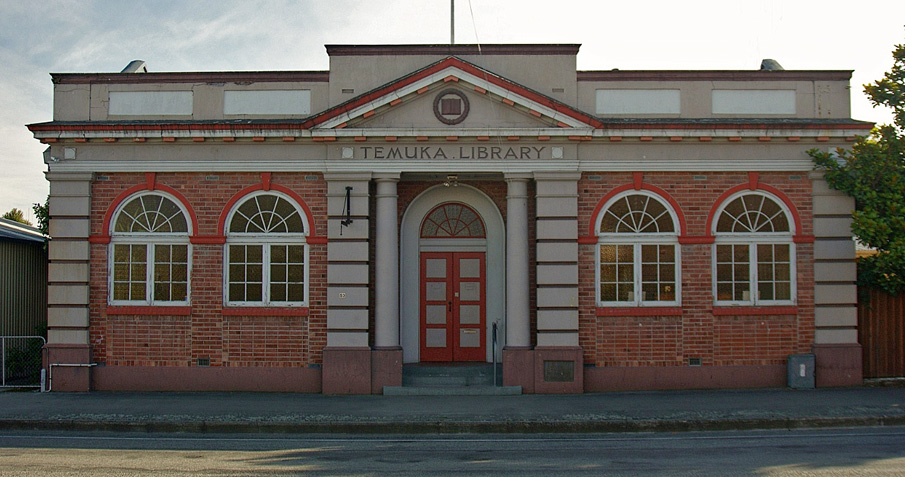
Temuka Library (Former). Image courtesy of www.flickr.com | PhilBee NZ (Phil Braithwaite) | 09/04/2012 | PhilBee NZ (Phil Braithwaite)
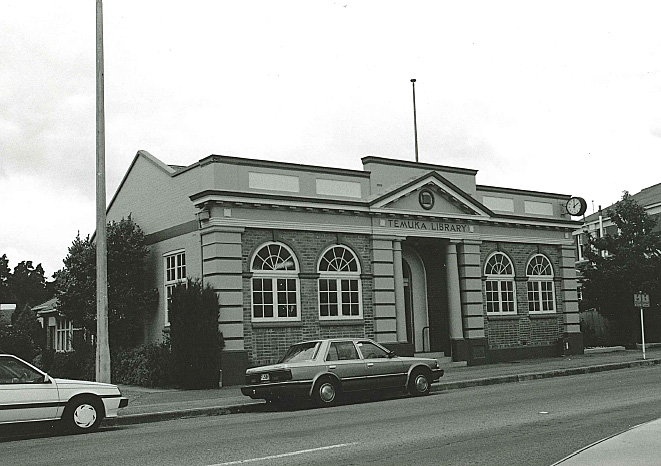
Temuka Library | P. Wilson | 16/03/2004 | Heritage New Zealand Pouhere Taonga
Temuka Library (Former). Original image submitted at time of registration | Heritage New Zealand Pouhere Taonga
Temuka Library (Former). Image courtesy of www.flickr.com | PhilBee NZ (Phil Braithwaite) | 09/04/2012 | PhilBee NZ (Phil Braithwaite)
Temuka Library | P. Wilson | 16/03/2004 | Heritage New Zealand Pouhere Taonga
Temuka Library (Former). Original image submitted at time of registration | Heritage New Zealand Pouhere Taonga

List Entry Information

Overview

Status
Listed

List Entry Status
Historic Place Category 2

Access
Private/No Public Access

List Number
2035

Date Entered
25th June 2004

Date of Effect
25th June 2004

City/District Council
Timaru District

Region
Canterbury Region

Extent of List Entry

Extent includes the land described as Lot 4 DP 24229 (RT CB20K/92), Canterbury Land District, and the building known as Temuka Library (Former) thereon, and its fixtures and fittings.

Legal description

Lot 4 DP 24229 (RT CB20K/92), Canterbury Land District

Detailed List Entry
Significance

Cultural Significance

The building is also valuable socially through what its history reveals about the attitudes and aspirations of the people who planned it. The importance placed on provision of a town library is seen through the community's support for the allocation of funds from local government and donations from local benefactors. The library also has social significance for its long-standing association with the people of Temuka serving as its library for some 60 years.

Historic Significance

Historical Significance or Value It is historically significant through its links to the town's development. As this small farming centre expanded it was possible for facilities like public libraries to be provided.

Physical Significance

The former Temuka Library building has aesthetic and architectural value as a well designed public building which makes a significant contribution to the main street of this well preserved Edwardian town.

Detail Of Assessed Criteria

(a)The Temuka community's desire to have a library which not only was a much utilised amenity but also a prestigious building enhancing their environs, is illustrative of the attitudes of residents in developing towns around New Zealand from the first years of settlement. It thus reflects a representative aspect of New Zealand history. (g) Completed in 1927 the classical styled library building harmonises well with the existing character of the town's centre and did not follow the current stylistic developments, which shunned historic references. It is well designed in its planning, meeting the needs of the time to provide a functioning amenity. The conservative forms and motifs are skilfully proportioned to provide a handsome structure. (k) King Street, Temuka's main street, features an almost intact row of fine Edwardian buildings, well preserved above the verandah level, and this building is a key element at the street's southern end.

Construction Professional

Name

Turnbull & Rule

Type

Architectural Partnership

Biography

James S. Turnbull worked in a Melbourne architect's office before returning to establish his own practice in Timaru in c.1895. In a career which spanned over forty years, Turnbull designed a wide range of building types in the South Canterbury town, including Chalmers Presbyterian Church (1903-04) and a considerable number of large town houses. Percy Watts Rule became James Turnbull's partner in c.1920 and subsequently became the firm's chief designer. From this time until his retirement in 1938, Turnbull was largely responsible for writing specifications and supervising the construction of buildings designed by Rule. In 1939 the latter was awarded the gold medal of the New Zealand Institute of Architects for his design of Timaru Hospital's Surgical Wing (1936-40), but little else is known about the junior partner of a firm which made a valuable contribution to Timaru architecture in the early years of this century.

Name

Kennedy, A

Type

Builder

Biography

No biography is currently available for this construction professional

Construction Details

Start Year

1926

Finish Year

1927

Type

Original Construction

Description

Foundation stone laid 24 June 1926. Officially opened 12 February 1927

Type

Modification

Description

Additions to rear of original domestic quarters, providing two further rooms

Period

1950s

Start Year

2001

Type

Modification

Description

Conversion of the whole complex, after it was sold into private ownership, for use as a restaurant/bar and small residence.

Construction Materials

Library section, brick and plaster, corrugated iron roof; plunket rooms and domestic quarters, brick with corrugated iron roof.

Physical Description

The former Temuka Library is a single storeyed masonry building of classical style. The main façade, which abuts the footpath, is symmetrically ordered with the recessed entrance way flanked by Doric columns and surmounted by a simple pediment. Plastered quoins emphasise the four pilasters which divide the frontage; and two pairs of round arched, multi-paned windows complete each side bay. An unpierced plastered parapet screens the building's low-pitched roof. Set back from the street to the right of the main library structure is the smaller brick section of the building constructed to house the Plunket Rooms and Ladies Rest Rooms, (now totally screened from street view by a timber fence). Behind the library on the left side are the brick living quarters, of distinctly domestic scale and character.

Reference

Completion Date

2nd September 2004

Report Written By

Pam Wilson

Information Sources

Wilson, 1991 (2)

J. Wilson, South Canterbury historical guide : including the towns of Timaru, Temuka, Geraldine, Pleasant Point, Fairlie and Waimate, their surrounding country districts, and the Mackenzie Country, Timaru, 1991.

New Zealand Historic Places Trust (NZHPT)

New Zealand Historic Places Trust

Timaru Herald

Timaru Herald, 30 Mar 1915, p.3.

Report Written By

A fully referenced version of this report is available from the NZHPT Southern Region Office. Please note that entry on the New Zealand Heritage List/Rarangi Korero identifies only the heritage values of the property concerned, and should not be construed as advice on the state of the property, or as a comment of its soundness or safety, including in regard to earthquake risk, safety in the event of fire, or insanitary conditions.

Further Information

Current Usages

Uses: Accommodation

Specific Usage: House

Former Usages

General Usage:: Civic Facilities

Specific Usage: Library

Themes

Web Links

Overview

Status

Listed

List Entry Status

Historic Place Category 2

Access

Private/No Public Access

List Number

2035

Date Entered

25th June 2004

Date of Effect

25th June 2004

City/District Council

Timaru District

Region

Canterbury Region

Extent of List Entry

Extent includes the land described as Lot 4 DP 24229 (RT CB20K/92), Canterbury Land District, and the building known as Temuka Library (Former) thereon, and its fixtures and fittings.

Legal description

Lot 4 DP 24229 (RT CB20K/92), Canterbury Land District

Status

Listed

List Entry Status

Historic Place Category 2

Access

Private/No Public Access

List Number

2035

Date Entered

25th June 2004

Date of Effect

25th June 2004

City/District Council

Timaru District

Region

Canterbury Region

Extent of List Entry

Extent includes the land described as Lot 4 DP 24229 (RT CB20K/92), Canterbury Land District, and the building known as Temuka Library (Former) thereon, and its fixtures and fittings.

Legal description

Lot 4 DP 24229 (RT CB20K/92), Canterbury Land District

Significance

Why is this place significant?

Cultural Significance

The building is also valuable socially through what its history reveals about the attitudes and aspirations of the people who planned it. The importance placed on provision of a town library is seen through the community's support for the allocation of funds from local government and donations from local benefactors. The library also has social significance for its long-standing association with the people of Temuka serving as its library for some 60 years.

Historic Significance

Historical Significance or Value It is historically significant through its links to the town's development. As this small farming centre expanded it was possible for facilities like public libraries to be provided.

Physical Significance

The former Temuka Library building has aesthetic and architectural value as a well designed public building which makes a significant contribution to the main street of this well preserved Edwardian town.

Why is this place Category 1 / Category 2?

Detail Of Assessed Criteria

(a)The Temuka community's desire to have a library which not only was a much utilised amenity but also a prestigious building enhancing their environs, is illustrative of the attitudes of residents in developing towns around New Zealand from the first years of settlement. It thus reflects a representative aspect of New Zealand history. (g) Completed in 1927 the classical styled library building harmonises well with the existing character of the town's centre and did not follow the current stylistic developments, which shunned historic references. It is well designed in its planning, meeting the needs of the time to provide a functioning amenity. The conservative forms and motifs are skilfully proportioned to provide a handsome structure. (k) King Street, Temuka's main street, features an almost intact row of fine Edwardian buildings, well preserved above the verandah level, and this building is a key element at the street's southern end.

Why is this place significant?

Cultural Significance

The building is also valuable socially through what its history reveals about the attitudes and aspirations of the people who planned it. The importance placed on provision of a town library is seen through the community's support for the allocation of funds from local government and donations from local benefactors. The library also has social significance for its long-standing association with the people of Temuka serving as its library for some 60 years.

Historic Significance

Historical Significance or Value It is historically significant through its links to the town's development. As this small farming centre expanded it was possible for facilities like public libraries to be provided.

Physical Significance

The former Temuka Library building has aesthetic and architectural value as a well designed public building which makes a significant contribution to the main street of this well preserved Edwardian town.

Why is this place Category 1 / Category 2?

Detail Of Assessed Criteria

(a)The Temuka community's desire to have a library which not only was a much utilised amenity but also a prestigious building enhancing their environs, is illustrative of the attitudes of residents in developing towns around New Zealand from the first years of settlement. It thus reflects a representative aspect of New Zealand history. (g) Completed in 1927 the classical styled library building harmonises well with the existing character of the town's centre and did not follow the current stylistic developments, which shunned historic references. It is well designed in its planning, meeting the needs of the time to provide a functioning amenity. The conservative forms and motifs are skilfully proportioned to provide a handsome structure. (k) King Street, Temuka's main street, features an almost intact row of fine Edwardian buildings, well preserved above the verandah level, and this building is a key element at the street's southern end.

Construction Information

Construction Professional

Name

Turnbull & Rule

Type

Architectural Partnership

Biography

James S. Turnbull worked in a Melbourne architect's office before returning to establish his own practice in Timaru in c.1895. In a career which spanned over forty years, Turnbull designed a wide range of building types in the South Canterbury town, including Chalmers Presbyterian Church (1903-04) and a considerable number of large town houses. Percy Watts Rule became James Turnbull's partner in c.1920 and subsequently became the firm's chief designer. From this time until his retirement in 1938, Turnbull was largely responsible for writing specifications and supervising the construction of buildings designed by Rule. In 1939 the latter was awarded the gold medal of the New Zealand Institute of Architects for his design of Timaru Hospital's Surgical Wing (1936-40), but little else is known about the junior partner of a firm which made a valuable contribution to Timaru architecture in the early years of this century.

Name

Kennedy, A

Type

Builder

Biography

No biography is currently available for this construction professional

Construction Details

Start Year

1926

Finish Year

1927

Type

Original Construction

Description

Foundation stone laid 24 June 1926. Officially opened 12 February 1927

Type

Modification

Description

Additions to rear of original domestic quarters, providing two further rooms

Period

1950s

Start Year

2001

Type

Modification

Description

Conversion of the whole complex, after it was sold into private ownership, for use as a restaurant/bar and small residence.

Construction Materials

Library section, brick and plaster, corrugated iron roof; plunket rooms and domestic quarters, brick with corrugated iron roof.

Construction Professional

Name

Turnbull & Rule

Type

Architectural Partnership

Biography

James S. Turnbull worked in a Melbourne architect's office before returning to establish his own practice in Timaru in c.1895. In a career which spanned over forty years, Turnbull designed a wide range of building types in the South Canterbury town, including Chalmers Presbyterian Church (1903-04) and a considerable number of large town houses. Percy Watts Rule became James Turnbull's partner in c.1920 and subsequently became the firm's chief designer. From this time until his retirement in 1938, Turnbull was largely responsible for writing specifications and supervising the construction of buildings designed by Rule. In 1939 the latter was awarded the gold medal of the New Zealand Institute of Architects for his design of Timaru Hospital's Surgical Wing (1936-40), but little else is known about the junior partner of a firm which made a valuable contribution to Timaru architecture in the early years of this century.

Name

Kennedy, A

Type

Builder

Biography

No biography is currently available for this construction professional

Construction Details

Start Year

1926

Finish Year

1927

Type

Original Construction

Description

Foundation stone laid 24 June 1926. Officially opened 12 February 1927

Type

Modification

Description

Additions to rear of original domestic quarters, providing two further rooms

Period

1950s

Start Year

2001

Type

Modification

Description

Conversion of the whole complex, after it was sold into private ownership, for use as a restaurant/bar and small residence.

Construction Materials

Library section, brick and plaster, corrugated iron roof; plunket rooms and domestic quarters, brick with corrugated iron roof.

Physical Description

The former Temuka Library is a single storeyed masonry building of classical style. The main façade, which abuts the footpath, is symmetrically ordered with the recessed entrance way flanked by Doric columns and surmounted by a simple pediment. Plastered quoins emphasise the four pilasters which divide the frontage; and two pairs of round arched, multi-paned windows complete each side bay. An unpierced plastered parapet screens the building's low-pitched roof. Set back from the street to the right of the main library structure is the smaller brick section of the building constructed to house the Plunket Rooms and Ladies Rest Rooms, (now totally screened from street view by a timber fence). Behind the library on the left side are the brick living quarters, of distinctly domestic scale and character.

The former Temuka Library is a single storeyed masonry building of classical style. The main façade, which abuts the footpath, is symmetrically ordered with the recessed entrance way flanked by Doric columns and surmounted by a simple pediment. Plastered quoins emphasise the four pilasters which divide the frontage; and two pairs of round arched, multi-paned windows complete each side bay. An unpierced plastered parapet screens the building's low-pitched roof. Set back from the street to the right of the main library structure is the smaller brick section of the building constructed to house the Plunket Rooms and Ladies Rest Rooms, (now totally screened from street view by a timber fence). Behind the library on the left side are the brick living quarters, of distinctly domestic scale and character.

Reference

Historical and Associated Iwi / Hapū / Whānau

Completion Date

2nd September 2004

Report Written By

Pam Wilson

Information Sources

Wilson, 1991 (2)

J. Wilson, South Canterbury historical guide : including the towns of Timaru, Temuka, Geraldine, Pleasant Point, Fairlie and Waimate, their surrounding country districts, and the Mackenzie Country, Timaru, 1991.

New Zealand Historic Places Trust (NZHPT)

New Zealand Historic Places Trust

Timaru Herald

Timaru Herald, 30 Mar 1915, p.3.

Other Information

A fully referenced version of this report is available from the NZHPT Southern Region Office. Please note that entry on the New Zealand Heritage List/Rarangi Korero identifies only the heritage values of the property concerned, and should not be construed as advice on the state of the property, or as a comment of its soundness or safety, including in regard to earthquake risk, safety in the event of fire, or insanitary conditions.

Historical and Associated Iwi / Hapū / Whānau

Completion Date

2nd September 2004

Report Written By

Pam Wilson

Information Sources

Wilson, 1991 (2)

J. Wilson, South Canterbury historical guide : including the towns of Timaru, Temuka, Geraldine, Pleasant Point, Fairlie and Waimate, their surrounding country districts, and the Mackenzie Country, Timaru, 1991.

New Zealand Historic Places Trust (NZHPT)

New Zealand Historic Places Trust

Timaru Herald

Timaru Herald, 30 Mar 1915, p.3.

Other Information

A fully referenced version of this report is available from the NZHPT Southern Region Office. Please note that entry on the New Zealand Heritage List/Rarangi Korero identifies only the heritage values of the property concerned, and should not be construed as advice on the state of the property, or as a comment of its soundness or safety, including in regard to earthquake risk, safety in the event of fire, or insanitary conditions.

Further Information

Current Usages

Uses: Accommodation

Specific Usage: House

Former Usages

General Usage: Civic Facilities

Specific Usage: Library

Current Usages

Uses: Accommodation

Specific Usage: House

Former Usages

General Usage: Civic Facilities

Specific Usage: Library

Location

Loading
Sign up to hear more

Get the latest heritage news, features and events delivered
straight to your inbox.

Subscribe