DonateSupporterVisit Heritage
  • Tūrangawaewae
    Places
  • Tira Māori
    Māori Heritage
  • Poutairangahia
    Archaeology
  • Rauemi
    Resources
  • Mō Tātou
    About Us
  • New Zealand Heritage List
  • Nominate and submit
  • Explore the List
  • National Historic Landmarks
  • Plaques
  • Rainbow List Project
  • Lost heritage
  • Visit Heritage
  • Our properties
  • Turnbull House Project
  • Collections
  • Shop
  • Tohu Whenua
  • Tira Māori
  • Conserving Māori heritage
  • Marae built heritage
  • Māori heritage on the List
  • Hinemihi—Te Hokinga Mai
  • What is archaeology?
  • Is there a site on my property?
  • What are my legal requirements?
  • Affecting an archaeological site
  • Declaring an archaeological site
  • Archaeology FAQs
  • Archaeology Digital Library
  • Archaeology guidelines and templates
  • Resources
  • Funding
  • Publications
  • Sustainable management guides
  • Disaster recovery
  • Podcasts & digital resources
  • Education Hub
  • Conservation plans
  • About
  • Board
  • Māori Heritage Council
  • Senior Staff
  • Offices
  • Contact us
  • Careers
  • Covenants
  • Fast-track
  • Corporate documents
  • Currently consulting on
  • Our submissions
  • News
  • Covid-19 response
Quick links
Rārangi Kōrero | The List
Explore the List
National Historic Landmarks
Ngā Manawhenua o Aotearoa me ōna Kōrero Tūturu
Quick links
Tapuwae
A Vision for Places of Māori Heritage
Funding for Māori Heritage
Resources
Quick links
Archaeological Authority Portal
Applying for an archaeological authority
Archaeology FAQs
Browse the most frequently asked questions about archaeological authorities and the archaeological process.
Quick links
Quick links
Contact us
Offices
DonateSupporterVisit Heritage
  • Tūrangawaewae
    Places
  • Tira Māori
    Māori Heritage
  • Poutairangahia
    Archaeology
  • Rauemi
    Resources
  • Mō Tātou
    About Us
  • New Zealand Heritage List
  • Nominate and submit
  • Explore the List
  • National Historic Landmarks
  • Plaques
  • Rainbow List Project
  • Lost heritage
  • Visit Heritage
  • Our properties
  • Turnbull House Project
  • Collections
  • Shop
  • Tohu Whenua
  • Tira Māori
  • Conserving Māori heritage
  • Marae built heritage
  • Māori heritage on the List
  • Hinemihi—Te Hokinga Mai
  • What is archaeology?
  • Is there a site on my property?
  • What are my legal requirements?
  • Affecting an archaeological site
  • Declaring an archaeological site
  • Archaeology FAQs
  • Archaeology Digital Library
  • Archaeology guidelines and templates
  • Resources
  • Funding
  • Publications
  • Sustainable management guides
  • Disaster recovery
  • Podcasts & digital resources
  • Education Hub
  • Conservation plans
  • About
  • Board
  • Māori Heritage Council
  • Senior Staff
  • Offices
  • Contact us
  • Careers
  • Covenants
  • Fast-track
  • Corporate documents
  • Currently consulting on
  • Our submissions
  • News
  • Covid-19 response
Quick links
Rārangi Kōrero | The List
Explore the List
National Historic Landmarks
Ngā Manawhenua o Aotearoa me ōna Kōrero Tūturu
Quick links
Tapuwae
A Vision for Places of Māori Heritage
Funding for Māori Heritage
Resources
Quick links
Archaeological Authority Portal
Applying for an archaeological authority
Archaeology FAQs
Browse the most frequently asked questions about archaeological authorities and the archaeological process.
Quick links
Quick links
Contact us
Offices
  • Places
  • Nominate and submit
  • National Historic Landmarks
  • Places
  • Nominate and submit
  • National Historic Landmarks
  • Tira Māori
  • Conserving Māori heritage
  • Marae built heritage
  • Tira Māori
  • Conserving Māori heritage
  • Marae built heritage
  • Archaeological authorities
  • Archaeology Digital Library
  • Archaeological authorities
  • Archaeology Digital Library
  • All resources
  • Publications
  • Funding
  • All resources
  • Publications
  • Funding
  • FAQs
  • FAQs
Follow us on:
Places
  • Places
  • Nominate and submit
  • National Historic Landmarks
Tira Māori
  • Tira Māori
  • Conserving Māori heritage
  • Marae built heritage
Archaeology
  • Archaeological authorities
  • Archaeology Digital Library
Resources
  • All resources
  • Publications
  • Funding
FAQs
  • FAQs
Follow us on
HomePrivacyTerms and conditionsAbout this site
© Heritage New Zealand Pouhere Taonga 2026.
 
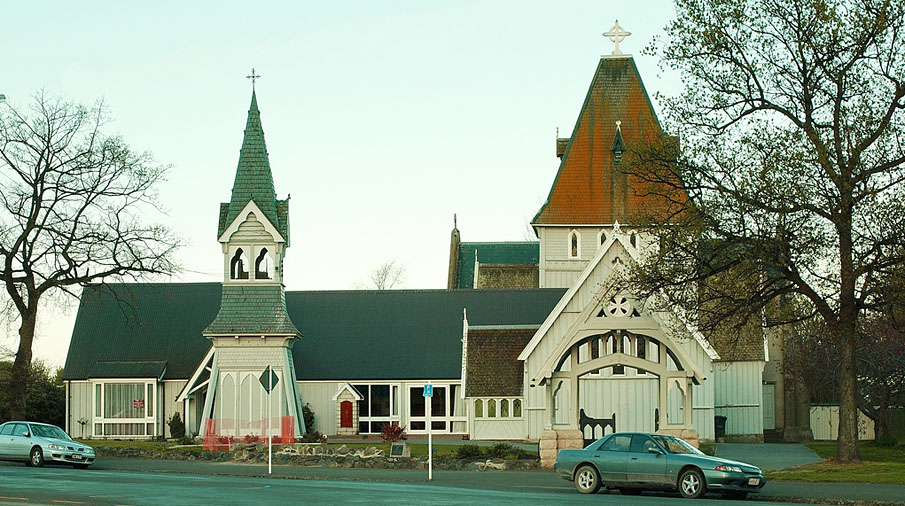
Lychgate, St Augustine's Church

John Street, WAIMATE

Private

Historic Place Category 2

List No. 2043

Quick links:
List GalleryLocationDetails
Lychgates were constructed in churchyard gateways from about the middle of the 16th century. It was a requirement of the 1549 Prayer Book that when someone was to be buried the priest should "meet the corpse at the church style" for the initial part of the service, and the provision of shelters for that purpose was encouraged. (The word lych is Saxon for corpse.) It also provided a place where the bearers of the corpse might rest it if they had been carrying it for some distance and had to wait for the arrival of the clergy.

They were covered open structures at the churchyard entrance. Usually four or six posts were embedded in the ground to create a square or rectangle, with beams forming a steeply sloping roof of shingles or tiles. Although their original use ceased as roads improved, more bodies were encased in coffins and the need for a rest lessened, the lychgate had become attractive, decorative features. They were popular with 19th century church designers and many Anglican parishes in New Zealand opted to build them as aspects of their home traditions.

St Augustine's Church at Waimate (Category I), designed by Benjamin Mountfort, was built in 1872. The founding settler of the district, Michael Studholme, who had taken up land here in 1854, was a generous supporter of the church, playing the typical role of the largest landowner in the district in assisting the local community to establish a place of worship as a central feature of the developing township.

In 1902 Mrs. Effie Studholme donated funds for the building of the lychgate. She was the widow of Michael Studholme and the lychgate was a memorial to her husband and two of their sons. It was designed by the prominent Arts and Crafts architect Samuel Hurst Seager from Christchurch. He is respected in particular for the fine houses he designed as well as his diverse work in other fields. He had designed a number of churches but this is the only known lychgate.

The plaque on the Lychgate reads:
To the glory of God and in loving remembrance of Michael Studholme and his eldest and youngest sons Michael Cuthbert and Geofrey.
Jesus saith I am the reserection and the light. He that believeth in me though he may die yet shall he live.
John 11 25
This gate is here placed by Effie, devoted wife and mother.
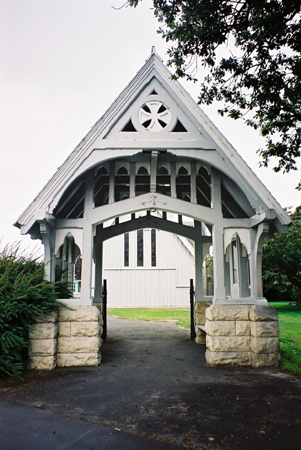
Lychgate, St Augustine's Church, Waimate. CC BY 3.0 Image courtesy of commons.wikimedia.org | jokertrekker | 19/09/2009 | jokertrekker - Wikimedia Commons
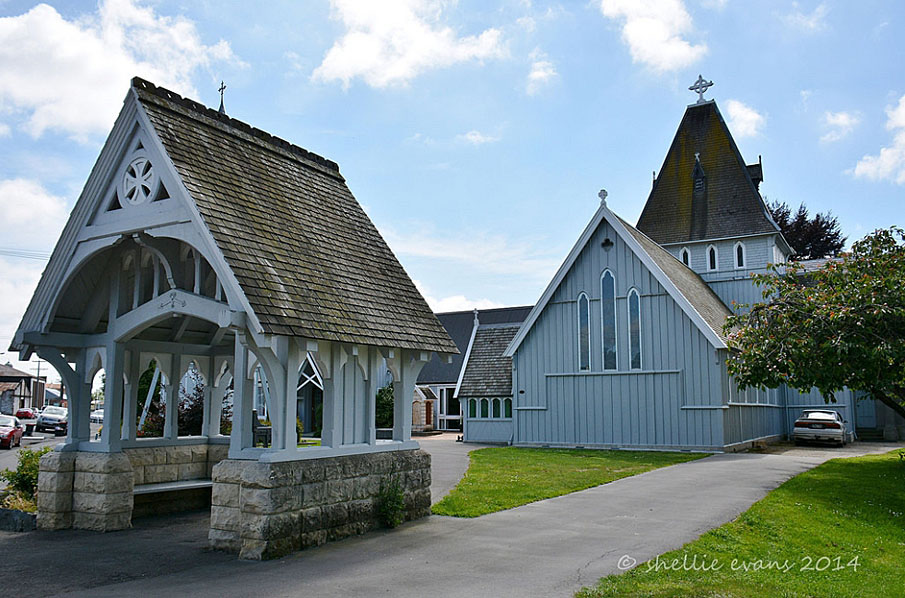
Lychgate, St Augustine's Church, Waimate. CC BY-NC-ND 2.0 Image courtesy of www.flickr.com | Shellie Evans - flyingkiwigirl | 03/12/2013 | Shellie Evans
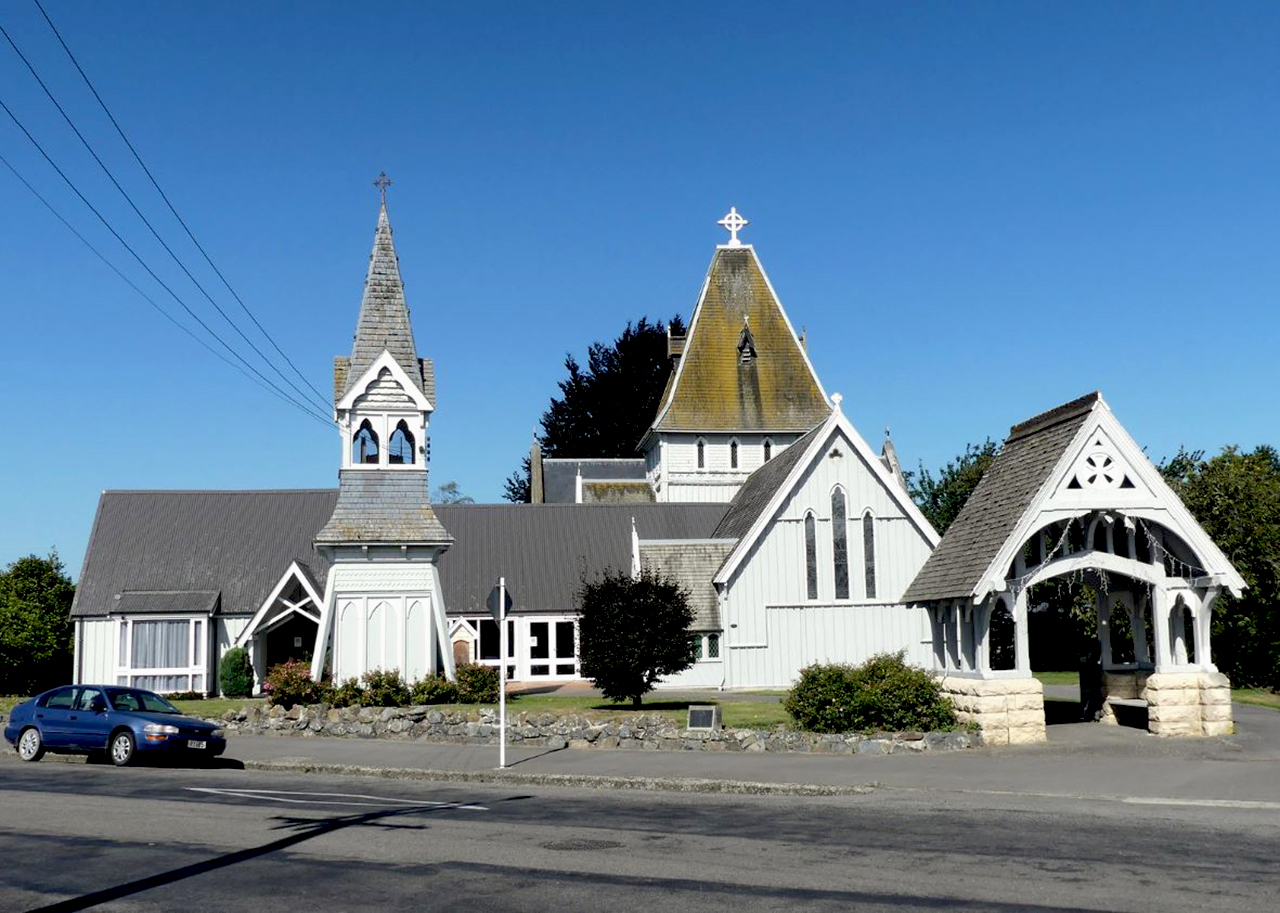
Lychgate, St Augustine's Church, Waimate. Image courtesy of www.flickr.com | PhilBee NZ - Phil Braithwaite | 07/02/2021 | Phil Braithwaite
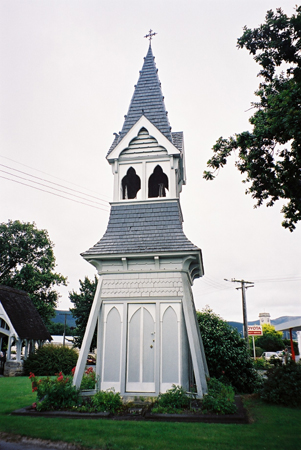
Lychgate, St Augustine's Church, Waimate. CC BY 3.0 Image courtesy of commons.wikimedia.org | jokertrekker | 19/09/2009 | jokertrekker - Wikimedia Commons
Lychgate, St Augustine's Church, Waimate. CC BY-NC-ND 2.0 Image courtesy of www.flickr.com | Shellie Evans - flyingkiwigirl | 03/12/2013 | Shellie Evans
Lychgate, St Augustine's Church, Waimate. Image courtesy of www.flickr.com | PhilBee NZ - Phil Braithwaite | 07/02/2021 | Phil Braithwaite

List Entry Information

Overview

Status
Listed

List Entry Status
Historic Place Category 2

Access
Private/No Public Access

List Number
2043

Date Entered
11th December 2003

Date of Effect
11th December 2003

City/District Council
Waimate District

Region
Canterbury Region

Extent of List Entry

Registration includes lychgate on its site.

Legal description

Pt Sec 118 Town of Waimate (RT CB21/79), Canterbury Land District

Detailed List Entry
Significance

Historic Significance

Historical Significance or Value The lychgate's historical significance relates to its association with the development of the church and the connections with the Studholme family.

Physical Significance

The lychgate at St. Augustine's Church has aesthetic values in its design and Gothic form. It has architectural significance as a work by notable architect Samuel Hurst Seager. This example demonstrates his focus on the Gothic forms of the structure as well as the finely crafted detailing of timber work and metal fastenings.

Detail Of Assessed Criteria

The lychgate merits Category II registration because of its special historical and cultural significance summarised as follows: It reflects an aspect of New Zealand history as part of the St. Augustine's Church's development. The building complex here illustrates the English traditions which the original settlers strove to replicate in Canterbury. The memorial is dedicated to members of the pioneering Studholme family, notable early settlers. The lychgate, along with the church complex, has the potential to provide knowledge of the district's past. The grouping is in a prominent position within the town and makes a major contribution to the townscape, appreciated by the community as a whole. The high quality of design in all elements of the church grouping - the church, bell tower and lychgate - give value to them all. Mrs. Studholme felt that the provision of a lychgate in this peaceful church setting was an appropriate means to commemorate her husband and sons.

Construction Professional

Name

Seager, Samuel Hurst

Type

Architect

Biography

Seager (1855-1933) studied at Canterbury College between 1880-82. He trained in Christchurch in the offices of Benjamin Woolfield Mountfort (1825-1898) and Alfred William Simpson before completing his qualifications in London in 1884. In 1885, shortly after his return to Christchurch, he won a competition for the design of the new Municipal Chambers, and this launched his career. Seager achieved renown for his domestic architecture. He was one of the earliest New Zealand architects to move away from historical styles and seek design with a New Zealand character. The Sign of the Kiwi, Christchurch (1917) illustrates this aspect of his work. He is also known for his larger Arts and Crafts style houses such as Daresbury, Christchurch (1899). Between 1893 and 1903 Seager taught architecture and design at the Canterbury University College School of Art. He was a pioneer in town planning, having a particular interest in the "garden city" concept. Some of these ideas were expressed in a group of houses designed as a unified and landscaped precinct on Sumner Spur (1902-14). He became an authority on the lighting of art galleries. After World War I he was appointed by the Imperial War Graves Commission to design war memorials in Gallipoli, Belgium and France. In New Zealand he designed the Massey Memorial, Point Halswell, Wellington (1925).

Construction Materials

Timber, shingled roof.

Physical Description

An Oamaru limestone base supports the timber side structure of open lancets. It has timber rafters and collar ties, diagonal herringbone sarked roof with timber shingles. A cross motif in timber decorates the apex of the gable ends and the steeply pitched roof is topped by a timber ridge cresting with diamond patterned piercing. Seat benches are built into the stone base at each side. A pair of low timber gates feature the original forged hardware and latch.

Reference

Completion Date

6th September 2004

Report Written By

Pam Wilson

Report Written By

A fully referenced version of this report is available from the NZHPT Southern Region Office. Please note that entry on the New Zealand Heritage List/Rarangi Korero identifies only the heritage values of the property concerned, and should not be construed as advice on the state of the property, or as a comment of its soundness or safety, including in regard to earthquake risk, safety in the event of fire, or insanitary conditions.

Further Information

Current Usages

Uses: Religion

Specific Usage: Lych Gate

Former Usages

General Usage:: Religion

Specific Usage: Lych Gate

Themes

Web Links

Overview

Status

Listed

List Entry Status

Historic Place Category 2

Access

Private/No Public Access

List Number

2043

Date Entered

11th December 2003

Date of Effect

11th December 2003

City/District Council

Waimate District

Region

Canterbury Region

Extent of List Entry

Registration includes lychgate on its site.

Legal description

Pt Sec 118 Town of Waimate (RT CB21/79), Canterbury Land District

Status

Listed

List Entry Status

Historic Place Category 2

Access

Private/No Public Access

List Number

2043

Date Entered

11th December 2003

Date of Effect

11th December 2003

City/District Council

Waimate District

Region

Canterbury Region

Extent of List Entry

Registration includes lychgate on its site.

Legal description

Pt Sec 118 Town of Waimate (RT CB21/79), Canterbury Land District

Significance

Why is this place significant?

Historic Significance

Historical Significance or Value The lychgate's historical significance relates to its association with the development of the church and the connections with the Studholme family.

Physical Significance

The lychgate at St. Augustine's Church has aesthetic values in its design and Gothic form. It has architectural significance as a work by notable architect Samuel Hurst Seager. This example demonstrates his focus on the Gothic forms of the structure as well as the finely crafted detailing of timber work and metal fastenings.

Why is this place Category 1 / Category 2?

Detail Of Assessed Criteria

The lychgate merits Category II registration because of its special historical and cultural significance summarised as follows: It reflects an aspect of New Zealand history as part of the St. Augustine's Church's development. The building complex here illustrates the English traditions which the original settlers strove to replicate in Canterbury. The memorial is dedicated to members of the pioneering Studholme family, notable early settlers. The lychgate, along with the church complex, has the potential to provide knowledge of the district's past. The grouping is in a prominent position within the town and makes a major contribution to the townscape, appreciated by the community as a whole. The high quality of design in all elements of the church grouping - the church, bell tower and lychgate - give value to them all. Mrs. Studholme felt that the provision of a lychgate in this peaceful church setting was an appropriate means to commemorate her husband and sons.

Why is this place significant?

Historic Significance

Historical Significance or Value The lychgate's historical significance relates to its association with the development of the church and the connections with the Studholme family.

Physical Significance

The lychgate at St. Augustine's Church has aesthetic values in its design and Gothic form. It has architectural significance as a work by notable architect Samuel Hurst Seager. This example demonstrates his focus on the Gothic forms of the structure as well as the finely crafted detailing of timber work and metal fastenings.

Why is this place Category 1 / Category 2?

Detail Of Assessed Criteria

The lychgate merits Category II registration because of its special historical and cultural significance summarised as follows: It reflects an aspect of New Zealand history as part of the St. Augustine's Church's development. The building complex here illustrates the English traditions which the original settlers strove to replicate in Canterbury. The memorial is dedicated to members of the pioneering Studholme family, notable early settlers. The lychgate, along with the church complex, has the potential to provide knowledge of the district's past. The grouping is in a prominent position within the town and makes a major contribution to the townscape, appreciated by the community as a whole. The high quality of design in all elements of the church grouping - the church, bell tower and lychgate - give value to them all. Mrs. Studholme felt that the provision of a lychgate in this peaceful church setting was an appropriate means to commemorate her husband and sons.

Construction Information

Construction Professional

Name

Seager, Samuel Hurst

Type

Architect

Biography

Seager (1855-1933) studied at Canterbury College between 1880-82. He trained in Christchurch in the offices of Benjamin Woolfield Mountfort (1825-1898) and Alfred William Simpson before completing his qualifications in London in 1884. In 1885, shortly after his return to Christchurch, he won a competition for the design of the new Municipal Chambers, and this launched his career. Seager achieved renown for his domestic architecture. He was one of the earliest New Zealand architects to move away from historical styles and seek design with a New Zealand character. The Sign of the Kiwi, Christchurch (1917) illustrates this aspect of his work. He is also known for his larger Arts and Crafts style houses such as Daresbury, Christchurch (1899). Between 1893 and 1903 Seager taught architecture and design at the Canterbury University College School of Art. He was a pioneer in town planning, having a particular interest in the "garden city" concept. Some of these ideas were expressed in a group of houses designed as a unified and landscaped precinct on Sumner Spur (1902-14). He became an authority on the lighting of art galleries. After World War I he was appointed by the Imperial War Graves Commission to design war memorials in Gallipoli, Belgium and France. In New Zealand he designed the Massey Memorial, Point Halswell, Wellington (1925).

Construction Materials

Timber, shingled roof.

Construction Professional

Name

Seager, Samuel Hurst

Type

Architect

Biography

Seager (1855-1933) studied at Canterbury College between 1880-82. He trained in Christchurch in the offices of Benjamin Woolfield Mountfort (1825-1898) and Alfred William Simpson before completing his qualifications in London in 1884. In 1885, shortly after his return to Christchurch, he won a competition for the design of the new Municipal Chambers, and this launched his career. Seager achieved renown for his domestic architecture. He was one of the earliest New Zealand architects to move away from historical styles and seek design with a New Zealand character. The Sign of the Kiwi, Christchurch (1917) illustrates this aspect of his work. He is also known for his larger Arts and Crafts style houses such as Daresbury, Christchurch (1899). Between 1893 and 1903 Seager taught architecture and design at the Canterbury University College School of Art. He was a pioneer in town planning, having a particular interest in the "garden city" concept. Some of these ideas were expressed in a group of houses designed as a unified and landscaped precinct on Sumner Spur (1902-14). He became an authority on the lighting of art galleries. After World War I he was appointed by the Imperial War Graves Commission to design war memorials in Gallipoli, Belgium and France. In New Zealand he designed the Massey Memorial, Point Halswell, Wellington (1925).

Construction Materials

Timber, shingled roof.

Physical Description

An Oamaru limestone base supports the timber side structure of open lancets. It has timber rafters and collar ties, diagonal herringbone sarked roof with timber shingles. A cross motif in timber decorates the apex of the gable ends and the steeply pitched roof is topped by a timber ridge cresting with diamond patterned piercing. Seat benches are built into the stone base at each side. A pair of low timber gates feature the original forged hardware and latch.

An Oamaru limestone base supports the timber side structure of open lancets. It has timber rafters and collar ties, diagonal herringbone sarked roof with timber shingles. A cross motif in timber decorates the apex of the gable ends and the steeply pitched roof is topped by a timber ridge cresting with diamond patterned piercing. Seat benches are built into the stone base at each side. A pair of low timber gates feature the original forged hardware and latch.

Reference

Historical and Associated Iwi / Hapū / Whānau

Completion Date

6th September 2004

Report Written By

Pam Wilson

Other Information

A fully referenced version of this report is available from the NZHPT Southern Region Office. Please note that entry on the New Zealand Heritage List/Rarangi Korero identifies only the heritage values of the property concerned, and should not be construed as advice on the state of the property, or as a comment of its soundness or safety, including in regard to earthquake risk, safety in the event of fire, or insanitary conditions.

Historical and Associated Iwi / Hapū / Whānau

Completion Date

6th September 2004

Report Written By

Pam Wilson

Other Information

A fully referenced version of this report is available from the NZHPT Southern Region Office. Please note that entry on the New Zealand Heritage List/Rarangi Korero identifies only the heritage values of the property concerned, and should not be construed as advice on the state of the property, or as a comment of its soundness or safety, including in regard to earthquake risk, safety in the event of fire, or insanitary conditions.

Further Information

Current Usages

Uses: Religion

Specific Usage: Lych Gate

Former Usages

General Usage: Religion

Specific Usage: Lych Gate

Current Usages

Uses: Religion

Specific Usage: Lych Gate

Former Usages

General Usage: Religion

Specific Usage: Lych Gate

Location

Loading
Related listings
St Augustine's Church Belltower
St Augustine's Church (Anglican). Image courtesy of www.flickr.com
St Augustine's Church (Anglican)
St Augustine's Church (Anglican). Image courtesy of www.flickr.com
St Augustine's Church (Anglican)
St Augustine's Church Belltower
Sign up to hear more

Get the latest heritage news, features and events delivered
straight to your inbox.

Subscribe
