Situated south of the prominent Te Waiateruati pā near Temuka, the Timaru pakainga was a well-known tauranga waka (landing place) and mahinga kai. In the 1830s, whalers had been attracted to Timaru and some stayed to settle on the land. The colonial town developed in the 1850s and maps from this time show the area where the Timaru Council Offices and Former Public Library (Façade) building now stands as being open hilly land, less than 300 metres from what was then the foreshore.
In 1904 the Timaru Borough Council purchased a site on George Street from Dr Gabites for £1150 to allow for municipal buildings and library to be erected for the Council. An architectural competition was held and the selected design by Walter Panton and Son was constructed in two phases. The first half completed was the public library, as a result of Mayor James Craigie securing funding from Andrew Carnegie for such a purpose. The library was constructed in 1908 and opened in 1909. The second half of the original design – the municipal buildings – was built soon after in 1911-1912.
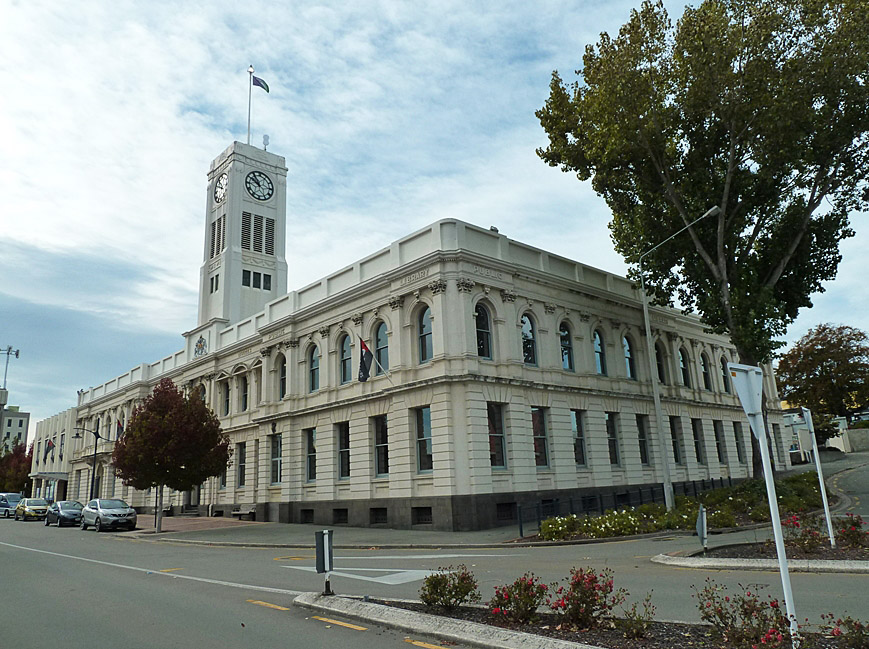
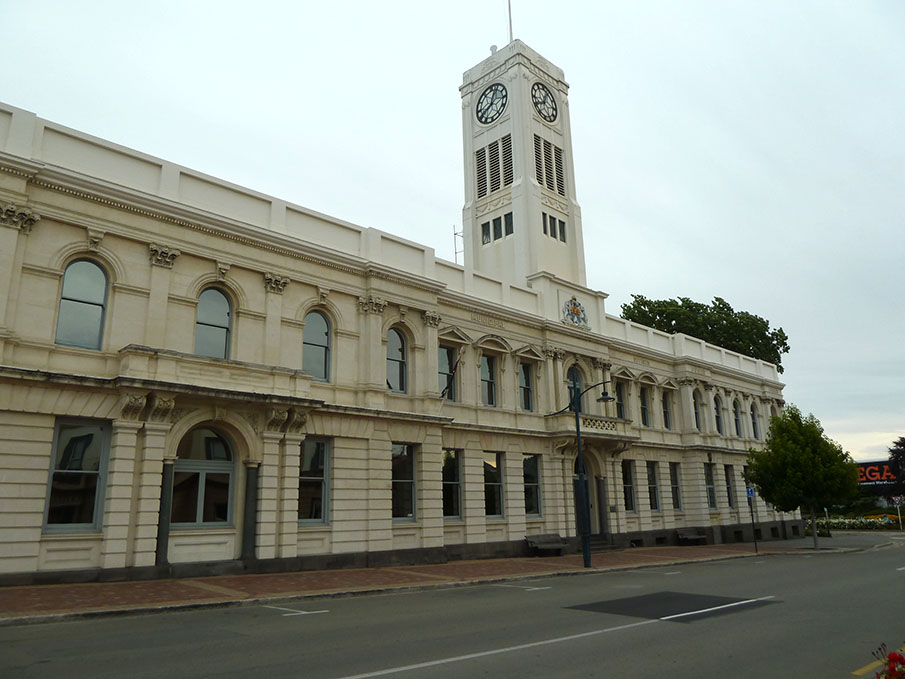
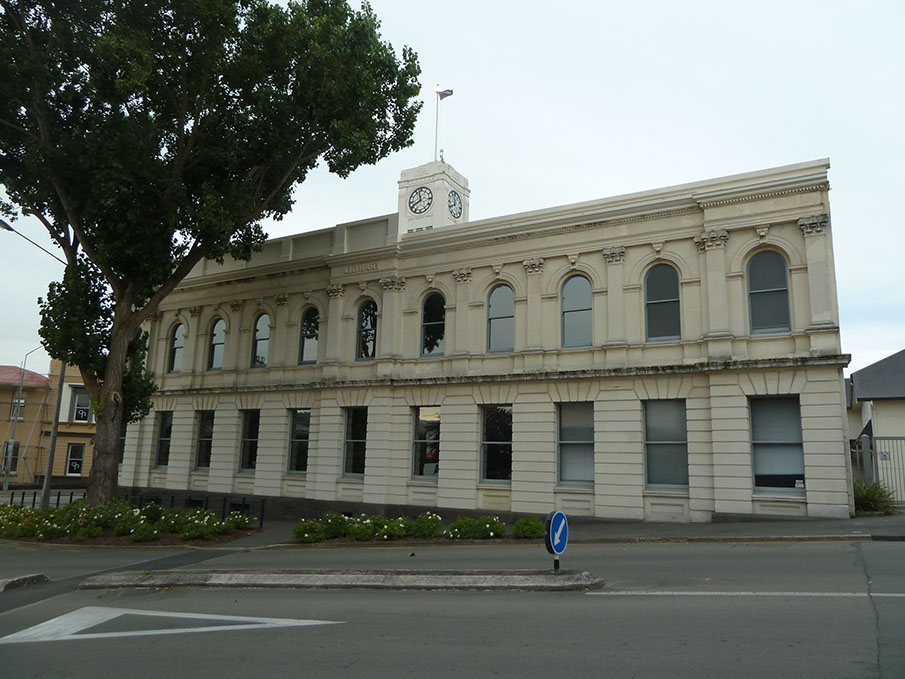
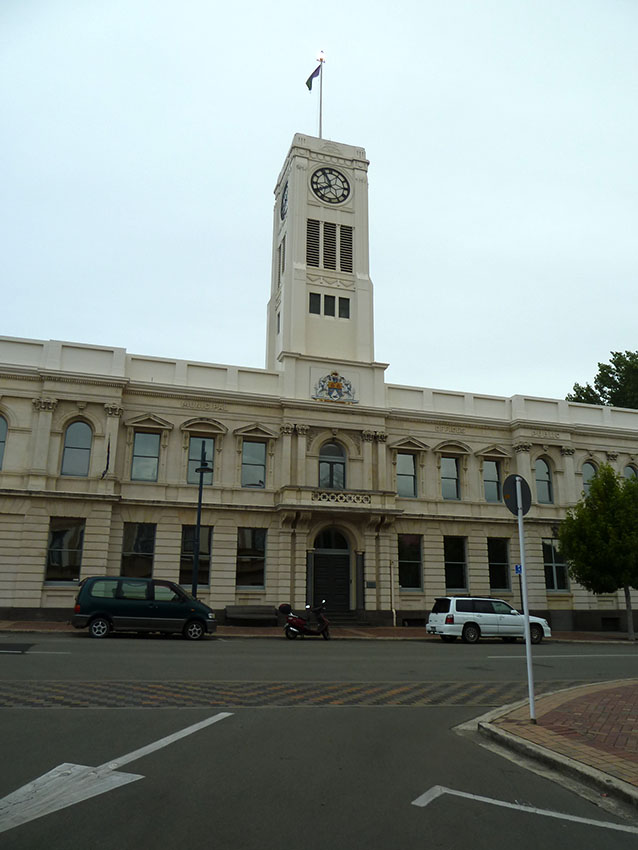
The Timaru Council Offices and Former Public Library (Façade) is a two storeyed classically designed frontage, in a palazzo style, with pilasters and Corinthian capitals, keystones and medallions. The foundations are grey Timaru ‘bluestone’, while the main part of the west and north façades are built of Ōamaru stone. The main entrance, fronting King George Place, is accessed by seven bluestone steps and a vestibule leading to a pair of doors. Above the main entrance is a balcony and the plain pediment contains the Council’s coat of arms. Inscribed in the stonework of the frieze, are the words ‘Municipal’, ‘Offices’, ‘Public’ and ‘Library’. A tall concrete clocktower rises centrally from the roof line. As well having glazed clock faces, the tower also contains bells behind louvres, and is surmounted by a 7.6 metre flagpole and topped with a lamp. The building fabric behind the north and west façades is modern, the south façade containing rows of fenestration and a light grey coloured cladding. Below is a renovated basement. The roof is corrugated steel.
Several major additions were made to the building in the two decades following initial completion. The library was extended to the south-west in 1914 and the council buildings were extended to the east in 1927. An impressive addition in 1933 was the clocktower, designed by Victor H Panton, which reuses a clock mechanism previously in the Post Office clocktower and given to the city by former Mayor, James Craigie, in 1913. In early 1946 a permanent Lamp of Remembrance was installed at the top of the clocktower’s flagpole, at the instigation of the then mayor, A E S Hanan, as a memorial to the men who served in World War Two. In 1962 the parapet, including pediments and finials, was removed during a general facelift of the façade. From 1979 the library part of the building was converted to offices. A major redevelopment programme in circa 2003-2005 involved the demolition and rebuilding of most of the building whilst retaining the north and west facades and the clocktower. In its new modern interior, the building continues to function as the Timaru District Council offices. Despite the major rebuild behind the north and west façades, the street-facing exterior looks largely the same as it did for much of the twentieth century, and it is an appreciated architectural feature of the town.

List Entry Information
Status
Listed
List Entry Status
Historic Place Category 2
Access
Private/No Public Access
List Number
2075
Date Entered
23rd June 1983
Date of Effect
2nd May 2024
City/District Council
Timaru District
Region
Canterbury Region
Extent of List Entry
Extent includes part of the land described as Lots 1-3 DP 1490 (CT CB185/272), Canterbury Land District and the north and west façades and clocktower of the building structure known as Timaru Council Offices and Former Public Library (Façade) thereon. The extent includes the clocktower, including its mechanisms and bells as well as the lamp of remembrance atop the clocktower. (Refer to map in Appendix 1 of the List entry report for further information).
Legal description
Lots 1-3 DP 1490 (CT CB185/272), Canterbury Land District
Status
Listed
List Entry Status
Historic Place Category 2
Access
Private/No Public Access
List Number
2075
Date Entered
23rd June 1983
Date of Effect
2nd May 2024
City/District Council
Timaru District
Region
Canterbury Region
Extent of List Entry
Extent includes part of the land described as Lots 1-3 DP 1490 (CT CB185/272), Canterbury Land District and the north and west façades and clocktower of the building structure known as Timaru Council Offices and Former Public Library (Façade) thereon. The extent includes the clocktower, including its mechanisms and bells as well as the lamp of remembrance atop the clocktower. (Refer to map in Appendix 1 of the List entry report for further information).
Legal description
Lots 1-3 DP 1490 (CT CB185/272), Canterbury Land District
Why is this place significant?
Cultural Significance
Cultural Significance or Value Timaru Council Offices and Former Public Library (Façade) has cultural significance. The historic façade is the recognisable face of a building that functions as an interface between the council and the community. A focal point for territorial local authority administration of the Timaru district, it represents the way our districts serve the community and can be seen as a place of civic pride as well as public scrutiny and diverging views. Elected representatives meet in the Council chambers and, along with staff as public servants, debate and make decisions that impact the community. The public library that was in this building for many years provided reading material to a wide range of readers, thus supporting various reading communities including those seeking self-improvement and further education. The Lamp of Remembrance memorial atop the flagpole on the clocktower reflects community attitudes to the commemoration of those from the district who lost their lives during the significant international conflict of World War Two. Social Significance or Value Timaru Council Offices and Former Public Library (Façade) has social significance. It is the front-facing presence of the council, and its clocktower acts as a centre point of the civic building which continues to bring people together. The clock face time pieces and, especially at night, the ever-lit beacon of the Lamp of Remembrance provide a point of reference for the community. It is expected that there would be a collective sense of loss should the community no longer be able to use and interact with the building.
Historic Significance
Historical Significance or Value Timaru Council Offices and Former Public Library (Façade) has historical significance. The first part of the building, constructed in 1908-1909, was its large free public library. One of the earliest of the 18 Carnegie libraries built in New Zealand with funding provided by the Scottish-born American steel magnate and philanthropist, Andrew Carnegie, the Timaru library was often singled out for praise for serving its residents more adequately than any other place in the country. Already a substantial building, it was soon added to with an extension of the reading and circulation rooms in the mid-1910s, demonstrating its popularity and relevance. The shift of the library contents to a new purpose-built library in the city in 1979 highlights its ongoing significance and value to the community, while the taking-over of the former library portion by the council at that time showed the ever-increasing space requirements of its administration. The municipal offices built adjoining the library, constructed in 1911-12 and extended again in the mid-1920s and early 1930s, demonstrate the development and influence of the local authority.
Physical Significance
Aesthetic Significance or Value Timaru Council Offices and Former Public Library (Façade) has aesthetic significance. In their scale, materials and design, the north and west façades are considered visually appealing. The sound of the bells chiming in the clocktower is also a celebrated component of the place, as evidenced by efforts made to repair when the mechanisms ceased functioning for a time. The Lamp of Remembrance and associated plaque can elicit an emotional response as a solemn reminder of locals from the district who lost their lives in the Second World War. Architectural Significance or Value The building has architectural significance. Designed by Walter Panton and Son as the result of an architectural design competition, the façade is noted for its Italianate style in Ōamaru stone, bluestone and Scotch granite, and the clocktower stands as a prominent feature on the skyline. Despite the changes behind, the façade continues to form a noteworthy part of the townscape and provides a visual continuity of proportion, scale, use of materials, relationship of solid to void, colour and texture. The façade has craftsmanship value, particularly in its decorative detailing around window and door openings.
Why is this place Category 1 / Category 2?
Detail Of Assessed Criteria
This place was assessed against the Section 66(3) criteria and found to qualify under the following criteria: a, b, e and h. The assessment concludes that this place should be listed as a Category 2 historic place. (a) The extent to which the place reflects important or representative aspects of New Zealand history Timaru Council Offices and Former Public Library (Façade) reflects representative aspects of New Zealand history. From the late nineteenth century, local authorities proliferated in New Zealand. At the start of the second decade of the twentieth century - around the time that the Timaru municipal building was constructed - the country had almost 4,000 local bodies. The smaller ones have since been amalgamated but Timaru council has maintained its local body prominence and continues to operate as the civic offices on this exact site. Throughout New Zealand, territorial local authorities are the established decision-makers for a wide range of regulatory and social functions in their communities. Like other centres, Timaru Borough Council (from 1948 Timaru City Council) has provided roading, drainage, water supply, piped water, parks, libraries and other public facilities. It represents the civic administration of the district, with the mayor, councillors and staff serving the interests of their community. (b) The association of the place with events, persons, or ideas of importance in New Zealand history Timaru Council Offices and Former Public Library (Façade) is especially notable for being an early Carnegie library, associated with the Scots-American philanthropist, Andrew Carnegie, who gave money for the construction of public libraries throughout the world in the early twentieth century. New Zealand benefited from his donations and 18 Carnegie libraries were opened in New Zealand between 1908 and 1916. The Timaru Public Library was one of the early Carnegie libraries in New Zealand. The library is also closely associated with Everlyn Culverwell, New Zealand’s first female chief librarian, who was at the helm of the library for 23 years from 1913 and was held in very high regard in the community and national library circles. (e) The community association with, or public esteem for the place As a recognised part of Timaru’s built heritage, Timaru Council Offices and Former Public Library (Façade)'s prominence and location is a much-appreciated tangible reminder of the city’s long and ongoing civic history. Despite the major alterations of the early twenty first century, its north and west exteriors are recognisably the same building as that which was built incrementally and with much pride throughout the first three decades of the twentieth century. The very fact that the façade was retained – and not pulled down – when redevelopment was required shows the value recognised. The clocktower as a visual and audible timekeeper continues to be of importance to the community and any works carried out to it are reported in the Timaru newspapers. (h) The symbolic or commemorative value of the place The Timaru Council Offices and Former Public Library (Façade) building has both symbolic and commemorative value. In each phase of its construction in the twentieth century, the building reflected the council’s view of progressiveness of the borough. When the clocktower was added, the importance of its audible and visible reliability was stressed, itself a reflection of how the council wished to portray its role. The retention of the north and west façades and clocktower as part of the major redevelopment of the council buildings in the early twenty first century shows that these historic elements symbolise the longevity and gravity of the place. The Lamp of Remembrance on top of the clocktower commemorates men who fought, suffered and died during the Second World War, 1939-1945. Perpetual lights have occasionally been utilised in New Zealand as memorials to those who died in events such as in the South African War, World War One and World War Two and can be found in places such as schools, churches, war memorials and at Returned Services Associations. The mayor of Timaru, A E S Hanan, was widely applauded for his effort in installing the Lamp of Remembrance on the Timaru municipal buildings and it is notable for continuing to shine as a beacon seen from near and far. Summary of Significance or Values The Timaru Council Offices and Former Public Library (Façade) has historical and cultural significance. As an important remnant of a well-crafted, architecturally significant work by Timaru architects Walter Panton and Son, it is part of the history of local government in Timaru and as a Carnegie Library. Despite major redevelopment in the early twenty first century, the building retains key physical elements, namely its north and west façades, war memorial lamp of remembrance, and clocktower. As such, the building has aesthetic, architectural, cultural, historical and social significance or value.
Why is this place significant?
Cultural Significance
Cultural Significance or Value Timaru Council Offices and Former Public Library (Façade) has cultural significance. The historic façade is the recognisable face of a building that functions as an interface between the council and the community. A focal point for territorial local authority administration of the Timaru district, it represents the way our districts serve the community and can be seen as a place of civic pride as well as public scrutiny and diverging views. Elected representatives meet in the Council chambers and, along with staff as public servants, debate and make decisions that impact the community. The public library that was in this building for many years provided reading material to a wide range of readers, thus supporting various reading communities including those seeking self-improvement and further education. The Lamp of Remembrance memorial atop the flagpole on the clocktower reflects community attitudes to the commemoration of those from the district who lost their lives during the significant international conflict of World War Two. Social Significance or Value Timaru Council Offices and Former Public Library (Façade) has social significance. It is the front-facing presence of the council, and its clocktower acts as a centre point of the civic building which continues to bring people together. The clock face time pieces and, especially at night, the ever-lit beacon of the Lamp of Remembrance provide a point of reference for the community. It is expected that there would be a collective sense of loss should the community no longer be able to use and interact with the building.
Historic Significance
Historical Significance or Value Timaru Council Offices and Former Public Library (Façade) has historical significance. The first part of the building, constructed in 1908-1909, was its large free public library. One of the earliest of the 18 Carnegie libraries built in New Zealand with funding provided by the Scottish-born American steel magnate and philanthropist, Andrew Carnegie, the Timaru library was often singled out for praise for serving its residents more adequately than any other place in the country. Already a substantial building, it was soon added to with an extension of the reading and circulation rooms in the mid-1910s, demonstrating its popularity and relevance. The shift of the library contents to a new purpose-built library in the city in 1979 highlights its ongoing significance and value to the community, while the taking-over of the former library portion by the council at that time showed the ever-increasing space requirements of its administration. The municipal offices built adjoining the library, constructed in 1911-12 and extended again in the mid-1920s and early 1930s, demonstrate the development and influence of the local authority.
Physical Significance
Aesthetic Significance or Value Timaru Council Offices and Former Public Library (Façade) has aesthetic significance. In their scale, materials and design, the north and west façades are considered visually appealing. The sound of the bells chiming in the clocktower is also a celebrated component of the place, as evidenced by efforts made to repair when the mechanisms ceased functioning for a time. The Lamp of Remembrance and associated plaque can elicit an emotional response as a solemn reminder of locals from the district who lost their lives in the Second World War. Architectural Significance or Value The building has architectural significance. Designed by Walter Panton and Son as the result of an architectural design competition, the façade is noted for its Italianate style in Ōamaru stone, bluestone and Scotch granite, and the clocktower stands as a prominent feature on the skyline. Despite the changes behind, the façade continues to form a noteworthy part of the townscape and provides a visual continuity of proportion, scale, use of materials, relationship of solid to void, colour and texture. The façade has craftsmanship value, particularly in its decorative detailing around window and door openings.
Why is this place Category 1 / Category 2?
Detail Of Assessed Criteria
This place was assessed against the Section 66(3) criteria and found to qualify under the following criteria: a, b, e and h. The assessment concludes that this place should be listed as a Category 2 historic place. (a) The extent to which the place reflects important or representative aspects of New Zealand history Timaru Council Offices and Former Public Library (Façade) reflects representative aspects of New Zealand history. From the late nineteenth century, local authorities proliferated in New Zealand. At the start of the second decade of the twentieth century - around the time that the Timaru municipal building was constructed - the country had almost 4,000 local bodies. The smaller ones have since been amalgamated but Timaru council has maintained its local body prominence and continues to operate as the civic offices on this exact site. Throughout New Zealand, territorial local authorities are the established decision-makers for a wide range of regulatory and social functions in their communities. Like other centres, Timaru Borough Council (from 1948 Timaru City Council) has provided roading, drainage, water supply, piped water, parks, libraries and other public facilities. It represents the civic administration of the district, with the mayor, councillors and staff serving the interests of their community. (b) The association of the place with events, persons, or ideas of importance in New Zealand history Timaru Council Offices and Former Public Library (Façade) is especially notable for being an early Carnegie library, associated with the Scots-American philanthropist, Andrew Carnegie, who gave money for the construction of public libraries throughout the world in the early twentieth century. New Zealand benefited from his donations and 18 Carnegie libraries were opened in New Zealand between 1908 and 1916. The Timaru Public Library was one of the early Carnegie libraries in New Zealand. The library is also closely associated with Everlyn Culverwell, New Zealand’s first female chief librarian, who was at the helm of the library for 23 years from 1913 and was held in very high regard in the community and national library circles. (e) The community association with, or public esteem for the place As a recognised part of Timaru’s built heritage, Timaru Council Offices and Former Public Library (Façade)'s prominence and location is a much-appreciated tangible reminder of the city’s long and ongoing civic history. Despite the major alterations of the early twenty first century, its north and west exteriors are recognisably the same building as that which was built incrementally and with much pride throughout the first three decades of the twentieth century. The very fact that the façade was retained – and not pulled down – when redevelopment was required shows the value recognised. The clocktower as a visual and audible timekeeper continues to be of importance to the community and any works carried out to it are reported in the Timaru newspapers. (h) The symbolic or commemorative value of the place The Timaru Council Offices and Former Public Library (Façade) building has both symbolic and commemorative value. In each phase of its construction in the twentieth century, the building reflected the council’s view of progressiveness of the borough. When the clocktower was added, the importance of its audible and visible reliability was stressed, itself a reflection of how the council wished to portray its role. The retention of the north and west façades and clocktower as part of the major redevelopment of the council buildings in the early twenty first century shows that these historic elements symbolise the longevity and gravity of the place. The Lamp of Remembrance on top of the clocktower commemorates men who fought, suffered and died during the Second World War, 1939-1945. Perpetual lights have occasionally been utilised in New Zealand as memorials to those who died in events such as in the South African War, World War One and World War Two and can be found in places such as schools, churches, war memorials and at Returned Services Associations. The mayor of Timaru, A E S Hanan, was widely applauded for his effort in installing the Lamp of Remembrance on the Timaru municipal buildings and it is notable for continuing to shine as a beacon seen from near and far. Summary of Significance or Values The Timaru Council Offices and Former Public Library (Façade) has historical and cultural significance. As an important remnant of a well-crafted, architecturally significant work by Timaru architects Walter Panton and Son, it is part of the history of local government in Timaru and as a Carnegie Library. Despite major redevelopment in the early twenty first century, the building retains key physical elements, namely its north and west façades, war memorial lamp of remembrance, and clocktower. As such, the building has aesthetic, architectural, cultural, historical and social significance or value.
Construction Professional
Name
Walter Panton
Type
Architect
Biography
No biography is currently available for this construction professional
Name
B R Tooth & Son
Type
Builder
Biography
No biography is currently available for this construction professional
Name
Hunt and Werry (Builders)
Type
Builder
Biography
Builders of Hay’s Building (Former), Timaru - 1908 and the concrete and brickwork for the D.C. Turnbull & Co. Limited Buildings, Timaru - 1901
Name
Victor Panton
Type
Architect
Biography
No biography is currently available for this construction professional
Name
W J Harding
Type
Builder
Biography
No biography is currently available for this construction professional
Name
John Calder
Type
Builder
Biography
Name
McDonald & Wilson
Type
Architect
Biography
Name
Trengrove & Blunt
Type
Architectural Partnership
Biography
Name
S Mcbride
Type
Stonemason
Biography
No biography is currently available for this construction professional
Construction Details
Start Year
1909
Type
Original Construction
Description
Library constructed
Start Year
1912
Type
Original Construction
Description
Municipal Chambers completed
Start Year
1926
startYearCirca
Type
Addition
Start Year
1946
Type
Modification
Description
Lamp of Remembrance added to top of flagpole
Type
Modification
Description
Façade alterations
Period
1960s
Start Year
1914
Type
Addition
Description
South-west extension to Library
Start Year
1927
Type
Addition
Description
East extension to Municipal Buildings
Start Year
1933
Finish Year
1934
Type
Addition
Description
Clocktower constructed
Type
Partial Demolition
Description
north and west façades and clocktower retained, while remainder of building demolished and rebuilt
Period
Early 2000s
Construction Materials
Ōamaru stone, bluestone foundations, Scotch granite columns, reinforced concrete, glass, timber, metal
Construction Professional
Name
Walter Panton
Type
Architect
Biography
No biography is currently available for this construction professional
Name
B R Tooth & Son
Type
Builder
Biography
No biography is currently available for this construction professional
Name
Hunt and Werry (Builders)
Type
Builder
Biography
Builders of Hay’s Building (Former), Timaru - 1908 and the concrete and brickwork for the D.C. Turnbull & Co. Limited Buildings, Timaru - 1901
Name
Victor Panton
Type
Architect
Biography
No biography is currently available for this construction professional
Name
W J Harding
Type
Builder
Biography
No biography is currently available for this construction professional
Name
John Calder
Type
Builder
Biography
Name
McDonald & Wilson
Type
Architect
Biography
Name
Trengrove & Blunt
Type
Architectural Partnership
Biography
Name
S Mcbride
Type
Stonemason
Biography
No biography is currently available for this construction professional
Construction Details
Start Year
1909
Type
Original Construction
Description
Library constructed
Start Year
1912
Type
Original Construction
Description
Municipal Chambers completed
Start Year
1926
startYearCirca
Type
Addition
Start Year
1946
Type
Modification
Description
Lamp of Remembrance added to top of flagpole
Type
Modification
Description
Façade alterations
Period
1960s
Start Year
1914
Type
Addition
Description
South-west extension to Library
Start Year
1927
Type
Addition
Description
East extension to Municipal Buildings
Start Year
1933
Finish Year
1934
Type
Addition
Description
Clocktower constructed
Type
Partial Demolition
Description
north and west façades and clocktower retained, while remainder of building demolished and rebuilt
Period
Early 2000s
Construction Materials
Ōamaru stone, bluestone foundations, Scotch granite columns, reinforced concrete, glass, timber, metal
Early Timaru Timaru was an integral component of the extensive Ngāi Tahu network of kāinga (settlement) and mahinga kai (food-gathering places) located throughout South Canterbury. Situated south of the prominent Te Waiateruati pā, Hoani Kahu from Arowhenua described Timaru as 'he pā nō mua, he kāinga nohoaka tūturu, he tūahu tapu, he urupā tūpapa, and he tauranga waka’. There was open space and plentiful kai to be found in the area. Building and clothing resources and foods were gathered at Timaru, including manu (birds), tuna (eel), ika (fish), makō (shark), hāpuku (groper), pipi, pāua, kina, and kaeo. Whalers had been attracted to Timaru in the 1830s, and some stayed to settle on the land, providing early colonial presence. The controversial Canterbury Purchase (Kemp’s Deed) land sale took place in the late 1840s but the area remained important to iwi who were able to negotiate a 20 acre reserve to be set aside (Native Reserve 884 at Caroline Bay). Early maps from the 1850s show the area where the Timaru Council building now stands as being open hilly land, less than 300 metres from what was then the foreshore. In 1850, William and George Rhodes took up ‘The Levels run’, a vast tract of land in South Canterbury, and subsequently began to use the shoreline at Timaru to ship goods in and out. The Rhodes brothers were responsible for the initial land purchase and survey of a town in 1853. The government surveyed its own settlement immediately to the south of the Rhodes land in 1856 but it was ‘Rhodes Town’, immediately behind the beach by the established immigrant landing sites, where the commercial centre of Timaru developed and flourished after 1859. Colonial settlers began to arrive in significant numbers from 1859, and over the next decades Timaru’s population and prosperity grew on the back of farming and the port. There was especially high population growth between 1896 until 1911. An important provincial hub, Timaru connected its residents and the South Canterbury region to the rest of New Zealand and beyond physically through road and rail and intangibly via mail, newspapers and other reading material. A building fitting the town’s civic infrastructure was required. In 1904 the Timaru Borough Council purchased a site on George Street from Dr Gabites for £1150 to allow for new corporation buildings to be erected for the Council. Competitive designs for the municipal buildings and library had been called for and that of architect Walter Panton was accepted. Library The first part of the building completed was the public library, as a result of Mayor James Craigie securing a gift of ₤3000 by ‘steel king’, Andrew Carnegie, for such a purpose. Carnegie was a Scots-American philanthropist who donated funds for libraries all over the world, including in New Zealand. The library replaced the Mechanics’ Institute and Library, which had been located in North Street, and which been established as a subscription library in Timaru in the early 1860s. The Carnegie-funded new library was constructed in 1908 and opened in 1909. On the day of the opening, the Timaru Herald’s editorial commented: ‘The possession of a free public library seems to be one of the marks which indicate that a town has reached a certain maturity, as the communal provision and use of such an institution is to some extent a luxury. … All over the civilised world, legislative provision has been made for the equipment of public libraries at the public expense, while here and there this has been done by the generosity of individuals, who thus acknowledged their personal indebtedness to the world of literature. The acquisition of a public library by Timaru, which will shortly be achieved, is a notable mark of the progress of the town …’. When it opened in 1909, it was one of only three libraries in New Zealand offering free access and borrowing rights to all residents. As well as being a key institution for accessing reading material, it was a place where connections were established and extended. Within two years of the library’s opening, 15% of Timaru’s population had become members. By 1934 that figure had increased to almost 30%, a notably high proportion given that the average library membership across New Zealand, Australia and Britain at this time was 10%. In early 1913 the Timaru Borough Council appointed Evelyn Culverwell as chief librarian, the first woman to hold this position in New Zealand. The appointment of a female was considered a bold move by the Council but Culverwell’s professional training and ethos soon proved invaluable. The first action she took as chief librarian was to review and re-order the entire book stock and begin cataloguing using the Dewey System, which she stated would ‘bring the Timaru Library into line with the four leading libraries of the Dominion’. She also set aside a section in the lending library for children and juvenile readers, mirroring a trend in public libraries in the English-speaking world. In 1913-14 the library was extended to the south-west, with the addition of two spacious rooms for reading and circulating. Municipal Chambers The remainder of Panton’s initial design, the Municipal Chambers, was completed in 1912 in the same style as the library. These new buildings were intended to reflect the dignity of the ‘august body’ of the Timaru Borough Council, the local government law makers. They contained rooms for the Town Clerk, Mayor, Council Chambers, general office with a counter and strong room, waiting room, a room to be used to hold booths when elections were held, an engineer’s room (which was also a strong room), toilets and a cellar which housed more toilets, heating plant and storage rooms. The stone balcony above the main entrance, built to accommodate about 20 people, was intended ‘to make public utterances whenever occasion arises’. Additions and Clocktower In 1927 the building was extended further to the east in the same style, accommodating the municipal electricity department showrooms and offices. The architects for the ‘extensive additions to the Municipal Buildings for the Timaru Borough Council’ were again Walter Panton and Son. Early in 1933, the council held a competition for the design of a new town clocktower as a further major addition. The successful entrant was Victor H Panton, son of Walter who had died two years earlier, and the clocktower was built by W J Harding Ltd. Standing tall above the roof line, it houses a clock mechanism with chimes given to the city by former Mayor, James Craigie, in 1913, which was original in the Post Office clocktower (later demolished). Lamp of Remembrance In August 1945, at the instigation of the mayor, A E S Hanan, a temporary lamp burned on top of the flagpole on the clocktower in memory of men who had fallen, so recently, in the Second World War. It was an experiment to trial how a lamp might perform, and the following year it was replaced by a perpetual burning light, paid for by public subscription. Known as the Lamp of Remembrance, the permanent memorial was installed in 1946 at the top of the clocktower’s flagpole, shining for miles to the outer suburbs. In 1962 the building’s parapet, including pediments and finials, was removed during a general facelift of the façade. From 1979 a new library opened in the town and the library part of the municipal building was converted to offices. A major redevelopment programme in circa 2003-2005 involved the demolition and rebuilding of most of the building whilst retaining the north and west facades and the clocktower. In its new interior, the building continues to function as the Timaru District Council offices. The mechanisms for the chimes were repaired in 2023, so that the clock once again rings out on the hour.
Current Description Located in an elevated location in King George Place in Timaru’s central business district, the Timaru Council Offices and Former Public Library (Façade) is a prominent building seen from many vantage points. When viewed from the street, the building retains much the same appearance as it did through most of the twentieth century. Designed by Walter Panton and Son, it is a two storeyed classically designed building, in a Renaissance palazzo style, with pilasters and Corinthian capitals, keystones and medallions. The foundations are grey Timaru ‘bluestone’, while the main part of west and north façades are Ōamaru stone. It has rusticated detailing on the ground floor, decorative rounded headed windows and entrances, colonnades, decorative brackets supporting a parapet and central clocktower. The main entrance, on the north elevation, is accessed by seven bluestone steps and a vestibule leading to a pair of doors. Above the main entrance is a balcony and the plain pediment contains the Council’s coat of arms. Inscribed in the stonework of the frieze, are the words ‘Municipal’, ‘Offices’, ‘Public’ and ‘Library’. The concrete clocktower rises centrally from the roof line, around 27 metres in height above the footpath. As well having glazed clock faces, the tower also contains bells behind louvres, and is surmounted by a 7.6 metre flagpole and topped with a perpetually lit lamp. Major works to the building in the first decade of the twenty first century resulted in the street-fronting facades, the basement space and the clocktower being retained, while the rest was demolished and rebuilt. The building fabric behind the north and west façades is modern, the south façade containing rows of fenestration and a light grey coloured cladding. The roof is corrugated steel. Below is a basement which has been relined as part of the early twenty first century redevelopment. Comparative information: historic places as façades A small number of historic places were already only historic façades when first entered on the List, such as Waitaki Boys’ High School Façades (Category 1 historic place, List No. 358) and Kirkcaldie and Stains Department Store Façade, Wellington (Category 2 historic place, List No. 1402). Even when the Timaru City Council Offices and Former Public Library was first assessed for Listing in 1983, it was the exterior that the Buildings Classification Committee were primarily interested in. Most Listed places that are façades were originally entered on the List as a whole building but later development has resulted in façade-only retention. Where those places remain on the List following formal review, they tend to be in prominent locations within towns and cities and, from the outside at least, are recognisably the buildings that were identified for their heritage values. Examples of places on the New Zealand Heritage List/Rārangi Kōrero (the List) which were previously a whole building and reviewed as a ‘Façade’ include: Commercial Building Façade, 181 High Street and Tuam Street, Christchurch (Category 2 historic place, List No. 1909), which is a three-storeyed stone-faced building providing a noteworthy streetscape presence as a post-Canterbury Earthquakes (2010-11) survivor from what was previously a prominent 1910 Edwardian building on the site. The façade is a tangible reminder of the building’s long and respected history as a city furniture and furnishings store, first as A J White’s and later as McKenzie and Willis. Junction Hotel (Former) Façade, 112 High Street, Rangiora (Category 2 historic place, List No. 3783, which provides a noteworthy streetscape presence as a post-Canterbury Earthquakes (2010 and 2011) survivor from what was previously a prominent Victorian building on the site. When viewed from the street, the Hotel Façade retains much the same classical appearance as it did for nearly 90 years before the 2010 and 2011 Canterbury earthquakes. It is two storeys in height, with rusticated detailing on the ground floor, decorative rounded headed windows and entrances, colonnades, decorative brackets supporting a simple balcony with metal railing and dentils supporting a plain parapet. The façade is a tangible reminder of the building’s long and prominent history as a hotel. Oxley’s Hotel Façade, Picton (Category 2 historic place, List No. 5108) which retains architectural significance as a very good example of the public architecture of a quality hotel from the 1890s. Much of the aesthetic value of the original Oxley's Hotel façade remains in place and is enhanced by the refurbishment and reinstatement of the colonial verandah, which contributes a significant three-dimensional aspect to this façade. As one of the most important remaining fragments of built heritage in the town, Oxley's Hotel Façade's prominence and location in an area highly visible from the foreshore and harbour approach provides an excellent opportunity for utilising interpretation to tell the story of the history of Picton.
Historical and Associated Iwi / Hapū / Whānau
Completion Date
22nd January 2024
Report Written By
Robyn Burgess
Information Sources
Liebich, 2022
Liebich, Susann, Connected Readers: Reading Practices and Communities Across the British Empire, c. 1890-1930, PhD Thesis, 2012, Victoria University of Wellington
Other Information
A fully referenced copy of the review report is available from the Southern Regional Office of Heritage New Zealand Pouhere Taonga Please note that entry on the New Zealand Heritage List/Rārangi Kōrero identifies only the heritage values of the property concerned, and should not be construed as advice on the state of the property, or as a comment of its soundness or safety, including in regard to earthquake risk, safety in the event of fire, or insanitary conditions. A fully referenced upgrade report is available on request from the Southern Regional Office of Heritage New Zealand
Historical and Associated Iwi / Hapū / Whānau
Completion Date
22nd January 2024
Report Written By
Robyn Burgess
Information Sources
Liebich, 2022
Liebich, Susann, Connected Readers: Reading Practices and Communities Across the British Empire, c. 1890-1930, PhD Thesis, 2012, Victoria University of Wellington
Other Information
A fully referenced copy of the review report is available from the Southern Regional Office of Heritage New Zealand Pouhere Taonga Please note that entry on the New Zealand Heritage List/Rārangi Kōrero identifies only the heritage values of the property concerned, and should not be construed as advice on the state of the property, or as a comment of its soundness or safety, including in regard to earthquake risk, safety in the event of fire, or insanitary conditions. A fully referenced upgrade report is available on request from the Southern Regional Office of Heritage New Zealand
Current Usages
Uses: Commemoration
Specific Usage: Memorial - World War One
Uses: Commemoration
Specific Usage: Memorial - World War Two
Uses: Government
Specific Usage: Council/local government building
Uses: Government
Specific Usage: Flagpole
Former Usages
General Usage: Civic Facilities
Specific Usage: Library
Current Usages
Uses: Commemoration
Specific Usage: Memorial - World War One
Uses: Commemoration
Specific Usage: Memorial - World War Two
Uses: Government
Specific Usage: Council/local government building
Uses: Government
Specific Usage: Flagpole
Former Usages
General Usage: Civic Facilities
Specific Usage: Library
Location
Sign up to hear more
Get the latest heritage news, features and events delivered
straight to your inbox.

