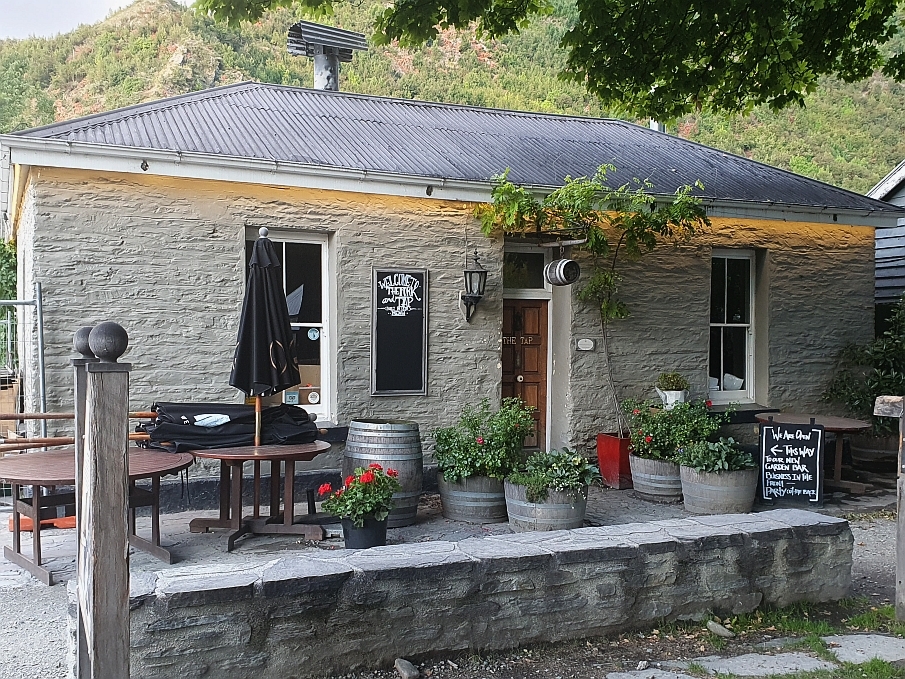
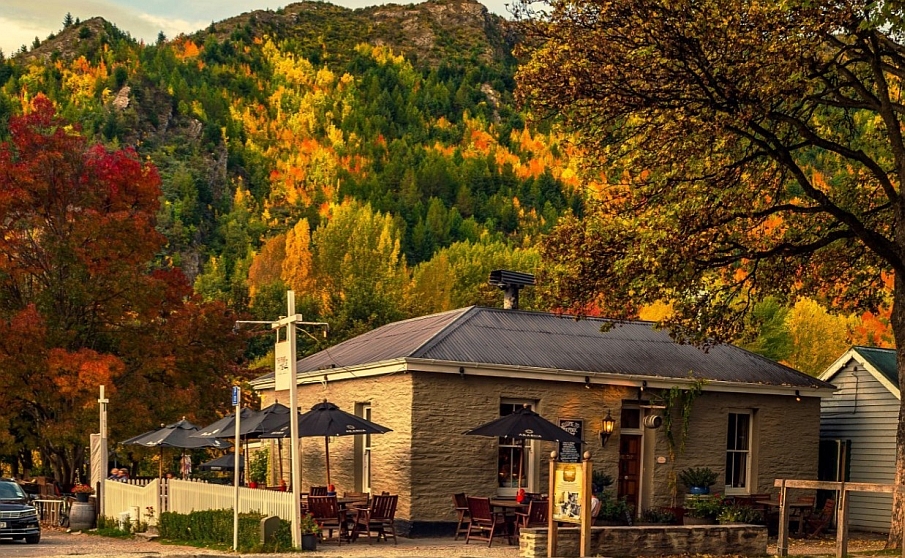
The stone building at the corner of Buckingham and Wiltshire Streets was constructed as a residence in 1874-5 for Marion and James Marshall. For many years during the 19th century, it was the face of the Colonial Bank of New Zealand in Arrowtown, as well as other commercial premises; later it was converted to a tearooms and currently operates as a bar and restaurant. It has been assessed as having historic and aesthetic heritage value.
Te Wai Pounamu has an enduring history of Māori occupation including at Te Haehaenui (the Arrow River) and Kā-muriwai (the Arrowtown Flat). Te Haehaenui was one of the ara tawhito (travel routes) between the Wanaka and Hāwea to Whakatipu-wai-Māori. Hunting of weka, koreke, tuna, aruhe, kāuru and kōura, supported the communities that were located there. Trade and transport continued throughout early gold mining (including Māori undertaking goldmining themselves) and despite alienation, tangata whenua for the area retain strong connections to the land.
Gold was first discovered on the Arrow in 1862 by William Fox. In the same year the goldfield was opened, and miners poured into the region, many from Victoria, Australia. During the goldrush years the total population of the Shotover and Arrow districts was estimated at about 3000. Like other goldfield towns, Arrowtown grew rapidly. In the early years accommodation for the miners consisted merely of calico tents, but this gradually changed with the erection of more permanent structures of timber and iron, and later in stone. The first Crown Grant for the land was given to Henry John Cope in 1870. Cope sold the land to Marion Marshall in 1874.
It is likely that Marion, and her husband, James, had the building constructed. A mortgage was taken out on the property in 1874 which could have provided the finance for this. A photograph taken in 1874 shows the building in mid-construction, while an article in the Lake County Press indicated that the erection of ‘a five-roomed house for Mr. Marshall’ was underway. The house is constructed in local stone, with a limewash render; the original building’s dimensions are 32 ft (~9.75 m) by 35 ft (~10.75 m). The windows have heavy stone sills and two-over-two timber sash windows. The roof (as of 2023) is hipped corrugated iron.
The Marshalls sold the property in 1875 to The Colonial Bank of New Zealand, who appear to have converted the building into a bank. The building may have been shared with other businesses – the legal/real estate firm of Preston & Cope advertised their business here from 1880, and later, the building became the offices of the Lake Country Press newspaper. Following the closure of the Colonial Bank of New Zealand, the property was sold in 1896 to Richard Turton, a barrister; later the property would pass to Wesley Turton in 1908. It is likely that the building reverted to residential use from 1896 until the 1970s, when the building was converted into tearooms. Since the 1970s the building has undergone various interior modifications, as well as the construction of a lean-to and outbuilding to the rear. In 2021, the building underwent seismic strengthening. As of 2023, it remains a commercial premises, operating as the Fork & Tap Restaurant and Bar.
Te Wai Pounamu has an enduring history of Māori occupation including at Te Haehaenui (the Arrow River) and Kā-muriwai (the Arrowtown Flat). Te Haehaenui was one of the ara tawhito (travel routes) between the Wanaka and Hāwea to Whakatipu-wai-Māori. Hunting of weka, koreke, tuna, aruhe, kāuru and kōura, supported the communities that were located there. Trade and transport continued throughout early gold mining (including Māori undertaking goldmining themselves) and despite alienation, tangata whenua for the area retain strong connections to the land.
Gold was first discovered on the Arrow in 1862 by William Fox. In the same year the goldfield was opened, and miners poured into the region, many from Victoria, Australia. During the goldrush years the total population of the Shotover and Arrow districts was estimated at about 3000. Like other goldfield towns, Arrowtown grew rapidly. In the early years accommodation for the miners consisted merely of calico tents, but this gradually changed with the erection of more permanent structures of timber and iron, and later in stone. The first Crown Grant for the land was given to Henry John Cope in 1870. Cope sold the land to Marion Marshall in 1874.
It is likely that Marion, and her husband, James, had the building constructed. A mortgage was taken out on the property in 1874 which could have provided the finance for this. A photograph taken in 1874 shows the building in mid-construction, while an article in the Lake County Press indicated that the erection of ‘a five-roomed house for Mr. Marshall’ was underway. The house is constructed in local stone, with a limewash render; the original building’s dimensions are 32 ft (~9.75 m) by 35 ft (~10.75 m). The windows have heavy stone sills and two-over-two timber sash windows. The roof (as of 2023) is hipped corrugated iron.
The Marshalls sold the property in 1875 to The Colonial Bank of New Zealand, who appear to have converted the building into a bank. The building may have been shared with other businesses – the legal/real estate firm of Preston & Cope advertised their business here from 1880, and later, the building became the offices of the Lake Country Press newspaper. Following the closure of the Colonial Bank of New Zealand, the property was sold in 1896 to Richard Turton, a barrister; later the property would pass to Wesley Turton in 1908. It is likely that the building reverted to residential use from 1896 until the 1970s, when the building was converted into tearooms. Since the 1970s the building has undergone various interior modifications, as well as the construction of a lean-to and outbuilding to the rear. In 2021, the building underwent seismic strengthening. As of 2023, it remains a commercial premises, operating as the Fork & Tap Restaurant and Bar.