

Both iwi history and archaeological evidence show Māori occupation in the Ōtākou / Otago region since the 12th century. Today, Kāi Tahu mana whenua is recognised over a large part of Te Wai Pounamu. Kāti Māmoe and Waitaha shared occupation are always acknowledged. The hapū Kai Te Pahi, Kāti Moki, and Kāti Taoka still maintain their presence and responsibility as kaitiaki in this region. Traditional Māori place names include Ōwheo (the Water of Leith), a river that runs in North Dunedin that the bridge crosses, that facilitated travel by waka from the coast to places further inland and the mouth of Ōwheo, known as Te Tutai o Te Matauira, was likely a valuable settlement area for accessing kaimoana and other resources.
By the 1870s Pākehā settlement at this end of George Street saw the value of the easy access to fresh water from the Water of the Leith and breweries and flour mills were established in the area. By 1900, residents were calling for a connection from Pine Hill and the north end of Dunedin to the northern end of George Street and were demanding a substantial traffic bridge.
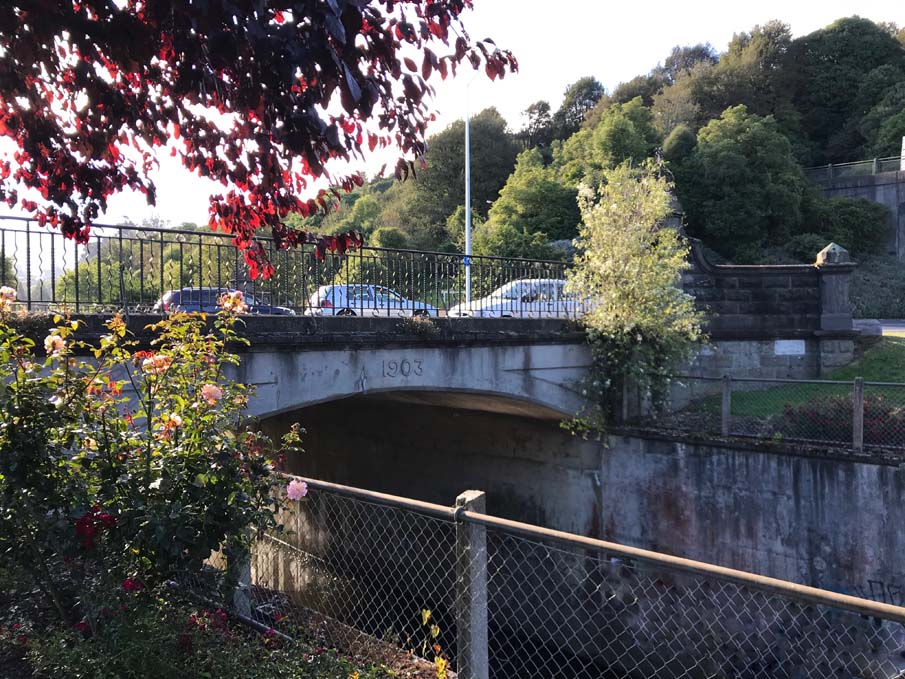
Proclaimed in 1903 as the first concrete arch bridge in the colony, Dunedin's George Street Bridge is a landmark in the history of bridge design in New Zealand. The designer was John Rogers recently appointed City Engineer for Dunedin. Rodgers recommended Monier construction, recently used in Australia from where he’d last been employed, which involved iron netting in cement mortar, which would be light, strong, inexpensive and durable. This was the first time Monier construction had been used as a bridge in New Zealand. Other projects such as the Musselburgh Pumping Station works and major drainage works in South Dunedin and central city in 1903-4 also went on to use the Monier construction. The plans were described as a “very pretty bridge… and should prove quite an ornament to the City”. The tender was won by A. Ferry. The Water of the Leith course was changed for a small distance by the bridge.
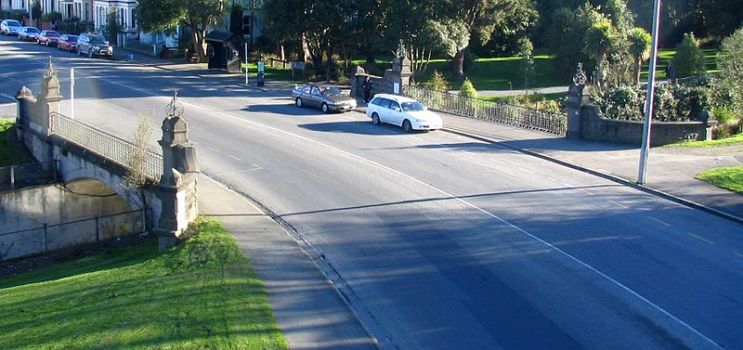
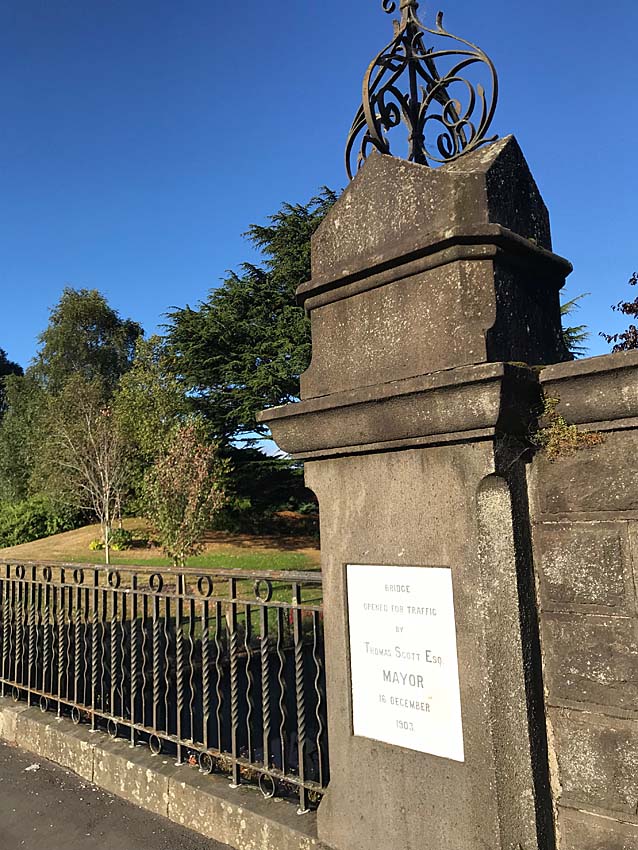
The walls of the bridge are constructed of Port Chalmers breccia with Timaru stone moulding panel with Kokonga granite for the pillar bases and cap mouldings. Wrought iron ornamental railing is in the stone base with four ornamental wrought iron lamps on four large pillars, that were lit by electric light from 1903. The arch was constructed on the 9 December 1902.
The new bridge enabled a new tram line to be established along George Street and the first sod was turned in a ceremony immediately after an inscribed tablet was inserted into the foundation stone of the George Street Bridge. The banks of the Leith were planted out in willows to add “beauty in years to come”. The bridge officially opened with the northern section of the Electric Tramways, the first concrete bridge of Monier construction in New Zealand. Guests of a luncheon took six trams to the George Street bridge where the Mayor unveiled a marble tablet and declared the bridge open for traffic. The bridge is a pioneer example of engineering technology along with significant historical and aesthetic values and is still used as a traffic bridge today.
List Entry Information
Status
Listed
List Entry Status
Historic Place Category 2
Access
Able to Visit
List Number
2157
Date Entered
2nd July 1982
Date of Effect
2nd July 1982
City/District Council
Dunedin City
Region
Otago Region
Extent of List Entry
Extent includes the land described as Part Town Belt (RT OT301/116) Town of Dunedin and the bridge known as George Street Bridge thereon.
Legal description
Part Town Belt (RT OT301/116) Town of Dunedin
Status
Listed
List Entry Status
Historic Place Category 2
Access
Able to Visit
List Number
2157
Date Entered
2nd July 1982
Date of Effect
2nd July 1982
City/District Council
Dunedin City
Region
Otago Region
Extent of List Entry
Extent includes the land described as Part Town Belt (RT OT301/116) Town of Dunedin and the bridge known as George Street Bridge thereon.
Legal description
Part Town Belt (RT OT301/116) Town of Dunedin
Construction Professional
Name
Ferry, A
Type
Builder
Biography
Name
Thompson and Co
Type
Stonemason
Biography
Name
Mr J Mann
Type
Foundry
Biography
Construction Details
Start Year
1903
Type
Original Construction
Construction Professional
Name
Ferry, A
Type
Builder
Biography
Name
Thompson and Co
Type
Stonemason
Biography
Name
Mr J Mann
Type
Foundry
Biography
Construction Details
Start Year
1903
Type
Original Construction
Historical and Associated Iwi / Hapū / Whānau
Completion Date
2nd August 2024
Report Written By
Alison Breese
Information Sources
Thornton, 1996
Geoffrey Thornton, Cast in Concrete: Concrete Construction in New Zealand 1850-1939, Auckland, 1996
Rillstone, 2002
Rillstone, Thomas, ‘A Piss-tory of Dunedin Breweries’, The Critic Te Ārohi, Issue 8, 2002, https://www.critic.co.nz/features/article/10059/a-piss-tory-of-dunedin-breweries accessed 15 July 2024
Otago Daily Times, 1899
Otago Daily Times, ‘The Monier Concrete System’, 13 June 1899, p 7, https://paperspast.natlib.govt.nz/newspapers/ODT18990613.2.55
Wymer, 2005
Wymer, Paul, “Cementing New Zealand’s Position as Innovators in Concrete Construction”, Conference Paper 2005, Concrete NZ
Other Information
This place was identified as significant under previous legislation with different information requirements. It remains significant under the current legislation. There is opportunity under our legislation and policies to add to this information. Further information about this place may be available from the Otago/Southland Office of Heritage New Zealand Pouhere Taonga. A fully referenced copy of the Upgrade Report is available upon request from the Southern Area Office of Heritage New Zealand Pouhere Taonga Disclaimer Please note that entry on the New Zealand Heritage List/Rarangi Korero identifies only the heritage values of the property concerned, and should not be construed as advice on the state of the property, or as a comment of its soundness or safety, including in regard to earthquake risk, safety in the event of fire, or insanitary conditions. Archaeological sites are protected by the Heritage New Zealand Pouhere Taonga Act 2014, regardless of whether they are entered on the New Zealand Heritage List/Rarangi Korero or not. Archaeological sites include ‘places associated with pre-1900 human activity, where there may be evidence relating to the history of New Zealand’. This List entry report should not be read as a statement on whether or not the archaeological provisions of the Act apply to the property (s) concerned. Please contact your local Heritage New Zealand office for archaeological advice
Historical and Associated Iwi / Hapū / Whānau
Completion Date
2nd August 2024
Report Written By
Alison Breese
Information Sources
Thornton, 1996
Geoffrey Thornton, Cast in Concrete: Concrete Construction in New Zealand 1850-1939, Auckland, 1996
Rillstone, 2002
Rillstone, Thomas, ‘A Piss-tory of Dunedin Breweries’, The Critic Te Ārohi, Issue 8, 2002, https://www.critic.co.nz/features/article/10059/a-piss-tory-of-dunedin-breweries accessed 15 July 2024
Otago Daily Times, 1899
Otago Daily Times, ‘The Monier Concrete System’, 13 June 1899, p 7, https://paperspast.natlib.govt.nz/newspapers/ODT18990613.2.55
Wymer, 2005
Wymer, Paul, “Cementing New Zealand’s Position as Innovators in Concrete Construction”, Conference Paper 2005, Concrete NZ
Other Information
This place was identified as significant under previous legislation with different information requirements. It remains significant under the current legislation. There is opportunity under our legislation and policies to add to this information. Further information about this place may be available from the Otago/Southland Office of Heritage New Zealand Pouhere Taonga. A fully referenced copy of the Upgrade Report is available upon request from the Southern Area Office of Heritage New Zealand Pouhere Taonga Disclaimer Please note that entry on the New Zealand Heritage List/Rarangi Korero identifies only the heritage values of the property concerned, and should not be construed as advice on the state of the property, or as a comment of its soundness or safety, including in regard to earthquake risk, safety in the event of fire, or insanitary conditions. Archaeological sites are protected by the Heritage New Zealand Pouhere Taonga Act 2014, regardless of whether they are entered on the New Zealand Heritage List/Rarangi Korero or not. Archaeological sites include ‘places associated with pre-1900 human activity, where there may be evidence relating to the history of New Zealand’. This List entry report should not be read as a statement on whether or not the archaeological provisions of the Act apply to the property (s) concerned. Please contact your local Heritage New Zealand office for archaeological advice
Former Usages
General Usage: Transport
Specific Usage: Bridge/ Viaduct
Former Usages
General Usage: Transport
Specific Usage: Bridge/ Viaduct
Location
Stay up to date with Heritage this month
