

Dunedin-born Alexander Crow McGeorge (1868-1953) was a major figure in the gold dredging boom of the late nineteenth century. McGeorge made his way in the world through luck and hard work – forming important partnerships which made him a wealthy man. An engineer, trained at Dunedin firm Cossens and Black, he later joined R.S. Sparrow and Company, a major supplier of dredging and gold saving machinery. In 1893, he was appointed engineer on a dredge working the Clutha River near Clyde. He was later engineer on the Chicago dredge owned by the Alexander Dredging Company. With his brothers he secured shares in the Chicago Gold Dredging Company and also the Manuherikia Gold Dredging Company. He returned to Dunedin in 1894, forming a new partnership to work the Electric and Magnetic claims on the Kawarau River, working near Cromwell. His Electric Gold Dredging Company, of which McGeorge was secretary and treasurer, ran the Lady Ranfurly dredge, which in 1902, set a record for the gold return on a week’s dredging.
In 1899, McGeorge married Ethel Aldred – Ethel’s wedding ring was crafted from the first gold won by McGeorge’s dredge. The couple moved to Dunedin in 1900, commissioning an ample residence on their generous section. An earlier dwelling was removed from the prominent site on the corner of High (now Highgate) and Leven Streets. Salmond advertised for tenders in July 1900. Ethel and Alexander called their home Kawarau, perhaps an indication of the wealth gleaned from the Kawarau River. When the couple returned from Central Otago to see how the house was getting on, they found that the builder had given the foundations a quarter turn, orienting the house to the view rather than the sun.
McGeorge’s trappings of wealth included the purchase of Humber car, an event of sufficient interest that it was reported in the newspaper. A ‘motor house’ for the second larger car was built in 1907. Lois Houston’s biography of McGeorge provides delightful insight into family life at Kawarau. Ethel died around 1938; Alexander lived in the house till his death in 1953. After Alexander’s death, the house was sold out of the family, and has had a varied history – converted to flats at one point, and later returned to a single family residence.
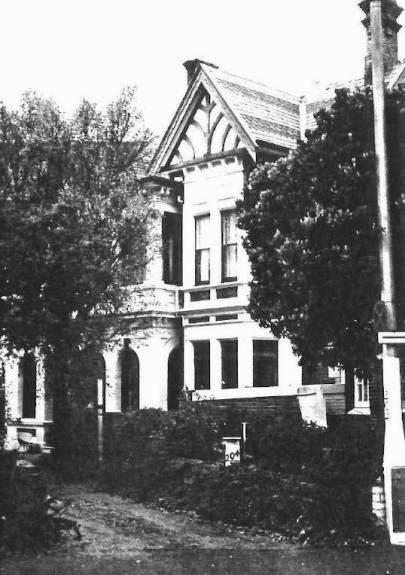
Kawarau is a grand gentleman’s residence, originally set on extensive grounds, although subdivided in 1939. Kawarau is two storeys, built of brick, with a slate roof. It has ornate decorative detailing with Tudors influences in the half timbering and veranda details. A 1920s photograph shows the grand house with its slate roof, decorative finials, pillars, glassed in sun porch, flagpole and immaculate gardens, and sweeping drive. In 2016, Kawarau remains a private residence.
List Entry Information
Status
Listed
List Entry Status
Historic Place Category 2
Access
Private/No Public Access
List Number
2186
Date Entered
2nd July 1982
Date of Effect
2nd July 1982
City/District Council
Dunedin City
Region
Otago Region
Extent of List Entry
Extent includes the land described as Lot 1 DP 437891 (RT 540882), Otago Land District, and the house known as Kawarau, thereon.
Legal description
Lot 1 DP 437891 (RT 540882), Otago Land District
Status
Listed
List Entry Status
Historic Place Category 2
Access
Private/No Public Access
List Number
2186
Date Entered
2nd July 1982
Date of Effect
2nd July 1982
City/District Council
Dunedin City
Region
Otago Region
Extent of List Entry
Extent includes the land described as Lot 1 DP 437891 (RT 540882), Otago Land District, and the house known as Kawarau, thereon.
Legal description
Lot 1 DP 437891 (RT 540882), Otago Land District
Construction Professional
Name
Salmond, James Louis
Type
Architect
Biography
James Louis Salmond (1868-1950) was born in North Shields, England. He was educated at Otago Boys' High School and began his career articled to Robert Arthur Lawson (1833-1902). Salmond initially practised on his own account but later rejoined Lawson in partnership. Salmond took over the practice when Lawson died in 1902. Salmond was the architect of over 20 churches in Otago including the Presbyterian churches at Roslyn, Kaikorai, North Dunedin and the Wesleyan church at Mornington. He designed many private residences including Watson Shennan's house at 367 High Street, as well as those at 114 Cargill Street and 14 Pitt Street, all in Dunedin. Salmond was president of the Otago Art Society, and also served a term as president of the New Zealand Institute of Architects. His son Arthur joined the firm having studied in London and his grandson John continues to work in the firm today. It is now known as Salmond Anderson Architects.
Construction Details
Start Year
1900
Finish Year
1901
Type
Original Construction
Start Year
1907
Type
Additional building added to site
Description
‘Motor House’ (garage) built
Start Year
1910
Type
Modification
Description
Electric light installed
Construction Professional
Name
Salmond, James Louis
Type
Architect
Biography
James Louis Salmond (1868-1950) was born in North Shields, England. He was educated at Otago Boys' High School and began his career articled to Robert Arthur Lawson (1833-1902). Salmond initially practised on his own account but later rejoined Lawson in partnership. Salmond took over the practice when Lawson died in 1902. Salmond was the architect of over 20 churches in Otago including the Presbyterian churches at Roslyn, Kaikorai, North Dunedin and the Wesleyan church at Mornington. He designed many private residences including Watson Shennan's house at 367 High Street, as well as those at 114 Cargill Street and 14 Pitt Street, all in Dunedin. Salmond was president of the Otago Art Society, and also served a term as president of the New Zealand Institute of Architects. His son Arthur joined the firm having studied in London and his grandson John continues to work in the firm today. It is now known as Salmond Anderson Architects.
Construction Details
Start Year
1900
Finish Year
1901
Type
Original Construction
Start Year
1907
Type
Additional building added to site
Description
‘Motor House’ (garage) built
Start Year
1910
Type
Modification
Description
Electric light installed
Historical and Associated Iwi / Hapū / Whānau
Completion Date
16th November 2016
Report Written By
Heather Bauchop
Information Sources
Dictionary of New Zealand Biography
Dictionary of New Zealand Biography
Houston, 2011
Lois Houston, Dredging the Past: The Life of Alex C. McGeorge, Lois Houston, Dunedin, 2011
Other Information
This place was identified as significant under previous legislation with different information requirements. It remains significant under the current legislation. There is opportunity under our legislation and policies to add to this information. Further information about this place may be available from the Otago/Southland Office of Heritage New Zealand Pouhere Taonga. Please note that entry on the New Zealand Heritage List/Rarangi Korero identifies only the heritage values of the property concerned, and should not be construed as advice on the state of the property, or as a comment of its soundness or safety, including in regard to earthquake risk, safety in the event of fire, or insanitary conditions. A fully referenced upgrade report is available on request from the Otago/Southland Area Office of Heritage New Zealand.
Historical and Associated Iwi / Hapū / Whānau
Completion Date
16th November 2016
Report Written By
Heather Bauchop
Information Sources
Dictionary of New Zealand Biography
Dictionary of New Zealand Biography
Houston, 2011
Lois Houston, Dredging the Past: The Life of Alex C. McGeorge, Lois Houston, Dunedin, 2011
Other Information
This place was identified as significant under previous legislation with different information requirements. It remains significant under the current legislation. There is opportunity under our legislation and policies to add to this information. Further information about this place may be available from the Otago/Southland Office of Heritage New Zealand Pouhere Taonga. Please note that entry on the New Zealand Heritage List/Rarangi Korero identifies only the heritage values of the property concerned, and should not be construed as advice on the state of the property, or as a comment of its soundness or safety, including in regard to earthquake risk, safety in the event of fire, or insanitary conditions. A fully referenced upgrade report is available on request from the Otago/Southland Area Office of Heritage New Zealand.
Current Usages
Uses: Accommodation
Specific Usage: House
Former Usages
General Usage: Accommodation
Specific Usage: House
Current Usages
Uses: Accommodation
Specific Usage: House
Former Usages
General Usage: Accommodation
Specific Usage: House
Location
Sign up to hear more
Get the latest heritage news, features and events delivered
straight to your inbox.
