Origins of the Otago Museum:
The museum has its origins in the work of Scottish-born geologist James Hector. In 1861 Hector was appointed director of the Geological Survey of Otago by the Otago Provincial Government. His arrival marked the beginning of a lengthy career in which he dominated the Colony's scientific institutions. Hector was asked to bring a set of mineral specimens that could be displayed in a museum, to which Otago’s examples could be added.
At the 1865 New Zealand Industrial Exhibition in Dunedin, the collection of five thousand rocks and minerals was displayed for the first time. Also for the first time, the collection was referred to as that of the Otago Museum. The exhibit was a success and a steering committee was formed to look into the establishment of a natural history museum. Time passed with little achieved. This was made poetically evident by one newspaper reporter:
‘...at the Exhibition of 1865, Otago’s exhibits of objects of Natural History took a prominent place; how there was great talk of what would be done with them when the Exhibition closed; how plans were suggested, and how in conversation and on paper a formidable rival to the British Museum was formed. And who does not know the result? Who does not know that when the Exhibition closed, our collection was bundled pell-mell into that noble building the Otago Rag and Bone Store? For months and months our precious exhibits lay there neglected. We can well remember how we used to fancy that the melancholy, and rather seedy looking penguin,…which looked as if it had mounted guard over the ruins of the collection, seemed to reproach passers by for the neglect of his duties as a citizen and a colonist.
On 1 July 1868 the first meeting of the Otago Museum Committee was held. The chairman was James Macandrew, Provincial Superintendent, and the committee included Sir Julius Vogel, Provincial Secretary and Treasurer.
Dunedin was transforming from a fledgling Presbyterian settlement, to a gold rush town, to New Zealand’s largest urban centre. Its population tripled in the 1870s. Dunedin experienced a growth of major public buildings, and space was found on one side of the upper story of the new Post Office Building to house the Museum collection. The following year the University of Otago moved into the same building; and so began the long-standing link between the two institutions. By 15 September 1868 the Otago Museum was opened to the public.
Appointed as the Director of the New Zealand Geological Survey and the Colonial Museum, Hector had left Dunedin in 1865. In October 1873 the Provincial Superintendent appointed Frederick Wollaston Hutton (1836-1905) as Provincial Geologist and the first official curator. Hutton’s first priority was larger, purpose-built accommodation.
Selection of the museum site caused debate. Initial plans sited the museum opposite the entrance to the Botanical Gardens. In August 1874, three political heavyweights Rev Dr D.M. Stuart, Captain Edward Cargill and John Hyde Harris, formed a deputation to the Provincial Deputy Superintendent, arguing that it was ‘absolutely necessary that the Museum be as near to the University as possible...The desire was to promote education generally...and if the institution was placed so great a distance from the centre of the town, it would be deprived of its character as a great practical school for the people, because working men and others would find it hard to attend the institution at so great a distance’. Their appeal was duly noted and sections on the public recreation reserve between Great King Street, Albany Street and Cumberland Street were secured.
The land on which the Museum was built was located in a block of swampy reserve land which included a public reserve for gardens (used as Chinese market gardens), the police barracks and a school reserve. These public reserves were part of a group of reserves set aside by Charles Kettle in his 1846 survey for the New Zealand Company, withheld from the sale of the 400,000 acre Otago Block and Crown granted to the superintendent of the Otago province in 1865, and vested in the management of the Dunedin City Corporation.
The Maori history of this area relates particularly to coastal Otago (Te Tai o Araiteuru) and the tradition of the waka Arai Te Uru. Muaupoko (Otago Peninsula) in particular provided a sheltered place for settlement At one time, prior to Pakeha settlement, up to twelve kaika existed in the lower Otago harbour. The coastline was a major trade route. Tauranga waka (moorings) and associated nohoanga (dwelling places) occurred up and down the coast, linking sea and land based resources. These traditions and histories are echoed in the present day Museum, presented in consultation with local Maori. The carving at the entrance way to the Tangata Whenua Gallery depicts the three ancestral waka - Araiteuru, Takitimu, and Uruao. The gallery includes Pataka Whakairo (the carved storehouse), WakaTe Paranihi and the gateway from Mapoutahi Pa - the scene of fighting between two groups of the Ngai Tahu tribe in the middle of the eighteenth century.
The Design:
In July 1874 Otago Provincial Gazette invited competitive designs for a museum building. In mid October architect David Ross (1827-1908) was announced as the winner. Ross was one of Dunedin’s most important architects and designed a number’s of the city’s major buildings, including the Union Steam Ship Company’s office, the Octagon Buildings, and the Athenaeum. Born in Scotland, Ross settled in Dunedin around 1862. After a brief partnership with William Mason he established his own practice. In 1870 he applied for a patent for the frames and apparatus required for concrete construction. This application places Ross at the forefront of the development of mass concrete construction. In 1875, architect Francis Petre used concrete to build Judge Chapman’s house. Although Petre was nicknamed ‘Lord Concrete’, it was not until 1877 that he used concrete in a major public building; the same year the Museum was constructed. Arguably, Ross was no less at the forefront of the new technology than Petre.
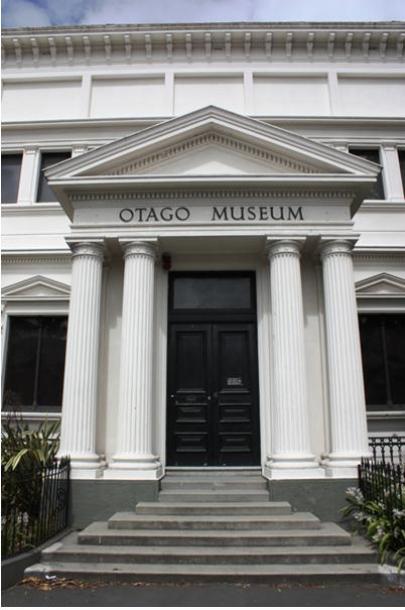
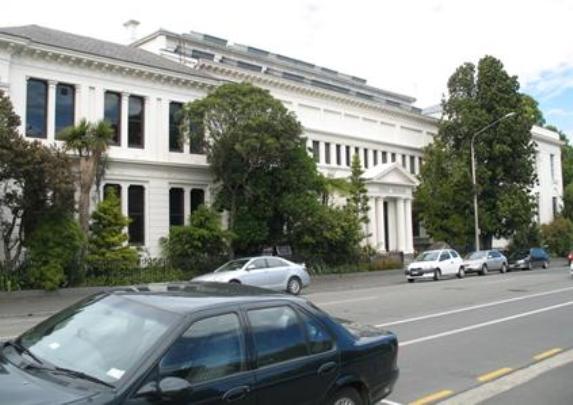
Ross’ design was based on the Cambridge Museum of Natural History in the United Kingdom. Due to financial considerations the Council decided to construct only the central portion of his design. The Otago Witness described Ross’ design, classifying the style of architecture as ‘Classical Greek.’ The entrance had sweeping steps up to a porch with imposing double Doric columns on each side. The design had a total frontage to Great King Street of about 200 feet (61 metres) by a depth of about 80 feet (24.3 metres). The basement was only partially sunk and, in this way, it could be well lighted and ventilated. The front of the building was designed with panelled spaces in which it was proposed to insert groups of statues in bas relief.
The main hall was 90 feet by 45 feet (27.4 by 13.7 metres). The height of the hall was 50 feet (15.2 metres) in the central portion. Two mezzanine galleries ran around the outer walls, providing more exhibition space. Elegant iron columns running from the floor to the roof supported the galleries on their outer sides. Behind the main hall were the curator’s room, invertebrate room and herbarium. The basement included a private room for the professor, a lecture room, a class room, a library, an unpacking-room, and a taxidermists’ room.
Ross proposed that all floors be made of fireproof concrete and that iron girders be used. He also ensured the building would be well lit using large skylights over the main hall, large and numerous windows and a row of lunettes on the perpendicular section of the roof.
Construction:
Contractor Edward Willis Uren won the tender. The foundations were laid in December 1874 and construction took almost three years. By February 1876 the walls of the basement were in place with the breccia and andesite base ready to receive the concrete walls. Some of the blocks were nearly eight feet long (2.4 metres), weighing up to nearly three tons (2721 kg). On completion the total cost of the structure and fittings was £12,500.
The Otago Museum Act 1877 vested the land, the buildings and all the exhibits to the University of Otago. An endowment fund was also provided. This arrangement lasted almost 80 years.
The Opening:
The Museum was opened on 11 August 1877. Though no ceremony was held it was visited by several hundred people that afternoon. First impressions were positive: ‘In point of construction, it leaves nothing to be desired, and is, in this particular, better adapted to the purpose than any Museum in New Zealand or Australia’. The Otago Museum was second only to the Colonial Museum in Wellington in providing a purpose-built facility for its collections.
One visitor was ‘agreeably surprised yesterday at the internal appearance of the building, the numerousness of the exhibits, and…the taste and judgement exhibited in classifying them:
‘On entering the building, the first thing which strikes the attention is the skeleton of a huge whale, and in close proximity the skeletons of moas and other large struthious birds, and the skeleton of a giraffe. On the same floor are numerous predaceous beasts (stuffed), including representatives of the lion and tiger species, Seals, sharks, monkeys, of varieties too numerous to mention, are here found in life-like postures. This floor, if it may not instruct many of the old, will certainly delight the young.’
On the first floor, accessed ‘by a commodious and handsome staircase’, were fossils, New Zealand stone implements, Maori images and artefacts, and a large collection of shells. On the upper floor the ‘eye is literally bewildered with the superb collection of birds of all countries and climes.’ There was also a large collection of insects.
The opening of the Museum was not without controversy. A week later, Rev Dr Stuart read the advertisement announcing that the Museum would be opened on Sunday afternoons at Knox Church’s morning service. He had ‘observed the announcement with regret, as this was another innovation on the rights and privileges of the people in the due observance of the Sabbath Day.’ He trusted his congregation ‘would not countenance the affair by their presence’. Public meetings followed, petitioning the Governor of New Zealand to close the Museum on Sundays.
Sabbatarians did not go unopposed. As one commentator wrote ‘So says Dr Stuart. Faugh! I am sick of hearing such balderdash. But as for the Museum, you pay for it, but it is by no means for you. It is only for rich people, those who have leisure during the week to visit it whilst you are at work. On Sundays – the only day when it is possible for you to see it - it is to be shut. It is, then, no longer a means of education...’
The public voted with their feet. It was reported that on each of the Sunday afternoons on 12th and 19th August about 7000 persons visited. Even the Dunedin Presbytery in January of 1878 remarked that ‘thousands mustered in favour of the opening.’ This controversy was echoed in other parts of New Zealand and the world, as debate raged over the secularisation of the Sabbath. In December 1879 the director, Hutton, resigned. He was succeeded by Professor Thomas Jeffery Parker, one of New Zealand’s greatest biologists. Parker organised the natural history specimens along Darwinian lines during his tenure from 1880 to 1897. Some of his handwritten labels are still on display.
In 1884 the whale skeleton, earlier purchased from Captain William Barry, was mounted and suspended from iron girders extending between the columns supporting the upper gallery. The 17 metre long fin whale skeleton is one of only a few complete fin whale skeletons in the world.
Into the Twentieth Century:
Spanning the nineteenth and twentieth centuries as head of the Museum was another prominent scientist, Professor William Benham (1860-1950). He was a zoologist of international renown who took up the Chair of Biology at the University in 1898 and, with it, the curatorship of the Otago Museum. He reorganised collections along ‘modern’ lines, building a notable comparative anatomy collection. He taught botany, zoology, dental anatomy, palaeontology, and was active on the University Council. Benham helped cement the relationship between the Museum and the University. By 1929, the Otago University Museum was considered the finest teaching museum in the Commonwealth. Benham was curator for 39 years. Retiring in 1937, he was awarded an honorary doctorate of science and in 1939 was knighted.
The Hocken Wing:
While work continued on maintaining the building and fixing some of the apparent defects (for example, in 1907 the Museum was ‘rendered watertight’ by the removal of the original wooden-framed skylights and the substitution of modern metal-framed lights, which effectively keep the rain out of the building) it became clear that more space was required for the expanding collection. By the early years of the twentieth century exhibition space was at a premium. A new Wing was required. Coincidentally, Dr Hocken was looking for a suitable institution to house his collection.
Thomas Morland Hocken (1836-1910) arrived in Dunedin in February 1862. He quickly established himself as a leading physician, a coroner, and later as manager of Dunedin Hospital and Lunatic Asylum. From the late 1870s, however, Hocken’s major passion was collecting. He travelled widely, collecting artefacts including Maori cloaks, hei tiki, mere and wooden carvings. From 1891 the Museum acquired almost the whole of this collection of Maori artefacts, which formed the basis of the ethnographic department. More particularly, however, Hocken is remembered for his collection of manuscripts, maps, paintings, photographs, newspapers, books and pamphlets relating to New Zealand and the Pacific.
On 2 September 1907 the Hocken Library Deed of Trust was signed gifting the collection to the people of New Zealand, to be held in trust by the University of Otago. The Deed was signed ‘upon condition that proper provision was made for appropriately housing the said Collection in Dunedin’. A new Museum Wing was agreed upon. The Deed included details of a building appeal which had raised £5553. The public subscribed £2576, £200 was donated by the Dunedin City Council, and £2776 was provided by the government, which matched pound for pound the amounts donated by subscribers and the Council.
Ross’ original design was reconsidered but thought to be too expensive. John Arthur Burnside (1856-1920) was chosen as architect for the new Wing. Born in Dunedin, Burnside became a well-known architect designing many of Dunedin’s important buildings, including the Perpetual Trustees and Agency Company building, the Theological Hall, Ashburn Hall, and the Burns Monument. He won competitions for the Colonial Mutual Life Offices and the Auckland Stock Exchange.
Burnside’s design was ‘in accordance’ with Ross’ original design. Added to the north side of the existing structure, Burnside designed a two-storied Wing. He also changed the shape and order of the windows but added similar decorative masonry on the cornice. The frontage was 47 feet (14.3 metres), with a height of 34 feet (10.3 metres) above the footpath. The northern side was 80 feet (24.4 metres) in length. The basement was to be constructed in stone and the two upper stories in brick and cement. The exterior would be as ‘as ornate as funds will permit and in keeping with the main building’. The large ground floor was for the display of exhibits. A large arched entranceway connected the central portion and the new Wing. Immediately inside this arch was to be a large concrete staircase leading to the first floor containing the Hocken Library.
The Curator, William Benham, said of the design ‘it is a distinctly handsome building, and the lighting is surprisingly good. I instructed the architect to use prismatic glass for the windows, which I had noticed highly recommended by museum experts in Europe and America: the result surpasses our expectation. The Exhibition Hall on the ground floor, which measures 75 feet by 40 feet (22.8 by 12.2 metres), and is 15 feet high (4.6 metres), is illuminated by windows at each end along one side; there is no dark corner in the hall….The Picture Gallery above is similarly lighted, but the library has clear glass windows on two sides, and being a smaller room is equally well lit. A gas-stove has been placed in this room for the convenience of readers in the winter...The basement, which I propose to have fitted partly as a laboratory, partly as a museum for teaching purposes,...is also illuminated on one side by prismatic glass, while the widows on the east side, below which the work benches will be placed, have clear glass’.
In January 1908 tenders were called for. Mr Orr Campbell’s tender for £3981 was accepted in February By April 1909 the build was complete. The Hocken Wing was opened on 23 March 1910 by the Governor Lord Plunket. Dr Hocken was ill and did not attend. He died in May.
Fels Wing:
The Museum collections continued to expand, due in part to the generosity of its many benefactors. Preeminent among these were the likes of Mary, Dora and Esmond de Beer, Charles Brasch, James Rattray, Alexander Thomson, Sir Frederick Chapman, James Begg, Dr Marjorie Barclay, Fred Waite, Percy Sargood, David Teviotdale, David Theomin, and Daniel Colquhoun.
Foremost amongst such benefactors was Willi Fels (1858-1946), who donated some 80,000 artefacts over the course of his life. Fels was born in Germany but moved to New Zealand with his new wife Sara, and her father successful businessman Bendix Hallenstein. Fels eventually became Managing Director of Hallenstein Bros and the Drapery and General Importing Company of NZ (DIC). Fels was an avid collector of objects of art, coins and of ethnographic material. Financially generous, donating more that £25,000 to the Museum, Fels was also a long-time chairman of the Museum Management Committee. The establishment of the Melanesian, Polynesian and Maori collections were largely due to his efforts.
When additional exhibition space was required Willi Fels was at the forefront of the project. The Willi Fels Wing was added to the south of Ross’ central portion. The Wing was designed by the architect Edmund Anscombe, although it is often ascribed to Miller and White. Edmund Anscombe (1874-1948) studied architecture in the United States, returning to Dunedin in 1907. Soon after he was appointed architect to the University Council, a position he held until 1929.
By 1927 sketch plans for a new wing were before the Museum Extension Committee. On 30 January 1928 Anscombe submitted his final plans. Later that year, Anscombe left for Wellington and his firm was taken over by the new Dunedin architectural partnership of Miller and White. They submitted the plans to the Dunedin City Council under the name of Miller & White, for Edmund Anscombe and Associates.
G. Lawrence & Sons won the tender at a price of £20,359. Construction began in October 1928 and by December 1929 the building was completed, with costs increasing to £22,000. The Extension Committee raised almost £25,000, to which the Government agreed to grant a subsidy of an equal amount.
On 16 October 1930 the Willi Fels Wing was officially opened by the chairman of the Museum Committee, Dr Marshall Macdonald. The wing was described as ‘striking architectural contrast to the main building, for in place of the dull grey concrete with Corinthian pillars and various heavy ornamentations considered correct at the time of its erection, in the new Wing the concrete is coated with a cream-coloured cement, giving the appearance of Oamaru stone, and the ornamentation has been reduced to a minimum; broad flat-grooved pillars separating the tall windows and passing from the base to the roof. ‘ The Wing consisted of two floors, each containing large halls measuring 120 feet by 60 feet (36.6 by 18.3 metres). Graceful narrow square concrete pillars supported the ceilings. The design included a handsome stairway of marble-like terrazzo flanked at the bottom by a pair of green serpentine square newel posts, and banisters covered by the same material. The Curator saluted the efforts of Fels, noting ‘this fine addition was rendered possible by the enthusiasm of Mr. Willi Fels’.
The 1930s and 1940s:
The Museum’s first New Zealand-born director was Henry Devenish Skinner, who was in charge from 1937 to 1957, although he was on staff as assistant curator from 1918. In 1919 Skinner was the first in Australasia to be appointed as a lecturer in anthropology. Skinner also obtained the position of librarian at the Hocken Library (1919-1926) and expanded in the collection. The greatest contribution of his career, however, is generally regarded as his revival of the Museum. Whereas his predecessors focussed mainly on natural science collections, Skinner built up the Museum’s cultural side. He grew the Maori and Pacific collections and encouraged the collection of antiquities from the Mediterranean and Middle East, and fine arts from Europe and Asia. He encouraged archaeological research into New Zealand pre-history. By 1951 Skinner could report that the Museum was richer by more than 100,000 acquisitions since 1919. He successfully brought the Museum ‘from provincial obscurity to national significance’.
The 1950s-1960s:
Succeeding Skinner as director in August 1957, Dr Raymond Forster (1922-2000) ushered in a period of research in the biological sciences. Forster combined his administrative duties with his research into spiders, gaining an international reputation for the collection, classification and biology of New Zealand spiders.
Two major changes took place in the 1950s. In 1955 the control of the museum was transferred from the University to a new Otago Museum Trust Board created by an Act of Parliament. Secondly, in the early 1950s the central well space between the second and third mezzanine galleries was filled in. This created extra exhibition space but altered Ross’ original design.
The 1963 Memorial Wing:
To commemorate the centenary of Otago in 1948, an additional wing was proposed. Funding issues saw the project delayed. In July 1957 Cabinet approved a grant of £40,000. A further £30,000 was still required. It was not until November 1958 that the final plans by James Hodge White (1896-1970) were approved.
James White had trained with Dunedin firm Salmond & Vane before serving in World War I. After the war he trained at the London School of Architecture. Returning to Dunedin, he formed a successful partnership with Eric Miller in 1927. Particularly interested in Art Deco, it has been said that he left ‘an indelible impression on the Dunedin cityscape’.
On 23 March 1963 the Centennial Memorial Wing was opened by the Governor-General Brigadier Sir Bernard Fergusson. Built by Fletcher Construction, it was attached to the eastern side of the Fels Wing and fronted on to the Museum Reserve. The Centennial Wing accommodated the H.D. Skinner Hall of Polynesia ‘which demonstrated beautifully the modern method of display techniques.’ The spaces also catered for the Hall of Marine Life, the new Natural History gallery and administration offices.
July 1973 saw the new Maritime Gallery opened. Situated on the second floor of Ross’ original building, it was established in conjunction with the Otago Maritime Society. Containing model boats, ship flags, and bells, the centrepiece was the fin whale skeleton suspended from the ceiling since 1884.
The Children’s Gallery: Animal Attic:
Despite the Museum’s many physical changes, the Children’s Gallery remained largely intact and unchanged. Now known as the Animal Attic, it is one of New Zealand’s finest examples of timbered Victorian architecture. The centre of the Gallery is shiplap rimu, the centre is supported by kauri and rimu beams and the display cases are carved oak and mahogany. The exhibition layout also remains intact, representing one of the few remaining examples worldwide of a Victorian gallery and the only one of its kind in New Zealand. The layout reflects the Victorian’s evolutionary views, ‘with the specimens displayed in a linear fashion from single celled animals to human beings, seen as the pinnacle of evolution.’
The Animal Attic is at the top level of the original Ross portion. From its inception, the Museum was lit by skylights and windows that flooded the gallery with natural light. This caused UV damage to the specimens which faded over the years. The Attic, having fallen into disrepair, was closed in 1979 by the New Zealand Fire Service as it no longer satisfied egress requirements. In 1996, however, the Animal Attic underwent a major redevelopment project, with the goal to restore the gallery to its original layout.
The 1980s-2000s:
In 1980 the Hocken Library moved from the Hocken Wing to the Hocken Building on the University Campus. Hocken’s collection of artefacts remained at the Museum.
Following Richard Cassels, who focused on the Museum’s responsibilities in the wider community, Shimrath Paul was appointed Director in 1995. Paul oversaw an 18 million dollar Museum redevelopment, designed by prominent Dunedin architect Ted McCoy.
Ted McCoy, of McCoy and Wixon, established his practice in 1950. He was awarded the Gold Medal for lifetime achievement in architecture from the NZ Institute of Architects and has won eight national awards and twenty regional awards for his buildings.
The contractors were Naylor Love. Funds were attracted from the New Zealand Lottery Grants Board, the Community Trust of Otago, Central Government, local government and corporate and public fundraising.
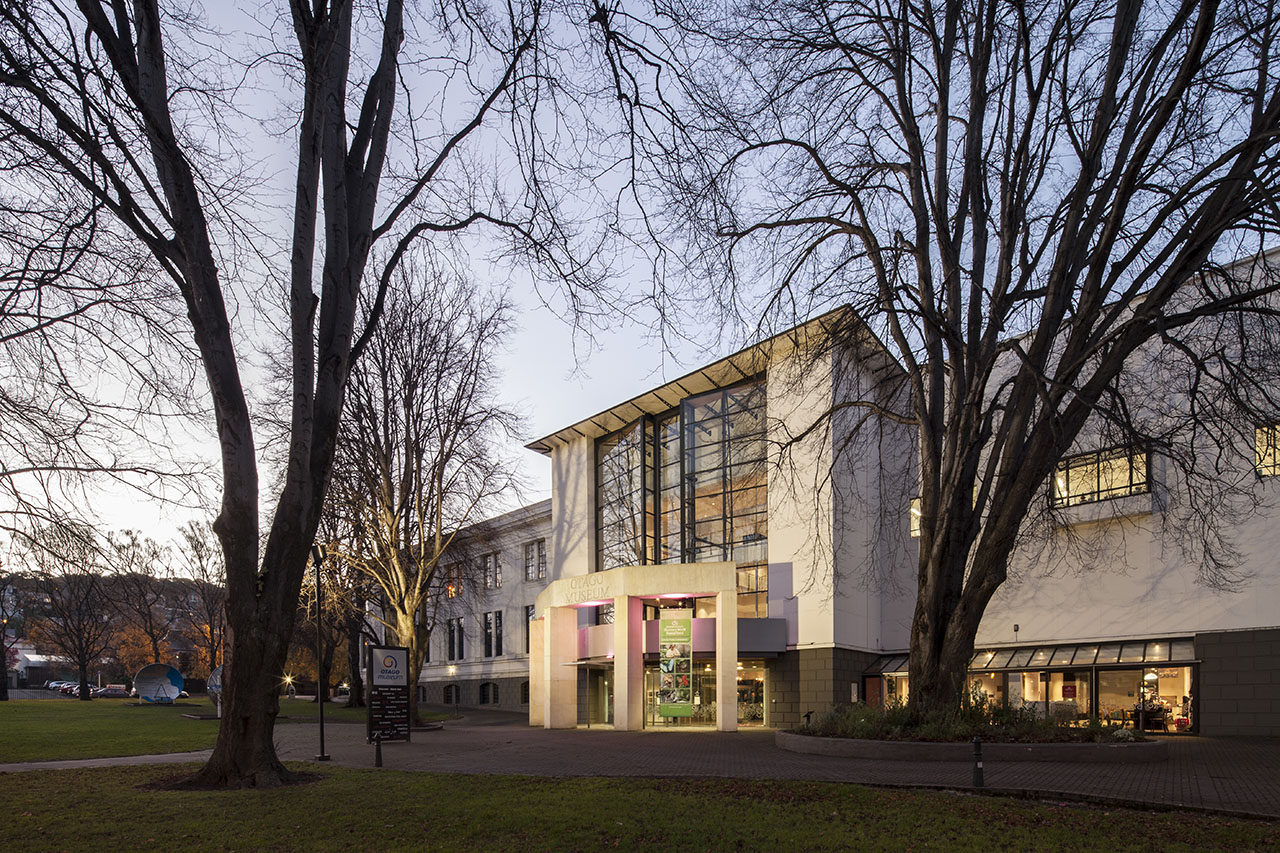
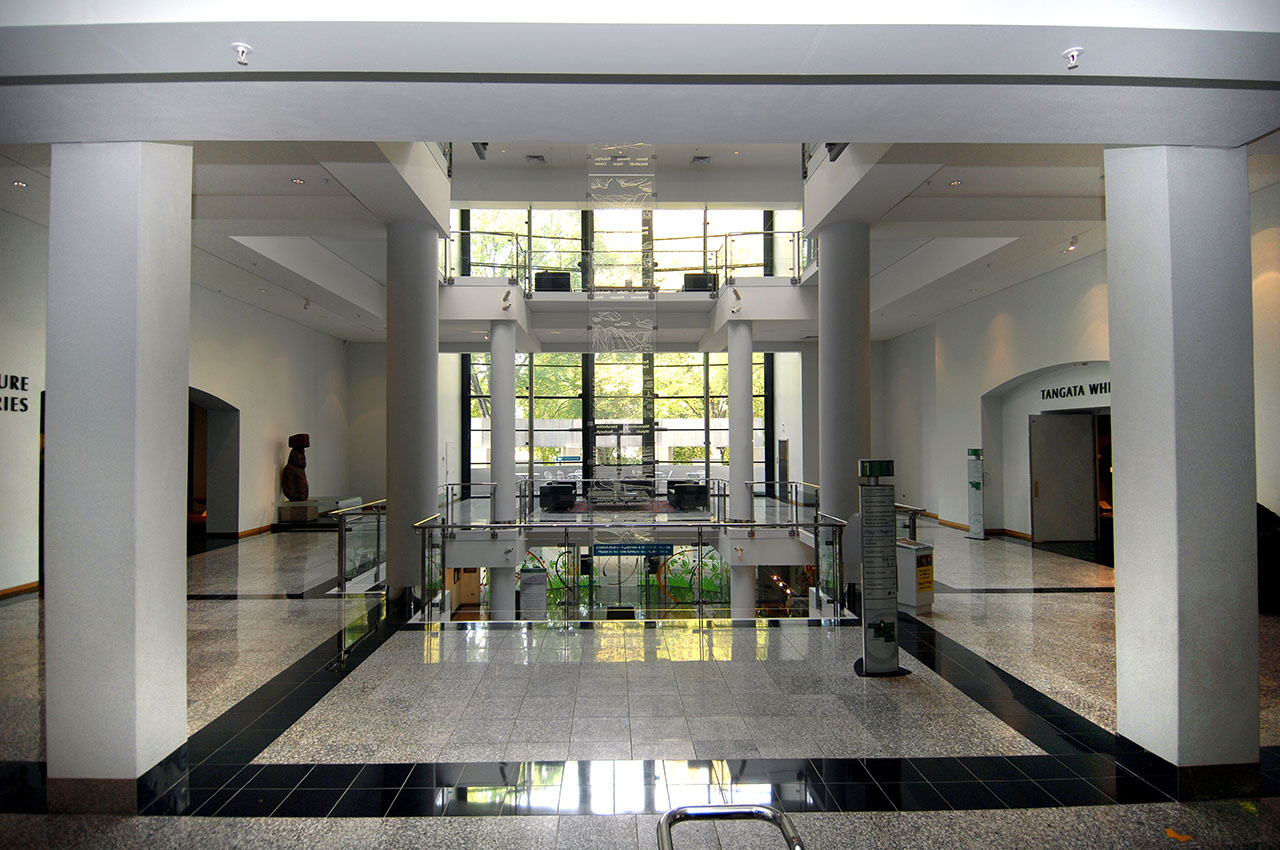
Extensions were carried out to the rear of Ross’ main block. Two stages, completed in 1996 and 2000, saw a new building of three floors. By 2000 there was a new entrance way, atrium, café, shop, conference venue and grand staircase. On 9 December 2000 Prime Minister Helen Clark opened the redeveloped Museum. With over 1.7 million collection items, many of national and international significance, the Otago Museum is one of the largest museums in New Zealand.