

Moves to establish the first Episcopalian Church in Lawrence were made in December 1866, but it was not until February 1868 that the first vicar Rev. H.W. Martin from Victoria, Australia, was appointed.
The first Holy Trinity Church (1871) was constructed of timber, plainly-detailed, with Gothic elements. It had a small belfry at the gable end. The Bell Tower is thought to have been constructed in the 1890s and was erected at the front of the section adjacent to Whitehaven Street, the main street through Lawrence from Waitahuna.
The Bell Tower was retained when the first church was demolished to make way for the current brick church, which was built to a design by Invercargill Architect E.R. Wilson c.1924-1925. According to local historian Daphne Lemon the bell from the original church hangs in the belfry.
The Bell Tower was described in church records at the time it was built as "a neat and substantial bell tower" with a "nice toned bell." The £65 9s 4d cost was raised by the Ladies Guild.
The Bell Tower was restored and rededicated by Bishop Peter Mann in June 1980. A tree was planted and a plaque erected to commemorate the occasion. Money from the Lions Club, the NZHPT, church members and the public helped fund the restoration.
The Bell Tower remains an important feature of the historic landscape in Lawrence and a distinctive element in the buildings associated with the Anglican Church in Lawrence.
List Entry Information
Status
Listed
List Entry Status
Historic Place Category 2
Access
Private/No Public Access
List Number
2245
Date Entered
24th June 2005
Date of Effect
24th June 2005
City/District Council
Clutha District
Region
Otago Region
Legal description
Sec 3 Blk VI Town of Lawrence (RT OT222/173), Otago Land District
Status
Listed
List Entry Status
Historic Place Category 2
Access
Private/No Public Access
List Number
2245
Date Entered
24th June 2005
Date of Effect
24th June 2005
City/District Council
Clutha District
Region
Otago Region
Legal description
Sec 3 Blk VI Town of Lawrence (RT OT222/173), Otago Land District
Why is this place significant?
Physical Significance
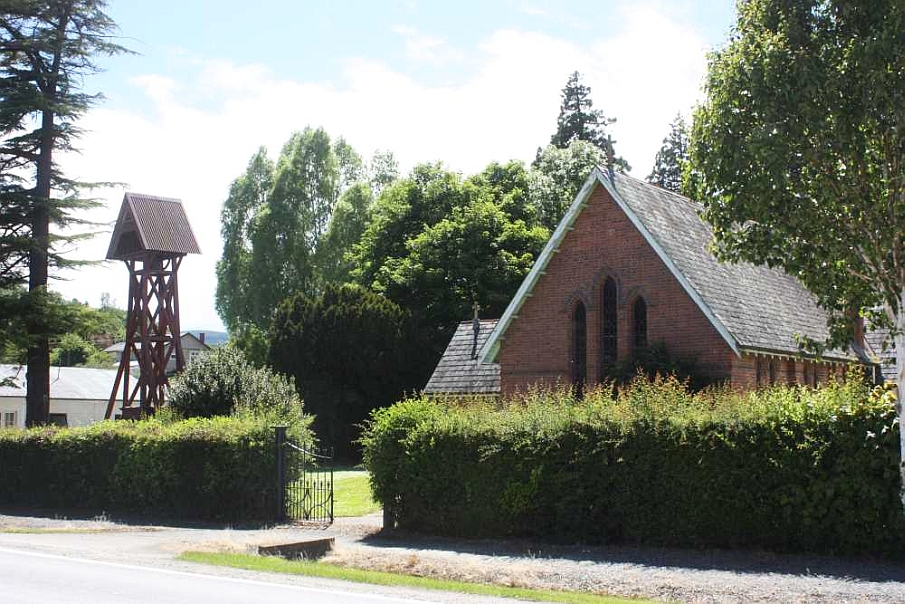
The Holy Trinity Anglican Church Bell Tower has aesthetic value. It is an elegantly- proportioned, distinctively-designed Bell Tower prominently positioned next to the tree-lined main street through Lawrence. The Tower is itself flanked by two large trees which further emphasise its visual appeal and character. The Bell Tower has architectural significance as an example of nineteenth century Gothic architecture. The Tower is a carefully considered piece of design with the structural elements of the tower - in particular the bracing struts and posts forming essential elements in the design. The Gothic detailing expressed through the repeating lancet form in the bell ringer's shelter and the belfry, is an important aspect of the design. The distinctive design and visual appeal makes this a significant example of religious architecture from the late nineteenth century.
Why is this place Category 1 / Category 2?
Detail Of Assessed Criteria
(e) The Holy Trinity Anglican Church Bell Tower shows technical accomplishment and a strong sense of design. As noted above it is a carefully considered and elegant example of a Bell Tower, with its own character and style. (g) The Bell Tower forms a significant element in the historical and cultural complex in Lawrence. The Tower stands on the distinctive and notable tree-lined street of Lawrence, next to the Holy Trinity Anglican Church, and is a distinctive element in the historic landscape of Lawrence. (k) The community involvement in the restoration of the Bell Tower in the 1980s illustrates that the structure is held in some esteem by the local community.
Why is this place significant?
Physical Significance
The Holy Trinity Anglican Church Bell Tower has aesthetic value. It is an elegantly- proportioned, distinctively-designed Bell Tower prominently positioned next to the tree-lined main street through Lawrence. The Tower is itself flanked by two large trees which further emphasise its visual appeal and character. The Bell Tower has architectural significance as an example of nineteenth century Gothic architecture. The Tower is a carefully considered piece of design with the structural elements of the tower - in particular the bracing struts and posts forming essential elements in the design. The Gothic detailing expressed through the repeating lancet form in the bell ringer's shelter and the belfry, is an important aspect of the design. The distinctive design and visual appeal makes this a significant example of religious architecture from the late nineteenth century.
Why is this place Category 1 / Category 2?
Detail Of Assessed Criteria
(e) The Holy Trinity Anglican Church Bell Tower shows technical accomplishment and a strong sense of design. As noted above it is a carefully considered and elegant example of a Bell Tower, with its own character and style. (g) The Bell Tower forms a significant element in the historical and cultural complex in Lawrence. The Tower stands on the distinctive and notable tree-lined street of Lawrence, next to the Holy Trinity Anglican Church, and is a distinctive element in the historic landscape of Lawrence. (k) The community involvement in the restoration of the Bell Tower in the 1980s illustrates that the structure is held in some esteem by the local community.
Construction Details
Start Year
1894
Type
Original Construction
Type
Modification
Description
Restoration with NZHPT support and funding
Period
1980s
Construction Materials
Painted timber framing set in concrete footing.
Construction Details
Start Year
1894
Type
Original Construction
Type
Modification
Description
Restoration with NZHPT support and funding
Period
1980s
Construction Materials
Painted timber framing set in concrete footing.
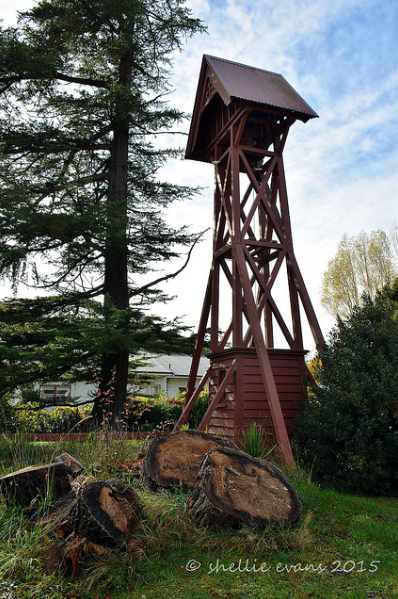
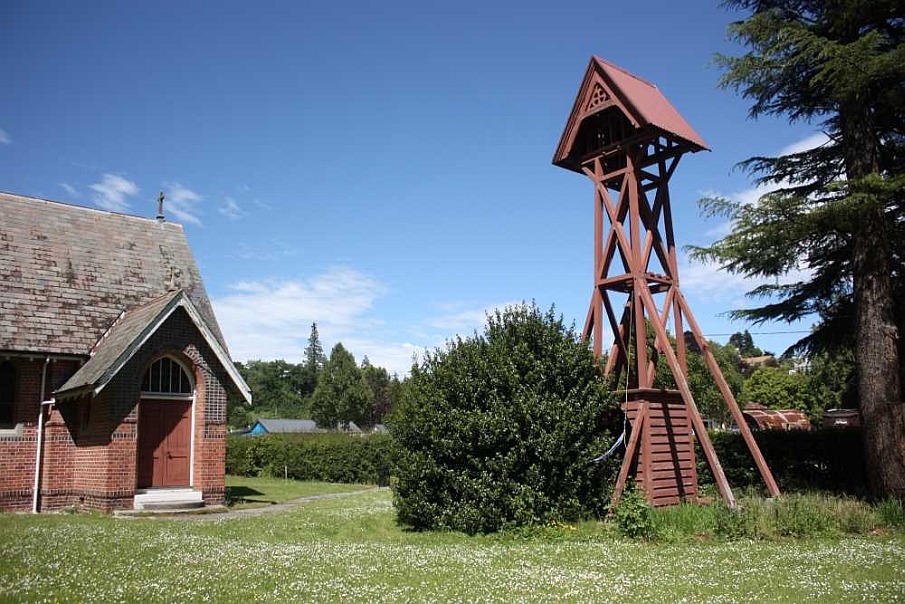
The Bell Tower is an elegant, tall, slender, four-post timber tower with four extended bracing struts, which are integral to the design. The Tower is topped with a belfry with a gabled roof and decorative Gothic detailing. The belfry is has a corrugated iron roof. The gable end detail has a quatrefoil-like pattern at the apex, and repetition of the lancet-arch form, below. The base of the Tower is enclosed to form a bell-ringer's shelter. The shelter has a Gothic arched door with a small lancet window on a side wall. In the 1980s the Bell Tower was restored by the local community with assistance from the NZHPT and the Lion's. The timber floor of the bell-ringer's shelter was replaced with concrete, and some of the timber struts replaced. Other elements were repaired as necessary, and the structure painted. Five belfrys or bell towers are registered by the NZHPT, each with its own individual styling. The Holy Trinity Bell Tower is significant as a modest but well-proportioned and visually appealing Gothic structure.
The Bell Tower is an elegant, tall, slender, four-post timber tower with four extended bracing struts, which are integral to the design. The Tower is topped with a belfry with a gabled roof and decorative Gothic detailing. The belfry is has a corrugated iron roof. The gable end detail has a quatrefoil-like pattern at the apex, and repetition of the lancet-arch form, below. The base of the Tower is enclosed to form a bell-ringer's shelter. The shelter has a Gothic arched door with a small lancet window on a side wall. In the 1980s the Bell Tower was restored by the local community with assistance from the NZHPT and the Lion's. The timber floor of the bell-ringer's shelter was replaced with concrete, and some of the timber struts replaced. Other elements were repaired as necessary, and the structure painted. Five belfrys or bell towers are registered by the NZHPT, each with its own individual styling. The Holy Trinity Bell Tower is significant as a modest but well-proportioned and visually appealing Gothic structure.
Historical and Associated Iwi / Hapū / Whānau
Completion Date
21st June 2006
Report Written By
Heather Bauchop
Information Sources
Curl, 1999
James Curl, A Dictionary of Architecture, Oxford University Press, Oxford, 1999.
Knight, 1999
Hardwicke Knight, Church Building in Otago, [Hardwicke Knight, Dunedin], 1999
Lemon, 1979
Daphne Lemon, Stars in Orion, Tuapeka then and now, John McIndoe, Dunedin, 1979
Mayhew, 1977
WR Mayhew, 'Tuapeka The Land and Its People. A Social History of the Borough of Lawrence and its Surrounding Districts', Capper Press, Christchurch, 1977, [First published, Otago Centennial Historical Publications, Dunedin, 1949]
Other Information
A fully referenced version of this report is available from the NZHPT Otago/Southland Area Office Please note that entry on the New Zealand Heritage List/Rarangi Korero identifies only the heritage values of the property concerned, and should not be construed as advice on the state of the property, or as a comment of its soundness or safety, including in regard to earthquake risk, safety in the event of fire, or insanitary conditions.
Historical and Associated Iwi / Hapū / Whānau
Completion Date
21st June 2006
Report Written By
Heather Bauchop
Information Sources
Curl, 1999
James Curl, A Dictionary of Architecture, Oxford University Press, Oxford, 1999.
Knight, 1999
Hardwicke Knight, Church Building in Otago, [Hardwicke Knight, Dunedin], 1999
Lemon, 1979
Daphne Lemon, Stars in Orion, Tuapeka then and now, John McIndoe, Dunedin, 1979
Mayhew, 1977
WR Mayhew, 'Tuapeka The Land and Its People. A Social History of the Borough of Lawrence and its Surrounding Districts', Capper Press, Christchurch, 1977, [First published, Otago Centennial Historical Publications, Dunedin, 1949]
Other Information
A fully referenced version of this report is available from the NZHPT Otago/Southland Area Office Please note that entry on the New Zealand Heritage List/Rarangi Korero identifies only the heritage values of the property concerned, and should not be construed as advice on the state of the property, or as a comment of its soundness or safety, including in regard to earthquake risk, safety in the event of fire, or insanitary conditions.
Current Usages
Uses: Religion
Specific Usage: Belfry/Bell tower
Former Usages
General Usage: Religion
Specific Usage: Belfry/Bell tower
Current Usages
Uses: Religion
Specific Usage: Belfry/Bell tower
Former Usages
General Usage: Religion
Specific Usage: Belfry/Bell tower
Location
Sign up to hear more
Get the latest heritage news, features and events delivered
straight to your inbox.
