DonateMembershipVisit Heritage
  • Tūrangawaewae
    Places
  • Tira Māori
    Māori Heritage
  • Poutairangahia
    Archaeology
  • Rauemi
    Resources
  • Mō Tātou
    About Us
  • New Zealand Heritage List
  • Nominate and submit
  • Explore the List
  • National Historic Landmarks
  • Plaques
  • Rainbow List Project
  • Lost heritage
  • Visit Heritage
  • Our properties
  • Turnbull House Project
  • Collections
  • Shop
  • Tohu Whenua
  • Tira Māori
  • Conserving Māori heritage
  • Marae built heritage
  • Māori heritage on the List
  • Hinemihi—Te Hokinga Mai
  • What is archaeology?
  • Is there a site on my property?
  • What are my legal requirements?
  • Affecting an archaeological site
  • Declaring an archaeological site
  • Archaeology FAQs
  • Archaeology Digital Library
  • Archaeology guidelines and templates
  • Resources
  • Funding
  • Publications
  • Sustainable management guides
  • Disaster recovery
  • Podcasts & digital resources
  • Education Hub
  • Conservation plans
  • About
  • Board
  • Māori Heritage Council
  • Senior Staff
  • Offices
  • Contact us
  • Careers
  • Covenants
  • Fast-track
  • Corporate documents
  • Currently consulting on
  • Our submissions
  • News
  • Covid-19 response
Quick links
Rārangi Kōrero | The List
Explore the List
National Historic Landmarks
Ngā Manawhenua o Aotearoa me ōna Kōrero Tūturu
Quick links
Tapuwae
A Vision for Places of Māori Heritage
Funding for Māori Heritage
Resources
Quick links
Archaeological Authority Portal
Applying for an archaeological authority
Archaeology FAQs
Browse the most frequently asked questions about archaeological authorities and the archaeological process.
Quick links
Quick links
News
News Keep up to date with Heritage New Zealand Pouhere Taonga
Membership
Membership Find out more and sign up today
DonateMembershipVisit Heritage
  • Tūrangawaewae
    Places
  • Tira Māori
    Māori Heritage
  • Poutairangahia
    Archaeology
  • Rauemi
    Resources
  • Mō Tātou
    About Us
  • New Zealand Heritage List
  • Nominate and submit
  • Explore the List
  • National Historic Landmarks
  • Plaques
  • Rainbow List Project
  • Lost heritage
  • Visit Heritage
  • Our properties
  • Turnbull House Project
  • Collections
  • Shop
  • Tohu Whenua
  • Tira Māori
  • Conserving Māori heritage
  • Marae built heritage
  • Māori heritage on the List
  • Hinemihi—Te Hokinga Mai
  • What is archaeology?
  • Is there a site on my property?
  • What are my legal requirements?
  • Affecting an archaeological site
  • Declaring an archaeological site
  • Archaeology FAQs
  • Archaeology Digital Library
  • Archaeology guidelines and templates
  • Resources
  • Funding
  • Publications
  • Sustainable management guides
  • Disaster recovery
  • Podcasts & digital resources
  • Education Hub
  • Conservation plans
  • About
  • Board
  • Māori Heritage Council
  • Senior Staff
  • Offices
  • Contact us
  • Careers
  • Covenants
  • Fast-track
  • Corporate documents
  • Currently consulting on
  • Our submissions
  • News
  • Covid-19 response
Quick links
Rārangi Kōrero | The List
Explore the List
National Historic Landmarks
Ngā Manawhenua o Aotearoa me ōna Kōrero Tūturu
Quick links
Tapuwae
A Vision for Places of Māori Heritage
Funding for Māori Heritage
Resources
Quick links
Archaeological Authority Portal
Applying for an archaeological authority
Archaeology FAQs
Browse the most frequently asked questions about archaeological authorities and the archaeological process.
Quick links
Quick links
News
News Keep up to date with Heritage New Zealand Pouhere Taonga
Membership
Membership Find out more and sign up today
  • Places
  • Nominate and submit
  • National Historic Landmarks
  • Places
  • Nominate and submit
  • National Historic Landmarks
  • Tira Māori
  • Conserving Māori heritage
  • Marae built heritage
  • Tira Māori
  • Conserving Māori heritage
  • Marae built heritage
  • Archaeological authorities
  • Archaeology Digital Library
  • Archaeological authorities
  • Archaeology Digital Library
  • All resources
  • Publications
  • Funding
  • All resources
  • Publications
  • Funding
  • FAQs
  • FAQs
Follow us on:
Places
  • Places
  • Nominate and submit
  • National Historic Landmarks
Tira Māori
  • Tira Māori
  • Conserving Māori heritage
  • Marae built heritage
Archaeology
  • Archaeological authorities
  • Archaeology Digital Library
Resources
  • All resources
  • Publications
  • Funding
FAQs
  • FAQs
Follow us on
HomePrivacyTerms and conditionsAbout this site
© Heritage New Zealand Pouhere Taonga 2026.
 
Fallen Troopers' Memorial

Thames Street, OAMARU

Public

Historic Place Category 2

List No. 2273

Quick links:
List GalleryLocationDetails
The Fallen Troopers’ Memorial stands as ‘an imperishable tribute to the memories’ of North Otago’s sons ‘whose valor ended in their sepulture in a strange and far distant land’ and has historical, architectural and commemorative significance. It was unveiled in Thames Street, Oamaru, by Governor Lord Plunket on 2 February 1905.

The South African War (or Second Anglo-Boer War), which began on 12 October 1899, was the first overseas conflict to involve New Zealand troops. The British Empire fought the Boer South African Republic (Transvaal) and their ally, the Orange Free State. New Zealand Premier Richard Seddon was keen to help the Empire, offering to send a contingent of 200 mounted riflemen, a proposal that received wide public support. A hastily assembled force, relying much on volunteer equipment, departed on 21 October 1899. The New Zealanders fought in unfamiliar territory with an opponent who did not follow expected conventions. The British annexed Transvaal in October 1900, marking the second stage of the war: guerilla war. The last engagement New Zealand troops took part in was at Langerwacht Hill on 23 February 1902. A peace treaty was signed on 1 June 1902.

New Zealanders were quick to erect memorials to its war dead – the first erected within six months of the troops’ return. Some 43 memorials were erected, expressing loyalty and commitment to the Empire and New Zealand’s place in it. Prominent citizens, leading businessmen and mayors and councilors were the prime movers of war memorials. In Oamaru, local solicitor, climber and explorer, William G. Grave, raised most of the £1,700 needed to build the memorial by cycling around North Otago, extracting donations from virtually every household and claiming just five shillings for expenses.

Bergamini and Reid of Dunedin designed the memorial. Supervising architect John Megget Forrester advertised for tenders for the erection of the ‘Fallen Troopers’ Memorial’ on 17 June 1903. Thompson and Co. won the contract with their price of £1,375, but asked to be relieved of the job in December 1903, because they could not complete it within the tendered amount without altering the specifications. Monumental mason John Crombie offered to take up the contract, with some changes, at a cost of £1,300. The committee accepted Crombie’s offer.

Thames Street was crowded with people who came to watch the Governor unveil the memorial on 2 February 1905. A band and an infantry guard of honour met the Governor General at the railway station and escorted him to the memorial where mounted troops under Lieutenant Colonel Nichols stood ready to fire a salute. Public School Cadets, Defence Cadets and the Third Battalion of the Otago Volunteer Regiment lined the streets, mingling with the crowds. After the Governor unveiled the monument, the volunteers fired three volleys in the air, bugles sounded the last post, and invited guests attended a garden party.

'Trooper Jack', the soldier atop the monument, is based on North Otago man David Mickle Jack, and was carved by the Italian sculptor Carlo Bergamini. The foundation is concrete, the base is Port Chalmers bluestone, and the rest is granite and marble sourced from Europe. Lamps stand at the corners of the memorial.

In 2008 the memorial was dismantled, shifted 40 metres south and turned around 180 degrees to face north as part of a major road realignment to improve traffic safety. The photographs taken in November 2008 showed it nearing the end of that process, with both Trooper Jack and the imperial lion showing the benefits of cleaning and restoration. In 2015, the Fallen Troopers’ Memorial remains a landmark on Thames Street, remembering not only of ‘loyalty and homage’ but also acting as a warning against the ‘grave blunder which resulted in so appalling a sacrifice’ – a ‘sorrowful remembrancer and a mentor’.
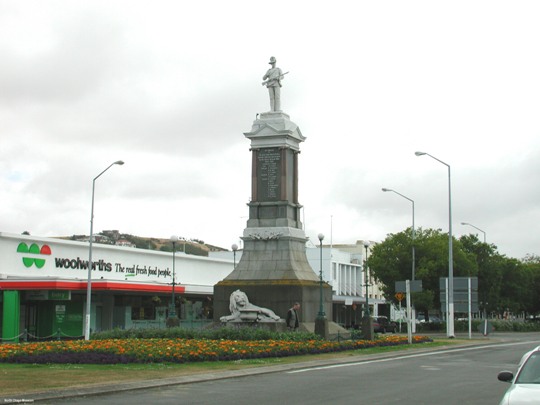
Fallen Troopers’ Memorial | North Otago Museum

List Entry Information

Overview

Status
Listed

List Entry Status
Historic Place Category 2

Access
Able to Visit

List Number
2273

Date Entered
2nd July 1982

Date of Effect
2nd July 1982

City/District Council
Waitaki District

Region
Otago Region

Extent of List Entry

Extent includes the land described as Legal Road, Otago Land District, and the Fallen Troopers’ Memorial, Oamaru, thereon.

Legal description

Legal Road, Otago Land District

Detailed List Entry

Construction Professional

Name

Bergamini and Reid

Type

Designer

Biography

No biography is currently available for this construction professional

Name

Carlo Bergamini

Type

Sculptor

Biography

No biography is currently available for this construction professional

Name

John Combie

Type

Stonemason

Biography

No biography is currently available for this construction professional

Name

Forrester, John Meggett

Type

Architect

Biography

John Meggett Forrester (1866-1965) grew up in Oamaru where his father Thomas Forrester (1838-1907) was practising as an architect. Having been educated at Oamaru Grammar School, he entered the architectural profession and in 1890 took over his father's practice, Forrester and Lemon, following the death of John Lemon (1828-90). He was responsible for the Oamaru Opera House (1907), the Borough Council building, the World War I Memorial and the Waitaki Boys High School Hall of Memories, all in Oamaru. In 1919 he was joined in partnership by Ivan Steenson and he retired in 1931. Forrester was prominent in Oamaru public life. He was a Justice of the Peace for many years, an Oamaru Borough Councillor (1913-33) and Mayor of Oamaru (1931-33). When he died in 1965 he left a bequest for the establishment of an Art Gallery in North Otago. The Forrester Gallery was opened in 1983 in the former Bank of New South Wales building.

Construction Details

Start Year

1905

Type

Original Construction

Description

Unveiled on 2 Feb 1905

Start Year

2008

Type

Relocation

Description

Memorial shifted 40 metres south and turned 180 degrees to face north.

Reference

Completion Date

17th August 2015

Report Written By

Heather Bauchop

Information Sources

Ministry for Culture and Heritage

www.nzhistory.net.nz

Ministry for Culture and Heritage

www.nzhistory.net.nz

Ministry for Culture and Heritage

www.nzhistory.net.nz

Oamaru Mail

22 Mar 1882, p. 2.

Otago Witness

Otago Witness

Valerie B. Parkhouse

Memorializing the Anglo-Boer War of 1899-1902: Militarization of the Landscape: Monuments and Memorials in Britain, Matador, Kibworth Beauchamp, 2015

Report Written By

This place was identified as significant under previous legislation with different information requirements. It remains significant under the current legislation. There is opportunity under our legislation and policies to add to this information. Further information about this place may be available from the Otago/Southland Office of Heritage New Zealand Pouhere Taonga. Please note that entry on the New Zealand Heritage List/Rarangi Korero identifies only the heritage values of the property concerned, and should not be construed as advice on the state of the property, or as a comment of its soundness or safety, including in regard to earthquake risk, safety in the event of fire, or insanitary conditions. A fully referenced upgrade report is available on request from the Otago/Southland Office of Heritage New Zealand

Further Information

Current Usages

Uses: Commemoration

Specific Usage: Memorial - South African War

Former Usages

General Usage:: Commemoration

Specific Usage: Memorial - South African War

Themes

War Memorial

Web Links

Overview

Status

Listed

List Entry Status

Historic Place Category 2

Access

Able to Visit

List Number

2273

Date Entered

2nd July 1982

Date of Effect

2nd July 1982

City/District Council

Waitaki District

Region

Otago Region

Extent of List Entry

Extent includes the land described as Legal Road, Otago Land District, and the Fallen Troopers’ Memorial, Oamaru, thereon.

Legal description

Legal Road, Otago Land District

Status

Listed

List Entry Status

Historic Place Category 2

Access

Able to Visit

List Number

2273

Date Entered

2nd July 1982

Date of Effect

2nd July 1982

City/District Council

Waitaki District

Region

Otago Region

Extent of List Entry

Extent includes the land described as Legal Road, Otago Land District, and the Fallen Troopers’ Memorial, Oamaru, thereon.

Legal description

Legal Road, Otago Land District

Construction Information

Construction Professional

Name

Bergamini and Reid

Type

Designer

Biography

No biography is currently available for this construction professional

Name

Carlo Bergamini

Type

Sculptor

Biography

No biography is currently available for this construction professional

Name

John Combie

Type

Stonemason

Biography

No biography is currently available for this construction professional

Name

Forrester, John Meggett

Type

Architect

Biography

John Meggett Forrester (1866-1965) grew up in Oamaru where his father Thomas Forrester (1838-1907) was practising as an architect. Having been educated at Oamaru Grammar School, he entered the architectural profession and in 1890 took over his father's practice, Forrester and Lemon, following the death of John Lemon (1828-90). He was responsible for the Oamaru Opera House (1907), the Borough Council building, the World War I Memorial and the Waitaki Boys High School Hall of Memories, all in Oamaru. In 1919 he was joined in partnership by Ivan Steenson and he retired in 1931. Forrester was prominent in Oamaru public life. He was a Justice of the Peace for many years, an Oamaru Borough Councillor (1913-33) and Mayor of Oamaru (1931-33). When he died in 1965 he left a bequest for the establishment of an Art Gallery in North Otago. The Forrester Gallery was opened in 1983 in the former Bank of New South Wales building.

Construction Details

Start Year

1905

Type

Original Construction

Description

Unveiled on 2 Feb 1905

Start Year

2008

Type

Relocation

Description

Memorial shifted 40 metres south and turned 180 degrees to face north.

Construction Professional

Name

Bergamini and Reid

Type

Designer

Biography

No biography is currently available for this construction professional

Name

Carlo Bergamini

Type

Sculptor

Biography

No biography is currently available for this construction professional

Name

John Combie

Type

Stonemason

Biography

No biography is currently available for this construction professional

Name

Forrester, John Meggett

Type

Architect

Biography

John Meggett Forrester (1866-1965) grew up in Oamaru where his father Thomas Forrester (1838-1907) was practising as an architect. Having been educated at Oamaru Grammar School, he entered the architectural profession and in 1890 took over his father's practice, Forrester and Lemon, following the death of John Lemon (1828-90). He was responsible for the Oamaru Opera House (1907), the Borough Council building, the World War I Memorial and the Waitaki Boys High School Hall of Memories, all in Oamaru. In 1919 he was joined in partnership by Ivan Steenson and he retired in 1931. Forrester was prominent in Oamaru public life. He was a Justice of the Peace for many years, an Oamaru Borough Councillor (1913-33) and Mayor of Oamaru (1931-33). When he died in 1965 he left a bequest for the establishment of an Art Gallery in North Otago. The Forrester Gallery was opened in 1983 in the former Bank of New South Wales building.

Construction Details

Start Year

1905

Type

Original Construction

Description

Unveiled on 2 Feb 1905

Start Year

2008

Type

Relocation

Description

Memorial shifted 40 metres south and turned 180 degrees to face north.

Reference

Historical and Associated Iwi / Hapū / Whānau

Completion Date

17th August 2015

Report Written By

Heather Bauchop

Information Sources

Ministry for Culture and Heritage

www.nzhistory.net.nz

Ministry for Culture and Heritage

www.nzhistory.net.nz

Ministry for Culture and Heritage

www.nzhistory.net.nz

Oamaru Mail

22 Mar 1882, p. 2.

Otago Witness

Otago Witness

Valerie B. Parkhouse

Memorializing the Anglo-Boer War of 1899-1902: Militarization of the Landscape: Monuments and Memorials in Britain, Matador, Kibworth Beauchamp, 2015

Other Information

This place was identified as significant under previous legislation with different information requirements. It remains significant under the current legislation. There is opportunity under our legislation and policies to add to this information. Further information about this place may be available from the Otago/Southland Office of Heritage New Zealand Pouhere Taonga. Please note that entry on the New Zealand Heritage List/Rarangi Korero identifies only the heritage values of the property concerned, and should not be construed as advice on the state of the property, or as a comment of its soundness or safety, including in regard to earthquake risk, safety in the event of fire, or insanitary conditions. A fully referenced upgrade report is available on request from the Otago/Southland Office of Heritage New Zealand

Historical and Associated Iwi / Hapū / Whānau

Completion Date

17th August 2015

Report Written By

Heather Bauchop

Information Sources

Ministry for Culture and Heritage

www.nzhistory.net.nz

Ministry for Culture and Heritage

www.nzhistory.net.nz

Ministry for Culture and Heritage

www.nzhistory.net.nz

Oamaru Mail

22 Mar 1882, p. 2.

Otago Witness

Otago Witness

Valerie B. Parkhouse

Memorializing the Anglo-Boer War of 1899-1902: Militarization of the Landscape: Monuments and Memorials in Britain, Matador, Kibworth Beauchamp, 2015

Other Information

This place was identified as significant under previous legislation with different information requirements. It remains significant under the current legislation. There is opportunity under our legislation and policies to add to this information. Further information about this place may be available from the Otago/Southland Office of Heritage New Zealand Pouhere Taonga. Please note that entry on the New Zealand Heritage List/Rarangi Korero identifies only the heritage values of the property concerned, and should not be construed as advice on the state of the property, or as a comment of its soundness or safety, including in regard to earthquake risk, safety in the event of fire, or insanitary conditions. A fully referenced upgrade report is available on request from the Otago/Southland Office of Heritage New Zealand

Further Information

Current Usages

Uses: Commemoration

Specific Usage: Memorial - South African War

Former Usages

General Usage: Commemoration

Specific Usage: Memorial - South African War

Themes

War Memorial

Current Usages

Uses: Commemoration

Specific Usage: Memorial - South African War

Former Usages

General Usage: Commemoration

Specific Usage: Memorial - South African War

Themes

War Memorial

Location

Loading
Stay up to date with Heritage this month
