Early history
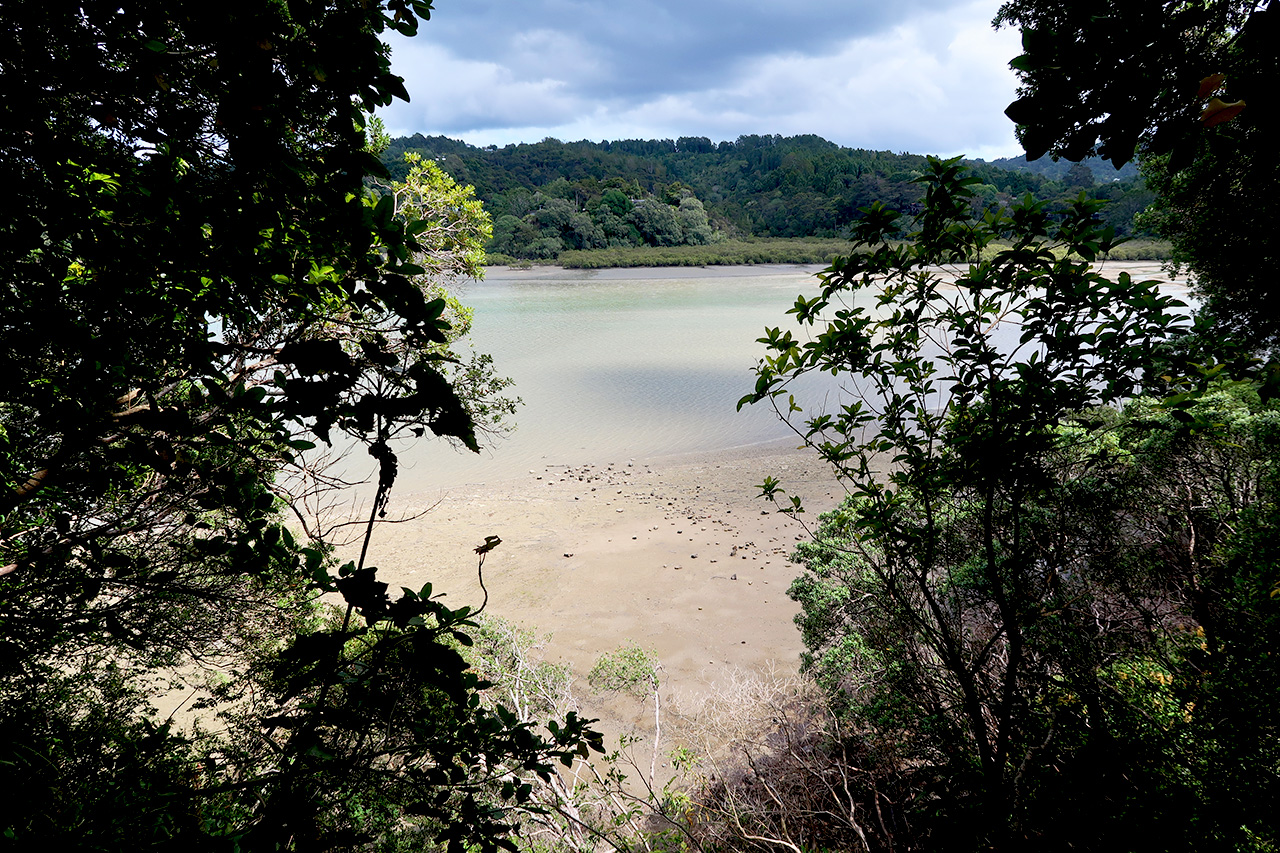
The site overlooks the Manukau Harbour, on a peninsula to the east of Waikūmete (Little Muddy Bay). The peninsula formed part of an extensive forest, which according to Te Kawerau ā Maki traditions was initially occupied by Patupaiarehe or fairy people. Subsequent arrivals included the tohunga of the Tainui waka, Rakataura - also known as Hape - who named many places adjoining the Manukau. From the 1600s, the area’s occupants included Te Kawerau ā Maki, the northernmost grouping of the Tainui confederation.
Te Kawerau accounts attest to extensive use of the Manukau coastline, including lands immediately to the east of the Waikūmete inlet:
‘The coastal area extending west from Motukaraka [beside the Whau canoe portage] to Waikūmete (Little Muddy Creek) is known collectively as Tītirangi, having been named by Rakataura in commemoration of a hill in the Pacific homeland. Along these shores are places of historical importance to Te Kawerau ā Maki including: Te Kai ō Poutūkeka, Ōtītore, Ōkewa, Paturoa, and Taumatarearea (the headland overlooking the entrance of Waikūmete). The latter inlet was strategically important as it was located at the southern end of a major inland walk way that ran north-south, and also as the embarkation point for canoe travel on the Manukau Harbour. The importance of Waikūmete and its catchment as a canoe building area, until the 1860s, is reflected in the place names Te-Tō-o-Parahiku, “the dragging place of the semi-finished canoe hulls”, and Maramara Tōtara, “the chips of totara wood”.’
Numerous identified midden sites along the peninsula coastline indicate the use of marine resources. Occupation at the southern end of the peninsula, some 300 m from the current Shadbolt House, is also attested by an archaeologically recorded bank and ditch.
During the eighteenth century, conflict between neighbouring iwi to the north and south, Ngāti Whātua ō Kaipara and Te Waiōhua, resulted in battles at nearby Paruroa (Big Muddy Creek) and Paturoa (Tītirangi Creek) - at which Ngāti Whātua prevailed. Te Kawerau and other groups continued to occupy the area, but pressure to fell the forest for kauri and other timber increasingly led to tracts passing into European hands from the late 1830s onwards. In 1854, the land on which the future Shadbolt House was erected was acquired as part of a 190-acre holding of ‘Forest Land’ by Major Joseph Greenwood, a former British soldier in India and Afghanistan who had recently been elected to New Zealand’s first parliament. During the 1850s, both Māori and European sawyers worked in the vicinity. After extensive logging, a 20-acre portion of Greenwood’s land was sold in 1880 to Smith as part of a wider subdivision into small farm sections. By the early twentieth century, most of this area was in mānuka and grass.
Use of the land for farming was relatively short-lived. In 1922, a subsequent owner J. R. Herring subdivided the holding, now sixteen acres in size, into 42 individual lots. By this time, the nearby village of Titirangi had become increasing popular as a recreational destination for Aucklanders. The new sections were advertised as being the settlement’s first subdivision and promoted for summer holiday and weekend use. ‘Beautiful Titirangi’ was touted for its ‘glorious views - mountain air - sea bathing’. Although several properties were sold over the ensuing decade, some sections were retained by the Herring family - including Lot 4, where Maurice Shadbolt House was subsequently built.
Construction and initial use of Maurice Shadbolt House (1940s-1964)
The Maurice Shadbolt House appears to have been erected as a small holiday home for J. R. Herring’s son, James Sinclair Herring and his wife Zena (née Morrell). James Herring was provided with Lot 4 in 1933, during the Great Depression, when he was just 20 years old. Occupying relatively steep land between View (later renamed Arapito) Road and the Manukau Harbour, the section may have been especially desirable for its position next to the subdivision’s only recreation reserve, as well as having access to a beach at its base. Other lots, including the adjoining section to the north, were transferred to additional family members.
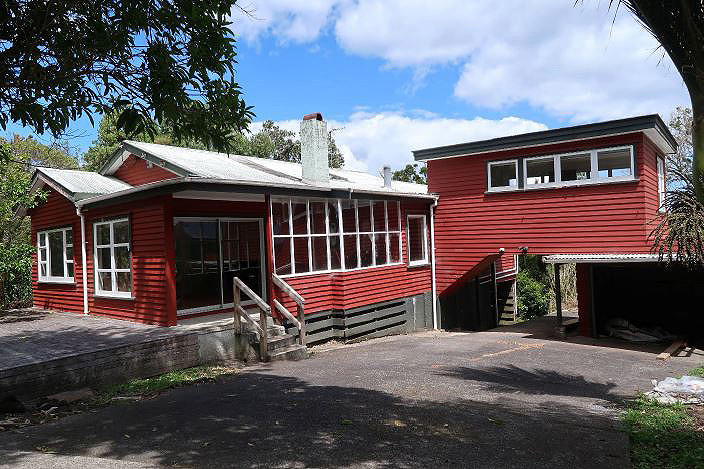
The house was built in the 1940s, when James Herring evidently worked in his father’s carrying business. Erected at the top of the property, it consisted of a modest timber structure of gabled, California Bungalow design. Internally, it contained a front living room and bedroom, and service areas at the rear including a kitchen. James and Zena likely used it as a recreational retreat, retaining a main residence in suburban Auckland.
In 1948, the couple transferred the property to a close relative, Bruce Nicolson. A radiator repairer, Nicolson provided Arapito Road as his main address. Either Nicolson, or the next owners from 1954 - brother-in-law Edward William Herring and wife Dawn Herring (née Nicolson) - may have extended the building to incorporate additional rooms at the rear including an underlying basement. Edward Herring was another son of the original subdivider J. R. Herring, and similarly a carrier by trade. During his tenure, in 1960, a garage was erected beside the house, reflecting his profession as well as the importance of motorised transport in accessing Titirangi. By this time, the area’s scenic beauty was attracting an increasing population, including individuals who wished to pursue artistic endeavour or a stronger connection with the natural environment - or both.
In 1964, the property was purchased as a ‘cliff-hanging home’ by published author, Maurice Shadbolt and his young family. From this time until shortly before his death forty years later, it was to form both Shadbolt’s main place of residence and where he wrote much of the work that made his name.
Maurice Shadbolt
One of this country’s best-known authors, Maurice Francis Richard Shadbolt (1932-2004) has been considered ‘a leading figure in the growth of a New Zealand literature during the second half of the twentieth century’. Also a political activist and ‘early Pākehā proponent of the need to recognise and embrace Māori culture in national life’, he became a significant contributor to debates about New Zealand history and identity at a time of widespread social change. During his lifetime, Shadbolt produced a large and varied corpus that included short stories, novels, biography and journalistic pieces - as well as a major play and other works - with a particular focus on New Zealand themes and topics. Through widespread overseas publication, he played a leading part in projecting this country and the wider Pacific to an international audience.
Born into a working-class family during the Great Depression, Shadbolt experienced a peripatetic childhood in the North Island, partly due to his parents Frank and Violet’s attempts to find work. Both his father and maternal uncle Joseph Kearon - a significant mentor - were involved in Communist-influenced activities to assist the unemployed. Shadbolt’s other influences included forebears such as great-grandfather Ben Shadbolt, who milled timber at Akaroa following deportation from Britain via penal institutions at Norfolk Island and Port Arthur, Tasmania. For parts of his childhood, Maurice Shadbolt lived in Te Kūiti - a stronghold of the Kīngitanga movement - where encounters with Māori communities as well as provincial Pākehā culture and the wider environment also helped shape his outlook and writings.
Shadbolt’s early literary interest was in short stories, the dominant form of post-war fiction in New Zealand. Entering Auckland University College in 1950, he became friends with other writers who were to become notable, such as Maurice Gee and Kevin Ireland. While working as a journalist in 1952-4 with the Taranaki Daily News and then the Waitakere Gazette, he married a fellow reporter Gillian (Gill) Heming. After travelling around the country for the National Film Unit and being mentored by poet James K. Baxter, he became focussed on writing stories about New Zealand and New Zealanders, reflecting a growing public interest in explorations of national experience and identity in the post-war era.
In 1959, during a three-year sojourn in London (1957-60), Shadbolt published his first collection of short stories, The New Zealanders to overseas acclaim. Both he and Gill engaged in political activism, participating in an anti-nuclear march to Aldermaston and working to collect a 2000-strong petition protesting Māori being excluded from the All Black rugby tour to South Africa. After the couple returned to New Zealand in 1960, Shadbolt undertook work with the renowned photographer Brian Brake for National Geographic magazine, resulting in a 48-page article about New Zealand (1962), and a separate large-format publication New Zealand: Gift of the Sea (1963). The latter has been described as ‘a book that celebrated New Zealanders in a way never seen before’. Both reached mass audiences, increasing Shadbolt’s national and international profile.
During this period, Shadbolt became the country’s first full-time professional author. Early recognition for his endeavours included the Landfall Prose Award (1957), Scholarship in Letters (1959), Katherine Mansfield Short Story Award and Burns Fellowship (both 1963). Versed in film direction and commercial journalism, he was also ‘the first New Zealand writer to effectively use the media to promote both his books and his persona as author’. His image included ‘a thick mop of black hair…currently fashionable spectacles above a thick black moustache…and…a pipe that was to become part of his apparatus until the end’.
Shadbolt and Maurice Shadbolt House (1964-71)
Acquisition of the Arapito Road property reflected aspects of Shadbolt’s identity and aspirations. With two young children Sean (born 1960) and Brendan (born 1962), he and Gill were looking for a more permanent home than they had previously occupied. In general, West Auckland was strongly working class. More particularly, Titirangi held associations with artistic endeavour, notably through the painter Colin McCahon, who had pioneered residing there as a way of experiencing life near a city that was close to nature and allowed freedom of expression. With imported-style housing nestling in regenerating native bush, both the Arapito Road property and wider Titirangi reflected Shadbolt’s view of living and belonging in more than one world: ‘the near and the far, the native and the exotic, the insular and the cosmopolitan’. The site’s setting, with its dramatic views over the Waikūmete estuary, perhaps also mirrored the strong visual qualities observed in his writings.
Shadbolt himself later stated:
‘I was taken by green Titirangi: the houses sequestered among the trees. The bird-filled bushland and sunny harbour views. This was the New Zealand I dreamed about in smoggy London winters……the suburb’s sole land agent...took us down a road winding past the fern-fringed beaches and rocky inlets of the Manukau harbour’s tidal coastline. Then he halted outside a modest dwelling half-hidden in fern. Though the rooms were small, there were large views. The place didn’t feel cramped. There was a small basement I could use as a workplace…It was the boys’ [Sean and Brendan’s] endorsement which decided the issue. I also envisaged a productive life here, a place where I might stand or fall as a novelist’.
The basement where Shadbolt began working looked out towards the estuary, as did his later studio. Upstairs rooms were for family use, initially including three bedrooms, with a small kitchen at the heart of the domestic layout. Shadbolt soon planted banana palms and other trees on the road bank and garden in front of the house, reinforcing its subtropical appeal. The property was, in part, purchased on proceeds from Gift of the Sea.
Shadbolt’s tenure coincided with a general shift from writing short stories to longer fiction. News that his first novel Among the Cinders might find publication occurred when he and Gill first took possession. He soon began writing This Summer’s Dolphin (published 1969), and revising Strangers and Journeys, his major early novel (1972). Writings between 1964 and the late 1970s have also been characterised as shifting from an earlier phase of preoccupation with contemporary matters towards combining this with explorations of New Zealand’s past. In 1965, he wrote ‘This is what interests me - making sense of my time and place’.
Writing short stories initially remained ongoing, including The Presence of Music (1967) whose triptych format was directly influenced by Colin McCahon. McCahon later (1969) painted a pre-existing bar in the basement in bright colours, with the title ‘Buttercup Fields Forever’, and also showed Shadbolt how to grow watercress. Reflecting earlier self-sufficient habits, Shadbolt routinely tended a vegetable garden on a terrace retained by a self-built concrete wall, and fished from the beach below the house. Political engagement included Anti-Vietnam War activism and criminal justice reform, part of his view that a writer’s role involved leadership on social matters. Early visitors to the house included cousin and fellow activist Tim Shadbolt, author and publisher Dennis McEldowney, and poet Louis Johnson. Marti Friedlander photographed Maurice Shadbolt among palms in the front garden.
After twins Tui and Daniel were born (1965), a bedroom addition was erected over the pre-existing garage. Built in 1966, this was evidently designed by architect Nigel Cook - part of Shadbolt’s wider personal and artistic network, which also included sisters Marilyn Duckworth and Fleur Adcock, and others. The space was subsequently subdivided to accommodate a studio, but after Shadbolt reverted to the basement the latter became a fifth bedroom. The underlying garage housing the family’s Holden station wagon - in which Shadbolt travelled the country on journalistic and other assignments - was also partly subdivided for a rear storeroom.
In the late 1960s, Shadbolt compiled The Shell Guide to New Zealand - the country’s first motoring guide, ‘which stimulated an increasingly motorised public to explore its own country’. He acquired greater historical knowledge during this project, including about the New Zealand Wars. Also extensively visiting the wider Pacific on international assignments, he considered that New Zealand was becoming a Pacific nation rather than a European outpost. Sympathising with Māori as disadvantaged members of society, he noted that ‘we have hardly begun, officially, to acknowledge that we have not just one but two living cultures’, developing an especially close affinity with Ngāti Porou carver Pineamine Taiapa, to whom he later felt in greatest debt as a novelist. After the breakup of his relationship with Gill, he had a child Brigid (born 1971) with second wife Barbara Magner, a television broadcaster who had participated in making a programme about Taiapa and was one of the first of her profession to address the viewing public in ‘a natural, non-BBC acculturated accent’.
With an enlarged family to support, Shadbolt made plans to fulfill an early desire - creating a dedicated writing studio in the rear garden.
Construction of writer’s studio and other alterations (1972-2004)
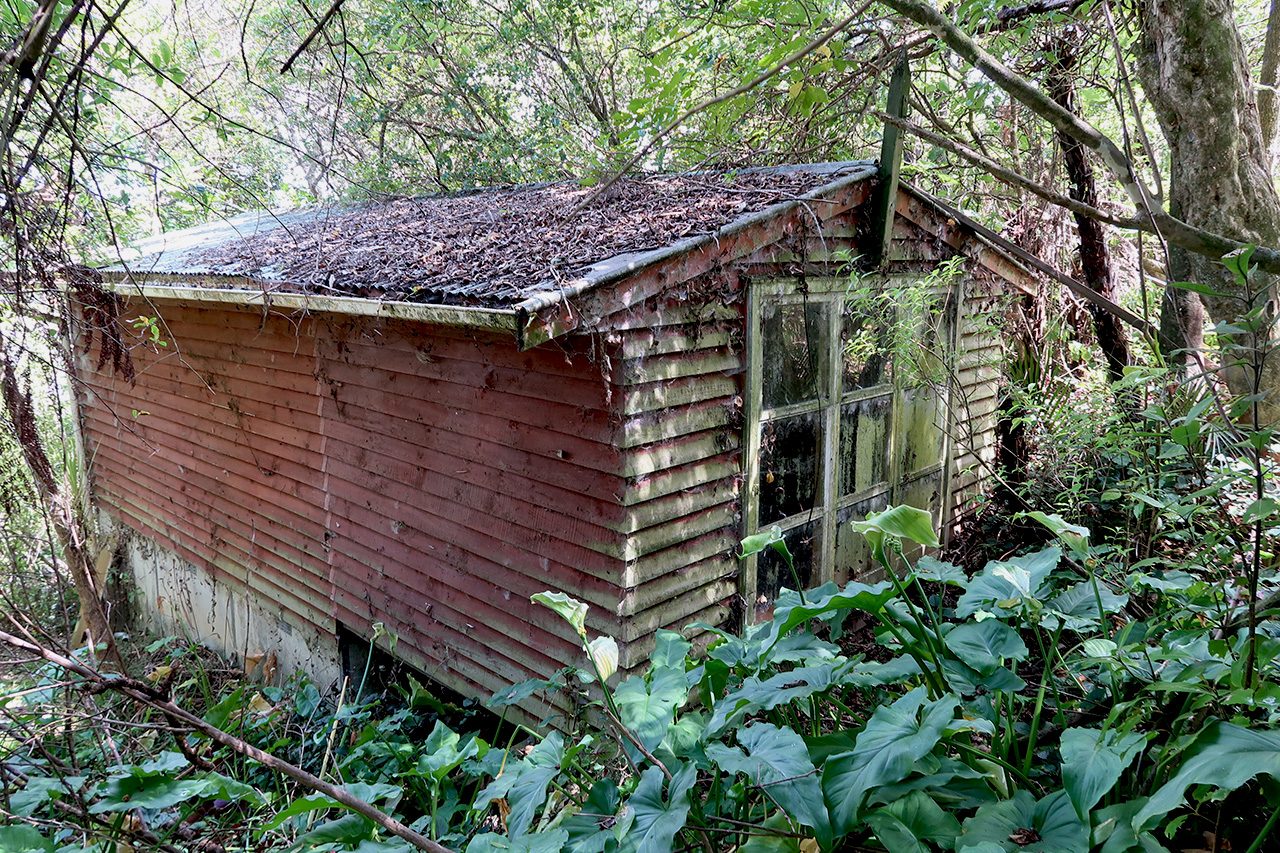
In 1971-2, Shadbolt with sons Sean and Brendan hand-built a long, stepped concrete path down the property to the beach. This facilitated construction of a single-room, timber studio on a former lawn midway between the house and foreshore. Shadbolt had initially envisaged a separate writing space in the garden when the property was purchased. According to biographer Philip Temple, this new studio was to be ‘his ‘hideout’, a ‘sanctuary’ where he could construct a writing life within his personal ecology’. Its creation represented ‘the throwing out of a spiritual anchor’. The McCahon-painted bar was moved into the building, and its interior filled with other artwork, writings and mementoes.
While the studio was under construction (1972), Shadbolt undertook a trip to Mururoa and Tahiti on the yacht Tamure to oppose French nuclear testing in the Pacific. As part of the first wave of flotilla protest, he participated in a seminal development that ultimately led to New Zealand’s nuclear-free policy in 1987. Another notable contributor was Martyn Finlay, a witness at Shadbolt and Magner’s wedding, and a frequent visitor to the house. As Attorney-General and Minister of Justice in a new Labour government, Finlay took out a case at the International Court of Justice (1973) which resulted in cessation of atmospheric testing at Mururoa in 1975.
After returning, Shadbolt moved into the new ‘bush-bound’ studio with inspiring views towards the estuary. Contemporary alterations to the main house (1972-3) included expanding the rear bathroom and the former dining room as an extended lounge and terrace, with enlarged basement below. Extensions also included converting the earlier living room into a larger front dining area, and part-enclosing an earlier front terrace. Ranch-sliding doors provided greater connection with the exterior. Shadbolt later wrote movingly about reading a volume of James K. Baxter’s poetry in the living room during this period, shortly before Baxter’s untimely death. In 1973 a beloved family dog, Terry, was buried in the garden, near the studio.
Social gatherings in the mid-1970s featured many notable literary and artistic names, variously encompassing writers Kevin Ireland, C. K. Stead, Fleur Adcock and Keith Sinclair; painters Don Binney, Jacqueline Fahey, Nigel Brown and Michael Smither; photographers Brian Brake and Marti Friedlander, and many others. In 1972 noted Samoan-born author Albert Wendt, New Zealand’s leading Pacific writer of fiction in English, stayed at the house ‘on the occasion of the publication of his first novel, Sons for the Return Home’. Other visitors included Barry Crump, the only better-known New Zealand author than Shadbolt at this time; and literary critic and lecturer in English at the University of Canterbury, Cherry Hankin, who became the first to introduce Shadbolt’s work into a university curriculum. The house formed a refuge for many writers and artists away from the demands of usual routines. Shadbolt’s published works at this time included novels A Touch of Clay and Danger Zone (both 1974), the latter loosely based on his Mururoa experiences.
Shadbolt had a complex personal life, partly reflecting the socially experimental times. In 1978 he married third wife, actress Bridget Armstrong who had a varied career in Britain and elsewhere, having been directed on stage by Sir John Gielgud as well as appearing in television soap operas, costume dramas, and alternative comedy shows such as The Goodies and Ripping Yarns. The wedding took place in the front garden, with Brian Brake as photographer. Both Shadbolt and Armstrong participated in the country’s anti-Springbok tour protests (1981), being among a group of 200 that opposed the South African team’s arrival at Māngere Airport as well as joining much larger demonstrations at Hamilton Stadium and Eden Park, Auckland - the latter alongside Tim Shadbolt, who returned with them after the event to Arapito Road. Amstrong additionally played a major role in organising a 25,000-strong Artists Against Apartheid march and an outdoor concert in Aotea Square, a day before the Auckland match; and later became ‘both Auckland and New Zealand president of Actors Equity, leading strikes for better pay and conditions during the first year of the new [Labour] government’.
The couple were also among 29 people arrested while protesting demolition of His Majesty’s Theatre in early 1988, a seminal event in attempts to stem the rapid loss of built heritage in central Auckland during liberalisation of the economy.
Further changes to the property included expansion of the vegetable garden in 1981; refitting the basement as a self-contained flat for wider family use in 1988; and extending the rear part of the studio in the same year. In late 1989, Shadbolt briefly shared the studio with fourth wife and notable author in her own right, Elspeth Sandys, between spells when she used other writing spaces in the house.
From the late 1970s until the end of his career, Shadbolt focussed more substantively on historical themes - producing many of his most notable works. These included The Lovelock Version (1980), considered probably the most outstanding of his novels; and a significant trilogy on the New Zealand Wars, namely Season of the Jew (1986), Monday’s Warriors (1990) and The House of Strife (1993). He also engaged with New Zealand’s experience at Gallipoli in 1915-16, now seen as a defining event in this country’s evolving history and identity. Consequent works included the acclaimed play Once on Chunuk Bair (1982) and a non-fiction collection, Voices of Gallipoli (1988), based around survivors’ narratives. He also published The Reader’s Digest Guide to New Zealand (1988, revised 1993), and the well-received first volume of an autobiography, One of Ben’s (1993).
In 1989, Shadbolt became a Commander of the Order of the British Empire (CBE) for services to literature. He was subsequently recognised as ‘New Zealand’s foremost writer of historical fiction’. Kevin Ireland noted that he was ‘not just our best and most inventive historical storyteller…[but] one of our most determinedly ambitious writers…a kind of Hector Berlioz of the New Zealand novel’. Publication of a volume of critical essays devoted to Shadbolt’s works in 1995 was a significant event: until that date few New Zealand writers - perhaps only Frank Sargeson, Katherine Mansfield and Janet Frame - had received a similar accolade. Two years later, the University of Auckland awarded him an honorary doctorate. At this time, he considered that a major role of a New Zealand writer was ‘filling the spaces; ending the silences of our history’.
In 1997, Shadbolt and Sandys attended the nearby Going West literary festival with other authors including Maurice Gee and Marilyn Duckworth. After the effective ending of his marriage with Sandys, he was assisted by his second wife Barbara Magner as the onset of dementia became increasingly apparent. In 1999, he sold the McCahon-painted bar in the studio to the Museum of New Zealand Te Papa Tongarewa. Publication of his last major work, the autobiographical From the Edge of the Sky, occurred in the same year.
In 2000, Shadbolt left the house permanently for a residential home in Taumaranui. As well as his CBE and honorary doctorate, while living at Arapito Road he had been awarded the New Zealand Book award for fiction (1981), the Goodman Fielder Wattie Book of the Year twice (1973, 1987) and the NZ Literary Fund’s Scholarship in Letters three times (1970, 1982, 1990). He had also been an Auckland University Literary Fellow (1987), Writer in Residence at Waikato University (1992) and Katherine Mansfield Fellow (1998). He was additionally the only author to receive the Katherine Mansfield Short Story Award on three occasions, adding wins in 1967 and 1995 to that in 1960
.
Maurice Shadbolt died in October 2004. He was brought back to the house to lie in state for two days before a funeral at St-Matthew-in-the-City in central Auckland. The latter event was attended by more than three hundred people, with eulogies by Kevin Ireland and others. He was buried at Waikūmete Cemetery, a relatively short distance from Titirangi, ‘with a view to the Waitakere Ranges’.
Later history (2004 onwards)
Immediately after Shadbolt’s death, Mayor of Waitakere City Bob Harvey recommended to Waitakere City Council that he pursue obtaining the property to preserve it as a residence for promising writers. A six-term mayor of Waitakere, Harvey had known Shadbolt personally for over 40 years. In 2006, Waitakere City Council purchased the property from Shadbolt’s family. A subsequent project to create a writer’s centre in association with Auckland University of Technology (AUT) was mooted but did not proceed. For several years after 2007, the house was rented out for residential use.
In 2010, Waitakere City Council agreed in principle to transfer the property to Going West Trust for a writers’ residence. A registered charity, the Trust had emerged from the Going West Books and Writers’ Festival, begun in 1996 to promote literary arts in west Auckland and subsequently the longest-running literary festival in the country. A development group furthering the writer-in-residence project included Sean Shadbolt, Maurice Shadbolt’s publisher David Ling, and Naomi McCleary. Repairs and maintenance in 2012-13 included creating an enlarged northern deck.
After Council amalgamation and with the active support of the Waitākere Ranges Local Board, Auckland Council confirmed leasing the property to the Trust in 2022. Subsequent conservation included replacement of 1988 basement linings and extensive stabilisation. This formed part of an ongoing programme undertaken in accordance with a 2013 conservation plan prepared by Burgess and Treep Architects. The work has been supported by a wide variety of public bodies and groups, with the aim of furthering the property’s association with literary endeavour into the future as a writers’-in-residence retreat. The place retains many of the aesthetic qualities that inspired Shadbolt, the Going West Trust noting that it remains in ‘an idyllic location…surrounded by native trees and overlooking the Manukau Harbour’.