

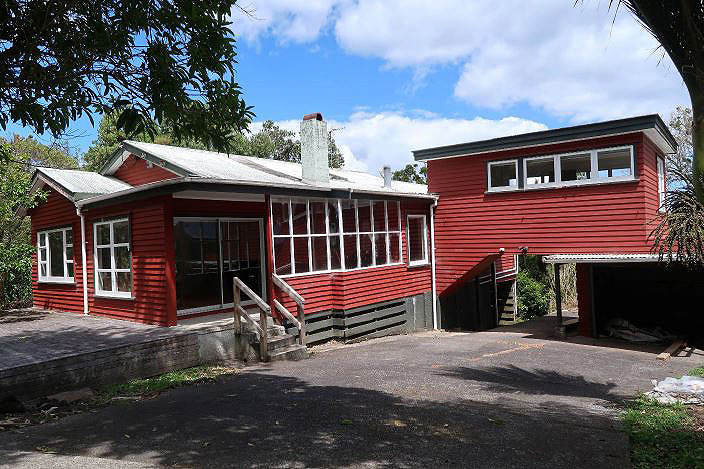
Adjoining the Manukau Harbour, the place forms part of a coastline between Waikūmete and the Whau portage of significance to tangata whenua, including Te Kawerau ā Maki. Activities in this locality included settlement, waka construction and use of marine resources. Initially forested, the land was largely cleared of trees after acquisition by former British soldier Major Joseph Greenwood in 1854, and the area converted for use as small farms. In 1922, it formed part of a subdivision by carrier J. R. Herring, when Titirangi was gaining popularity as a recreational resort for Aucklanders. Lot 4 of the subdivision was passed on to son, James Herring, who likely erected the current timber residence as a modest holiday home in the 1940s. With a garage (1960) added during later tenure by other family members, the property was purchased by Maurice Shadbolt as a family residence and writing place in 1964.
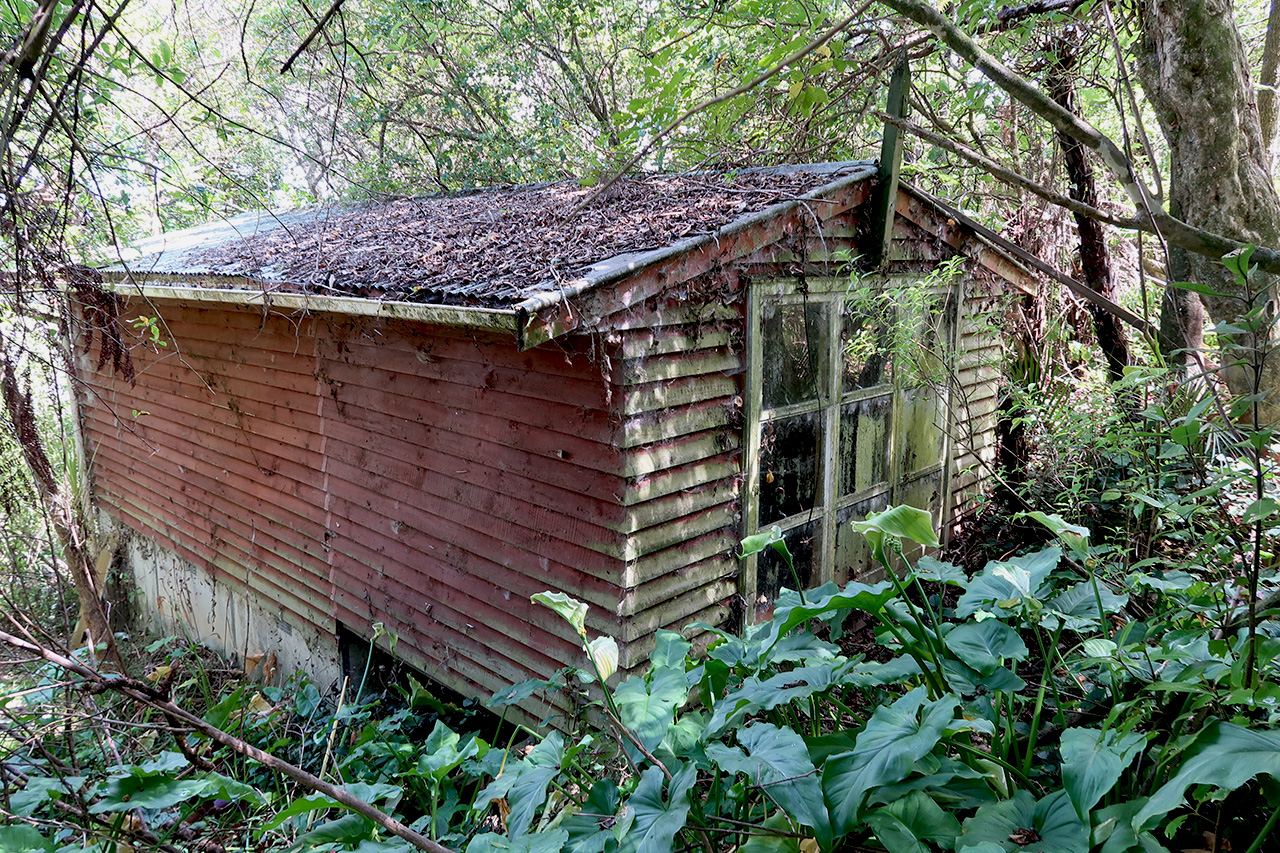
Already successfully published with an emerging national and international profile, Shadbolt was attracted by the ‘cliff-hanging home’ for continuing a productive life as a professional author. Although gaining a living through an unusually wide variety of writing, his arrival coincided with a desire to develop as a novelist. Initial writing took place in a basement studio and also, briefly, in a bedroom addition evidently designed by architect friend Nigel Cook (1966). In 1971-2, eldest sons Sean and Brendan helped him construct a concrete path to a new, single-room studio in the garden. This timber structure, extended in 1988, was where most of his work was created from the early 1970s. Contemporary additions to the house in 1972-3 similarly reflect ongoing success.
Occupying the house until 2000, Shadbolt produced a very large corpus. This included the award-winning novel The Lovelock Version (1980) and the similarly acclaimed New Zealand Wars trilogy Season of the Jew (1986), Mondays Warriors (1990) and the House of Strife (1993). Other works ranged in style from this country’s first comprehensive motoring guide - the Shell Guide to New Zealand ¬(1968) - to a major play about national experiences at Gallipoli in 1915-16, Once on Chunuk Bair (1982). In 1989, Shadbolt received the award of a CBE for service to literature. Engaged with explorations of New Zealandness from an early stage, he has been considered an ‘early Pākehā proponent of the need to recognise and embrace Māori culture in national life’ as this country shifted more towards becoming a Pacific nation. Believing that writers had an obligation to lead in social matters, he protested French nuclear testing in the Pacific on board the Tamure in 1972; and together with then-wife Bridget Armstrong, demonstrated against the Springbok rugby tour of New Zealand (1981) as well as being arrested for opposing demolition of His Majesty’s Theatre - a key event in eventually stemming the destruction of built heritage in central Auckland during economic liberalisation in the 1980s.
Shadbolt had a complex personal life, encompassing four marriages and many other associations. Numerous partners and other members of his personal, creative and political circle with direct connections to the place were highly notable in their own right. Author Elspeth Sandys, artists Colin McCahon and Michel Smither, and photographers Brian Brake and Marti Friedlander were among those who directly undertook creative or professional endeavour there. After Shadbolt’s death (2004), the place’s historical and cultural importance was recognised by moves to conserve it for ongoing literary endeavour as a writers’-in-residence retreat. This has been supported by a wide range of community bodies and individuals, including Shadbolt’s family, professional colleagues and friends.
List Entry Information
Status
Listed
List Entry Status
Historic Place Category 1
Access
Unknown
List Number
2286
Date Entered
20th June 2024
Date of Effect
11th July 2024
City/District Council
Auckland Council
Region
Auckland Council
Extent of List Entry
Extent includes the land described as Lot 4 DP 15824 (RT NA649/9) and part of the land described as Legal Road, North Auckland Land District, and the buildings known as Maurice Shadbolt House and Studio thereon. The extent includes all structures on the land except for a concrete telegraph pole on the Legal Road; and also includes the following plantings: grapefruit tree and mature twentieth-century native trees, including cabbage trees and nīkau palms in the front and rear gardens, and pōhutukawa trees in the rear garden. (Refer to map in Appendix 1 of the List entry report for further information).
Legal description
Lot 4 DP 15824 (RT NA649/9) and Legal Road, North Auckland Land District
Location Description
NZTM Easting: 1746785.98 NZTM Northing: 5908026.88
Status
Listed
List Entry Status
Historic Place Category 1
Access
Unknown
List Number
2286
Date Entered
20th June 2024
Date of Effect
11th July 2024
City/District Council
Auckland Council
Region
Auckland Council
Extent of List Entry
Extent includes the land described as Lot 4 DP 15824 (RT NA649/9) and part of the land described as Legal Road, North Auckland Land District, and the buildings known as Maurice Shadbolt House and Studio thereon. The extent includes all structures on the land except for a concrete telegraph pole on the Legal Road; and also includes the following plantings: grapefruit tree and mature twentieth-century native trees, including cabbage trees and nīkau palms in the front and rear gardens, and pōhutukawa trees in the rear garden. (Refer to map in Appendix 1 of the List entry report for further information).
Legal description
Lot 4 DP 15824 (RT NA649/9) and Legal Road, North Auckland Land District
Location Description
NZTM Easting: 1746785.98 NZTM Northing: 5908026.88
Why is this place significant?
Cultural Significance
Cultural Significance or Value The Maurice Shadbolt House and Studio has high cultural significance for the strength and importance of its associations with New Zealand literary endeavour, and especially that of Maurice Shadbolt. It is where Shadbolt, a major figure in late twentieth-century New Zealand literature, created the bulk of his writings between 1964 and the end of the century. These included many of his best-known works, which encompassed novels, short stories, a major play and commissions that included New Zealand’s first comprehensive motoring guide. Shadbolt was acknowledged in his lifetime as a Commander of the Order of the British Empire for his contribution to New Zealand literature and gained numerous literary awards. The place also has cultural significance for its associations with a wider literary and artistic network linked with Shadbolt. For much of late twentieth century, it formed a site of social gathering and sometimes refuge for visiting writers and other artists. A large number of Shadbolt’s close associates, including partners, formed notable figures in their own right. Some, such as Elspeth Sandys, undertook literary endeavour in the house and studio. Artists Colin McCahon and Michael Smither, and photographers Brian Brake and Marti Friedlander also exercised their crafts at Arapito Road. The cultural importance of the site has been recognised through moves to preserve the property after Shadbolt’s death in 2004 for posterity and literary use. Early momentum involved Waitakere City mayor Bob Harvey and other Waitakere City Council members. Other groups, notably Going West Trust - a charitable body committed to promoting the arts in West Auckland - have since dedicated effort to the place’s retention and conservation as a writers’ residence, with the assistance of numerous people locally and further afield including Shadbolt’s family, professional colleagues and friends. Collectively, the efforts of councils, volunteer bodies and many individuals demonstrate the cultural importance and meaning of the place within a broader community context.
Historic Significance
Historical Significance or Value The place is historically significant for its connections with explorations of New Zealand and New Zealandness at a time of social and political change in late twentieth-century Aotearoa New Zealand. Maurice Shadbolt engaged directly with these ideas over a prolonged period through extensive writings and activism undertaken or conceived at Arapito Road. Credited with being an ‘early Pākehā proponent of the need to recognise and embrace Māori culture in national life’, he was a significant contributor to debates about New Zealand history and identity throughout the time that he lived and worked at the property. Enjoying extensive overseas publication, he also played a leading part in projecting this country and the wider Pacific to an international audience. Through Shadbolt’s activism, the place has connections with formative events linked with this country’s historical evolution. These include early protests against nuclear testing in the Pacific at Mururoa in 1972 aboard the Tamure. They also encompass several involvements in direct action against the Springbok tour in 1981, including when Bridget Armstrong - Shadbolt’s wife at the time - played a major role in organising a 25,000-strong Artists against Apartheid march and subsequent concert. The couple were also among 29 people arrested protesting demolition of His Majesty’s Theatre in 1988, a seminal event in attempts to stem the rapid loss of built heritage in central Auckland during liberalisation of the economy. Other campaigns that Shadbolt was closely involved with included anti-Vietnam protest and judicial reform.
Physical Significance
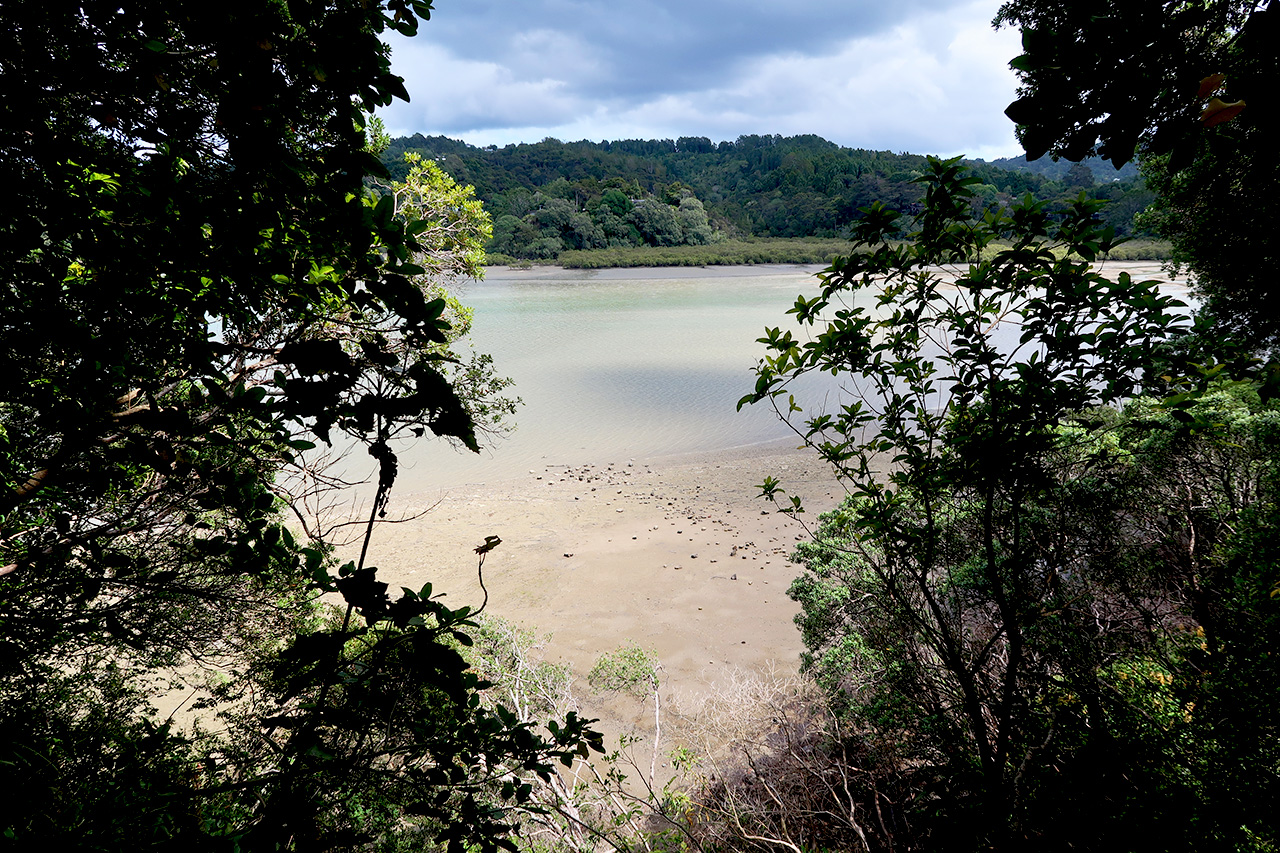
Aesthetic Significance or Value The place has aesthetic significance for its bush setting and impressive views towards the Waikūmete or Little Muddy Creek estuary. Maurice Shadbolt himself frequently mentioned these qualities in his writings and they formed a major consideration in his decision to live at Arapito Road. They are perhaps also mirrored in the strongly visual qualities observed in his writings. Others have acknowledged the site’s aesthetic appeal, including the Going West Trust which notes its idyllic location. The place’s aesthetic significance extends to the presence of birdsong linked with its bush setting - again referred to by Shadbolt in his writings.
Why is this place Category 1 / Category 2?
Detail Of Assessed Criteria
This place was assessed against the Section 66(3) criteria and found to qualify under the following criteria: a, b, e and k. The assessment concludes that this place should be listed as a Category 1 historic place. (a) The extent to which the place reflects important or representative aspects of New Zealand history The place has special significance for reflecting the development of professional writing in late twentieth-century New Zealand, being used as a residence and studio for most of his adult life by Maurice Shadbolt - this country’s first full-time professional author. Shadbolt achieved this position due the breadth and quantity of his output, which included pieces for National Geographic and other magazines, as well book reviews, short stories, novels, a major play, guides, historical books, and other works. Acquisition of the property was made possible by early success and coincided with his desire to shift focus away from writing short stories - the dominant form of post-war New Zealand fiction - to novels, for which he was repeatedly acclaimed. Extensions to the house and creation of a separate studio reflect reconfigurations to maintain productive professional endeavour, as well as being facilitated by the commercial popularity of his writings. The place can be seen to especially reflect aspects for which Shadbolt’s writings became notable, particularly in their exploration of historical themes and New Zealand identity. The property was chosen as a ‘hermit hideout’ by Shadbolt for reasons that included it being ‘the New Zealand I dreamed about in smoggy London winters’. Incorporating extensive native vegetation and views to the Waikūmete estuary as well as a house of California Bungalow style, the place can be seen to demonstrate broader dualities prevalent in Aotearoa New Zealand as this country emerged from a country tied to the wider northern hemisphere into a more fully Pacific nation. Shadbolt himself felt that aspects of the landscape reflected ‘where local tides blend with global currents’, noting his life to have similarly been ‘a miscellany of the near and the far, the native and the exotic, the insular and the cosmopolitan.’ Elements such as the garage also reflect Shadbolt’s direct explorations by car for New Zealand’s first comprehensive motoring guide in 1973, which encouraged others to get to know the country during a period of mass motoring. The outline traces of a bar painted by Colin McCahon in the writing studio additionally demonstrate the importance of creative networks, and intersections between writers and visual artists. (b) The association of the place with events, persons, or ideas of importance in New Zealand history The place has special or outstanding significance for the strength and nature of its associations with Maurice Shadbolt - a leading figure in the growth of a New Zealand literature during the second half of the twentieth century. Shadbolt received numerous literary awards during his career and was one of this country’s best-known writers. Credited with being an ‘early Pākehā proponent of the need to recognise and embrace Māori culture in national life’, he contributed significantly to international perceptions of New Zealand through extensive overseas publication. He has also been considered the earliest New Zealand writer to widely promote his work through the media, an activity that is now commonplace. The place has connections with many other literary figures, including novelist Elspeth Sandys; writers Marilyn Duckworth and Fleur Adcock; poet Kevin Ireland; and New Zealand’s leading Pacific writer of fiction in English, Albert Wendt. The country’s most widely regarded twentieth-century novelist, Janet Frame, also visited. The place additionally has close links with artists Colin McCahon, Michael Smither, Pat Hanly and Don Binney; photographers Brian Brake and Marti Friedlander; architect Nigel Cook and numerous others. Through Maurice Shadbolt and others who lived in or frequently visited the house, the place has close connections with several events of seminal importance in New Zealand or Auckland history. These include early anti-nuclear protests in 1972; opposition to the Springbok tour in 1981; and demonstration against demolition of His Majesty’s Theatre in 1988. In relation to government moves to oppose French nuclear testing, friend and local Member of Parliament Martyn Finlay was a frequent visitor. As Attorney-General and Minister of Justice Finlay took out a case at the International Court of Justice (1973) which resulted in cessation of atmospheric testing at Mururoa in 1975. (e) The community association with, or public esteem for the place Purchased by a local authority in 2006 to preserve it as a writers’ retreat and memorial to Maurice Shadbolt’s achievements, the Maurice Shadbolt House and Studio enjoys strong community association and esteem. It is currently undergoing conservation managed by a charitable organisation dedicated to the literary arts in West Auckland, the Going West Trust, with the support of a wide group of people including family, friends and professional colleagues of Maurice Shadbolt as well as Auckland Council and the wider creative community. (k) The extent to which the place forms part of a wider historical and cultural area The place forms a significant component of a dispersed historical and cultural area in Titirangi linked with the creative arts in late twentieth-century New Zealand. Connected residences in the locality include the former home of renowned artist Colin McCahon and internationally acclaimed photographer Brian Brake - both friends and associates of Maurice Shadbolt. The place also lies within a coastal area beside the Manukau Harbour between Waikūmete and the Whau portage, which has associations with waka production, use of marine resources and other activities of significance to tangata whenua including Te Kawerau ā Maki. Identified archaeological sites relating to Māori occupation have been recorded along the east side of the Waikūmete estuary, including to the south and north of the Maurice Shadbolt House and Studio. Shadbolt himself was aware of this activity, referring to ‘middens here and there, and rock paths meandering among mudbank and mangrove and along which canoes were portaged…’ in his writings about the locality. Summary of Significance or Values The Maurice Shadbolt House and Studio has special importance for the strength and nature of its connections with Maurice Shadbolt - one of New Zealand’s best-known late twentieth-century writers. Shadbolt occupied the property for most of his adult life and produced most of his best-known works there, erecting a well-preserved studio for this purpose. The place also has special value for reflecting the development of professional writing during this period, Shadbolt being this country’s first full-time professional author. His contributions to literature were recognised by a CBE in 1989 and he gained numerous other literary awards. Through Shadbolt, the place has connections with explorations of New Zealand history and identity at a time of widespread social and political change. It is linked with seminal events of the late twentieth-century including anti-nuclear protest in the Pacific, opposition to the 1981 Springbok tour and - in relation to attitudes towards this country’s built heritage - demonstration against the demolition of His Majesty’s Theatre in Auckland (1988). It has direct associations with numerous other individuals of importance in this country’s literary, artistic and other development, and contributes to a wider area in Titirangi connected with late twentieth-century creative achievement. The historical and cultural importance of the place has been recognised by many organisations and groups, with concerted attempts to preserve and conserve it as a writers’-in-residence retreat, enabling an ongoing tradition of literary use.
Why is this place significant?
Cultural Significance
Cultural Significance or Value The Maurice Shadbolt House and Studio has high cultural significance for the strength and importance of its associations with New Zealand literary endeavour, and especially that of Maurice Shadbolt. It is where Shadbolt, a major figure in late twentieth-century New Zealand literature, created the bulk of his writings between 1964 and the end of the century. These included many of his best-known works, which encompassed novels, short stories, a major play and commissions that included New Zealand’s first comprehensive motoring guide. Shadbolt was acknowledged in his lifetime as a Commander of the Order of the British Empire for his contribution to New Zealand literature and gained numerous literary awards. The place also has cultural significance for its associations with a wider literary and artistic network linked with Shadbolt. For much of late twentieth century, it formed a site of social gathering and sometimes refuge for visiting writers and other artists. A large number of Shadbolt’s close associates, including partners, formed notable figures in their own right. Some, such as Elspeth Sandys, undertook literary endeavour in the house and studio. Artists Colin McCahon and Michael Smither, and photographers Brian Brake and Marti Friedlander also exercised their crafts at Arapito Road. The cultural importance of the site has been recognised through moves to preserve the property after Shadbolt’s death in 2004 for posterity and literary use. Early momentum involved Waitakere City mayor Bob Harvey and other Waitakere City Council members. Other groups, notably Going West Trust - a charitable body committed to promoting the arts in West Auckland - have since dedicated effort to the place’s retention and conservation as a writers’ residence, with the assistance of numerous people locally and further afield including Shadbolt’s family, professional colleagues and friends. Collectively, the efforts of councils, volunteer bodies and many individuals demonstrate the cultural importance and meaning of the place within a broader community context.
Historic Significance
Historical Significance or Value The place is historically significant for its connections with explorations of New Zealand and New Zealandness at a time of social and political change in late twentieth-century Aotearoa New Zealand. Maurice Shadbolt engaged directly with these ideas over a prolonged period through extensive writings and activism undertaken or conceived at Arapito Road. Credited with being an ‘early Pākehā proponent of the need to recognise and embrace Māori culture in national life’, he was a significant contributor to debates about New Zealand history and identity throughout the time that he lived and worked at the property. Enjoying extensive overseas publication, he also played a leading part in projecting this country and the wider Pacific to an international audience. Through Shadbolt’s activism, the place has connections with formative events linked with this country’s historical evolution. These include early protests against nuclear testing in the Pacific at Mururoa in 1972 aboard the Tamure. They also encompass several involvements in direct action against the Springbok tour in 1981, including when Bridget Armstrong - Shadbolt’s wife at the time - played a major role in organising a 25,000-strong Artists against Apartheid march and subsequent concert. The couple were also among 29 people arrested protesting demolition of His Majesty’s Theatre in 1988, a seminal event in attempts to stem the rapid loss of built heritage in central Auckland during liberalisation of the economy. Other campaigns that Shadbolt was closely involved with included anti-Vietnam protest and judicial reform.
Physical Significance
Aesthetic Significance or Value The place has aesthetic significance for its bush setting and impressive views towards the Waikūmete or Little Muddy Creek estuary. Maurice Shadbolt himself frequently mentioned these qualities in his writings and they formed a major consideration in his decision to live at Arapito Road. They are perhaps also mirrored in the strongly visual qualities observed in his writings. Others have acknowledged the site’s aesthetic appeal, including the Going West Trust which notes its idyllic location. The place’s aesthetic significance extends to the presence of birdsong linked with its bush setting - again referred to by Shadbolt in his writings.
Why is this place Category 1 / Category 2?
Detail Of Assessed Criteria
This place was assessed against the Section 66(3) criteria and found to qualify under the following criteria: a, b, e and k. The assessment concludes that this place should be listed as a Category 1 historic place. (a) The extent to which the place reflects important or representative aspects of New Zealand history The place has special significance for reflecting the development of professional writing in late twentieth-century New Zealand, being used as a residence and studio for most of his adult life by Maurice Shadbolt - this country’s first full-time professional author. Shadbolt achieved this position due the breadth and quantity of his output, which included pieces for National Geographic and other magazines, as well book reviews, short stories, novels, a major play, guides, historical books, and other works. Acquisition of the property was made possible by early success and coincided with his desire to shift focus away from writing short stories - the dominant form of post-war New Zealand fiction - to novels, for which he was repeatedly acclaimed. Extensions to the house and creation of a separate studio reflect reconfigurations to maintain productive professional endeavour, as well as being facilitated by the commercial popularity of his writings. The place can be seen to especially reflect aspects for which Shadbolt’s writings became notable, particularly in their exploration of historical themes and New Zealand identity. The property was chosen as a ‘hermit hideout’ by Shadbolt for reasons that included it being ‘the New Zealand I dreamed about in smoggy London winters’. Incorporating extensive native vegetation and views to the Waikūmete estuary as well as a house of California Bungalow style, the place can be seen to demonstrate broader dualities prevalent in Aotearoa New Zealand as this country emerged from a country tied to the wider northern hemisphere into a more fully Pacific nation. Shadbolt himself felt that aspects of the landscape reflected ‘where local tides blend with global currents’, noting his life to have similarly been ‘a miscellany of the near and the far, the native and the exotic, the insular and the cosmopolitan.’ Elements such as the garage also reflect Shadbolt’s direct explorations by car for New Zealand’s first comprehensive motoring guide in 1973, which encouraged others to get to know the country during a period of mass motoring. The outline traces of a bar painted by Colin McCahon in the writing studio additionally demonstrate the importance of creative networks, and intersections between writers and visual artists. (b) The association of the place with events, persons, or ideas of importance in New Zealand history The place has special or outstanding significance for the strength and nature of its associations with Maurice Shadbolt - a leading figure in the growth of a New Zealand literature during the second half of the twentieth century. Shadbolt received numerous literary awards during his career and was one of this country’s best-known writers. Credited with being an ‘early Pākehā proponent of the need to recognise and embrace Māori culture in national life’, he contributed significantly to international perceptions of New Zealand through extensive overseas publication. He has also been considered the earliest New Zealand writer to widely promote his work through the media, an activity that is now commonplace. The place has connections with many other literary figures, including novelist Elspeth Sandys; writers Marilyn Duckworth and Fleur Adcock; poet Kevin Ireland; and New Zealand’s leading Pacific writer of fiction in English, Albert Wendt. The country’s most widely regarded twentieth-century novelist, Janet Frame, also visited. The place additionally has close links with artists Colin McCahon, Michael Smither, Pat Hanly and Don Binney; photographers Brian Brake and Marti Friedlander; architect Nigel Cook and numerous others. Through Maurice Shadbolt and others who lived in or frequently visited the house, the place has close connections with several events of seminal importance in New Zealand or Auckland history. These include early anti-nuclear protests in 1972; opposition to the Springbok tour in 1981; and demonstration against demolition of His Majesty’s Theatre in 1988. In relation to government moves to oppose French nuclear testing, friend and local Member of Parliament Martyn Finlay was a frequent visitor. As Attorney-General and Minister of Justice Finlay took out a case at the International Court of Justice (1973) which resulted in cessation of atmospheric testing at Mururoa in 1975. (e) The community association with, or public esteem for the place Purchased by a local authority in 2006 to preserve it as a writers’ retreat and memorial to Maurice Shadbolt’s achievements, the Maurice Shadbolt House and Studio enjoys strong community association and esteem. It is currently undergoing conservation managed by a charitable organisation dedicated to the literary arts in West Auckland, the Going West Trust, with the support of a wide group of people including family, friends and professional colleagues of Maurice Shadbolt as well as Auckland Council and the wider creative community. (k) The extent to which the place forms part of a wider historical and cultural area The place forms a significant component of a dispersed historical and cultural area in Titirangi linked with the creative arts in late twentieth-century New Zealand. Connected residences in the locality include the former home of renowned artist Colin McCahon and internationally acclaimed photographer Brian Brake - both friends and associates of Maurice Shadbolt. The place also lies within a coastal area beside the Manukau Harbour between Waikūmete and the Whau portage, which has associations with waka production, use of marine resources and other activities of significance to tangata whenua including Te Kawerau ā Maki. Identified archaeological sites relating to Māori occupation have been recorded along the east side of the Waikūmete estuary, including to the south and north of the Maurice Shadbolt House and Studio. Shadbolt himself was aware of this activity, referring to ‘middens here and there, and rock paths meandering among mudbank and mangrove and along which canoes were portaged…’ in his writings about the locality. Summary of Significance or Values The Maurice Shadbolt House and Studio has special importance for the strength and nature of its connections with Maurice Shadbolt - one of New Zealand’s best-known late twentieth-century writers. Shadbolt occupied the property for most of his adult life and produced most of his best-known works there, erecting a well-preserved studio for this purpose. The place also has special value for reflecting the development of professional writing during this period, Shadbolt being this country’s first full-time professional author. His contributions to literature were recognised by a CBE in 1989 and he gained numerous other literary awards. Through Shadbolt, the place has connections with explorations of New Zealand history and identity at a time of widespread social and political change. It is linked with seminal events of the late twentieth-century including anti-nuclear protest in the Pacific, opposition to the 1981 Springbok tour and - in relation to attitudes towards this country’s built heritage - demonstration against the demolition of His Majesty’s Theatre in Auckland (1988). It has direct associations with numerous other individuals of importance in this country’s literary, artistic and other development, and contributes to a wider area in Titirangi connected with late twentieth-century creative achievement. The historical and cultural importance of the place has been recognised by many organisations and groups, with concerted attempts to preserve and conserve it as a writers’-in-residence retreat, enabling an ongoing tradition of literary use.
Construction Professional
Name
Cook, Nigel
Type
Architect
Biography
No biography is currently available for this construction professional
Name
Aley and Irving
Type
Builder
Biography
Name
R. H. Cartwright
Type
Builder
Biography
Construction Details
Start Year
1940
startYearCirca
Type
Original Construction
Description
House
Period
1940s
Start Year
1960
Type
Original Construction
Description
Garage
Start Year
1966
Type
Original Construction
Description
Bedroom and studio connecting house and garage
Start Year
1971
Finish Year
1972
Type
Original Construction
Description
Garden path between house and studio
Start Year
1972
Type
Original Construction
Description
Detached studio in garden
Start Year
1972
Type
Addition
Description
Extensions to house lounge and bathroom, with attached timber terrace and steps
Start Year
1972
Type
Modification
Description
Alterations to house toilet
Start Year
1973
Type
Modification
Description
House dining room extension
Start Year
1978
Type
Modification
Description
House renovations, including interior painting
Start Year
1982
Type
Modification
Description
House renovations
Start Year
1984
Type
Modification
Description
Repairs to house bathroom ceiling
Start Year
1988
Type
Addition
Description
House basement extended and relined for self-contained flat
Start Year
1988
Type
Addition
Description
Studio extended
Start Year
1990
startYearCirca
Type
Modification
Description
House front deck erected
Period
1990s
Start Year
2012
Finish Year
2013
Type
Modification
Description
House front deck re-erected as larger structure
Start Year
2022
Finish Year
2023
Type
Modification
Description
House basement remodelled and strengthened
Construction Materials
House and studio: Timber with corrugated iron roof cladding
Construction Professional
Name
Cook, Nigel
Type
Architect
Biography
No biography is currently available for this construction professional
Name
Aley and Irving
Type
Builder
Biography
Name
R. H. Cartwright
Type
Builder
Biography
Construction Details
Start Year
1940
startYearCirca
Type
Original Construction
Description
House
Period
1940s
Start Year
1960
Type
Original Construction
Description
Garage
Start Year
1966
Type
Original Construction
Description
Bedroom and studio connecting house and garage
Start Year
1971
Finish Year
1972
Type
Original Construction
Description
Garden path between house and studio
Start Year
1972
Type
Original Construction
Description
Detached studio in garden
Start Year
1972
Type
Addition
Description
Extensions to house lounge and bathroom, with attached timber terrace and steps
Start Year
1972
Type
Modification
Description
Alterations to house toilet
Start Year
1973
Type
Modification
Description
House dining room extension
Start Year
1978
Type
Modification
Description
House renovations, including interior painting
Start Year
1982
Type
Modification
Description
House renovations
Start Year
1984
Type
Modification
Description
Repairs to house bathroom ceiling
Start Year
1988
Type
Addition
Description
House basement extended and relined for self-contained flat
Start Year
1988
Type
Addition
Description
Studio extended
Start Year
1990
startYearCirca
Type
Modification
Description
House front deck erected
Period
1990s
Start Year
2012
Finish Year
2013
Type
Modification
Description
House front deck re-erected as larger structure
Start Year
2022
Finish Year
2023
Type
Modification
Description
House basement remodelled and strengthened
Construction Materials
House and studio: Timber with corrugated iron roof cladding
Early history The site overlooks the Manukau Harbour, on a peninsula to the east of Waikūmete (Little Muddy Bay). The peninsula formed part of an extensive forest, which according to Te Kawerau ā Maki traditions was initially occupied by Patupaiarehe or fairy people. Subsequent arrivals included the tohunga of the Tainui waka, Rakataura - also known as Hape - who named many places adjoining the Manukau. From the 1600s, the area’s occupants included Te Kawerau ā Maki, the northernmost grouping of the Tainui confederation. Te Kawerau accounts attest to extensive use of the Manukau coastline, including lands immediately to the east of the Waikūmete inlet: ‘The coastal area extending west from Motukaraka [beside the Whau canoe portage] to Waikūmete (Little Muddy Creek) is known collectively as Tītirangi, having been named by Rakataura in commemoration of a hill in the Pacific homeland. Along these shores are places of historical importance to Te Kawerau ā Maki including: Te Kai ō Poutūkeka, Ōtītore, Ōkewa, Paturoa, and Taumatarearea (the headland overlooking the entrance of Waikūmete). The latter inlet was strategically important as it was located at the southern end of a major inland walk way that ran north-south, and also as the embarkation point for canoe travel on the Manukau Harbour. The importance of Waikūmete and its catchment as a canoe building area, until the 1860s, is reflected in the place names Te-Tō-o-Parahiku, “the dragging place of the semi-finished canoe hulls”, and Maramara Tōtara, “the chips of totara wood”.’ Numerous identified midden sites along the peninsula coastline indicate the use of marine resources. Occupation at the southern end of the peninsula, some 300 m from the current Shadbolt House, is also attested by an archaeologically recorded bank and ditch. During the eighteenth century, conflict between neighbouring iwi to the north and south, Ngāti Whātua ō Kaipara and Te Waiōhua, resulted in battles at nearby Paruroa (Big Muddy Creek) and Paturoa (Tītirangi Creek) - at which Ngāti Whātua prevailed. Te Kawerau and other groups continued to occupy the area, but pressure to fell the forest for kauri and other timber increasingly led to tracts passing into European hands from the late 1830s onwards. In 1854, the land on which the future Shadbolt House was erected was acquired as part of a 190-acre holding of ‘Forest Land’ by Major Joseph Greenwood, a former British soldier in India and Afghanistan who had recently been elected to New Zealand’s first parliament. During the 1850s, both Māori and European sawyers worked in the vicinity. After extensive logging, a 20-acre portion of Greenwood’s land was sold in 1880 to Smith as part of a wider subdivision into small farm sections. By the early twentieth century, most of this area was in mānuka and grass. Use of the land for farming was relatively short-lived. In 1922, a subsequent owner J. R. Herring subdivided the holding, now sixteen acres in size, into 42 individual lots. By this time, the nearby village of Titirangi had become increasing popular as a recreational destination for Aucklanders. The new sections were advertised as being the settlement’s first subdivision and promoted for summer holiday and weekend use. ‘Beautiful Titirangi’ was touted for its ‘glorious views - mountain air - sea bathing’. Although several properties were sold over the ensuing decade, some sections were retained by the Herring family - including Lot 4, where Maurice Shadbolt House was subsequently built. Construction and initial use of Maurice Shadbolt House (1940s-1964) The Maurice Shadbolt House appears to have been erected as a small holiday home for J. R. Herring’s son, James Sinclair Herring and his wife Zena (née Morrell). James Herring was provided with Lot 4 in 1933, during the Great Depression, when he was just 20 years old. Occupying relatively steep land between View (later renamed Arapito) Road and the Manukau Harbour, the section may have been especially desirable for its position next to the subdivision’s only recreation reserve, as well as having access to a beach at its base. Other lots, including the adjoining section to the north, were transferred to additional family members. The house was built in the 1940s, when James Herring evidently worked in his father’s carrying business. Erected at the top of the property, it consisted of a modest timber structure of gabled, California Bungalow design. Internally, it contained a front living room and bedroom, and service areas at the rear including a kitchen. James and Zena likely used it as a recreational retreat, retaining a main residence in suburban Auckland. In 1948, the couple transferred the property to a close relative, Bruce Nicolson. A radiator repairer, Nicolson provided Arapito Road as his main address. Either Nicolson, or the next owners from 1954 - brother-in-law Edward William Herring and wife Dawn Herring (née Nicolson) - may have extended the building to incorporate additional rooms at the rear including an underlying basement. Edward Herring was another son of the original subdivider J. R. Herring, and similarly a carrier by trade. During his tenure, in 1960, a garage was erected beside the house, reflecting his profession as well as the importance of motorised transport in accessing Titirangi. By this time, the area’s scenic beauty was attracting an increasing population, including individuals who wished to pursue artistic endeavour or a stronger connection with the natural environment - or both. In 1964, the property was purchased as a ‘cliff-hanging home’ by published author, Maurice Shadbolt and his young family. From this time until shortly before his death forty years later, it was to form both Shadbolt’s main place of residence and where he wrote much of the work that made his name. Maurice Shadbolt One of this country’s best-known authors, Maurice Francis Richard Shadbolt (1932-2004) has been considered ‘a leading figure in the growth of a New Zealand literature during the second half of the twentieth century’. Also a political activist and ‘early Pākehā proponent of the need to recognise and embrace Māori culture in national life’, he became a significant contributor to debates about New Zealand history and identity at a time of widespread social change. During his lifetime, Shadbolt produced a large and varied corpus that included short stories, novels, biography and journalistic pieces - as well as a major play and other works - with a particular focus on New Zealand themes and topics. Through widespread overseas publication, he played a leading part in projecting this country and the wider Pacific to an international audience. Born into a working-class family during the Great Depression, Shadbolt experienced a peripatetic childhood in the North Island, partly due to his parents Frank and Violet’s attempts to find work. Both his father and maternal uncle Joseph Kearon - a significant mentor - were involved in Communist-influenced activities to assist the unemployed. Shadbolt’s other influences included forebears such as great-grandfather Ben Shadbolt, who milled timber at Akaroa following deportation from Britain via penal institutions at Norfolk Island and Port Arthur, Tasmania. For parts of his childhood, Maurice Shadbolt lived in Te Kūiti - a stronghold of the Kīngitanga movement - where encounters with Māori communities as well as provincial Pākehā culture and the wider environment also helped shape his outlook and writings. Shadbolt’s early literary interest was in short stories, the dominant form of post-war fiction in New Zealand. Entering Auckland University College in 1950, he became friends with other writers who were to become notable, such as Maurice Gee and Kevin Ireland. While working as a journalist in 1952-4 with the Taranaki Daily News and then the Waitakere Gazette, he married a fellow reporter Gillian (Gill) Heming. After travelling around the country for the National Film Unit and being mentored by poet James K. Baxter, he became focussed on writing stories about New Zealand and New Zealanders, reflecting a growing public interest in explorations of national experience and identity in the post-war era. In 1959, during a three-year sojourn in London (1957-60), Shadbolt published his first collection of short stories, The New Zealanders to overseas acclaim. Both he and Gill engaged in political activism, participating in an anti-nuclear march to Aldermaston and working to collect a 2000-strong petition protesting Māori being excluded from the All Black rugby tour to South Africa. After the couple returned to New Zealand in 1960, Shadbolt undertook work with the renowned photographer Brian Brake for National Geographic magazine, resulting in a 48-page article about New Zealand (1962), and a separate large-format publication New Zealand: Gift of the Sea (1963). The latter has been described as ‘a book that celebrated New Zealanders in a way never seen before’. Both reached mass audiences, increasing Shadbolt’s national and international profile. During this period, Shadbolt became the country’s first full-time professional author. Early recognition for his endeavours included the Landfall Prose Award (1957), Scholarship in Letters (1959), Katherine Mansfield Short Story Award and Burns Fellowship (both 1963). Versed in film direction and commercial journalism, he was also ‘the first New Zealand writer to effectively use the media to promote both his books and his persona as author’. His image included ‘a thick mop of black hair…currently fashionable spectacles above a thick black moustache…and…a pipe that was to become part of his apparatus until the end’. Shadbolt and Maurice Shadbolt House (1964-71) Acquisition of the Arapito Road property reflected aspects of Shadbolt’s identity and aspirations. With two young children Sean (born 1960) and Brendan (born 1962), he and Gill were looking for a more permanent home than they had previously occupied. In general, West Auckland was strongly working class. More particularly, Titirangi held associations with artistic endeavour, notably through the painter Colin McCahon, who had pioneered residing there as a way of experiencing life near a city that was close to nature and allowed freedom of expression. With imported-style housing nestling in regenerating native bush, both the Arapito Road property and wider Titirangi reflected Shadbolt’s view of living and belonging in more than one world: ‘the near and the far, the native and the exotic, the insular and the cosmopolitan’. The site’s setting, with its dramatic views over the Waikūmete estuary, perhaps also mirrored the strong visual qualities observed in his writings. Shadbolt himself later stated: ‘I was taken by green Titirangi: the houses sequestered among the trees. The bird-filled bushland and sunny harbour views. This was the New Zealand I dreamed about in smoggy London winters……the suburb’s sole land agent...took us down a road winding past the fern-fringed beaches and rocky inlets of the Manukau harbour’s tidal coastline. Then he halted outside a modest dwelling half-hidden in fern. Though the rooms were small, there were large views. The place didn’t feel cramped. There was a small basement I could use as a workplace…It was the boys’ [Sean and Brendan’s] endorsement which decided the issue. I also envisaged a productive life here, a place where I might stand or fall as a novelist’. The basement where Shadbolt began working looked out towards the estuary, as did his later studio. Upstairs rooms were for family use, initially including three bedrooms, with a small kitchen at the heart of the domestic layout. Shadbolt soon planted banana palms and other trees on the road bank and garden in front of the house, reinforcing its subtropical appeal. The property was, in part, purchased on proceeds from Gift of the Sea. Shadbolt’s tenure coincided with a general shift from writing short stories to longer fiction. News that his first novel Among the Cinders might find publication occurred when he and Gill first took possession. He soon began writing This Summer’s Dolphin (published 1969), and revising Strangers and Journeys, his major early novel (1972). Writings between 1964 and the late 1970s have also been characterised as shifting from an earlier phase of preoccupation with contemporary matters towards combining this with explorations of New Zealand’s past. In 1965, he wrote ‘This is what interests me - making sense of my time and place’. Writing short stories initially remained ongoing, including The Presence of Music (1967) whose triptych format was directly influenced by Colin McCahon. McCahon later (1969) painted a pre-existing bar in the basement in bright colours, with the title ‘Buttercup Fields Forever’, and also showed Shadbolt how to grow watercress. Reflecting earlier self-sufficient habits, Shadbolt routinely tended a vegetable garden on a terrace retained by a self-built concrete wall, and fished from the beach below the house. Political engagement included Anti-Vietnam War activism and criminal justice reform, part of his view that a writer’s role involved leadership on social matters. Early visitors to the house included cousin and fellow activist Tim Shadbolt, author and publisher Dennis McEldowney, and poet Louis Johnson. Marti Friedlander photographed Maurice Shadbolt among palms in the front garden. After twins Tui and Daniel were born (1965), a bedroom addition was erected over the pre-existing garage. Built in 1966, this was evidently designed by architect Nigel Cook - part of Shadbolt’s wider personal and artistic network, which also included sisters Marilyn Duckworth and Fleur Adcock, and others. The space was subsequently subdivided to accommodate a studio, but after Shadbolt reverted to the basement the latter became a fifth bedroom. The underlying garage housing the family’s Holden station wagon - in which Shadbolt travelled the country on journalistic and other assignments - was also partly subdivided for a rear storeroom. In the late 1960s, Shadbolt compiled The Shell Guide to New Zealand - the country’s first motoring guide, ‘which stimulated an increasingly motorised public to explore its own country’. He acquired greater historical knowledge during this project, including about the New Zealand Wars. Also extensively visiting the wider Pacific on international assignments, he considered that New Zealand was becoming a Pacific nation rather than a European outpost. Sympathising with Māori as disadvantaged members of society, he noted that ‘we have hardly begun, officially, to acknowledge that we have not just one but two living cultures’, developing an especially close affinity with Ngāti Porou carver Pineamine Taiapa, to whom he later felt in greatest debt as a novelist. After the breakup of his relationship with Gill, he had a child Brigid (born 1971) with second wife Barbara Magner, a television broadcaster who had participated in making a programme about Taiapa and was one of the first of her profession to address the viewing public in ‘a natural, non-BBC acculturated accent’. With an enlarged family to support, Shadbolt made plans to fulfill an early desire - creating a dedicated writing studio in the rear garden. Construction of writer’s studio and other alterations (1972-2004) In 1971-2, Shadbolt with sons Sean and Brendan hand-built a long, stepped concrete path down the property to the beach. This facilitated construction of a single-room, timber studio on a former lawn midway between the house and foreshore. Shadbolt had initially envisaged a separate writing space in the garden when the property was purchased. According to biographer Philip Temple, this new studio was to be ‘his ‘hideout’, a ‘sanctuary’ where he could construct a writing life within his personal ecology’. Its creation represented ‘the throwing out of a spiritual anchor’. The McCahon-painted bar was moved into the building, and its interior filled with other artwork, writings and mementoes. While the studio was under construction (1972), Shadbolt undertook a trip to Mururoa and Tahiti on the yacht Tamure to oppose French nuclear testing in the Pacific. As part of the first wave of flotilla protest, he participated in a seminal development that ultimately led to New Zealand’s nuclear-free policy in 1987. Another notable contributor was Martyn Finlay, a witness at Shadbolt and Magner’s wedding, and a frequent visitor to the house. As Attorney-General and Minister of Justice in a new Labour government, Finlay took out a case at the International Court of Justice (1973) which resulted in cessation of atmospheric testing at Mururoa in 1975. After returning, Shadbolt moved into the new ‘bush-bound’ studio with inspiring views towards the estuary. Contemporary alterations to the main house (1972-3) included expanding the rear bathroom and the former dining room as an extended lounge and terrace, with enlarged basement below. Extensions also included converting the earlier living room into a larger front dining area, and part-enclosing an earlier front terrace. Ranch-sliding doors provided greater connection with the exterior. Shadbolt later wrote movingly about reading a volume of James K. Baxter’s poetry in the living room during this period, shortly before Baxter’s untimely death. In 1973 a beloved family dog, Terry, was buried in the garden, near the studio. Social gatherings in the mid-1970s featured many notable literary and artistic names, variously encompassing writers Kevin Ireland, C. K. Stead, Fleur Adcock and Keith Sinclair; painters Don Binney, Jacqueline Fahey, Nigel Brown and Michael Smither; photographers Brian Brake and Marti Friedlander, and many others. In 1972 noted Samoan-born author Albert Wendt, New Zealand’s leading Pacific writer of fiction in English, stayed at the house ‘on the occasion of the publication of his first novel, Sons for the Return Home’. Other visitors included Barry Crump, the only better-known New Zealand author than Shadbolt at this time; and literary critic and lecturer in English at the University of Canterbury, Cherry Hankin, who became the first to introduce Shadbolt’s work into a university curriculum. The house formed a refuge for many writers and artists away from the demands of usual routines. Shadbolt’s published works at this time included novels A Touch of Clay and Danger Zone (both 1974), the latter loosely based on his Mururoa experiences. Shadbolt had a complex personal life, partly reflecting the socially experimental times. In 1978 he married third wife, actress Bridget Armstrong who had a varied career in Britain and elsewhere, having been directed on stage by Sir John Gielgud as well as appearing in television soap operas, costume dramas, and alternative comedy shows such as The Goodies and Ripping Yarns. The wedding took place in the front garden, with Brian Brake as photographer. Both Shadbolt and Armstrong participated in the country’s anti-Springbok tour protests (1981), being among a group of 200 that opposed the South African team’s arrival at Māngere Airport as well as joining much larger demonstrations at Hamilton Stadium and Eden Park, Auckland - the latter alongside Tim Shadbolt, who returned with them after the event to Arapito Road. Amstrong additionally played a major role in organising a 25,000-strong Artists Against Apartheid march and an outdoor concert in Aotea Square, a day before the Auckland match; and later became ‘both Auckland and New Zealand president of Actors Equity, leading strikes for better pay and conditions during the first year of the new [Labour] government’. The couple were also among 29 people arrested while protesting demolition of His Majesty’s Theatre in early 1988, a seminal event in attempts to stem the rapid loss of built heritage in central Auckland during liberalisation of the economy. Further changes to the property included expansion of the vegetable garden in 1981; refitting the basement as a self-contained flat for wider family use in 1988; and extending the rear part of the studio in the same year. In late 1989, Shadbolt briefly shared the studio with fourth wife and notable author in her own right, Elspeth Sandys, between spells when she used other writing spaces in the house. From the late 1970s until the end of his career, Shadbolt focussed more substantively on historical themes - producing many of his most notable works. These included The Lovelock Version (1980), considered probably the most outstanding of his novels; and a significant trilogy on the New Zealand Wars, namely Season of the Jew (1986), Monday’s Warriors (1990) and The House of Strife (1993). He also engaged with New Zealand’s experience at Gallipoli in 1915-16, now seen as a defining event in this country’s evolving history and identity. Consequent works included the acclaimed play Once on Chunuk Bair (1982) and a non-fiction collection, Voices of Gallipoli (1988), based around survivors’ narratives. He also published The Reader’s Digest Guide to New Zealand (1988, revised 1993), and the well-received first volume of an autobiography, One of Ben’s (1993). In 1989, Shadbolt became a Commander of the Order of the British Empire (CBE) for services to literature. He was subsequently recognised as ‘New Zealand’s foremost writer of historical fiction’. Kevin Ireland noted that he was ‘not just our best and most inventive historical storyteller…[but] one of our most determinedly ambitious writers…a kind of Hector Berlioz of the New Zealand novel’. Publication of a volume of critical essays devoted to Shadbolt’s works in 1995 was a significant event: until that date few New Zealand writers - perhaps only Frank Sargeson, Katherine Mansfield and Janet Frame - had received a similar accolade. Two years later, the University of Auckland awarded him an honorary doctorate. At this time, he considered that a major role of a New Zealand writer was ‘filling the spaces; ending the silences of our history’. In 1997, Shadbolt and Sandys attended the nearby Going West literary festival with other authors including Maurice Gee and Marilyn Duckworth. After the effective ending of his marriage with Sandys, he was assisted by his second wife Barbara Magner as the onset of dementia became increasingly apparent. In 1999, he sold the McCahon-painted bar in the studio to the Museum of New Zealand Te Papa Tongarewa. Publication of his last major work, the autobiographical From the Edge of the Sky, occurred in the same year. In 2000, Shadbolt left the house permanently for a residential home in Taumaranui. As well as his CBE and honorary doctorate, while living at Arapito Road he had been awarded the New Zealand Book award for fiction (1981), the Goodman Fielder Wattie Book of the Year twice (1973, 1987) and the NZ Literary Fund’s Scholarship in Letters three times (1970, 1982, 1990). He had also been an Auckland University Literary Fellow (1987), Writer in Residence at Waikato University (1992) and Katherine Mansfield Fellow (1998). He was additionally the only author to receive the Katherine Mansfield Short Story Award on three occasions, adding wins in 1967 and 1995 to that in 1960 . Maurice Shadbolt died in October 2004. He was brought back to the house to lie in state for two days before a funeral at St-Matthew-in-the-City in central Auckland. The latter event was attended by more than three hundred people, with eulogies by Kevin Ireland and others. He was buried at Waikūmete Cemetery, a relatively short distance from Titirangi, ‘with a view to the Waitakere Ranges’. Later history (2004 onwards) Immediately after Shadbolt’s death, Mayor of Waitakere City Bob Harvey recommended to Waitakere City Council that he pursue obtaining the property to preserve it as a residence for promising writers. A six-term mayor of Waitakere, Harvey had known Shadbolt personally for over 40 years. In 2006, Waitakere City Council purchased the property from Shadbolt’s family. A subsequent project to create a writer’s centre in association with Auckland University of Technology (AUT) was mooted but did not proceed. For several years after 2007, the house was rented out for residential use. In 2010, Waitakere City Council agreed in principle to transfer the property to Going West Trust for a writers’ residence. A registered charity, the Trust had emerged from the Going West Books and Writers’ Festival, begun in 1996 to promote literary arts in west Auckland and subsequently the longest-running literary festival in the country. A development group furthering the writer-in-residence project included Sean Shadbolt, Maurice Shadbolt’s publisher David Ling, and Naomi McCleary. Repairs and maintenance in 2012-13 included creating an enlarged northern deck. After Council amalgamation and with the active support of the Waitākere Ranges Local Board, Auckland Council confirmed leasing the property to the Trust in 2022. Subsequent conservation included replacement of 1988 basement linings and extensive stabilisation. This formed part of an ongoing programme undertaken in accordance with a 2013 conservation plan prepared by Burgess and Treep Architects. The work has been supported by a wide variety of public bodies and groups, with the aim of furthering the property’s association with literary endeavour into the future as a writers’-in-residence retreat. The place retains many of the aesthetic qualities that inspired Shadbolt, the Going West Trust noting that it remains in ‘an idyllic location…surrounded by native trees and overlooking the Manukau Harbour’.
Early history The site overlooks the Manukau Harbour, on a peninsula to the east of Waikūmete (Little Muddy Bay). The peninsula formed part of an extensive forest, which according to Te Kawerau ā Maki traditions was initially occupied by Patupaiarehe or fairy people. Subsequent arrivals included the tohunga of the Tainui waka, Rakataura - also known as Hape - who named many places adjoining the Manukau. From the 1600s, the area’s occupants included Te Kawerau ā Maki, the northernmost grouping of the Tainui confederation. Te Kawerau accounts attest to extensive use of the Manukau coastline, including lands immediately to the east of the Waikūmete inlet: ‘The coastal area extending west from Motukaraka [beside the Whau canoe portage] to Waikūmete (Little Muddy Creek) is known collectively as Tītirangi, having been named by Rakataura in commemoration of a hill in the Pacific homeland. Along these shores are places of historical importance to Te Kawerau ā Maki including: Te Kai ō Poutūkeka, Ōtītore, Ōkewa, Paturoa, and Taumatarearea (the headland overlooking the entrance of Waikūmete). The latter inlet was strategically important as it was located at the southern end of a major inland walk way that ran north-south, and also as the embarkation point for canoe travel on the Manukau Harbour. The importance of Waikūmete and its catchment as a canoe building area, until the 1860s, is reflected in the place names Te-Tō-o-Parahiku, “the dragging place of the semi-finished canoe hulls”, and Maramara Tōtara, “the chips of totara wood”.’ Numerous identified midden sites along the peninsula coastline indicate the use of marine resources. Occupation at the southern end of the peninsula, some 300 m from the current Shadbolt House, is also attested by an archaeologically recorded bank and ditch. During the eighteenth century, conflict between neighbouring iwi to the north and south, Ngāti Whātua ō Kaipara and Te Waiōhua, resulted in battles at nearby Paruroa (Big Muddy Creek) and Paturoa (Tītirangi Creek) - at which Ngāti Whātua prevailed. Te Kawerau and other groups continued to occupy the area, but pressure to fell the forest for kauri and other timber increasingly led to tracts passing into European hands from the late 1830s onwards. In 1854, the land on which the future Shadbolt House was erected was acquired as part of a 190-acre holding of ‘Forest Land’ by Major Joseph Greenwood, a former British soldier in India and Afghanistan who had recently been elected to New Zealand’s first parliament. During the 1850s, both Māori and European sawyers worked in the vicinity. After extensive logging, a 20-acre portion of Greenwood’s land was sold in 1880 to Smith as part of a wider subdivision into small farm sections. By the early twentieth century, most of this area was in mānuka and grass. Use of the land for farming was relatively short-lived. In 1922, a subsequent owner J. R. Herring subdivided the holding, now sixteen acres in size, into 42 individual lots. By this time, the nearby village of Titirangi had become increasing popular as a recreational destination for Aucklanders. The new sections were advertised as being the settlement’s first subdivision and promoted for summer holiday and weekend use. ‘Beautiful Titirangi’ was touted for its ‘glorious views - mountain air - sea bathing’. Although several properties were sold over the ensuing decade, some sections were retained by the Herring family - including Lot 4, where Maurice Shadbolt House was subsequently built. Construction and initial use of Maurice Shadbolt House (1940s-1964) The Maurice Shadbolt House appears to have been erected as a small holiday home for J. R. Herring’s son, James Sinclair Herring and his wife Zena (née Morrell). James Herring was provided with Lot 4 in 1933, during the Great Depression, when he was just 20 years old. Occupying relatively steep land between View (later renamed Arapito) Road and the Manukau Harbour, the section may have been especially desirable for its position next to the subdivision’s only recreation reserve, as well as having access to a beach at its base. Other lots, including the adjoining section to the north, were transferred to additional family members. The house was built in the 1940s, when James Herring evidently worked in his father’s carrying business. Erected at the top of the property, it consisted of a modest timber structure of gabled, California Bungalow design. Internally, it contained a front living room and bedroom, and service areas at the rear including a kitchen. James and Zena likely used it as a recreational retreat, retaining a main residence in suburban Auckland. In 1948, the couple transferred the property to a close relative, Bruce Nicolson. A radiator repairer, Nicolson provided Arapito Road as his main address. Either Nicolson, or the next owners from 1954 - brother-in-law Edward William Herring and wife Dawn Herring (née Nicolson) - may have extended the building to incorporate additional rooms at the rear including an underlying basement. Edward Herring was another son of the original subdivider J. R. Herring, and similarly a carrier by trade. During his tenure, in 1960, a garage was erected beside the house, reflecting his profession as well as the importance of motorised transport in accessing Titirangi. By this time, the area’s scenic beauty was attracting an increasing population, including individuals who wished to pursue artistic endeavour or a stronger connection with the natural environment - or both. In 1964, the property was purchased as a ‘cliff-hanging home’ by published author, Maurice Shadbolt and his young family. From this time until shortly before his death forty years later, it was to form both Shadbolt’s main place of residence and where he wrote much of the work that made his name. Maurice Shadbolt One of this country’s best-known authors, Maurice Francis Richard Shadbolt (1932-2004) has been considered ‘a leading figure in the growth of a New Zealand literature during the second half of the twentieth century’. Also a political activist and ‘early Pākehā proponent of the need to recognise and embrace Māori culture in national life’, he became a significant contributor to debates about New Zealand history and identity at a time of widespread social change. During his lifetime, Shadbolt produced a large and varied corpus that included short stories, novels, biography and journalistic pieces - as well as a major play and other works - with a particular focus on New Zealand themes and topics. Through widespread overseas publication, he played a leading part in projecting this country and the wider Pacific to an international audience. Born into a working-class family during the Great Depression, Shadbolt experienced a peripatetic childhood in the North Island, partly due to his parents Frank and Violet’s attempts to find work. Both his father and maternal uncle Joseph Kearon - a significant mentor - were involved in Communist-influenced activities to assist the unemployed. Shadbolt’s other influences included forebears such as great-grandfather Ben Shadbolt, who milled timber at Akaroa following deportation from Britain via penal institutions at Norfolk Island and Port Arthur, Tasmania. For parts of his childhood, Maurice Shadbolt lived in Te Kūiti - a stronghold of the Kīngitanga movement - where encounters with Māori communities as well as provincial Pākehā culture and the wider environment also helped shape his outlook and writings. Shadbolt’s early literary interest was in short stories, the dominant form of post-war fiction in New Zealand. Entering Auckland University College in 1950, he became friends with other writers who were to become notable, such as Maurice Gee and Kevin Ireland. While working as a journalist in 1952-4 with the Taranaki Daily News and then the Waitakere Gazette, he married a fellow reporter Gillian (Gill) Heming. After travelling around the country for the National Film Unit and being mentored by poet James K. Baxter, he became focussed on writing stories about New Zealand and New Zealanders, reflecting a growing public interest in explorations of national experience and identity in the post-war era. In 1959, during a three-year sojourn in London (1957-60), Shadbolt published his first collection of short stories, The New Zealanders to overseas acclaim. Both he and Gill engaged in political activism, participating in an anti-nuclear march to Aldermaston and working to collect a 2000-strong petition protesting Māori being excluded from the All Black rugby tour to South Africa. After the couple returned to New Zealand in 1960, Shadbolt undertook work with the renowned photographer Brian Brake for National Geographic magazine, resulting in a 48-page article about New Zealand (1962), and a separate large-format publication New Zealand: Gift of the Sea (1963). The latter has been described as ‘a book that celebrated New Zealanders in a way never seen before’. Both reached mass audiences, increasing Shadbolt’s national and international profile. During this period, Shadbolt became the country’s first full-time professional author. Early recognition for his endeavours included the Landfall Prose Award (1957), Scholarship in Letters (1959), Katherine Mansfield Short Story Award and Burns Fellowship (both 1963). Versed in film direction and commercial journalism, he was also ‘the first New Zealand writer to effectively use the media to promote both his books and his persona as author’. His image included ‘a thick mop of black hair…currently fashionable spectacles above a thick black moustache…and…a pipe that was to become part of his apparatus until the end’. Shadbolt and Maurice Shadbolt House (1964-71) Acquisition of the Arapito Road property reflected aspects of Shadbolt’s identity and aspirations. With two young children Sean (born 1960) and Brendan (born 1962), he and Gill were looking for a more permanent home than they had previously occupied. In general, West Auckland was strongly working class. More particularly, Titirangi held associations with artistic endeavour, notably through the painter Colin McCahon, who had pioneered residing there as a way of experiencing life near a city that was close to nature and allowed freedom of expression. With imported-style housing nestling in regenerating native bush, both the Arapito Road property and wider Titirangi reflected Shadbolt’s view of living and belonging in more than one world: ‘the near and the far, the native and the exotic, the insular and the cosmopolitan’. The site’s setting, with its dramatic views over the Waikūmete estuary, perhaps also mirrored the strong visual qualities observed in his writings. Shadbolt himself later stated: ‘I was taken by green Titirangi: the houses sequestered among the trees. The bird-filled bushland and sunny harbour views. This was the New Zealand I dreamed about in smoggy London winters……the suburb’s sole land agent...took us down a road winding past the fern-fringed beaches and rocky inlets of the Manukau harbour’s tidal coastline. Then he halted outside a modest dwelling half-hidden in fern. Though the rooms were small, there were large views. The place didn’t feel cramped. There was a small basement I could use as a workplace…It was the boys’ [Sean and Brendan’s] endorsement which decided the issue. I also envisaged a productive life here, a place where I might stand or fall as a novelist’. The basement where Shadbolt began working looked out towards the estuary, as did his later studio. Upstairs rooms were for family use, initially including three bedrooms, with a small kitchen at the heart of the domestic layout. Shadbolt soon planted banana palms and other trees on the road bank and garden in front of the house, reinforcing its subtropical appeal. The property was, in part, purchased on proceeds from Gift of the Sea. Shadbolt’s tenure coincided with a general shift from writing short stories to longer fiction. News that his first novel Among the Cinders might find publication occurred when he and Gill first took possession. He soon began writing This Summer’s Dolphin (published 1969), and revising Strangers and Journeys, his major early novel (1972). Writings between 1964 and the late 1970s have also been characterised as shifting from an earlier phase of preoccupation with contemporary matters towards combining this with explorations of New Zealand’s past. In 1965, he wrote ‘This is what interests me - making sense of my time and place’. Writing short stories initially remained ongoing, including The Presence of Music (1967) whose triptych format was directly influenced by Colin McCahon. McCahon later (1969) painted a pre-existing bar in the basement in bright colours, with the title ‘Buttercup Fields Forever’, and also showed Shadbolt how to grow watercress. Reflecting earlier self-sufficient habits, Shadbolt routinely tended a vegetable garden on a terrace retained by a self-built concrete wall, and fished from the beach below the house. Political engagement included Anti-Vietnam War activism and criminal justice reform, part of his view that a writer’s role involved leadership on social matters. Early visitors to the house included cousin and fellow activist Tim Shadbolt, author and publisher Dennis McEldowney, and poet Louis Johnson. Marti Friedlander photographed Maurice Shadbolt among palms in the front garden. After twins Tui and Daniel were born (1965), a bedroom addition was erected over the pre-existing garage. Built in 1966, this was evidently designed by architect Nigel Cook - part of Shadbolt’s wider personal and artistic network, which also included sisters Marilyn Duckworth and Fleur Adcock, and others. The space was subsequently subdivided to accommodate a studio, but after Shadbolt reverted to the basement the latter became a fifth bedroom. The underlying garage housing the family’s Holden station wagon - in which Shadbolt travelled the country on journalistic and other assignments - was also partly subdivided for a rear storeroom. In the late 1960s, Shadbolt compiled The Shell Guide to New Zealand - the country’s first motoring guide, ‘which stimulated an increasingly motorised public to explore its own country’. He acquired greater historical knowledge during this project, including about the New Zealand Wars. Also extensively visiting the wider Pacific on international assignments, he considered that New Zealand was becoming a Pacific nation rather than a European outpost. Sympathising with Māori as disadvantaged members of society, he noted that ‘we have hardly begun, officially, to acknowledge that we have not just one but two living cultures’, developing an especially close affinity with Ngāti Porou carver Pineamine Taiapa, to whom he later felt in greatest debt as a novelist. After the breakup of his relationship with Gill, he had a child Brigid (born 1971) with second wife Barbara Magner, a television broadcaster who had participated in making a programme about Taiapa and was one of the first of her profession to address the viewing public in ‘a natural, non-BBC acculturated accent’. With an enlarged family to support, Shadbolt made plans to fulfill an early desire - creating a dedicated writing studio in the rear garden. Construction of writer’s studio and other alterations (1972-2004) In 1971-2, Shadbolt with sons Sean and Brendan hand-built a long, stepped concrete path down the property to the beach. This facilitated construction of a single-room, timber studio on a former lawn midway between the house and foreshore. Shadbolt had initially envisaged a separate writing space in the garden when the property was purchased. According to biographer Philip Temple, this new studio was to be ‘his ‘hideout’, a ‘sanctuary’ where he could construct a writing life within his personal ecology’. Its creation represented ‘the throwing out of a spiritual anchor’. The McCahon-painted bar was moved into the building, and its interior filled with other artwork, writings and mementoes. While the studio was under construction (1972), Shadbolt undertook a trip to Mururoa and Tahiti on the yacht Tamure to oppose French nuclear testing in the Pacific. As part of the first wave of flotilla protest, he participated in a seminal development that ultimately led to New Zealand’s nuclear-free policy in 1987. Another notable contributor was Martyn Finlay, a witness at Shadbolt and Magner’s wedding, and a frequent visitor to the house. As Attorney-General and Minister of Justice in a new Labour government, Finlay took out a case at the International Court of Justice (1973) which resulted in cessation of atmospheric testing at Mururoa in 1975. After returning, Shadbolt moved into the new ‘bush-bound’ studio with inspiring views towards the estuary. Contemporary alterations to the main house (1972-3) included expanding the rear bathroom and the former dining room as an extended lounge and terrace, with enlarged basement below. Extensions also included converting the earlier living room into a larger front dining area, and part-enclosing an earlier front terrace. Ranch-sliding doors provided greater connection with the exterior. Shadbolt later wrote movingly about reading a volume of James K. Baxter’s poetry in the living room during this period, shortly before Baxter’s untimely death. In 1973 a beloved family dog, Terry, was buried in the garden, near the studio. Social gatherings in the mid-1970s featured many notable literary and artistic names, variously encompassing writers Kevin Ireland, C. K. Stead, Fleur Adcock and Keith Sinclair; painters Don Binney, Jacqueline Fahey, Nigel Brown and Michael Smither; photographers Brian Brake and Marti Friedlander, and many others. In 1972 noted Samoan-born author Albert Wendt, New Zealand’s leading Pacific writer of fiction in English, stayed at the house ‘on the occasion of the publication of his first novel, Sons for the Return Home’. Other visitors included Barry Crump, the only better-known New Zealand author than Shadbolt at this time; and literary critic and lecturer in English at the University of Canterbury, Cherry Hankin, who became the first to introduce Shadbolt’s work into a university curriculum. The house formed a refuge for many writers and artists away from the demands of usual routines. Shadbolt’s published works at this time included novels A Touch of Clay and Danger Zone (both 1974), the latter loosely based on his Mururoa experiences. Shadbolt had a complex personal life, partly reflecting the socially experimental times. In 1978 he married third wife, actress Bridget Armstrong who had a varied career in Britain and elsewhere, having been directed on stage by Sir John Gielgud as well as appearing in television soap operas, costume dramas, and alternative comedy shows such as The Goodies and Ripping Yarns. The wedding took place in the front garden, with Brian Brake as photographer. Both Shadbolt and Armstrong participated in the country’s anti-Springbok tour protests (1981), being among a group of 200 that opposed the South African team’s arrival at Māngere Airport as well as joining much larger demonstrations at Hamilton Stadium and Eden Park, Auckland - the latter alongside Tim Shadbolt, who returned with them after the event to Arapito Road. Amstrong additionally played a major role in organising a 25,000-strong Artists Against Apartheid march and an outdoor concert in Aotea Square, a day before the Auckland match; and later became ‘both Auckland and New Zealand president of Actors Equity, leading strikes for better pay and conditions during the first year of the new [Labour] government’. The couple were also among 29 people arrested while protesting demolition of His Majesty’s Theatre in early 1988, a seminal event in attempts to stem the rapid loss of built heritage in central Auckland during liberalisation of the economy. Further changes to the property included expansion of the vegetable garden in 1981; refitting the basement as a self-contained flat for wider family use in 1988; and extending the rear part of the studio in the same year. In late 1989, Shadbolt briefly shared the studio with fourth wife and notable author in her own right, Elspeth Sandys, between spells when she used other writing spaces in the house. From the late 1970s until the end of his career, Shadbolt focussed more substantively on historical themes - producing many of his most notable works. These included The Lovelock Version (1980), considered probably the most outstanding of his novels; and a significant trilogy on the New Zealand Wars, namely Season of the Jew (1986), Monday’s Warriors (1990) and The House of Strife (1993). He also engaged with New Zealand’s experience at Gallipoli in 1915-16, now seen as a defining event in this country’s evolving history and identity. Consequent works included the acclaimed play Once on Chunuk Bair (1982) and a non-fiction collection, Voices of Gallipoli (1988), based around survivors’ narratives. He also published The Reader’s Digest Guide to New Zealand (1988, revised 1993), and the well-received first volume of an autobiography, One of Ben’s (1993). In 1989, Shadbolt became a Commander of the Order of the British Empire (CBE) for services to literature. He was subsequently recognised as ‘New Zealand’s foremost writer of historical fiction’. Kevin Ireland noted that he was ‘not just our best and most inventive historical storyteller…[but] one of our most determinedly ambitious writers…a kind of Hector Berlioz of the New Zealand novel’. Publication of a volume of critical essays devoted to Shadbolt’s works in 1995 was a significant event: until that date few New Zealand writers - perhaps only Frank Sargeson, Katherine Mansfield and Janet Frame - had received a similar accolade. Two years later, the University of Auckland awarded him an honorary doctorate. At this time, he considered that a major role of a New Zealand writer was ‘filling the spaces; ending the silences of our history’. In 1997, Shadbolt and Sandys attended the nearby Going West literary festival with other authors including Maurice Gee and Marilyn Duckworth. After the effective ending of his marriage with Sandys, he was assisted by his second wife Barbara Magner as the onset of dementia became increasingly apparent. In 1999, he sold the McCahon-painted bar in the studio to the Museum of New Zealand Te Papa Tongarewa. Publication of his last major work, the autobiographical From the Edge of the Sky, occurred in the same year. In 2000, Shadbolt left the house permanently for a residential home in Taumaranui. As well as his CBE and honorary doctorate, while living at Arapito Road he had been awarded the New Zealand Book award for fiction (1981), the Goodman Fielder Wattie Book of the Year twice (1973, 1987) and the NZ Literary Fund’s Scholarship in Letters three times (1970, 1982, 1990). He had also been an Auckland University Literary Fellow (1987), Writer in Residence at Waikato University (1992) and Katherine Mansfield Fellow (1998). He was additionally the only author to receive the Katherine Mansfield Short Story Award on three occasions, adding wins in 1967 and 1995 to that in 1960 . Maurice Shadbolt died in October 2004. He was brought back to the house to lie in state for two days before a funeral at St-Matthew-in-the-City in central Auckland. The latter event was attended by more than three hundred people, with eulogies by Kevin Ireland and others. He was buried at Waikūmete Cemetery, a relatively short distance from Titirangi, ‘with a view to the Waitakere Ranges’. Later history (2004 onwards) Immediately after Shadbolt’s death, Mayor of Waitakere City Bob Harvey recommended to Waitakere City Council that he pursue obtaining the property to preserve it as a residence for promising writers. A six-term mayor of Waitakere, Harvey had known Shadbolt personally for over 40 years. In 2006, Waitakere City Council purchased the property from Shadbolt’s family. A subsequent project to create a writer’s centre in association with Auckland University of Technology (AUT) was mooted but did not proceed. For several years after 2007, the house was rented out for residential use. In 2010, Waitakere City Council agreed in principle to transfer the property to Going West Trust for a writers’ residence. A registered charity, the Trust had emerged from the Going West Books and Writers’ Festival, begun in 1996 to promote literary arts in west Auckland and subsequently the longest-running literary festival in the country. A development group furthering the writer-in-residence project included Sean Shadbolt, Maurice Shadbolt’s publisher David Ling, and Naomi McCleary. Repairs and maintenance in 2012-13 included creating an enlarged northern deck. After Council amalgamation and with the active support of the Waitākere Ranges Local Board, Auckland Council confirmed leasing the property to the Trust in 2022. Subsequent conservation included replacement of 1988 basement linings and extensive stabilisation. This formed part of an ongoing programme undertaken in accordance with a 2013 conservation plan prepared by Burgess and Treep Architects. The work has been supported by a wide variety of public bodies and groups, with the aim of furthering the property’s association with literary endeavour into the future as a writers’-in-residence retreat. The place retains many of the aesthetic qualities that inspired Shadbolt, the Going West Trust noting that it remains in ‘an idyllic location…surrounded by native trees and overlooking the Manukau Harbour’.
Context Situated on the edge of the Waitākere Ranges, Titirangi forms an outer suburb on the western fringes of Auckland. Developing particularly from the early twentieth century as a recreational destination for Aucklanders to enjoy the natural environment, it is notable as a ‘bush suburb’ with large amounts of native vegetation. Much of the suburb remains relatively low density with single-unit housing on bush sections. Its current architecture has been characterised as eclectic, ‘reflective of Titirangi’s past as a holiday destination and its popularity with artistic people, who were open to developments in modern architecture and looking for freedom from conformity in a like-minded community’. It also sits in a wider ancestral and archaeological landscape, with names, associations and archaeological sites connecting the Titirangi area with peoples who occupied the land before European arrival and subsequent development. The Maurice Shadbolt House and Studio is situated on Arapito Road in South Titirangi. Recorded archaeological sites linked with Māori occupation in the vicinity include several midden along the South Titirangi coastline, and bank and ditch remnants at the southern end of the South Titirangi peninsula - a few hundred metres from the current property. Shadbolt himself was aware of this activity, referring to pā as well as ‘middens here and there, and rock paths meandering among mudbank and mangrove and along which canoes were portaged…’ in his writings about the locality. Other identified historic heritage places in southern parts of the suburb include a house on the peninsula at 12 Paturoa Road; and a brick bridge and other residences at the head of the Waikūmete or Little Muddy Bay inlet on Huia Road. More widely, formal recognition has encompassed several places linked with Titirangi’s twentieth-century artistic community. These include the former Brian Brake House on Scenic Drive (List No. 9649, Category 1 historic place) and the Colin McCahon residence in French Bay (List No. 5259, Category 2 historic place). Both Brake and McCahon had close connections with Shadbolt. Auckland Council has also identified the Donner House and Studio on Kohu Road. Further places reflecting Titirangi’s cultural and artistic associations include the Hotel Titirangi (Former), Te Uru Gallery and the Treasure House (Former) (List No. 9823, Category 1 historic place), which is linked with the area’s evolution as a recreational resort, growing appreciations of ‘New Zealandness’, and later identity as a cultural hub. Site The site consists of a rectangular area extending between Arapito Road and the Waikūmete or Little Muddy Bay foreshore. It includes part of the Arapito Road road reserve containing plantings and other elements encompassed in the functional curtilage of the property. Apart from a flat area occupied by the front lawn, the land slopes steeply towards the foreshore. Much of the site is covered with native bush. View from lower concrete path The site contains a main residence near the road and a studio approximately halfway down the section. A small front garden adjoining the road encompasses a lawn, a mature tī kōuka or cabbage tree and a grapefruit tree planted by Maurice Shadbolt. Plantings along the embanked road frontage include both cabbage trees and nīkau palms. A free-standing letter box survives at the top of a steep driveway to the house. A tall nīkau flanks the driveway to its north. To the south of the house is a stepped, concrete path, created in the early 1970s by Maurice Shadbolt and his sons Sean and Brendan. This extended through the entire property to the foreshore via the studio, although its very southern part was removed by a land slip prior to 2013. Narrow in width, the upper surface of this path is consistently scored with a criss-cross pattern. Steps in the lower surviving section are cambered. Other garden elements include Shadbolt’s self-built, concrete wall for retaining his vegetable garden, a short distance south of the house. A line of basalt stones on a similar NW-SE alignment further south again may be edging for a path or additional beds. Remnants of a small A-frame playhouse are believed to survive. The rear garden additionally contains trees, including large pōhutukawa existing before 2000, as well as recently regenerating bush. The main house incorporates a small residence of California Bungalow design that has been extended in several stages, especially to the rear (south) but also to the front and one side (west). It is predominantly of timber construction, with weatherboard wall cladding and a gabled, corrugated iron roof. Most of the main living spaces are at ground floor level, with a basement area at the rear and a once-detached garage to the west now beneath a 1960s extension. The residence remains largely as it was when last occupied by Maurice Shadbolt and his family, with the exception of subsequent basement alterations and minor modifications at ground floor level. The core of the house is broadly rectangular in plan. Classic California Bungalow features include a double gable at the front and an external chimney breast. The main entrance is set back from the front elevation, accessed via a long porch on the building’s west side. Mostly enclosed, the porch includes large windows to the exterior and a built-in bench. Ranch sliding doors provide alternative access between this space and the house interior. Maurice Shadbolt often sat in the open part of the porch outside these doors. The main entrance provides direct access to a small lobby and narrow kitchen. Unusually, the latter sits in the centre of the house, reflecting the building’s informal layout as well as its evident evolution through successive extension. The front rooms, consisting of a dining room and main bedroom, are reached from a doorway near the west end of the kitchen. The dining room, enlarged in the 1970s to include part of an earlier front porch or verandah, includes a fireplace with a rusticated brick surround. The main bedroom, like most spaces other than the kitchen, includes windows that provide direct visual connection with the surrounding bush. Built-in cupboards and other cabinetry at the south end of the room incorporate doorknobs of 1950s or 1960s design. The kitchen is lined with vertical boards and is lit by a skylight. An open alcove at the east end is similarly lined, suggesting initial use as another service room, although employed as a small bedroom when occupied in the 1960s by the Shadbolt family. A narrow, built-in feature - possibly an early broom cupboard - survives in its northwest corner, the interior of which bears remnants of successive paint schemes. The main lounge, accessed from the south side of the kitchen, offers extensive views across the surrounding bush towards the Waikūmete or Little Muddy Bay inlet. In the 1990s, Shadbolt considered this to be his favourite room. It incorporates built-in shelving that housed some of his books, and the slate base and surrounds for a wood-burning stove. A serving hatch in the north wall connects directly with the kitchen. A large alcove in the east wall incorporates a built-in bed and set of drawers. The latter space served as another children’s bedroom in the 1960s and has since been converted to a day room. Other spaces at ground floor level are accessed from the front lobby. These include a bathroom, and a 1966 bedroom extension built above a pre-existing garage. The extension retains evidence of having once been divided into two spaces, one briefly used as a studio by Shadbolt. The southward view is similar to that from the lounge. It retains an attached bookcase and built-in cabinetry. Beneath the main living areas and accessed externally, the basement is generally built of concrete blocks with internal plastering. Timber linings created during late 1980s conversion to a self-contained flat have been removed and stabilisation added. A storeroom with separate access to the exterior via a ledged door survives. Under the west extension, a previously detached, timber-built garage has a corrugated iron roof and weatherboard wall cladding, and sits on a flat pad retained by exposed basalt stonework. Its unlined interior retains a rail and other furniture for a sliding door, and nogging in the upper east wall with nail pegs for holding everyday items. Pencil graffiti on this wall’s internal face include references to 7’ 1½” and possibly 9’ 7¾”, which may relate to the insertion of a partition wall subdividing the rear of the garage into a small storage or work space. The latter is accessed from a separate door towards the south end of the east wall and has a window in its south elevation. Studio The studio consists of a single-storey, timber structure of rectangular plan. It has a gabled, corrugated iron roof and weatherboard wall cladding. Internally, it is effectively of open-plan design with split-level spaces at the front and back connected by a wide aperture. Structurally, the building is unaltered from the period when it was used as Maurice Shadbolt’s main writing studio. The simple, weatherboarded structure is generally functional in appearance but contains some ornamental flourishes. These include a vertical-boarded skirt in the upper part of its south gable which terminates in a zig-zag, and a sturdy, rustic finial at the apex of the north gable. A small area of ornamental concretework incorporating seashells and water-worn stones similarly lies at the foot of steps leading towards the building entrance at the northeast corner. The earlier, front part of the building is raised from the ground with enclosed footings, which accommodate a small sub-floor for storage. The rear part, forming a later extension, contains open footings but is otherwise of similar design. The front (south) elevation incorporates the main entrance, which is recessed towards the west end, with a landing reached by a set of timber steps from the concrete path. The four-light door may be re-used from the front entrance of the 1960s main house. A large flanking window forms a significant feature, having directly provided impressive views of the Waikūmete (Little Muddy Bay) inlet from the studio interior. Access to the sub-floor area is via a low doorway near the east end of the elevation. Other windows survive mid-way along the west elevation and centrally in the north wall of the building. An external globe lamp survives on the west side of the building. The interior contains a main room at its south end, used as Shadbolt’s primary working space. This retains extensive original finishes as well as built-in furniture. The latter includes a writing table beneath the west window and several bookcases. Traces of where a bar painted by Colin McCahon - ‘Buttercup Fields Forever’ - was placed in 1972 survive. A subsidiary space in the extension at the north end of the building has a raised floor accessed via steps and a broad, T-shaped aperture from the first room. Lined with vertical boards, this area was briefly employed as a separate writing space by Shadbolt when Elspeth Sandys used the front portion of the studio in the late 1980s. Comparisons The Maurice Shadbolt House and Studio is the main place in Aotearoa New Zealand associated with Maurice Shadbolt and his literary activity. It is where he lived for much of his adulthood, engaged in family and other social life, and created the bulk of his written output including most of his most well-known works. In the 1990s, he reflected: ‘Much of my life, possibly too much, has been lived in a studio set above a serene New Zealand estuary. This hermit hideout, where I write now, is fringed with spindly mangroves, wreathed with rainforest, and always under siege from loudmouthed birds. My nearest dictionary defines an estuary as a breach in the land where local tides blend with global currents. That bears some similarity to my situation. With one foot in Oceania, the other in Europe, my life has been a miscellany of the near and the far, the native and the exotic, the insular and the cosmopolitan.’ During a peripatetic upbringing, he lived in a variety of other dwellings and also occupied numerous residences during early adulthood and later periods away from the property, including overseas. Nevertheless, ‘this cliff-hanging bivouac, all but buried in greenery, has been a sanctuary for more than thirty years…three hundred square feet where I dwell with my fancies and fantasies.’ Other places linked with writers of importance in twentieth-century New Zealand include the Katherine Mansfield Birthplace, Wellington (List No. 4428, Cat 1 historic place); Frank Sargeson House, Auckland (List No. 7540, Category 1 historic place); and Ngaio Marsh House, Christchurch (List No. 3673, Category 1 historic place). The latter includes a 1980 studio. Robert Lord Writers’ Cottage, Dunedin (List No. 9274, Category 1 historic place) was the last home of New Zealand’s first professional playwright and has an ongoing life as a writers’ residence. Rise Cottage and Garden, Dunedin (List No. 1921, Category 2 historic place) formed the residence of notable poet Ursula Bethell and companion Effie Pollen between 1924 and 1934. Bethell’s literary work reflects the beginnings of modern poetry in Aotearoa New Zealand. St Joseph's Church (Catholic), Jerusalem/Hiruharama (List No. 161, Category 1 historic place) has close connections with the later life of poet James K. Baxter, a significant early mentor to Maurice Shadbolt. The former Seacliff Asylum outside Dunedin (List No. 9050, Category 1 historic place) is similarly associated with important author Janet Frame. One of Frame’s residences, Willow Glen in Ōamaru (List No. 3252, Category 2 historic place), was demolished before the mid-1990s and has had its listing status removed. Several of Frame’s other places of residence survive, including her main childhood home in Eden Street, Ōamaru. Homes of people more broadly connected with the arts in twentieth-century Aotearoa New Zealand include the Rita Angus Cottage, Wellington (List No. 2291, Category 1 historic place) - known by Angus as Fernbank Studio. The studio of painter Bill Sutton forms part of Sutton House and Garden, Christchurch (List No. 9845, Category 1 historic place). Studio of Ralph Hotere (Former) in Port Chalmers has also been recognised (List No. 9762, Category 1 historic place). A residence owned and occupied by landscape and birdlife artist Don Binney survives as Binney House, Auckland (List No. 595, Category 2 historic place). With immediate connections to Maurice Shadbolt, the houses of painter Colin McCahon and photographer Brian Brake - the latter designed by noted architect Ron Sang - survive in Titirangi (respectively List Nos. 5259 and 9649).
Context Situated on the edge of the Waitākere Ranges, Titirangi forms an outer suburb on the western fringes of Auckland. Developing particularly from the early twentieth century as a recreational destination for Aucklanders to enjoy the natural environment, it is notable as a ‘bush suburb’ with large amounts of native vegetation. Much of the suburb remains relatively low density with single-unit housing on bush sections. Its current architecture has been characterised as eclectic, ‘reflective of Titirangi’s past as a holiday destination and its popularity with artistic people, who were open to developments in modern architecture and looking for freedom from conformity in a like-minded community’. It also sits in a wider ancestral and archaeological landscape, with names, associations and archaeological sites connecting the Titirangi area with peoples who occupied the land before European arrival and subsequent development. The Maurice Shadbolt House and Studio is situated on Arapito Road in South Titirangi. Recorded archaeological sites linked with Māori occupation in the vicinity include several midden along the South Titirangi coastline, and bank and ditch remnants at the southern end of the South Titirangi peninsula - a few hundred metres from the current property. Shadbolt himself was aware of this activity, referring to pā as well as ‘middens here and there, and rock paths meandering among mudbank and mangrove and along which canoes were portaged…’ in his writings about the locality. Other identified historic heritage places in southern parts of the suburb include a house on the peninsula at 12 Paturoa Road; and a brick bridge and other residences at the head of the Waikūmete or Little Muddy Bay inlet on Huia Road. More widely, formal recognition has encompassed several places linked with Titirangi’s twentieth-century artistic community. These include the former Brian Brake House on Scenic Drive (List No. 9649, Category 1 historic place) and the Colin McCahon residence in French Bay (List No. 5259, Category 2 historic place). Both Brake and McCahon had close connections with Shadbolt. Auckland Council has also identified the Donner House and Studio on Kohu Road. Further places reflecting Titirangi’s cultural and artistic associations include the Hotel Titirangi (Former), Te Uru Gallery and the Treasure House (Former) (List No. 9823, Category 1 historic place), which is linked with the area’s evolution as a recreational resort, growing appreciations of ‘New Zealandness’, and later identity as a cultural hub. Site The site consists of a rectangular area extending between Arapito Road and the Waikūmete or Little Muddy Bay foreshore. It includes part of the Arapito Road road reserve containing plantings and other elements encompassed in the functional curtilage of the property. Apart from a flat area occupied by the front lawn, the land slopes steeply towards the foreshore. Much of the site is covered with native bush. View from lower concrete path The site contains a main residence near the road and a studio approximately halfway down the section. A small front garden adjoining the road encompasses a lawn, a mature tī kōuka or cabbage tree and a grapefruit tree planted by Maurice Shadbolt. Plantings along the embanked road frontage include both cabbage trees and nīkau palms. A free-standing letter box survives at the top of a steep driveway to the house. A tall nīkau flanks the driveway to its north. To the south of the house is a stepped, concrete path, created in the early 1970s by Maurice Shadbolt and his sons Sean and Brendan. This extended through the entire property to the foreshore via the studio, although its very southern part was removed by a land slip prior to 2013. Narrow in width, the upper surface of this path is consistently scored with a criss-cross pattern. Steps in the lower surviving section are cambered. Other garden elements include Shadbolt’s self-built, concrete wall for retaining his vegetable garden, a short distance south of the house. A line of basalt stones on a similar NW-SE alignment further south again may be edging for a path or additional beds. Remnants of a small A-frame playhouse are believed to survive. The rear garden additionally contains trees, including large pōhutukawa existing before 2000, as well as recently regenerating bush. The main house incorporates a small residence of California Bungalow design that has been extended in several stages, especially to the rear (south) but also to the front and one side (west). It is predominantly of timber construction, with weatherboard wall cladding and a gabled, corrugated iron roof. Most of the main living spaces are at ground floor level, with a basement area at the rear and a once-detached garage to the west now beneath a 1960s extension. The residence remains largely as it was when last occupied by Maurice Shadbolt and his family, with the exception of subsequent basement alterations and minor modifications at ground floor level. The core of the house is broadly rectangular in plan. Classic California Bungalow features include a double gable at the front and an external chimney breast. The main entrance is set back from the front elevation, accessed via a long porch on the building’s west side. Mostly enclosed, the porch includes large windows to the exterior and a built-in bench. Ranch sliding doors provide alternative access between this space and the house interior. Maurice Shadbolt often sat in the open part of the porch outside these doors. The main entrance provides direct access to a small lobby and narrow kitchen. Unusually, the latter sits in the centre of the house, reflecting the building’s informal layout as well as its evident evolution through successive extension. The front rooms, consisting of a dining room and main bedroom, are reached from a doorway near the west end of the kitchen. The dining room, enlarged in the 1970s to include part of an earlier front porch or verandah, includes a fireplace with a rusticated brick surround. The main bedroom, like most spaces other than the kitchen, includes windows that provide direct visual connection with the surrounding bush. Built-in cupboards and other cabinetry at the south end of the room incorporate doorknobs of 1950s or 1960s design. The kitchen is lined with vertical boards and is lit by a skylight. An open alcove at the east end is similarly lined, suggesting initial use as another service room, although employed as a small bedroom when occupied in the 1960s by the Shadbolt family. A narrow, built-in feature - possibly an early broom cupboard - survives in its northwest corner, the interior of which bears remnants of successive paint schemes. The main lounge, accessed from the south side of the kitchen, offers extensive views across the surrounding bush towards the Waikūmete or Little Muddy Bay inlet. In the 1990s, Shadbolt considered this to be his favourite room. It incorporates built-in shelving that housed some of his books, and the slate base and surrounds for a wood-burning stove. A serving hatch in the north wall connects directly with the kitchen. A large alcove in the east wall incorporates a built-in bed and set of drawers. The latter space served as another children’s bedroom in the 1960s and has since been converted to a day room. Other spaces at ground floor level are accessed from the front lobby. These include a bathroom, and a 1966 bedroom extension built above a pre-existing garage. The extension retains evidence of having once been divided into two spaces, one briefly used as a studio by Shadbolt. The southward view is similar to that from the lounge. It retains an attached bookcase and built-in cabinetry. Beneath the main living areas and accessed externally, the basement is generally built of concrete blocks with internal plastering. Timber linings created during late 1980s conversion to a self-contained flat have been removed and stabilisation added. A storeroom with separate access to the exterior via a ledged door survives. Under the west extension, a previously detached, timber-built garage has a corrugated iron roof and weatherboard wall cladding, and sits on a flat pad retained by exposed basalt stonework. Its unlined interior retains a rail and other furniture for a sliding door, and nogging in the upper east wall with nail pegs for holding everyday items. Pencil graffiti on this wall’s internal face include references to 7’ 1½” and possibly 9’ 7¾”, which may relate to the insertion of a partition wall subdividing the rear of the garage into a small storage or work space. The latter is accessed from a separate door towards the south end of the east wall and has a window in its south elevation. Studio The studio consists of a single-storey, timber structure of rectangular plan. It has a gabled, corrugated iron roof and weatherboard wall cladding. Internally, it is effectively of open-plan design with split-level spaces at the front and back connected by a wide aperture. Structurally, the building is unaltered from the period when it was used as Maurice Shadbolt’s main writing studio. The simple, weatherboarded structure is generally functional in appearance but contains some ornamental flourishes. These include a vertical-boarded skirt in the upper part of its south gable which terminates in a zig-zag, and a sturdy, rustic finial at the apex of the north gable. A small area of ornamental concretework incorporating seashells and water-worn stones similarly lies at the foot of steps leading towards the building entrance at the northeast corner. The earlier, front part of the building is raised from the ground with enclosed footings, which accommodate a small sub-floor for storage. The rear part, forming a later extension, contains open footings but is otherwise of similar design. The front (south) elevation incorporates the main entrance, which is recessed towards the west end, with a landing reached by a set of timber steps from the concrete path. The four-light door may be re-used from the front entrance of the 1960s main house. A large flanking window forms a significant feature, having directly provided impressive views of the Waikūmete (Little Muddy Bay) inlet from the studio interior. Access to the sub-floor area is via a low doorway near the east end of the elevation. Other windows survive mid-way along the west elevation and centrally in the north wall of the building. An external globe lamp survives on the west side of the building. The interior contains a main room at its south end, used as Shadbolt’s primary working space. This retains extensive original finishes as well as built-in furniture. The latter includes a writing table beneath the west window and several bookcases. Traces of where a bar painted by Colin McCahon - ‘Buttercup Fields Forever’ - was placed in 1972 survive. A subsidiary space in the extension at the north end of the building has a raised floor accessed via steps and a broad, T-shaped aperture from the first room. Lined with vertical boards, this area was briefly employed as a separate writing space by Shadbolt when Elspeth Sandys used the front portion of the studio in the late 1980s. Comparisons The Maurice Shadbolt House and Studio is the main place in Aotearoa New Zealand associated with Maurice Shadbolt and his literary activity. It is where he lived for much of his adulthood, engaged in family and other social life, and created the bulk of his written output including most of his most well-known works. In the 1990s, he reflected: ‘Much of my life, possibly too much, has been lived in a studio set above a serene New Zealand estuary. This hermit hideout, where I write now, is fringed with spindly mangroves, wreathed with rainforest, and always under siege from loudmouthed birds. My nearest dictionary defines an estuary as a breach in the land where local tides blend with global currents. That bears some similarity to my situation. With one foot in Oceania, the other in Europe, my life has been a miscellany of the near and the far, the native and the exotic, the insular and the cosmopolitan.’ During a peripatetic upbringing, he lived in a variety of other dwellings and also occupied numerous residences during early adulthood and later periods away from the property, including overseas. Nevertheless, ‘this cliff-hanging bivouac, all but buried in greenery, has been a sanctuary for more than thirty years…three hundred square feet where I dwell with my fancies and fantasies.’ Other places linked with writers of importance in twentieth-century New Zealand include the Katherine Mansfield Birthplace, Wellington (List No. 4428, Cat 1 historic place); Frank Sargeson House, Auckland (List No. 7540, Category 1 historic place); and Ngaio Marsh House, Christchurch (List No. 3673, Category 1 historic place). The latter includes a 1980 studio. Robert Lord Writers’ Cottage, Dunedin (List No. 9274, Category 1 historic place) was the last home of New Zealand’s first professional playwright and has an ongoing life as a writers’ residence. Rise Cottage and Garden, Dunedin (List No. 1921, Category 2 historic place) formed the residence of notable poet Ursula Bethell and companion Effie Pollen between 1924 and 1934. Bethell’s literary work reflects the beginnings of modern poetry in Aotearoa New Zealand. St Joseph's Church (Catholic), Jerusalem/Hiruharama (List No. 161, Category 1 historic place) has close connections with the later life of poet James K. Baxter, a significant early mentor to Maurice Shadbolt. The former Seacliff Asylum outside Dunedin (List No. 9050, Category 1 historic place) is similarly associated with important author Janet Frame. One of Frame’s residences, Willow Glen in Ōamaru (List No. 3252, Category 2 historic place), was demolished before the mid-1990s and has had its listing status removed. Several of Frame’s other places of residence survive, including her main childhood home in Eden Street, Ōamaru. Homes of people more broadly connected with the arts in twentieth-century Aotearoa New Zealand include the Rita Angus Cottage, Wellington (List No. 2291, Category 1 historic place) - known by Angus as Fernbank Studio. The studio of painter Bill Sutton forms part of Sutton House and Garden, Christchurch (List No. 9845, Category 1 historic place). Studio of Ralph Hotere (Former) in Port Chalmers has also been recognised (List No. 9762, Category 1 historic place). A residence owned and occupied by landscape and birdlife artist Don Binney survives as Binney House, Auckland (List No. 595, Category 2 historic place). With immediate connections to Maurice Shadbolt, the houses of painter Colin McCahon and photographer Brian Brake - the latter designed by noted architect Ron Sang - survive in Titirangi (respectively List Nos. 5259 and 9649).
Historical and Associated Iwi / Hapū / Whānau
Completion Date
4th June 2024
Report Written By
Martin Jones
Information Sources
Burgess and Treep Architects, 2013
Burgess and Treep Architects, ‘Maurice Shadbolt House and Studio: Conservation Plan’, [Auckland], Oct 2013.
Crane, 1995
Crane, Ralph, J. (ed.), Ending the Silences: Critical Essays on the Works of Maurice Shadbolt, Auckland, 1995.
Shadbolt, 1993
Shadbolt, Maurice, One of Ben’s: A New Zealand Medley, Auckland, 1993.
Shadbolt, 1999
Shadbolt, Maurice, From the Edge of the Sky: A Memoir, Auckland, 1999.
Temple, 2019
Temple, Philip, 'Shadbolt, Maurice Francis Richard - Biography', Dictionary of New Zealand Biography, first published in 2019, Te Ara - the Encyclopedia of New Zealand, https://teara.govt.nz/en/biographies/6s4/shadbolt-maurice-francis-richard
Temple, 2018
Temple, Philip, Life as a Novel: A Biography of Maurice Shadbolt – Volume One, 1932-1973, Mangawhai, 2018.
Temple, 2021
Temple, Philip, Life as a Novel: A Biography of Maurice Shadbolt – Volume Two, 1973-2004, Mangawhai, 2021.
Other Information
A fully referenced copy of the List Report is available upon request from the Northern Regional Office of Heritage New Zealand Pouhere Taonga. Disclaimer Please note that entry on the New Zealand Heritage List/Rārangi Kōrero identifies only the heritage values of the property concerned, and should not be construed as advice on the state of the property, or as a comment of its soundness or safety, including in regard to earthquake risk, safety in the event of fire, or insanitary conditions. Archaeological sites are protected by the Heritage New Zealand Pouhere Taonga Act 2014, regardless of whether they are entered on the New Zealand Heritage List/Rārangi Kōrero or not. Archaeological sites include ‘places associated with pre-1900 human activity, where there may be evidence relating to the history of New Zealand’. This List entry report should not be read as a statement on whether or not the archaeological provisions of the Act apply to the property (s) concerned. Please contact your local Heritage New Zealand office for archaeological advice.
Historical and Associated Iwi / Hapū / Whānau
Completion Date
4th June 2024
Report Written By
Martin Jones
Information Sources
Burgess and Treep Architects, 2013
Burgess and Treep Architects, ‘Maurice Shadbolt House and Studio: Conservation Plan’, [Auckland], Oct 2013.
Crane, 1995
Crane, Ralph, J. (ed.), Ending the Silences: Critical Essays on the Works of Maurice Shadbolt, Auckland, 1995.
Shadbolt, 1993
Shadbolt, Maurice, One of Ben’s: A New Zealand Medley, Auckland, 1993.
Shadbolt, 1999
Shadbolt, Maurice, From the Edge of the Sky: A Memoir, Auckland, 1999.
Temple, 2019
Temple, Philip, 'Shadbolt, Maurice Francis Richard - Biography', Dictionary of New Zealand Biography, first published in 2019, Te Ara - the Encyclopedia of New Zealand, https://teara.govt.nz/en/biographies/6s4/shadbolt-maurice-francis-richard
Temple, 2018
Temple, Philip, Life as a Novel: A Biography of Maurice Shadbolt – Volume One, 1932-1973, Mangawhai, 2018.
Temple, 2021
Temple, Philip, Life as a Novel: A Biography of Maurice Shadbolt – Volume Two, 1973-2004, Mangawhai, 2021.
Other Information
A fully referenced copy of the List Report is available upon request from the Northern Regional Office of Heritage New Zealand Pouhere Taonga. Disclaimer Please note that entry on the New Zealand Heritage List/Rārangi Kōrero identifies only the heritage values of the property concerned, and should not be construed as advice on the state of the property, or as a comment of its soundness or safety, including in regard to earthquake risk, safety in the event of fire, or insanitary conditions. Archaeological sites are protected by the Heritage New Zealand Pouhere Taonga Act 2014, regardless of whether they are entered on the New Zealand Heritage List/Rārangi Kōrero or not. Archaeological sites include ‘places associated with pre-1900 human activity, where there may be evidence relating to the history of New Zealand’. This List entry report should not be read as a statement on whether or not the archaeological provisions of the Act apply to the property (s) concerned. Please contact your local Heritage New Zealand office for archaeological advice.
Former Usages
General Usage: Accommodation
Specific Usage: Artist's Residence
General Usage: Accommodation
Specific Usage: House
Former Usages
General Usage: Accommodation
Specific Usage: Artist's Residence
General Usage: Accommodation
Specific Usage: House
Location
Sign up to hear more
Get the latest heritage news, features and events delivered
straight to your inbox.
