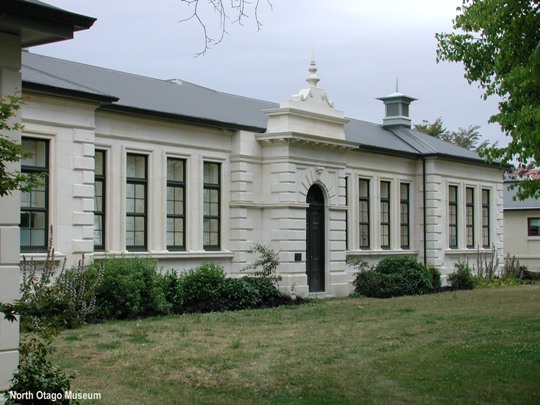
The former Oamaru Grammar School, designed by Oamaru architect John Forrester in 1875, has social, historical and architectural significance. Its chaste design, reflecting perhaps the ‘disciplined scholastic environment’ of the time, recalls the developing importance of secondary education nineteenth century Otago.
Oamaru’s first school was the Greta Street School, built in 1862, which by 1870 had an average attendance of 170 pupils. A second school was established in 1874 (known as Oamaru North School), and a third in 1877, known as Oamaru South School.
Another school was needed to provide a bridge into the secondary school system. The title ‘Grammar School’ meant, according to historian K.C. McDonald that ‘senior pupils were given the opportunity to go on to secondary subjects.’ Architect Thomas Forrester designed the school. The stone mason was James Calder and the carpenter was E. Rowland.
Oamaru Grammar School opened on 4 October 1875. With classrooms full of children and a crowd of visitors, George Sumpter, the chair of the school committee struggled to make himself heard. Sumpter told the crowd that the building was a credit to the architect and all concerned, and how the airy classrooms would be conducive to ‘the health and happiness of those who would be scholars [there]. Mr Petrie, the Inspector of Schools, parised the building as ‘the best designed building for the purpose in the Province.’ Mr Fitzgerald, the Rector, said that he could already see the difference compared with the old school where students struggled with ‘listless eyes and dull heads over tasks that in better ventilated rooms would have been mastered easily and with pleasure.’
The school buildings, besides smaller rooms and lobbies, comprised two central teaching rooms of 44 feet by 18 feet, and four rooms (two at the front and two at the back) of 35 feet by 20 feet. Some 13,000 to 13,000 feet of stone was required to build the school.
After the establishment of Oamaru North School and Oamaru South School, Oamaru Grammar School became known as Oamaru District High School, with some 17 boy pupils. It continued to offer secondary education until 1887. With the establishment of Waitaki Boys’ High School in 1883, and Waitaki Girls’ High School in 1887, the building was no longer needed for a secondary school and was converted to a primary school, renamed Oamaru Middle School (being between Oamaru North School and Oamaru South School).
Oamaru Middle School continued to house a primary school in 1924. With the introduction of the Junior High School system in Oamaru in the mid-1920s, Waitaki Girls’ High School had insufficient space to house the Form 1 and 2 pupils, so Middle School became their home until the new block was built in 1928. After this time, the building was used for a variety of purposes, including temporary classrooms, and as a venue for night classes, as a home for the technical/manual classes for pupils from the surrounding country schools for Standards 5 and 5, and for in-service courses for teachers. At its centenary in 1975, it housed the Meldrum Special School for Intellectually Handicapped Children. Until the 19080s, the school was used for courses run by the Workers’ Education Authority, Otago University Extension and the North Otago Adult Education Committee. In 2000, Oamaru Hospital was integrated into the former Oamaru Grammar School. In 2015, Oamaru Grammar School remains part of the Oamaru Hospital.
Oamaru’s first school was the Greta Street School, built in 1862, which by 1870 had an average attendance of 170 pupils. A second school was established in 1874 (known as Oamaru North School), and a third in 1877, known as Oamaru South School.
Another school was needed to provide a bridge into the secondary school system. The title ‘Grammar School’ meant, according to historian K.C. McDonald that ‘senior pupils were given the opportunity to go on to secondary subjects.’ Architect Thomas Forrester designed the school. The stone mason was James Calder and the carpenter was E. Rowland.
Oamaru Grammar School opened on 4 October 1875. With classrooms full of children and a crowd of visitors, George Sumpter, the chair of the school committee struggled to make himself heard. Sumpter told the crowd that the building was a credit to the architect and all concerned, and how the airy classrooms would be conducive to ‘the health and happiness of those who would be scholars [there]. Mr Petrie, the Inspector of Schools, parised the building as ‘the best designed building for the purpose in the Province.’ Mr Fitzgerald, the Rector, said that he could already see the difference compared with the old school where students struggled with ‘listless eyes and dull heads over tasks that in better ventilated rooms would have been mastered easily and with pleasure.’
The school buildings, besides smaller rooms and lobbies, comprised two central teaching rooms of 44 feet by 18 feet, and four rooms (two at the front and two at the back) of 35 feet by 20 feet. Some 13,000 to 13,000 feet of stone was required to build the school.
After the establishment of Oamaru North School and Oamaru South School, Oamaru Grammar School became known as Oamaru District High School, with some 17 boy pupils. It continued to offer secondary education until 1887. With the establishment of Waitaki Boys’ High School in 1883, and Waitaki Girls’ High School in 1887, the building was no longer needed for a secondary school and was converted to a primary school, renamed Oamaru Middle School (being between Oamaru North School and Oamaru South School).
Oamaru Middle School continued to house a primary school in 1924. With the introduction of the Junior High School system in Oamaru in the mid-1920s, Waitaki Girls’ High School had insufficient space to house the Form 1 and 2 pupils, so Middle School became their home until the new block was built in 1928. After this time, the building was used for a variety of purposes, including temporary classrooms, and as a venue for night classes, as a home for the technical/manual classes for pupils from the surrounding country schools for Standards 5 and 5, and for in-service courses for teachers. At its centenary in 1975, it housed the Meldrum Special School for Intellectually Handicapped Children. Until the 19080s, the school was used for courses run by the Workers’ Education Authority, Otago University Extension and the North Otago Adult Education Committee. In 2000, Oamaru Hospital was integrated into the former Oamaru Grammar School. In 2015, Oamaru Grammar School remains part of the Oamaru Hospital.