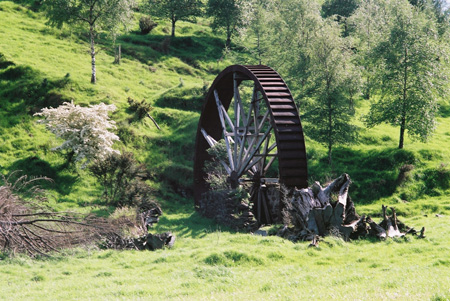
The site of the Phoenix Flour Mill, with its 34 foot breastshot waterwheel, on the site of an earlier flax mill, stands as a reminder of the importance of flour milling in nineteenth century Oamaru, and has historical and archaeological significance.
The first industry on this site was John Hunt’s flax mill. The mill was powered by a 28 foot [8.5 metres] overshot water wheel. Flax milling was an important industry in the 1860s, with over 300 flax mills established by the early 1870s. The flax mill was destroyed by a flood in 1870 – the waters destroying Hunt’s dam and plant. Hunt sold off his mill gear – the wheel, flax machines, scutcher and press.
In 1871, Hunt, in conjunction with Spence and Grave, replaced the flax mill with the Phoenix Flour Mill. The North Otago Times reported the opening festivities – ‘as jolly a party as ever met for a like purpose, admiring the picturesque spot where the mill had been erected and the great giant of a water-wheel.’ Designed by Michael Grenfell, and built by P. Mouritz, the mill reportedly covered an area of 36 feet by 20 feet [11 by 6 metres]. The machinery manufactured at the Oamaru engineering works of Reid and Gray. Motive power was supplied by a 3 feet 6 inch [1 metre] breast and a three quarter breast wheel of 30 foot [9.1 metre] in diameter. A breast wheel is used when the head of water is not sufficient for a large diameter overshot wheel – with the water striking the buckets midway between the top and bottom of the wheel. Two races brought water to the mill, one a quarter mile long, the other half a mile. Two bluestone dams were erected across the creek, together containing thirty hours of water. The water provided 8 horse power at low levels, and around 20 horse power at ordinary flow. The mill had a single pair of mill stones (but with capacity for another set). The grain was taken into the ground floor, taken by a smutter (a machine for cleaning impurities from the grain) to the basement, cleaned, and then raised by elevators to the upper storey. In the upper storey it was conveyed to the silks, where the bran, sharps and flour were separated, before being bagged on the ground floor.
Spence and Grave took over the mill. Spence sold his interest to a Mr McIntosh. Grave modified the mill, replacing the wheel with one with a larger, 34 feet (10.36 metre) diameter. Architect James Johnston advertised for tenders for building and installing the wheel in June 1876. In 1876, Lewis Morton and George Bruce took over the business. Bruce was the miller in the 1870s and early 1880s. George Bruce ran the business on his own account after 1886. In 1897, the mill stones were replaced with rollers. The Cyclopedia of New Zealand, published in 1905, described the mill site as 9 acres [3.6 hectares], with an additional 35 acres [14 hectares] of land with it. The mill dam covered 6 acres [2.4 hectares]. The flour was sold under the brand ‘White Spray.’ In 1906, after George Bruce’s death, the mill and much of its machinery was dismantled and moved to Clark’s Mill at Maheno. All in all three waterwheels are known to have been used at this site: c. 1868, a 28’ overshot wheel (Flax mill); the second was installed c. 1871 and was a 30’ ¾-breastshot (Flour mill); and the last, the c. 1877, a 34’ ¾-breastshot (Flour mill).
In 2015, there site of the mill is marked by bluestone foundations of the mill with features such as the mill races still evident, the archaeology of the site representing both the flour milling industry, and the life of a flour miller. Of the machinery, the water wheel, its ring gear and drive shaft remain. The mill wheel has been removed for repair.
The first industry on this site was John Hunt’s flax mill. The mill was powered by a 28 foot [8.5 metres] overshot water wheel. Flax milling was an important industry in the 1860s, with over 300 flax mills established by the early 1870s. The flax mill was destroyed by a flood in 1870 – the waters destroying Hunt’s dam and plant. Hunt sold off his mill gear – the wheel, flax machines, scutcher and press.
In 1871, Hunt, in conjunction with Spence and Grave, replaced the flax mill with the Phoenix Flour Mill. The North Otago Times reported the opening festivities – ‘as jolly a party as ever met for a like purpose, admiring the picturesque spot where the mill had been erected and the great giant of a water-wheel.’ Designed by Michael Grenfell, and built by P. Mouritz, the mill reportedly covered an area of 36 feet by 20 feet [11 by 6 metres]. The machinery manufactured at the Oamaru engineering works of Reid and Gray. Motive power was supplied by a 3 feet 6 inch [1 metre] breast and a three quarter breast wheel of 30 foot [9.1 metre] in diameter. A breast wheel is used when the head of water is not sufficient for a large diameter overshot wheel – with the water striking the buckets midway between the top and bottom of the wheel. Two races brought water to the mill, one a quarter mile long, the other half a mile. Two bluestone dams were erected across the creek, together containing thirty hours of water. The water provided 8 horse power at low levels, and around 20 horse power at ordinary flow. The mill had a single pair of mill stones (but with capacity for another set). The grain was taken into the ground floor, taken by a smutter (a machine for cleaning impurities from the grain) to the basement, cleaned, and then raised by elevators to the upper storey. In the upper storey it was conveyed to the silks, where the bran, sharps and flour were separated, before being bagged on the ground floor.
Spence and Grave took over the mill. Spence sold his interest to a Mr McIntosh. Grave modified the mill, replacing the wheel with one with a larger, 34 feet (10.36 metre) diameter. Architect James Johnston advertised for tenders for building and installing the wheel in June 1876. In 1876, Lewis Morton and George Bruce took over the business. Bruce was the miller in the 1870s and early 1880s. George Bruce ran the business on his own account after 1886. In 1897, the mill stones were replaced with rollers. The Cyclopedia of New Zealand, published in 1905, described the mill site as 9 acres [3.6 hectares], with an additional 35 acres [14 hectares] of land with it. The mill dam covered 6 acres [2.4 hectares]. The flour was sold under the brand ‘White Spray.’ In 1906, after George Bruce’s death, the mill and much of its machinery was dismantled and moved to Clark’s Mill at Maheno. All in all three waterwheels are known to have been used at this site: c. 1868, a 28’ overshot wheel (Flax mill); the second was installed c. 1871 and was a 30’ ¾-breastshot (Flour mill); and the last, the c. 1877, a 34’ ¾-breastshot (Flour mill).
In 2015, there site of the mill is marked by bluestone foundations of the mill with features such as the mill races still evident, the archaeology of the site representing both the flour milling industry, and the life of a flour miller. Of the machinery, the water wheel, its ring gear and drive shaft remain. The mill wheel has been removed for repair.