

Following Gabriel Read’s discovery of gold in 1861, thousands of people were attracted to Otago to seek their fortunes. In 1860 there were 69 ship arrivals at Port Chalmers, the following year there were 256. In 1864, the year the Flagstaff was raised, there were 865 arrivals. The Flagstaff was a signal station and used coloured flags to notify ships of the depth of the upper harbour and to warn ships of vessels approaching from Dunedin. Within a few years it also employed a timeball. The daily service of the Port Chalmers timeball was instituted on Saturday 1 June 1867 and every day but Sunday, the ball was raised at 12.45pm and was dropped at 1pm mean time “corresponding with 1h. 37m 23.5s Greenwich mean time.” This preceeded the official establishment of NZ Mean Time.
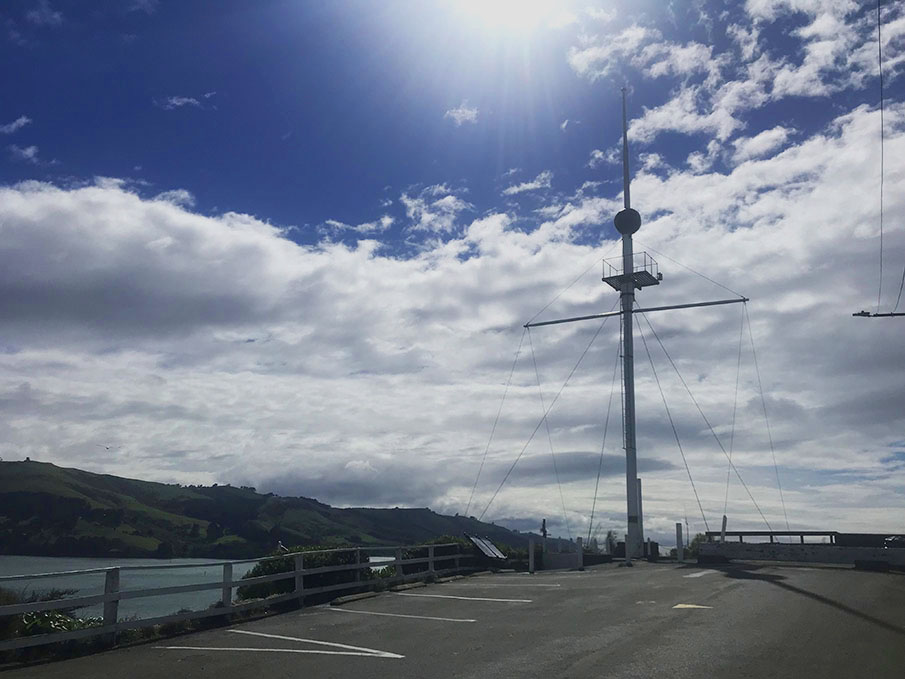
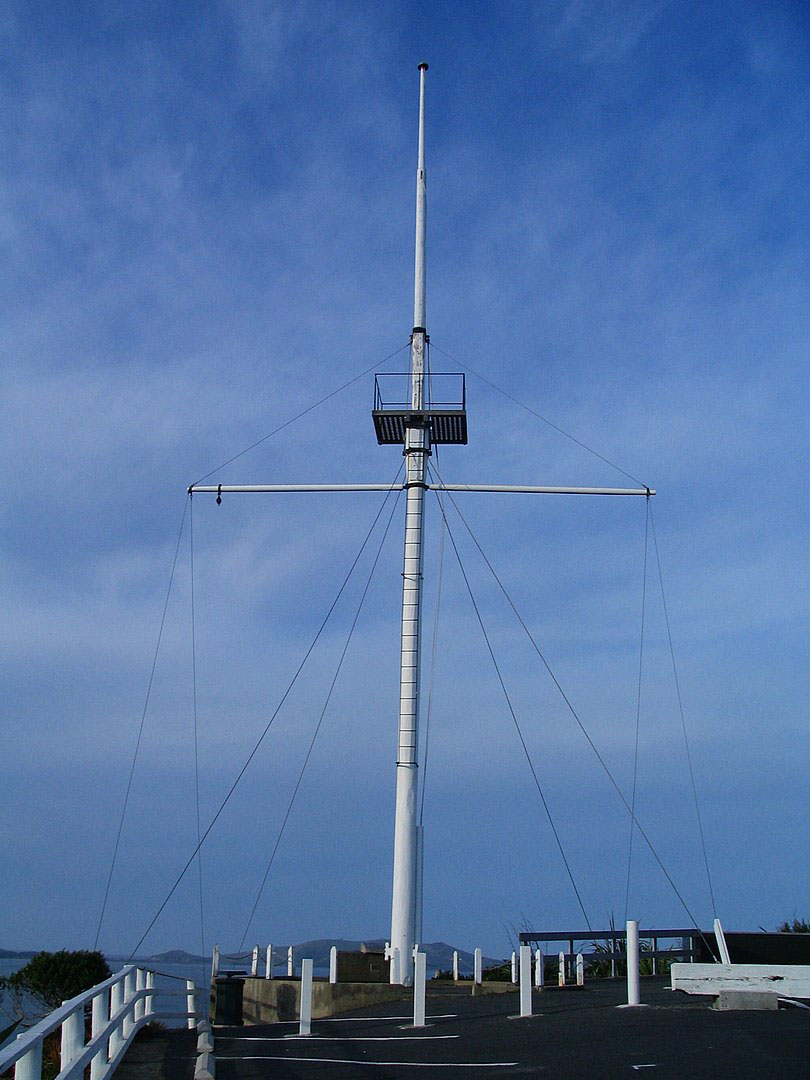
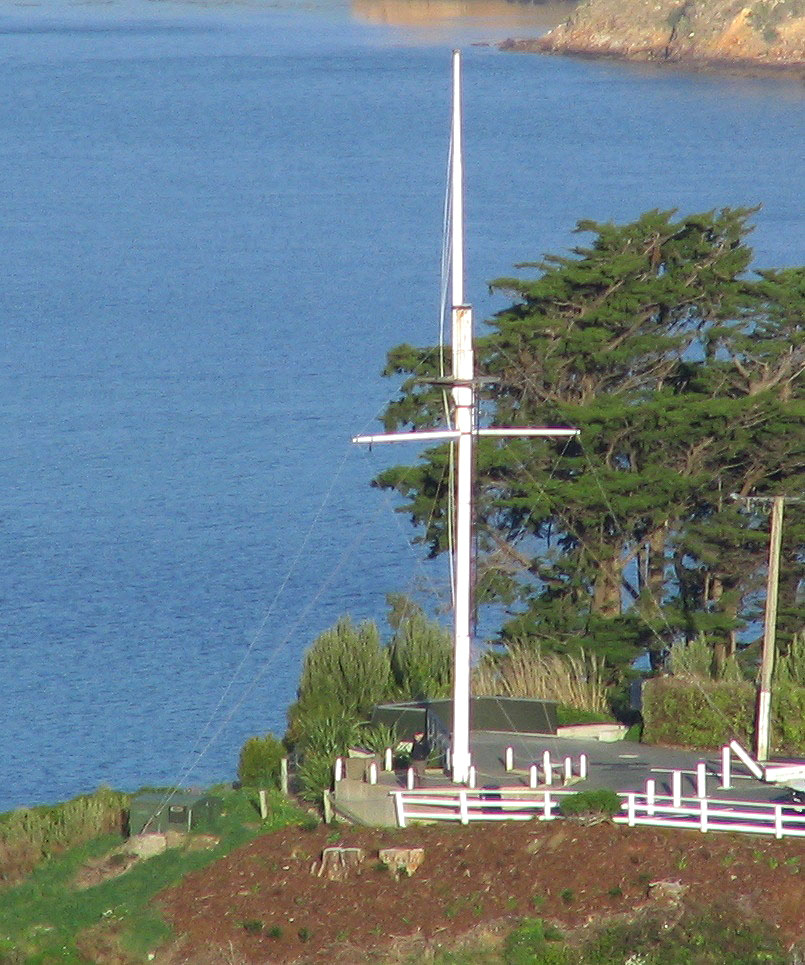
The structure is comprised of a mast with yard arms and a crows nest, stabilised by guy wires that decend and anchor the Flagstaff to the ground in six places. The original mast of the Flagstaff was the mizzen mast claimed from the condemned clipper “Cincinatti” which arrived in Port in 1862. This was eventually erected at Observation Point in June 1864, it’s purpose “to get more ready communication with the Heads ...” and a house was intended to be erected on the contiguous reserve. A report from the Harbour Office to the Provincial Council in April 1864 notes the appointment of a signal master. In 1866 a Mr MacAndrew presented a petition to the Provincial Council on behalf of a number of shipowners, shipmasters and agents, praying, “that a Time Ball be erected at Port Chalmers.” This request was granted. By April 1867 the timeball was complete. Otago Harbour Board minutes reveal the Harbourmaster was concerned about the signal station and timeball being left without an operator when Captain John Robertson was examining shipmasters and masters in Dunedin. By December of 1880 the timeball was discontinued. However a petition was sent to the Harbour Board signed by eleven shipsmasters on 26 Jan 1881 requesting a “competent person to work the ball and otherwise attend to the duties of the signal station.” A weekly service was reestablished in April 1882. The Otago Harbour Board took over the timeball station in 1885 and service was dropped to twice a week. By 1909 the service had been permanently withdrawn, the timeball had fallen into disrepair and with fewer vessels visiting port the need for its service was waning.
On 21 June 1910 a new “ironbark flagstaff was fitted.” This replaced the original which had rotted and was found to be unsafe. Signals clearing Captain Scott’s expedition to the South Pole were hung from the flagstaff’s halyards in 1910. Around 1970 the Flagstaff came under threat, being considered an impediment to traffic. A group of local people banded together and formed the Port Chalmers Flagstaff Appeal Committee. This group was responsible for the restoration and repositioning of the Flagstaff 50-100 yards closer to Port Chalmers under the guidance of J.R.G Hanlon, Structural Engineer. The Flagstaff was recommisisoned on Wednesday 29 September 1971 and was handed over to the Port Chalmers Borough Council by the Minister of Lands, Hon. Duncan McIntyre. The Dunedin City Council officially accepted ownership of the Flagstaff from the Borough of Port Chalmers on 4 October 1971. By the 1990s the Flagstaff had become a site of protest and was used to “mount banners for campaigns against the Aramoana smelter and the Observation Point excavation by Port Otago”. It was badly damaged in March 1994 when the guy ropes were loosened during the removal of the “pier masters house” by Maxwell Bros; it was reinstated at a cost of $15,000.
The Flagstaff has social and historical significance as a visual reminder of the important role shipping has played in the establishment and development of Dunedin and Otago during the last two centuries. It is a symbol of the historical significance of Port Chalmers, the development of industry, immigration, and the importance of signalling stations in maritime communications. The Port Chalmers Historical Society is currently fundraising to restore a time-ball to the Flagstaff.
[The timeball was reinstated and a ceremony held on Saturday 5 October 2020].
List Entry Information
Status
Listed
List Entry Status
Historic Place Category 2
Access
Able to Visit
List Number
2319
Date Entered
2nd July 1982
Date of Effect
2nd July 1982
City/District Council
Dunedin City
Region
Otago Region
Extent of List Entry
Extent includes part of the land described as Legal Road, Otago Land District, and the structure known as Flagstaff thereon. Refer to the extent map tabled at the Heritage List/ Rārangi Kōrero Committee meeting on 30 January 2020.
Legal description
Legal Road, Otago Land District
Status
Listed
List Entry Status
Historic Place Category 2
Access
Able to Visit
List Number
2319
Date Entered
2nd July 1982
Date of Effect
2nd July 1982
City/District Council
Dunedin City
Region
Otago Region
Extent of List Entry
Extent includes part of the land described as Legal Road, Otago Land District, and the structure known as Flagstaff thereon. Refer to the extent map tabled at the Heritage List/ Rārangi Kōrero Committee meeting on 30 January 2020.
Legal description
Legal Road, Otago Land District
Construction Details
Start Year
1910
Type
Original Construction
Description
Pole replaced ‘ironbark’
Start Year
1864
Type
Other
Description
Original Flagstaff erected
Start Year
1867
Type
Other
Description
Timeball added
Start Year
1971
Type
Relocation
Description
Flagstaff restored, relocated and recommissioned
Start Year
1994
Type
Reconstruction
Description
Flagstaff damaged and re-erected
Start Year
2019
Type
Modification
Description
Yard arm replaced
Construction Details
Start Year
1910
Type
Original Construction
Description
Pole replaced ‘ironbark’
Start Year
1864
Type
Other
Description
Original Flagstaff erected
Start Year
1867
Type
Other
Description
Timeball added
Start Year
1971
Type
Relocation
Description
Flagstaff restored, relocated and recommissioned
Start Year
1994
Type
Reconstruction
Description
Flagstaff damaged and re-erected
Start Year
2019
Type
Modification
Description
Yard arm replaced
Historical and Associated Iwi / Hapū / Whānau
Completion Date
11th December 2019
Report Written By
Sarah Gallagher
Information Sources
McLean, 1985
Gavin McLean, Otago Harbour: Currents of Controversy, Otago Harbour Board Dunedin, 1985
Journal of Astronomical History and Heritage
Morris, 2019
Gerard Morris., Time and the Making of New Zealand: a theme in the development of a settler society 1840-1868. A thesis submitted in fulfilment of the requirements for the degree of Mast of Arts in History. University of Canterbury, 2012 URL http://hdl.handle.net/10092/7084 accessed 26 August 2019.
Other Information
This place was identified as significant under previous legislation with different information requirements. It remains significant under the current legislation. There is opportunity under our legislation and policies to add to this information. Further information about this place may be available from the Otago/Southland Office of Heritage New Zealand Pouhere Taonga. Please note that entry on the New Zealand Heritage List/Rarangi Korero identifies only the heritage values of the property concerned, and should not be construed as advice on the state of the property, or as a comment of its soundness or safety, including in regard to earthquake risk, safety in the event of fire, or insanitary conditions. A fully referenced upgrade report is available on request from the Otago/Southland Office of Heritage New Zealand.
Historical and Associated Iwi / Hapū / Whānau
Completion Date
11th December 2019
Report Written By
Sarah Gallagher
Information Sources
McLean, 1985
Gavin McLean, Otago Harbour: Currents of Controversy, Otago Harbour Board Dunedin, 1985
Journal of Astronomical History and Heritage
Morris, 2019
Gerard Morris., Time and the Making of New Zealand: a theme in the development of a settler society 1840-1868. A thesis submitted in fulfilment of the requirements for the degree of Mast of Arts in History. University of Canterbury, 2012 URL http://hdl.handle.net/10092/7084 accessed 26 August 2019.
Other Information
This place was identified as significant under previous legislation with different information requirements. It remains significant under the current legislation. There is opportunity under our legislation and policies to add to this information. Further information about this place may be available from the Otago/Southland Office of Heritage New Zealand Pouhere Taonga. Please note that entry on the New Zealand Heritage List/Rarangi Korero identifies only the heritage values of the property concerned, and should not be construed as advice on the state of the property, or as a comment of its soundness or safety, including in regard to earthquake risk, safety in the event of fire, or insanitary conditions. A fully referenced upgrade report is available on request from the Otago/Southland Office of Heritage New Zealand.
Current Usages
Uses: Commemoration
Specific Usage: Memorial gate/fence/wall/arch
Uses: Commemoration
Specific Usage: Memorial marker/ plaque
Former Usages
General Usage: Civic Facilities
Specific Usage: Timeball Station
General Usage: Communication
Specific Usage: Signal/ Semaphore Station
General Usage: Government
Specific Usage: Flagpole
Current Usages
Uses: Commemoration
Specific Usage: Memorial gate/fence/wall/arch
Uses: Commemoration
Specific Usage: Memorial marker/ plaque
Former Usages
General Usage: Civic Facilities
Specific Usage: Timeball Station
General Usage: Communication
Specific Usage: Signal/ Semaphore Station
General Usage: Government
Specific Usage: Flagpole
Location
Sign up to hear more
Get the latest heritage news, features and events delivered
straight to your inbox.
