Maori History
Traditionally, the Waitaha people had authority over Murihiku, the southern part of the South Island. Around 1750 the Ngati Mamoe, originally from the North Island's East Coast, established themselves in Murihiku. They in turn fell under the sway of another tribe from the North Island's East Coast, Ngai Tahu. Archaeology suggests moa became extinct around 1500. The climate was too cold to grow kumara, so no horticulture was established. Settlement focused on the coast, where ocean fish, seabirds and seals were plentiful. People journeyed inland to harvest eels, forest birds such as weka and kereru, and cabbage trees. They also travelled to sources of highly-valued pounamu in the headwaters of rivers draining into Lakes Wakatipu and Wanaka, and on the South Island's West Coast. While Maori travelled considerable distances seasonally to gather food sources, permanent villages were usually on the coast.
The Maori name for the Blue Mountains in Otago is Tapuae-nuku. The township may have taken this name in the corrupted form of Tapanui. It is situated on land alienated in 1848 by Kemp's purchase of the Otago Block. Kemp failed to reserve for Ngai Tahu the land they wished to keep and, out of an area of 20 million acres included in the deed, a mere 6359 acres was set aside. Thus began southern Maori's pursuit of justice over the legality of the purchase and the inadequacy of the land reserved.
The Anglican Diocese of Dunedin
Otago and Southland were incorporated in the Diocese of Christchurch from its inception. The advent of gold, however, brought such an influx of people into Otago that a new diocese was required. The Diocese of Dunedin was created in 1869, although the first bishop, Bishop Samuel Tarratt Nevill, did not arrive until 1871.
Uniquely, Otago and Southland were the only parts of the country in which the Anglican Church was not the major denomination. Anglicans made up forty percent of the New Zealand population generally, but only twenty five percent in Otago and Southland, where Presbyterians referred to the Anglican Church as 'The Little Enemy'. The South was undoubtedly the stronghold of Presbyterianism, particularly in rural areas.
Tapanui
In the early 1870s land surrounding Tapanui was sold on the deferred payment system as pastoral leases in the area were broken up, including Runs 163, 167, 168, 140A and 140B. This resulted in a substantial population increase. 'Everywhere the ground is being broken up, and small homesteads are rapidly coming in view'. By 1875, the Tapanui township - ‘very prettily situated in gently rising ground at the back of the Blue Mountains'- was rapidly progressing. ‘All day long the sound of the builder's hammer may be heard, while houses seem to spring up like magic. In the township and district immediately surrounding, nearly 100 buildings have been erected within the past year'. In 1876, Tapanui was proclaimed a borough under the municipal ordinance of the Provincial Government of Otago.
All Saints' Church
‘The first residents of Tapanui cared so much for God and the Church that they undertook a venture which evidence wonderful vision and confidence in the future...This is to be witnessed in the fine church which stands in the township today - one of the best wooden churches in the whole of the Dunedin Diocese'.
A Presbyterian Church was erected in the township in 1873 but Church of England members were not far behind. The earliest record of Anglican activity in Tapanui is a baptism recorded in 1875. The Bruce Herald noted in May of that year that ‘preliminary services in connection with the Church of England have been held during the past month, and have been attended by serious and attentive congregations'.
On 25 February 1876 a meeting was held under the chairmanship of George Poynter, attended by other local land owners and the town mayor. ‘The Chairman read a letter from the Bishop intimating his willingness to license Revd Mr Withey to the Church of Tapanui and Clinton if a stipend of £250 per annum could be quartered.' The Committee resolved to send a notice to all Church of England members advertising a meeting on 1 March. The subsequent public meeting was asked if the stipend could be carried. While not entirely sure, the attendees resolved to obtain the services of Rev. Withey. This resolution saw the establishment of the All Saints' Anglican Church in Tapanui.
The Vestry noted on 8 April 1876, Rev Charles F. Withey's first meeting as Chairman, that a letter from the School Committee had been received, granting the use of the school room for Sunday services. The room was no more than a small hut standing near to where the council chambers now are. Mr South, the headmaster, was engaged to play the harmonium and lead the singing. Withey also had Clinton under his charge, taking services there on alternate Sundays except during winter. On alternating Sundays a lay reader took the service.
The ‘outward and visible' sign of Anglican presence in the community was the church building. In the South Island there was considerable building activity in the 1860s and 1870s. In 1850 there were only four Anglican churches in the entire South Island, 21 by 1860, 71 by 1870 and 141 by 1880. By 1861 there were 51 Anglican ‘settler church' buildings. In the Dunedin Diocese, there were no Anglican churches in 1850, one was built by 1860, 13 by 1870 and 18 by 1880.
It was against this background that the Vestry settled to the work of erecting a church. On 7 November 1876 at public auction, the Church paid £20 for sections 1 and 2 and £30 for section 16, Block XVII. The Church was built on the corner site afforded by sections 1 and 2. On 15 February 1877 a building fund was opened and a Building Committee formed. Similar to other country churches, the construction of the building relied on the community's motivation to ensure the construction of the Church with financial or other contributions.
At Rev. H.J, Congdon Gilbert's first Vestry meeting, on 26 March 1878, he laid plans and specifications on the table. The estimated cost was £650 and £80 was subscribed that night. In the course of the next few days £300 was raised. Tenders were advertised for immediately. On 9 April the tender of a local contractor, W & W.M. Hay, was accepted at just over £472.
The architect was Benjamin Woolfield Mountfort (1825-1898), a devout member of the Church of England, who subscribed to the theory that true spirituality was influenced by physical surroundings, and that the medieval church had been more spiritual than that of the early nineteenth century. Trained in this Gothic Revival architecture, Mountfort immigrated to New Zealand in 1850. He designed most of the public buildings which give Christchurch its distinctive Gothic Revival character. Pre-eminent among these are the Canterbury Provincial Council Buildings, the Canterbury Museum and the Canterbury College, on which he worked for twenty years from 1876 until 1896.
Mountfort's skill as an architect lay in adapting the Gothic style to suit the limited materials available in New Zealand. Gothic buildings were often created from stone and mortar. Yet Mountfort did not regard wood as an impediment to the Gothic style and his wooden churches are as ornately Gothic as those he designed in stone.
By 1872 Mountfort was at the pinnacle of his career. From the early 1870s he began to design small timber churches, many for Canterbury country parishes, but also for parishes throughout New Zealand. Helpfully, the architect was often known to revise his plans based on the limited funds available in each parish. By the 1880s, he was acknowledged as New Zealand's premier ecclesiastical architect with over forty churches to his credit.
From the beginning of his career, Mountfort's designs show ‘robustness of form combined with a rejection of symmetry; meticulous attention to detail linked to a firm grasp of the overall concept; a devotion to the Gothic RevivaI design principles of truth to materials; a desire to achieve variety within an overall stylistic unity. Added to these characteristics is the ability to surprise and delight with unexpected innovations'. Mountfort's small timber churches have long been recognised as among his most significant contributions. Samuel Hurst Seager, a fellow architect, commented in 1900 that the churches were ‘notable examples of simple, honest construction leading to the most pleasing results...each has one special feature making it distinctive; yet in all there is an expression of individual feeling, giving them - simple and inexpensive though they are - a high place among our architectural works.'
By November 1878 All Saints' Anglican Church was complete. The local newspaper reported that ‘the Church itself is unlike the general ran of Otago churches. It is more after the style of those of Canterbury. Perhaps we ought to say it is like all the churches designed by B.W. Mountfort, Esq. -handsome in appearance, ecclesiastical in structure, and most convenient for the purposes of public worship.'
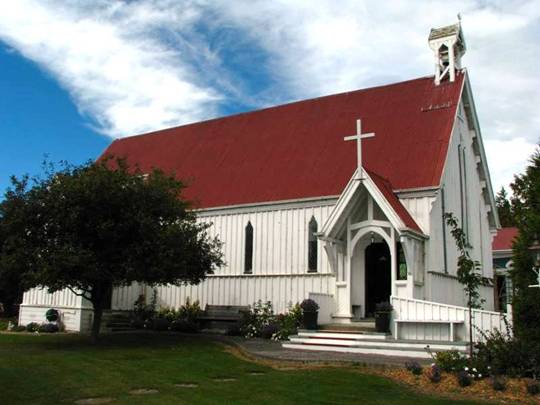
The reporter went on to describe the Church in detail. It contained a nave, chancel, small porch and organ chamber. The nave measured from the west wall to the chancel arch 40 feet in length and 25 feet wide (12.2 by 7.6). The chancel was 17 feet in length and 14 feet wide (5.2 by 4.3). The chancel was raised two steps above the nave, and the eastern part was raised a third step to form the sacrarium. The organ chamber opened into the chancel and nave by open arches. The walls of the nave were 12 feet high (3.6 metres), and from floor to ridge, 27 feet 6 inches (8.4 metres). Owing to the construction of the building the chancel walls were higher than those of the nave, ‘producing a very good effect whether viewed internally or externally'.
The interior was lined to the height of the window sills with diagonal boarding and finished with a bold capping. The walls above the dado were of upright boards of white pine, finished with a moulded cornice. The ceiling was stained and varnished. On the south elevation of the sacrarium was the credence table, supported by bold bracketing. The windows were filled with cathedral glass of light green tint in lead quarries. Patterns in the windows at the east and west ends were formed by the introduction of a darker tinted glass. Ventilation was achieved by openings in the east and west gables, which could be opened or shut, as well as casements in some of the windows. Seating was provided for 160 worshippers. All the furniture was constructed from designs furnished by Mountfort.
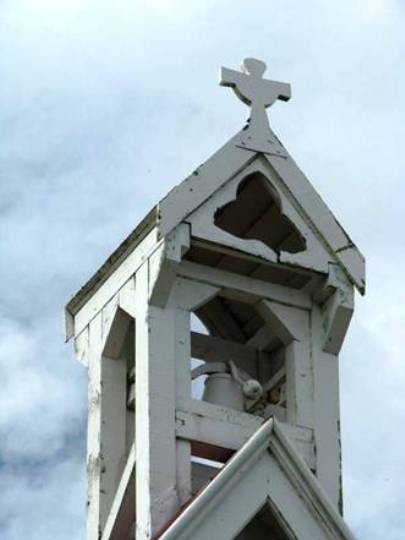
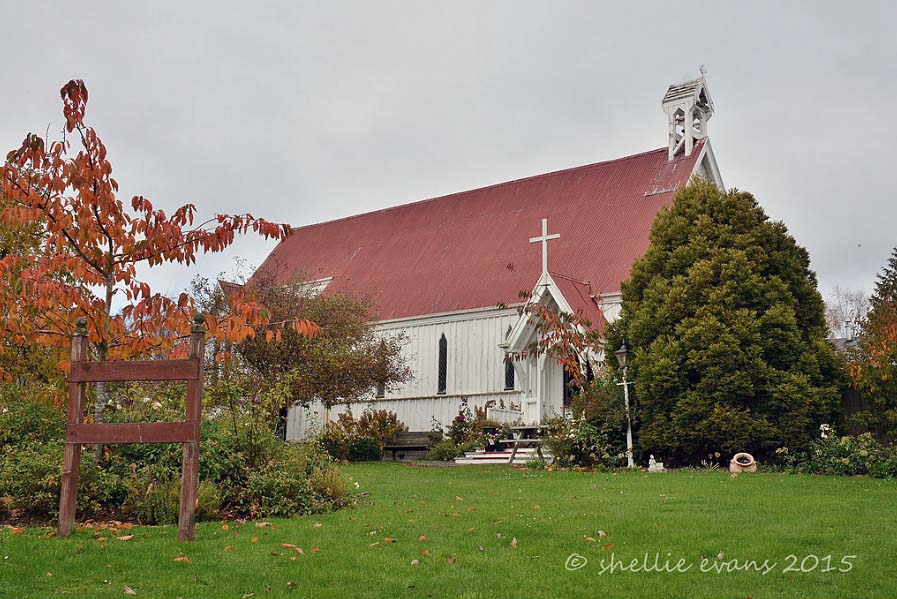
On the exterior, the Church was a Gothic style, board and batten building. It was built in durable matai. The distinctive vertical planking of the exterior is very much the same found on many of Mountfort's Canterbury churches. Underneath the exterior of the windows ran a boldly marked string course, adjusting to the various heights of the windows, which carried the eye over the entire building. The iron roof was high pitched, the gables surmounted with crosses of various designs, and the ridges were given an ornamental cut brattishing. Mr R. Austin carried out the painting and decorating, and construction was supervised by an Inspector of Works, James Keir. A small bell cot was added also at the west end of the nave. A bell weighing 100 lbs was secured and placed in the belfry by W. Kelty of the National Bank, one of the churchwardens, at his own expense. This was Tapanui's first church bell.
The reporter congratulated the church on building ‘so handsome a building, and one which must ever be considered an ornament to the town'. The Bishop of Dunedin on his visit to Tapanui in February 1880 noted that the ‘Church of England is a very handsome building, both inside and out, and is a credit to the Episcopalian body, considering its numerical strength, which is not great. The Bishop...expressed his faith in Tapanui as a church centre, and exhorted the members not to relax their efforts in the future.'
Dedication of the Church
Rural churches made a statement that religious belief was important to country folk. Moreover, the country church often became the focus for community activity well before the advent of the community hall. Many rural settlers lived in relative isolation, so occasions such as church openings and services were important social gatherings. They provided opportunities for interaction and connections which occurred only infrequently. All Saints' dedication ceremony was such an example. About 130 people, of whom only 16 were communicant members, gathered for the dedication service. The service was conducted by the Venerable E.G. Edwards, Archdeacon of Dunedin, on 1 November 1878, All Saints' Day. On Sunday morning at 8 am the Vicar celebrated Holy Communion in the new Church. At 11 am Matins and Litany were said. At 2 pm there were a number of baptisms. This was followed by a service for children. In the evening was Evensong led by the choir and the organist, Mr A. George. This busy pattern settled down in to at least one midweek and Sunday services.
Progress of the Church
Due to its rural setting, and the difficulty of meeting the costs of their own vicar, All Saints' Church found securing clergy was an ongoing problem. Consequently it became part of larger parishes. From 1883 to 1889, it was part of the Mataura River Mission District. The minister of the time, Rev. John Hobbs, later explained the nature of the parish to his English peers. Hobbs noted that the parochial district was of practically unlimited dimensions. His pastorate covered 25 miles. It proved a busy life including visiting the ‘colonials [who] do dearly love to be visited by the parson'. After 40 years, Hobbs reflected that
In the Back-blocks of the colonies, on the diggings, in the wool-shed, among the ‘sheepists' and the ‘cowspankers', you will find audiences as critical, perhaps even more so, as agnostic, as faithful, as earnest, as apathetic, as any in dear old England; you will find the religious appetite whetted by isolation; you will be so thankfully appreciated for any little you may do, but so unmercifully deserted if for bread you only take a stone'.
The Church continued to experience significant financial troubles and the debt on the Church building remained. The Church resorted to a number of entertainments to raise funds. Ladies bazaars, gift auctions, musical and dramatic entertainments were all employed. For example, a ‘grand musical festival' was held on Easter Monday in April 1880. A reporter noted that the ‘entertainment was a decided success so far as attendance was concerned, though some of the singing was not up to the mark...' However by the end of 1880, there remained a deficit of £337. Although Rev. H.J. Edwards opposed the motion, it was decided to let the pews at a rate of £5 per pew or £1 per sitting. The Church grounds were also now taken in hand. It was later remarked that, unfortunately, due consideration was not given to landscaping. The plantings were later the cause of many hours of hard labour as over-grown macrocarpas and gums were cut back.
In June 1882, the new ministers, Rev. Wilson, made the news. At a function held by the Church to welcome him, Wilson commented that lay-readers of the Episcopal church were far more ministers than the ordained clergyman of other denominations. The resulting furore caused many a letter to the editor, who commented that it was all a great shame given that ‘Mr Wilson is a very excellent gentleman in a social sense, and is also a good preacher. No doubt he sees his error, and regrets having made it himself. Charity! Charity! Is what is required.'
Perhaps Rev. Wilson never recovered from the controversy for he left the following year. In November 1883 the members of All Saints' then resolved to carry on Church work for a year without a clergyman and also to reduce the bills due by them as far as possible.
By 1885 the Church was still burdened by building debts. Rev. John Hobbs, of Gore, took the matter in hand and added Tapanui to his monthly visitation list in September 1885. . He 'exerted his strong personality and the parishioners returned to the fold and money poured in'. By 1886 the debt was significantly reduced. Hobs resigned in 1890 for a North Island posting. Rev. Sydney Hawthorne arrived from England to take up the post but left in 1891 finding the parish too large.
In 1891, All Saints' Church was incorporated into the Gore Parochial district. Rev. T.L. Stanley assumed the reigns of leadership over the new parish. Fundraisers continued to be held. There were concerts, ladies bazaars, dramatic entertainments, and gift auctions. The various functions were successful and in 1892 a letter was received from the Bishop congratulating the vestry on the Church being debt free. On 30 July 1892 the vestry decided to transfer all church property to the Diocesan Trustees in Dunedin. All Saints' Church was consecrated on 5 March 1893, almost 15 years after the archdeacon dedicated it. A font was also presented during the consecration by Mr J.A. Mason of Dalvey.
The Church continued to struggle financially, unable to contribute to their share to various costs incurred by the Parochial District. Also the Church building was comparatively large, as in the 1870s Tapanui gave every indication of becoming a flourishing centre. Unfortunately, this did not come to pass and the upkeep of a larger building became a problem for the congregation. The Church was no sooner out of debt, when they incurred another. In January 1891 an estimate was obtained for either roofing half of the Church, at £23, or the entire roof, at £52. A news item appeared in the local press shortly after to say the Church had been half roofed and given a much needed coat of paint. Unfortunately, shortly after the west end of the roof began to leak badly.
About 1899, tenders were received for placing iron on the north elevation of the roof. Mr McAllister's quote of £34 was accepted. Soon after decaying piles were found on the outer edge of the Church. Only three were sound and seven required replacement. The vestry settled on broadleaf rather than concrete. These lasted many years but were again replaced at a later date.
Fundraising continued as a cornerstone of the Church's finances. In November 1899 a bazaar was held in aid of the Church's organ fund. There was reportedly ‘an immense quantity of goods on sale, and a brisk business was done during the afternoons and evenings.'
Also of note in 1899 was the visit of Premier, Richard Seddon, to Tapanui. His address to ‘the largest audience that ever assembled in Tapanui..[was] spoken in his usual light and inconsequential way..' Sunday was spent quietly, and Mr Seddon attended All Saints' Church.
In 1902 All Saints' Church became part of the newly formed Tapanui-Clinton Parish. By 1930 Bishop Richards was bewailing the lack of clergy and so in 1931 Tapanui and Roxburgh were combined. In 1936 Tapanui was brought into the new Gore Curacy District with a team of three clergy.
The Church required continual upkeep. Rev. Frank Waldron who pastored the Church from 1942 to 1947 remarked that the matai stood up well to the passing decades, but later observed ‘what a pity that white pine was used for the sarking, for the borer dearly loves it'. He also reminiscenced that ‘in those days the only means of heating the Church was the stove. Unfortunately when the stove was not in use in spring and summer the starlings used to fill it up with their nests, and by the time the winter came and heat was needed, all that was obtainable was a vast quantity of smoke.' The mid 1940s also saw a new altar donated to the Church.
1951 saw the arrival of Rev. A. V. Jaquiery. Among the first duties he assumed was singlehandedly painting the Church roof and interior. During the 1950s there was a steady increase in numbers. A new parish was created, extending from east of Clinton to the west of Wakaia, with Tapanui as its central point. Regular weekly services and Sunday School classes were held. In 1957 a vicarage was built and the Church was painted. A hall ‘of pleasing design and appearance' was also erected.
In August 2003, the Bishop put a seat in front of the Church and attached a small plaque. The inscription read as follows:
To the Glory of God
For 125 Years of Pastoral Care
In the Tapanui District; 1878 - 2003.
By 2007, however, congregation numbers dwindled to between four and ten. That year, Tapanui Parish joined another parish, which declined to accept responsibility for the All Saints' Church building. The Church was deconsecrated on 23 February 2007 and vacated.
Grant and Crystal Arthur bought the Church in 2007. Plans to live in the Church were replaced by redevelopment of the Church hall into a home. In 2009 the Arthurs converted the Church into a home, garden and gift shop named Whitechapel Gifts. The shop draws both customers for their giftware and tourists interested in the design and history of the former Church.
The Church interior has been repainted and cleaned, and the Vestry is now a storage room. The nave, however, remains largely unchanged other than the removal of most of the pews (one remains) and the addition of a counter which does nothing to detract from the Church's interior. The imitation gas lamps and the carpet, replaced by the congregation probably in the 1980s, remain in situ. Homeware is artfully displayed around the Church's interiors without detracting from the impact of the overall space.
The Arthurs have also created a beautiful garden to enhance the aesthetic impact of the building and have plans to carry out repairs to the exterior cladding over the next year. The Arthurs have also fixed the bell, which may now be heard pealing across the rolling South Otago hills.