Maori
Traditionally, the Waitaha people had authority over Murihiku, the southern part of the South Island. Around 1750 the Ngati Mamoe, originally from the North Island’s East Coast, established themselves in Murihiku. They in turn fell under the control of another tribe from the North Island’s East Coast, Ngai Tahu. Archaeology suggests moa became extinct around 1500. The climate was too cold to grow kumara, so no horticulture was established. Settlement focused on the coast, where ocean fish, seabirds and seals were plentiful. People journeyed inland to harvest eels, forest birds such as weka and kereru, and cabbage trees. They also travelled to sources of highly-valued pounamu in the headwaters of rivers draining into Lakes Wakatipu and Wanaka. It would seem one of the main roads from the east coast to the Lakes district passed through the Strath Taieri. The remains of Maori ovens and numerous implements, weapons and utensils attest to this presence and help define traditional routes. While Maori travelled considerable distances seasonally to gather food sources, permanent villages were usually on the coast.
In 1848 with the arrival of 344 emigrants at Dunedin, the European and Maori population were almost equal. With increasing European settlement, the next few decades saw the loss of major inland mahika kai resources. Inland areas were still visited but the gold rushes in the 1860s lead to closer land settlement by Europeans which often shut out Maori.
Kati Huirapa ki Puketariki traditionally had manawhenua for the land on which Macraes Flat township, and now the mine, is located. The takiwa of Kati Huirapa ki Puketeraki centres on Karitane and extends from Waihemo to Purehurehu, including an interest in Otepoti and the greater harbour of Otakou. The takiwa extends inland to the Main Divide, sharing an interest in the lakes and mountains to Whakatipu-Waitai with Runanga to the south.
There are no recorded Maori archaeological sites on the land on which St Patrick’s Catholic Church is built.
Macraes Flat
Charles Kettles first surveyed Macraes Flat in about 1847 as part of his work on the Otago Block. The first European settler of the area was Swedish-born Charles Hopkinson. His application for Run109 was accepted on 14 May 1857. He was described as ‘a genial Swede who left his mark on the, who land It is generally agreed that Macraes Flat was named after his Scottish shepherd, John Macrae.
It was to be the discovery of gold in the area which prompted the development of a settlement at Macraes Flat, or McCraes Flat as it was spelled in early records. Gold was first found in Macraes in the winter of 1862 around Highlay Hill by prospectors following the Waikouaiti River upstream from the coast. The gold was worked mainly by sluicing and elevating, which required large amounts of water.
By 1865 the township was thriving. One observer wrote ‘I am afraid this place is being overrushed by business people, and I inline to think that many will regret they came. There are now about 25 business places, to a population of about 500 miners, none of whom are making extraordinary wages; but, generally from £3 to £5 per week. Certainly the place will be lively through winter, as people must work hard to keep themselves warm...’ The famous Johnny Jones had established a restaurant in the township which also boasted Stanley’s Hotel, a dance saloon, Bank of New Zealand, baker, stores and post office.
Macraes Flat’s population peaked around 1868-1869 when an upper and lower township came into existence. By 1871, however, the population was estimated at only 130. With the decline of gold, interest grew in acquiring land. In 1871 Francis Dillon Bell, politician and owner of Shag Valley Station, allocated 1500 acres to bona fide residents of Macraes Flat. In 1873 the Crown set aside 2500 acres of land, and licences and leases were granted from April 1874. Macraes Flat, however, was now an unsightly township with large holes in old worked ground and piles of debris and tailings. The miners, who had become settlers, had cultivated paddocks, gardens and substantial houses but ‘the gay, busy mining town...was slowly and surely slipping into its decline.’
The Catholic Church
The reminiscences of an old Macraes Flat pioneer included memories of an aged priest, Father Petitjean, who came once a year to the Macraes district and endeavoured to visit every Catholic. The discovery of gold and the subsequent inrush of miners, many of who were Catholic, led to the official appointment of Father Delphin Victor Moreau to the province of Otago. Born in the south of France, Moreau arrived in New Zealand in 1843. For 18 years he worked with the Catholic mission to North Island Maori until the discovery of gold saw his mission diverted.
The Roman Catholic community at Macraes Flat were active in their faith and in 1865 they secured themselves a clergyman and built a neat iron cottage as his Presbytery. A new era began with the formation of a Catholic Diocese of Dunedin in 1869. It was not until January 1871, however, that Bishop Patrick Moran arrived to take charge of the new Diocese. Moran arrived with the intention of building churches in every district. At the time Macraes Flat was attached to the Naseby Parish District where Father Norris, a priest lent from Auckland, was in charge. In 1874 Father Royer, previously of St Bathans, took charge of the Parish. When Bishop Moran visited Macraes in 1877, Mass was held in a private house. In 1886 the district was attached to the Port Chalmers parish.
St Patrick’s Catholic Church
Under the 1877 Land Act, the Crown granted The Right Reverend Patrick Moran, Roman Catholic Bishop of Dunedin, land in Macraes Flat on 15 August 1881. The land consisted of Block I, sections 60-64 and the adjoining sections 40-43. Previously sections 43, 44, and 45 land were held as a Police Reserve, although survey maps do not indicate any buildings on the site.
There were a number of Catholic families in the district - Phelans, Sheehys, Lavertys, Claffeys, Hatstonges, Hanlons, Flynns, O’Connells, Hurleys, Leahys, Gallaghers, Keatings, Nolans, Heffernans, Hayes, Fennesseys, Spains, and the local policeman, Jim Kennedy. It is small wonder that the impetus to build a church in the district was strong. In March 1879 the New Zealand Tablet, a Dunedin-published Catholic periodical, reported that the 'Catholic congregation in Macraes, although limited in number, have spiritually undertaken to build a church in their district. Their efforts are most praiseworthy, and no doubt will meet with sympathy generally throughout the province, and obtain acknowledgement in substantial aid’. On 14 November 1879 tenders were invited for the building of a church at Macraes Flat. Plans and specifications were available from Francis W. Petre, engineer and architect. The advertisement noted the Church Committee were able to supply sufficient stone free of charge and required tenders for masonry work only, lime and sand to be provided by the contractor. Tenders closed on 3 December.
The noted architect, Francis William Petre (1847-1918), was selected to draw a design for the church. Petre was born at Petone in 1847, into one of England’s oldest and most influential Catholic families. This religious faith was to play an important role in Petre’s career. Educated in England, he worked for architects and engineers. This experience afforded a thorough understanding of the latest engineering techniques including the use of concrete. In 1872 Petre returned to New Zealand to work as an engineer for a contracting company, building railway lines. By 1875 he was based in Dunedin, and had returned to architecture. His career went from strength to strength; the first New Zealand-born architect to rise to national importance.
It was Gothic Revival architecture, however, which was his first enthusiasm. One of New Zealand’s most able practitioners in the style, he praised it for ‘the great richness and delicacy of detail, and the closer application of geometrical rules to architecture....’ This ‘delicacy of detail’ is the common denominator in his buildings. It was said that his drawings of stones, window traceries, arches and ornamentation were so precise that stonemasons could execute his intentions from one single drawing.
His passion for sculpture also showed itself in his best work, which had a strong sculptural quality. Despite Petre’s emphasis on detailed, sculptural Gothic Revival architecture, he also believed that an architectural style should be ‘treated liberally’. His designs, therefore, remained individual creations, lighter and more delicate than many who designed in the Gothic style. It has been said that ‘he can now be seen as one of our great creative artists: the man, perhaps shy and modest, but the architect, one of daring and intelligence’.
Petre’s other strong passion, Roman Catholicism, equally directed his career. As a Catholic, he was often the architect of choice for Catholic dioceses. He designed St Joseph’s Cathedral and the Dominican Convent in Dunedin, Sacred Heart Basilica in Wellington (NZHPT Category I, Record no. 214) and, perhaps his most imposing design, the Cathedral of the Blessed Sacrament in Christchurch (NZHPT Category I, Record no. 47). His expertise was not only sought out for imposing cathedrals, but also for smaller local churches.
It is unclear who won the tender to erect the church. Perhaps the long delay between the calling for tenders and the opening of the church indicate no tender was successful. It does appear that the erection of the church owed much to an enthusiastic laity. One such example was Patrick Phelan, a goldminer and ‘a devoted and practical Catholic’. It was said that ‘his hand was always open to church building’ and it is not too much to say that among the laity he did for the erection of St Patrick’s Church in Macraes the lion’s share. Another parishioner, Richard Lockwood, carted free of charge from Oamaru to Macraes Flat the Oamaru stone used for the Cross and the facings. The stone for the walls was quarried within a few kilometres of the church site.
A building committee had been formed although its efforts to raise money appeared intermittent at best. It appears that as the committee raised more money the building of the church was moved on a stage. Impetus came in 1881 when Macraes Flat joined the Port Chalmers Parish and Father W.J. Newport took charge of the area. On 26 December 1882 a ‘grand concert’, under the patronage of Rev. Newport, was held in Macraes Flat in aid of the Catholic Chapel. Another evening of entertainment was held on St Stephen’s Day in 1883 to aid the building of the local chapel, which was not yet completed. Reportedly a ‘large number of ladies and gentlemen from the surrounding district, together with Miss Hill from Dunedin, contributed various kinds of vocal and instrumental music. The affair was a great success, and the residents of the town regarded it as one of the most enjoyable in the district.’ Another fundraising event was held in November 1884 with a concert and ball in aid of the church. These events were attended by people from as far afield as Palmerston and Dunedin. The reporter noted that ‘dancing was kept up’ until six in the morning.
Due to the enthusiastic efforts of local Catholics and a supportive community, the church was finished in 1883. The total expenditure was £300.
The Opening
On Sunday 11 March 1883 his Lordship the Bishop, Right Rev. Dr Patrick Moran, assisted by Rev. Father Newport, opened the new church at Macraes Flat. Mass was held after the opening ceremonies at 11 a.m. and 17 children were confirmed. There was a large attendance and the congregation filled the church which was described as ‘spacious and handsome’. The name given to the church was apparently St Brigid’s. It is unclear when the name changed to St Patrick’s.
In the congregation’s return speech to the Bishop, local Catholics showed themselves to be a community within a community. They spoke not so much of their joy at the opening of the new church but instead addressed the current nation-wide discussion about Catholic schools. They railed against the ‘hostile Government’ and the need to ‘obtain justice at the hands of Government for our schools’. The Catholics of Macraes Flat promised ‘like our forefathers, faithful under persecutions of every kind, we will remain devoted children of the one true Church, and aid by heart and hand its progress in the small portion of your Lordship’s diocese.’
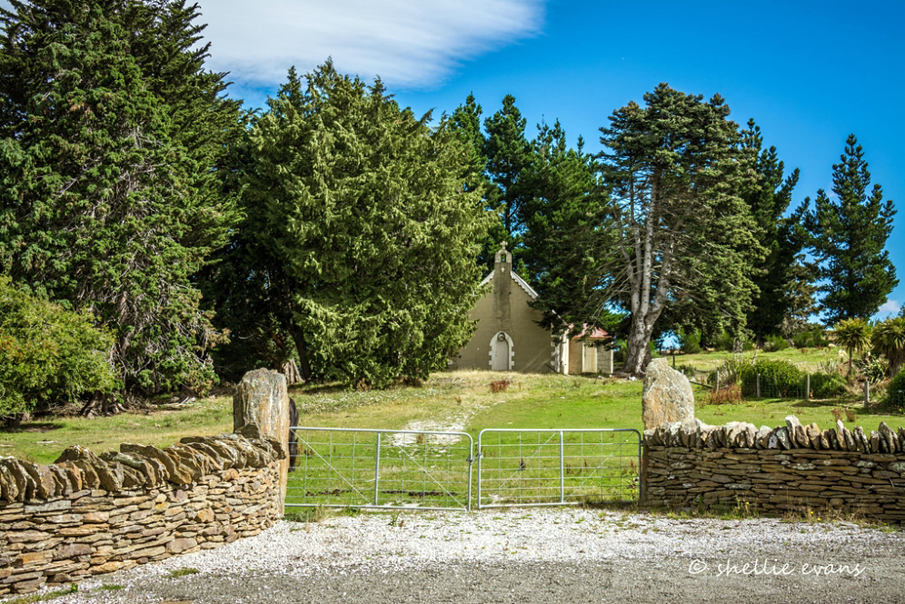
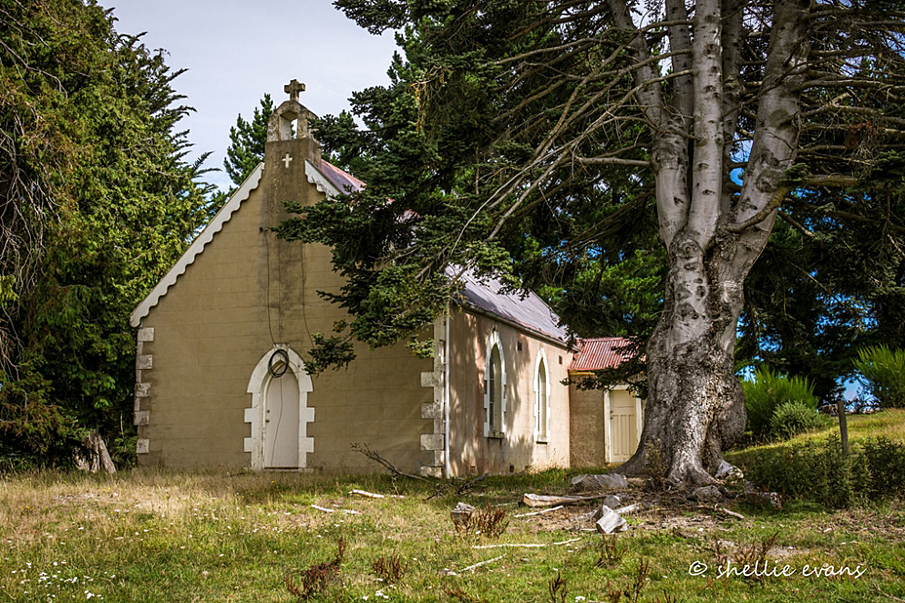
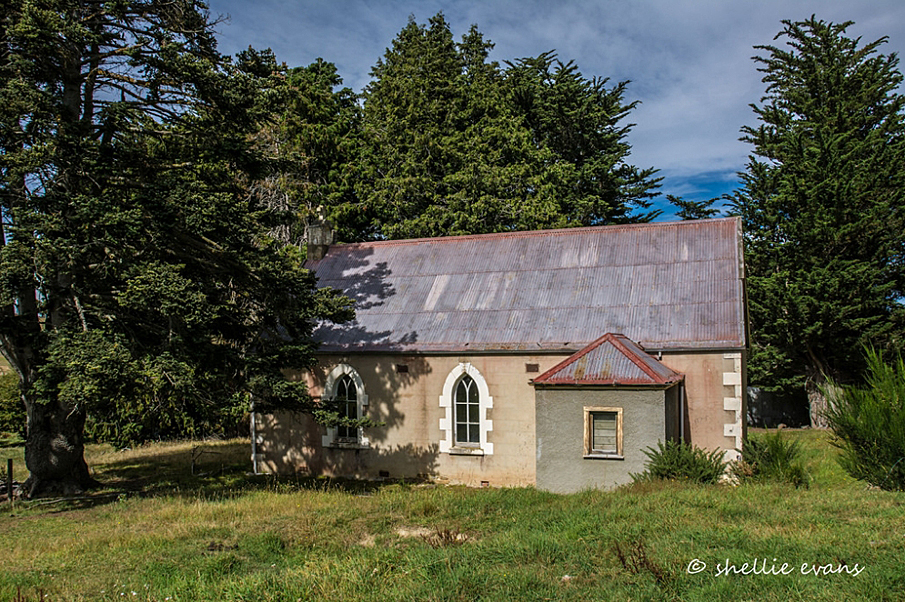
Contemporaries described it as ‘pretty little chapel’. A Catholic missionary congratulated the congregation on having such a ‘beautiful, well-appointed and devotional church..it was the best and most neatly-finished country church he had seen in all his travels..’ Designed to seat around 100, the church was single storied, approximately 14 metres long by 7 metres wide. The walls were 600mm thick solid masonry. The roof was timber framed with a corrugated iron roof with a gable at each end, featuring scalloped bargeboards. The foundations were stone, approximately 1200mm wide. The schist stone walls feature long and short Oamaru stone quoins. The simple belfry and cross atop the east elevation were carved from Oamaru stone. The Gibbs doorway, over the one single wooden door, was framed with projecting Oamaru stone working, echoing the long and short quoins. There were three lancet windows on the south elevation and probably three windows on the north elevation. Through the door in the east elevation was a small foyer and beyond this, the nave. The floor and ceiling were rimu tongue and groove. The interior walls were rimu tongue and groove panelling to about one third the height of the windows and then plaster. The window sills of the window were wide, almost forming window seats. A few steps defined the simple sanctuary area.
Alterations
In March 1890 the Bishop created a new mission district within the Diocese of Dunedin consisting of the Macraes and Nenthorn areas. Rev. Father Edward Donnelly was appointed to the new Parish from Oamaru.
By 1890, the church required some repairs and Rev. Father Donnelly wasted no time in meeting the need. He organised a concert in August 1890 to help pay off debts remaining on the building and for repairs to the Church. The repairs, it was said, would make the church ‘an ornament to the town, when finished’. Fundraising concerts proved a staple for the church finances. Indeed the community was very supportive of their efforts. At one concert held in August 1891, the event was so well attended that the church was ‘crowded in every part of the house, and many were unable to gain admittance’.
These repairs to the church, however, did not go as smoothly as Father Donnelly might have hoped. Indeed the result was a lengthy day in court. In October 1890, Father Donnelly testified that a member of the congregation, James Hartstonge, had done some repairs on the church building. When Father Donnelly spoke to him about the nature of the repairs, the defendant told the priest he would ‘smash his face in’. On Sunday 28 September Donnelly was on his way to church when ‘Hartstonge rushed out to me on the road at Macraes and asked me to pay him some money he alleged to be due him for timber. I said I owed him nothing for timber, when he replied, ‘You b---- villain, I’ll smash your b--- face if you don’t pay me.’ ..After a time we went to see the repairs to the church, and on returning went to my rooms at Claffy’s. While there the defendant attacked me again about some accounts, when I replied I would not have anything to say to him. I then turned to go in at the door, when defendant made a rush at me and struck me in the face.... I gave defendant no provocation whatever. I am in bodily fear of defendant. He has frequently threatened me with violence, and even to take my life.’
A further complication arose during the Sunday Mass.when Hartstonge called the Father ‘a scoundrel, liar, rogue and sweep’.’ Donnelly concluded his testimony by noting that the defendant ‘incurred excommunication ipso facto by striking a minister of God. I did not invoke the curse of Almighty God upon him in chapel, but quoted portions of Scripture showing the penalties of the Almighty upon those who committed the sin of slander.’ The judge commented that the case had been ‘a very painful one from its commencement, and unprecedented, I think, in Colonial records’. For the assault, James Hartstonge was fined £10 and costs, two months imprisonment and bound over to keep the peace for twelve months. He was further fined 20 shillings and costs, or fourteen days imprisonment, for disturbing the congregation.
In 1899 the stone church went through a ‘thorough restoration’. The correspondent wrote that it was ‘painted a light blue inside and tastefully stencilled with the cross and the shamrock entwined. The outside has been cement plastered, lined and jointed to imitate stone. On the whole it is now one of the nicest little country churches in the Colony, and entirely free from debt’.
A Vestry was added to the north elevation, probably in the 1920s. It had an exterior door and an interior door connecting to the church’s sanctuary area. The exterior was covered with a rough cast stucco render, possibly in the 1970s.
It is unclear when the church was deconsecrated although a new certificate of title was produced in February 1967, perhaps indicating the church and land were now in the hands of the Roman Catholic Bishop of the Diocese of Dunedin rather than the congregation. In 1999 the church and land was bought by Macraes Mining Limited, now Oceana Gold (New Zealand) Ltd. In 2005 Luise Fong installed art work on the west elevation. The art works consists of three large light panels, mimicking the shape of the lancet windows, displaying stormy cloud scenes.
Macraes Flat forms part of the Macraes Heritage and Art Park. The park includes not only the church but artworks, walkways, and interpreted historic mining and farm relics. The goal is to see the park become a vibrant tourist attraction, which will continue to add value to the local district.