

Following the war, memorials were erected in almost every town in New Zealand. As noted by historians Chris MacLean and Jock Phillips, the memorials served as surrogate tombs for families of the New Zealanders buried in overseas graves, and commemorated the achievements of all those who lost their lives.
The Marlborough memorial was the product of an agreement by its citizens to combine resources to erect a suitably imposing monument. Construction was delayed by years of heated debate over the appropriate location for a Marlborough memorial. The present, prominent site in Blenheim was finally selected in 1926. The memorial cost £4450 and was paid for entirely by public subscriptions. The stone used to construct the tower was collected from all over the Marlborough region to represent permanently the contributions of all its towns to the war effort. The only foreign stone is Australian sandstone, which symbolises the co-operation between New Zealand and Australian forces during the conflict.
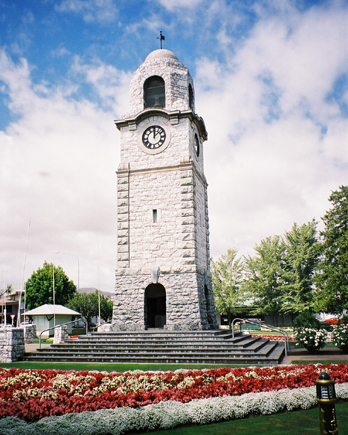
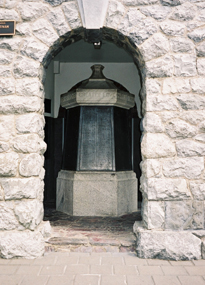
The Baroque form and high quality workmanship of the War Memorial and Clock Tower give it a commanding appearance. Designed by New Zealand architect Roger Bacon as a visible and aural reminder of the fallen, the tower stands at 16 metres (54 feet) high and its clock chimes every hour on the hour. Set on a course of seven steps, the lower storey of the tower is built of stones from the Awatere River. It features a memorial chamber that shelters a plinth of grey granite on a floor of red stone. The plinth supports plates bearing the names of the 419 Marlburians who lost their lives in the First World War. Engraved below the names are the words 'Greater love hath no man than this; that a man lay down his life for his friends'. Above the chamber is a strong, symmetrical tower of hard Wharanui limestone. It culminates in a belfry with four arched portals, a sandstone cupola and wind vane. The tower's clock and bells were donated by George F. Watts and his wife Ethel, in memory of two nephews killed in action. The clock was made in Wellington and the bells were specially cast and inscribed for the Watts at Loughborough, England. For the unveiling, special trains were used to transport people from all over Marlborough to Seymour Park. Located adjacent to the fountain that commemorates those that served in the Second World War, the tower remains the centre of ANZAC Day celebrations. It is a landmark in Blenheim, and served as the focus of the city's centenary celebrations in 1969.
The War Memorial and Tower has important spiritual significance as the principal memorial to Marlborough residents who died in conflict. It is a symbol of the contribution made by the province during the First World War and testifies to the strength of local and national sentiment both during and after the war. Its construction of stone from Marlborough and Australia is an important symbol of the ANZAC spirit and the co-operative relationship between residents in the Marlborough Province. Sited in a prominent public park, the tower is an important feature in the Blenheim cityscape. It enjoys high public esteem and has local value as an important focus for civic activities.
List Entry Information
Status
Listed
List Entry Status
Historic Place Category 1
Access
Able to Visit
List Number
243
Date Entered
19th April 1990
Date of Effect
19th April 1990
City/District Council
Marlborough District
Region
Marlborough Region
Legal description
Lot 1 DP 6917 (RT MBD/572), Marlborough Land District
Location Description
Seymour Square is bounded by Alfred, Henry, High and Seymour Streets, Blenheim.
Status
Listed
List Entry Status
Historic Place Category 1
Access
Able to Visit
List Number
243
Date Entered
19th April 1990
Date of Effect
19th April 1990
City/District Council
Marlborough District
Region
Marlborough Region
Legal description
Lot 1 DP 6917 (RT MBD/572), Marlborough Land District
Location Description
Seymour Square is bounded by Alfred, Henry, High and Seymour Streets, Blenheim.
Construction Professional
Name
Garnham & Robertson
Type
Builder
Biography
Building firm
Name
Gray & Waters
Type
Builder
Biography
No biography is currently available for this construction professional
Name
Bacon, Roger
Type
Architect
Biography
Nothing is known of the early life or work of Roger Bacon. In 1908 he entered partnership in Wellington with Alfred Atkins. The firm also maintained a branch in Wanganui and designed buildings at Wanganui Collegiate School including School Block, House Block, Hall and the headmaster's residence between 1909-19. It undertook several hospital designs including Cook Hospital, Gisborne (1911), Wairoa Hospital (1912) and the King Edward VII Memorial Hospital for Children, Wellington (1912). Atkins and Bacon were also responsible for several branch buildings for the Bank of Australasia around New Zealand and for many residences in Wellington. Owing to failing health Bacon left the firm and moved to Blenheim about 1918. He retained an interest in architecture and completed two further works while in Blenheim - the War Memorial Clock Tower for the Blenheim Borough Council and Holy Trinity Church at Tuamarina.
Construction Details
Start Year
1928
Type
Original Construction
Start Year
1953
Type
Modification
Description
Names of those who died in the Second World War inscribed on copper plates attached to the inner walls of the memorial chamber
Start Year
1969
Type
Modification
Description
Lead canister placed at the base of the tower to commemorate the centennial of Blenheim
Construction Materials
Masonry and river boulders set in reinforced concrete
Notable Features
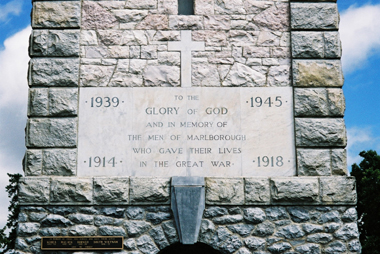
Marble dedication panel Bells and clock face Plinth in the Memorial Chamber and brass plaques bearing the names of those who died during the war
Construction Professional
Name
Garnham & Robertson
Type
Builder
Biography
Building firm
Name
Gray & Waters
Type
Builder
Biography
No biography is currently available for this construction professional
Name
Bacon, Roger
Type
Architect
Biography
Nothing is known of the early life or work of Roger Bacon. In 1908 he entered partnership in Wellington with Alfred Atkins. The firm also maintained a branch in Wanganui and designed buildings at Wanganui Collegiate School including School Block, House Block, Hall and the headmaster's residence between 1909-19. It undertook several hospital designs including Cook Hospital, Gisborne (1911), Wairoa Hospital (1912) and the King Edward VII Memorial Hospital for Children, Wellington (1912). Atkins and Bacon were also responsible for several branch buildings for the Bank of Australasia around New Zealand and for many residences in Wellington. Owing to failing health Bacon left the firm and moved to Blenheim about 1918. He retained an interest in architecture and completed two further works while in Blenheim - the War Memorial Clock Tower for the Blenheim Borough Council and Holy Trinity Church at Tuamarina.
Construction Details
Start Year
1928
Type
Original Construction
Start Year
1953
Type
Modification
Description
Names of those who died in the Second World War inscribed on copper plates attached to the inner walls of the memorial chamber
Start Year
1969
Type
Modification
Description
Lead canister placed at the base of the tower to commemorate the centennial of Blenheim
Construction Materials
Masonry and river boulders set in reinforced concrete
Notable Features
Marble dedication panel Bells and clock face Plinth in the Memorial Chamber and brass plaques bearing the names of those who died during the war
Historical and Associated Iwi / Hapū / Whānau
Completion Date
28th February 2003
Report Written By
Rebecca O'Brien
Information Sources
Beery, 1986
K. Beery, 'Scrutiny on the County', Marlborough, 1986
Beverley, 1969
A. Beverley, The First Hundred, Blenheim, 1969
MacLean, 1990
Chris MacLean and Jock Phillips, The Sorrow and the Pride: New Zealand War Memorials, Wellington, 1990
Other Information
This place was identified as significant under previous legislation with different information requirements. It remains significant under the current legislation. There is opportunity under our legislation and policies to add to this information. Further information about this place may be available from the Central Regional Office of Heritage New Zealand Pouhere Taonga. A fully referenced version of this report is available from the NZHPT Central Region Office Please note that entry on the New Zealand Heritage List/Rarangi Korero identifies only the heritage values of the property concerned, and should not be construed as advice on the state of the property, or as a comment of its soundness or safety, including in regard to earthquake risk, safety in the event of fire, or insanitary conditions.
Historical and Associated Iwi / Hapū / Whānau
Completion Date
28th February 2003
Report Written By
Rebecca O'Brien
Information Sources
Beery, 1986
K. Beery, 'Scrutiny on the County', Marlborough, 1986
Beverley, 1969
A. Beverley, The First Hundred, Blenheim, 1969
MacLean, 1990
Chris MacLean and Jock Phillips, The Sorrow and the Pride: New Zealand War Memorials, Wellington, 1990
Other Information
This place was identified as significant under previous legislation with different information requirements. It remains significant under the current legislation. There is opportunity under our legislation and policies to add to this information. Further information about this place may be available from the Central Regional Office of Heritage New Zealand Pouhere Taonga. A fully referenced version of this report is available from the NZHPT Central Region Office Please note that entry on the New Zealand Heritage List/Rarangi Korero identifies only the heritage values of the property concerned, and should not be construed as advice on the state of the property, or as a comment of its soundness or safety, including in regard to earthquake risk, safety in the event of fire, or insanitary conditions.
Current Usages
Uses: Civic Facilities
Specific Usage: Clocktower/ clock
Uses: Commemoration
Specific Usage: Memorial - World War One
Former Usages
General Usage: Civic Facilities
Specific Usage: Clocktower/ clock
General Usage: Commemoration
Specific Usage: Memorial - World War One
Themes
War Memorial
Web Links
description: The Memorials Register, New Zealand History Online, Ministry for Culture and Heritage.
Current Usages
Uses: Civic Facilities
Specific Usage: Clocktower/ clock
Uses: Commemoration
Specific Usage: Memorial - World War One
Former Usages
General Usage: Civic Facilities
Specific Usage: Clocktower/ clock
General Usage: Commemoration
Specific Usage: Memorial - World War One
Themes
War Memorial
Web Links
description: The Memorials Register, New Zealand History Online, Ministry for Culture and Heritage.
Location
Sign up to hear more
Get the latest heritage news, features and events delivered
straight to your inbox.
