Maori History
Ancient stories tell the origins of southern Maori, with the waka of Aoraki becoming Te Wai Pounamu (the South Island), and its sternpost, Te Taurapa a Te Waka o Aoraki becoming Bluff Hill (also known as Motupohue). The early generations learnt about the land and its resources: stone sources were found, and stone (especially pounamu) became an important trading item. Kaika were established close to resources. Rights and resources and places were established, and traditions established which protected the manawhenua.
According to the statutory acknowledgments in the Ngai Tahu Settlement, important villages along the south coast included: Te Wae Wae (Waiau), Taunoa (Orepuki), Kawakaputaputa (Wakapatu), Oraka (Colac bay), Aparima, Turangiteuaru, Awarua (Bluff), Te Whera, Toe Toe (mouth of the Mataura River) and Waikawa. Mokamoka (also known as Mokemoke or Mokomoko) was a settlement at the Invercargill estuary sustained by the rich resources found there. Tauranga waka occur up and down the coast linking land and sea trails with mahinga kai resources. Whaling boats plied the waters from the 1820s leading to changes in settlement patterns and resource use.
1853 saw the Murihiku purchase which left Maori south of the Waitaki (excluding the Otakou Block) with only 4,630 acres, the start of a long quest by southern Maori for justice questioning the legality of the purchase as well as the inadequacy of the land reserved.
All Saints Church
Anglicans had an early presence in Southland. A Christian presence had been introduced by Maori Anglican missionaries from the North Island, and there were also early Methodist missionaries active in Southland in the 1840s. It was not long after John Turnbull Thomson (1821-1884) started his survey of Invercargill in 1856 that the first Presbyterian clergyman arrived,and it is Rev. Alexander Bethune who is attributed with preaching the first Christian sermon in Invercargill in late 1856. Despite the strong Presbyterian settler influence from the mid-1850s, Southland was not a religious colony like Otago, and in the 1860s Presbyterians only nominally outnumbered Anglicans.
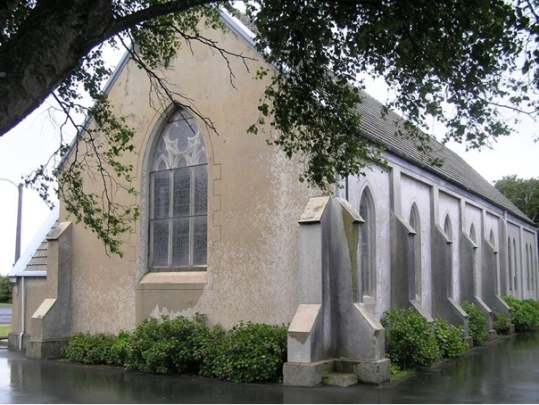
By the late 1850s it appears that most of the major Christian denominations had established a presence in Southland, but it was not until the early 1860s that the first purpose-built churches were constructed. The early church buildings in the Invercargill area, such as St John’s Anglican Church (1861), were constructed from timber, with the first brick church being St Paul’s Church in Invercargill, completed in 1876. Just a few years later, Invercargill’s renowned early architect Frederick William Burwell (1846-1915) designed All Saint’s Church, just north of Invercargill also in brick.
The construction of All Saints Church coincided with the development of a separate Anglican parish for the northern suburbs of Invercargill. At a public meeting in late 1876 a motion was passed stating it was ‘desirable a church should be built in this district to enable those living too far from St John’s to the attend Church of England services, and also that their children may be enabled to attend a Sunday School.’ In the 1870s Gladstone was a distinct borough complete with a town hall. As the main centre in the northern Invercargill settlements it seemed logical for Gladstone to be the seat of any new parish, and the Bishop of Dunedin was soon approached about this.
With diocesan permission granted for the church, a building committee was established in early 1877 to progress the fundraising and practical aspects of creating an Anglican church in Gladstone. Fundraising went well, possibly because of key donors such as Sir John Richardson (1810-1878). Richardson along with his £50 initial donation essentially gifted the land for the church, and was equally generous in furnishing the building. Richardson also went on to become a lay reader at All Saints Church, as well as church warden. People in the wider community also gave generously, and fundraising bazaars and other events proved popular.
The building committee engaged the then up-and-coming architect, Frederick Burwell, to design All Saints Church. Burwell had been articled to Scottish architect James Matthews of Aberdeen, remaining with him for several years, before moving to New Zealand, practising in Queenstown in the early 1870s. Lured by the prospect of numerous lucrative contracts in the flourishing town, Burwell had quickly established himself in Invercargill after he moved there from Queenstown in 1874. Burwell is intimately linked with the conversion of Invercargill from a frontier town to a ‘city of magnificent edifices’ over the subsequent 12 year period. Until Burwell began to assert his architectural influence it was said that Invercargill, was a ‘standing joke at Dunedin and elsewhere in New Zealand,’ hardly living up to the title of the ‘southern capital’ because it was characterised, among other negative aspects, as being ‘the ugliest and the worst built in the colony.’ It appears that Burwell had a vision of Invercargill’s potential and contributed greatly to cohesive commercial streetscapes, such as the impressive buildings which made up The Crescent. It was the profound effect that Burwell had in Invercargill by 1880 which led to him being elected a Fellow of the Royal Institute of British Architects, at the age of just 34.
Aside from commercial and public buildings, Burwell also designed many Southland ecclesiastical buildings. St Paul’s Church seems to have been his first and largest local foray into this sphere, and this was followed with other commissions for all the major Christian denominations around Southland and Otago. Along with St Paul’s Church, he designed other Presbyterian churches in Roxburgh and Cromwell in 1879, and Riverton (1881). As well as All Saints Church, Burwell also designed churches for the Anglican communities in Gore (1881) and Thornbury (1882-83), which were contemporary with his Methodist church in Invercargill (1881) and an early Catholic church in Gore (1882).
Following on from St Paul’s Church, Burwell also designed All Saints Church in brick. The foundation stone of All Saints Church was laid on 24 May 1877 with much pomp and ceremony. The event had a Masonic bent and the date of the ceremony, on Queen’s Birthday, was thought to especially appropriate since Queen Victoria was not only the patroness of the Order, but also the head of the Church of England. Around 800 people were present, with much of the large crowd having continued onto Gladstone as part of the general festivities of the day. The trowel used in the foundation stone ceremony was presented to W. J. Moffitt, Worshipful Master of the Southland Cross Lodge Freemason, by the church’s architect. In 1944 the trowel was donated to All Saints Church by Moffit’s daughter, where it is on display.
The contractors for the church, Smith and Fraser, took nine months to finish the building. All Saints Church was opened by the Bishop of Dunedin, Samuel Tarratt Neville (1837-1921), in late January 1878. This event seems to have been greatly anticipated because the Southland Times recorded that:
‘To say that the church was crowded would be but to just indicate the packed condition of the interior, for not only was every inch of seating accommodation occupied, but chairs were placed all along the aisle to accommodate worshippers, whilst many people had to stand at the door.’
While the building was built of brick, the east wall was timber-framed and clad in weatherboards in anticipation of the addition of a transept when funds allowed.
Subsequent building projects and adverse economic conditions meant that for many years All Saints Church struggled financially. Even with the generous contributions of parishioners, the congregation struggled. The Ladies’ Guild was instrumental in raising money. Among the events the Ladies’ Guild organised for the benefit of the church were concerts, fetes, and gymkhanas. The Guild also cleaned the church. It was not until 1901 that the debt on the church was cleared and All Saints was finally consecrated by the Bishop of Dunedin, 23 years after he opened it.
Among the social groups connected with the church the Mothers’ Union was active in the mid twentieth century. Many women graduated to this group as a from the Young Wives’ group. The Mothers’ Union, as the name suggests, provided a support network for mothers. They were notable contributors to the fundraising initiatives at the church. This group, which was disbanded in the early 1990s, also did charitable works within the wider community.
The clearing of the church’s debt and its subsequent consecration seems to have been a turning point. With an invigorated spirit, it was decided that the parochial district needed a Parish Hall close to All Saints Church. This building was constructed in 1905 to a design by well-known Invercargill architect Cuthbert John Brodrick (1867-1946).
The Brodrick family had moved to the area in 1864, and Thomas, who had been a successful sea captain, began farming. He also got involved with business affairs becoming a member of the Bluff Harbour Board and the Chambers of Commerce. Cuthbert’s father, Thomas Brodrick (1819-1904), had been a member of the All Saints building committee and a church warden. Cuthbert Brodrick was the nephew of the well known British architect of the same name (1822-1905). Cuthbert Brodrick was articled to Frederick Burwell from 1884-1889. He travelled to Australia in 1889-1890, and to England 1898-1900, before returning to Invercargill. Brodrick later became president of the New Zealand Institute of Architects, but in this period his impressive Bank of New South Wales in Invercargill had just been completed.
The Parish Hall seems to have been finished in late 1905 and it quickly began to be used for social occasions, such as large parties welcoming people home from holiday, and church related activities, like fundraising sales put on by the Ladies’ Guild. Brodrick’s work on the Parish Hall was voluntary, generosity which is perhaps not surprising given that the Brodrick family’s relationship with All Saints Church. The family connection with All Saints continued further into the twentieth century with Cuthbert’s sister being a longstanding Sunday School teacher there. In 1945 the Madonna and Child Window was installed in her honour. Cuthbert Brodrick left a substantial legacy to All Saints Church which greatly aided its ‘completion fund’ which was set up in 1946.
In the 1930s All Saints Church became the principal church in the newly established Parish of Gladstone.
As they were during World War One, New Zealand communities were profoundly affected by World War Two. Churches provided valuable spiritual and social support in these times of crisis. Active responses from All Saints Church parishioners included the establishment of a Patriotic Sub-Committee which met in the Parish Hall, and donations of goods to be sent to soldiers. Many parishioners fought overseas and eleven of these were among the war dead. The eleven men are commemorated at All Saints by the St George Window and by a Roll of Honour. One of the fallen was Eric Todd. His mother donated both the font and the St Michael Window in his memory.
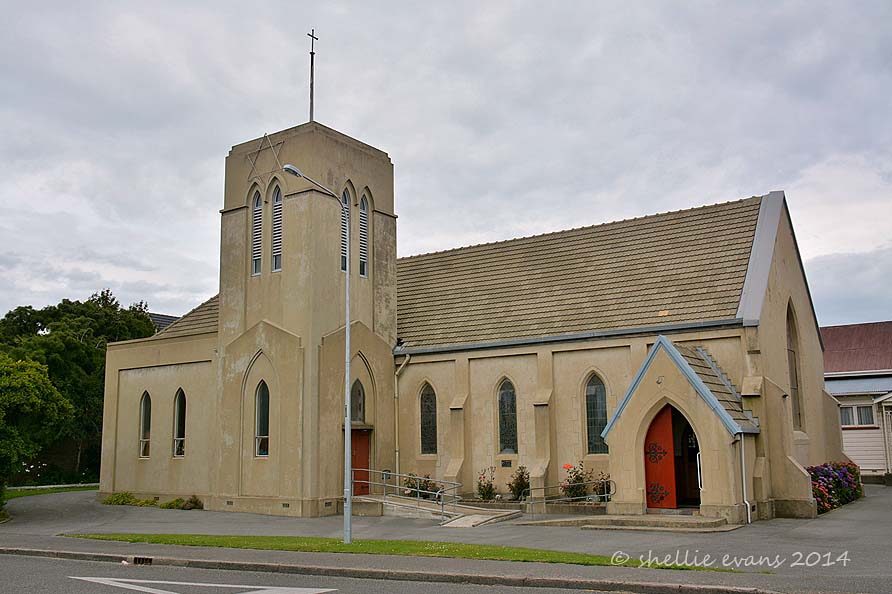
Despite the Great Depression and World War Two, the parish continued to grow and it soon became apparent that All Saints Church needed to do the same. The addition was designed by local architectural firm Ford Gray & Derbie in 1952. The additions included a sizeable eastward extension, creating new chancel, sanctuary, organ loft, vestry and bell tower. With their successful tender of just under £8,400, the contractors were R. Richardson & Co. While the extension was taking place the existing 1921 organ was dismantled and stored in the Parish Hall. After initially carrying on services in the church, eventually the services also had to be moved into the Parish Hall until the building project was completed in 1954. The Hall was consecrated on All Saints Day 1956.
The generous contributions from congregants in the 1940s carried through to the 1950s and 1960s. Donations included more stained glass windows and the bell in 1956, which was donated to All Saints Church in memory of Thomas Slater Royds who died in 1914. Earlier Royd had also been commemorated in the church’s St Paul Window.
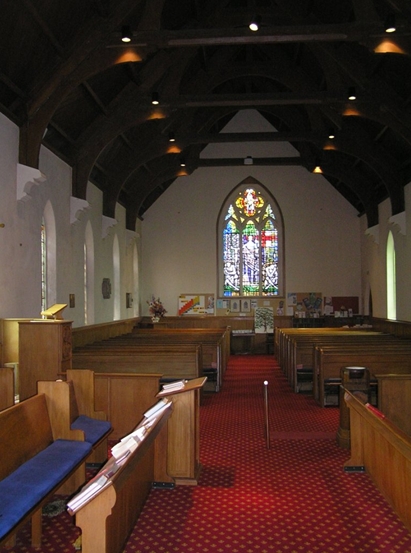
In the lead up to the centenary of All Saints Church two impressive stained glass windows were acquired for the building’s east and west walls in 1964 and 1968 [Information provided by a colleague of John Hayward, Doris Rollinson, gives 1965 (3 light east window) and 1970 (3 light west window) as the dates for the windows]. The windows were the work of distinguished English stained-glass artist, John Hayward (1929-2007). By the early 1960s Hayward had already created the windows for St Mary-le-Bow Church, London, which replaced its predecessor that had been destroyed in the bombing of World War Two. Hayward’s work is perhaps best known for his most famous work, the ‘Great West Window’ at Sherborne Abbey. The first Hayward window commissioned for All Saints Church was that for the east wall above the altar, depicting ‘Christ in Majesty with his Saints,’ which was appropriate given the dedication of the building to All Saints. The later window, at the opposite end of the church, celebrates Christ’s resurrection. Hayward himself is said to have suggested the theme for this window. The entire cost for the windows was covered by generous donations from parishioners.
Memorial aspects also continue to be added to the church and grounds, with a recent example being the Church of St Margaret of Scotland, Makarewa memorial garden, created in 2008, which curves around behind the church and Parish Hall.
In 2011 the church continues to be the spiritual centre of the local Anglican community. The social aspect of the church’s activities also continues with men and women’s groups meeting regularly, and Tai Chi as well as ‘Music and Movement’ sessions, in conjunction with the Plunket Society, take place in the Parish Hall.