

The site of the present Bank of New South Wales was occupied in 1856 by a store owned by James Macandrew, later Superintendent of Otago. These were the first commercial premises in Invercargill. He later bought the site at the sale of the Tay Street sections for £46. In 1863 the Bank of New South Wales purchased the site occupied by James Macandrew's store for £5,000. They moved to new premises on this site in 1875. The architect was W.H. Clayton.
In 1882 a fire destroyed the adjacent Bank of Australia building (where the present ANZ stands) and severely damaged the Bank of New South Wales. The premises were rebuilt. Tenders were called in 1902 for a new building to replace the existing structure. The banking chamber was opened for business 12 September 1904. The exterior of the building has remained relatively unchanged since its completion.
List Entry Information
Status
Listed
List Entry Status
Historic Place Category 1
Access
Private/No Public Access
List Number
2443
Date Entered
30th August 1990
Date of Effect
30th August 1990
City/District Council
Invercargill City
Region
Southland Region
Legal description
Lot 5, DP 5189, Pt Sec 22 Blk 2 Town of Invercargill, RT195/230
Location Description
Corner of 1 Dee Street and Tay Street, Invercargill.
Status
Listed
List Entry Status
Historic Place Category 1
Access
Private/No Public Access
List Number
2443
Date Entered
30th August 1990
Date of Effect
30th August 1990
City/District Council
Invercargill City
Region
Southland Region
Legal description
Lot 5, DP 5189, Pt Sec 22 Blk 2 Town of Invercargill, RT195/230
Location Description
Corner of 1 Dee Street and Tay Street, Invercargill.
Why is this place significant?
Historic Significance
Historical Significance or Value This building occupies a site that has been a significant one since Invercargill began and its commercial importance was recognised at an early stage by the Bank of New South Wales. The growing prosperity of Invercargill and its agriculturally rich region at the turn of the century was reflected in these comparatively lavish banking premises.
Physical Significance
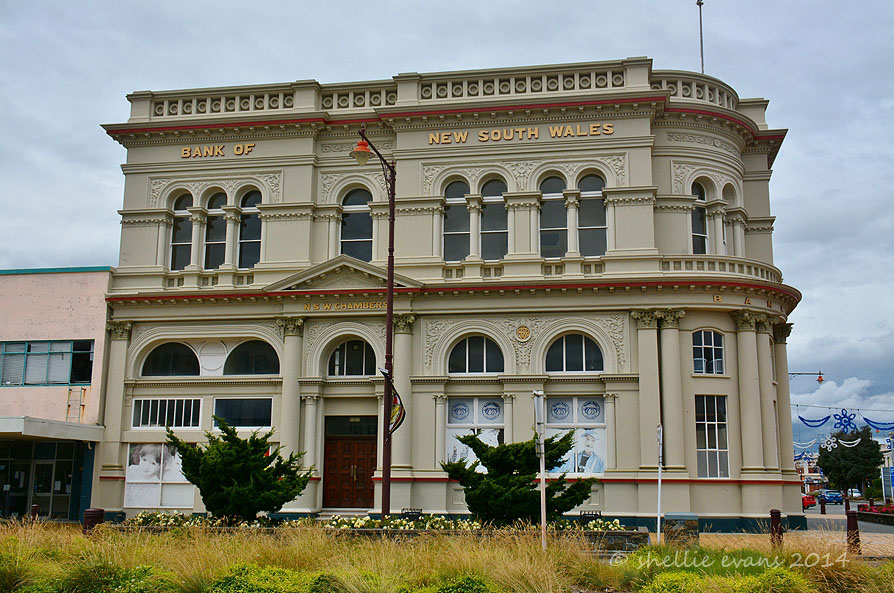
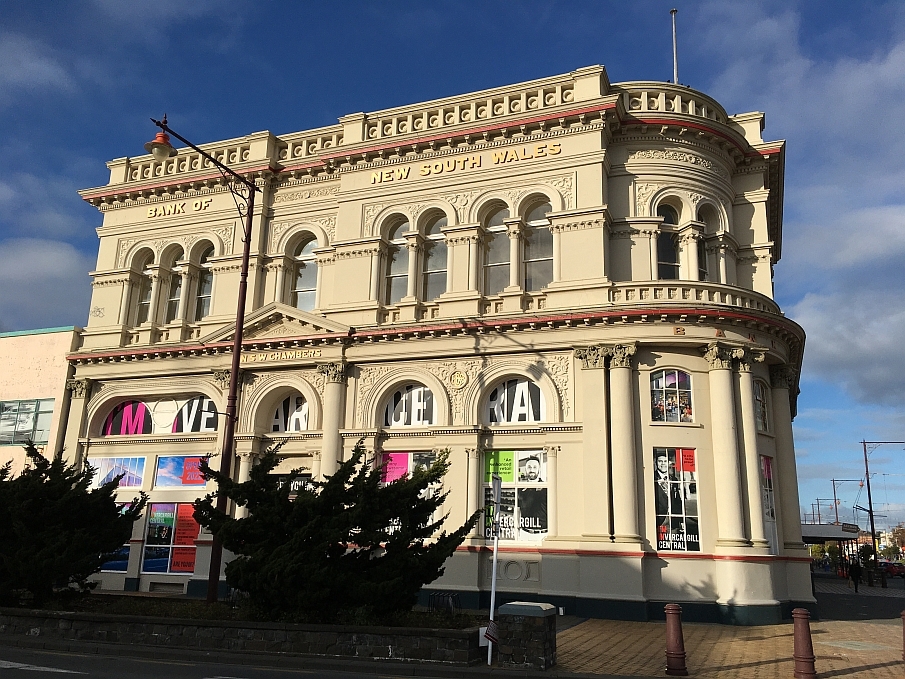
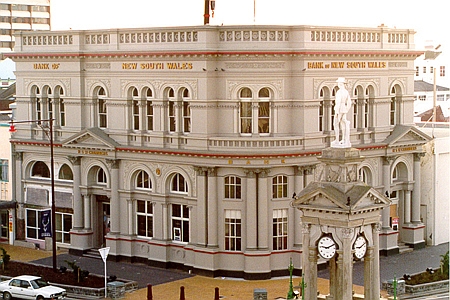
ARCHITECTURAL QUALITY: This building is a particularly fine example of an exuberant and ornate Classical style very popular in Edwardian New Zealand. The architect displayed an inventive originality in the use of fenestration and decoration and made full use of the building's corner site. The standard of decoration is very high. Such a substantial and lavish building is not that common in provincial centres. The building, on the exterior at least, remains in relatively original condition and has long been a major contributor to Invercargill's inner-city character. TOWNSCAPE/LANDMARK VALUE: With its bold form and decoration this building, sited as it is on one of Invercargill's most prominent corners and in conjunction with the nearby former Bank of New Zealand and National Bank makes a most valuable contribution to the city streetscape.
Why is this place significant?
Historic Significance
Historical Significance or Value This building occupies a site that has been a significant one since Invercargill began and its commercial importance was recognised at an early stage by the Bank of New South Wales. The growing prosperity of Invercargill and its agriculturally rich region at the turn of the century was reflected in these comparatively lavish banking premises.
Physical Significance
ARCHITECTURAL QUALITY: This building is a particularly fine example of an exuberant and ornate Classical style very popular in Edwardian New Zealand. The architect displayed an inventive originality in the use of fenestration and decoration and made full use of the building's corner site. The standard of decoration is very high. Such a substantial and lavish building is not that common in provincial centres. The building, on the exterior at least, remains in relatively original condition and has long been a major contributor to Invercargill's inner-city character. TOWNSCAPE/LANDMARK VALUE: With its bold form and decoration this building, sited as it is on one of Invercargill's most prominent corners and in conjunction with the nearby former Bank of New Zealand and National Bank makes a most valuable contribution to the city streetscape.
Construction Professional
Name
Brodrick, Cuthbert John
Type
Architect
Biography
Cuthbert John Brodrick (1867-1946) was born in Invercargill, the fifth son of Thomas Brodrick. He was named for his uncle, the well-known Victorian architect Cuthbert Brodrick (1822-1905). Brodrick was educated at Southland Boys High School. In 1884 Brodrick was articled to F.W. Burwell and trained in the classical tradition, travelling to Melbourne with Burwell to complete his training. Brodrick returned to New Zealand in 1891 after architectural draughting in Queensland for the Government. In 1906 he married Jemima ('Nonnie') Thomson, stepdaughter of surveyor John Turnbull Thomson. After practising in Hawera for six years he returned to Invercargill. Brodrick entered into a partnership with his pupil Thomas Royds during World War One. Royds died in 1936. Brodrick retired from practice about 1943. During his career, he served as President of the Institute of Architects in 1911, as Vice-President in 1917, and as a member of the council in 1935. The first building he designed in Invercargill was the Alexandra building. Others (with partner Thomas Royds) included the Italian Renaissance Bank of New South Wales (1912), the Kaiapoi building, the Grand Hotel (1914), the Edwardian Baroque Southland Daily News (1913), the stripped Classical Invercargill Savings Bank (1926), the classical temple Masonic Lodge of St John (1926), the Georgian Waimahaka Homestead, and grandstands for the Southland Racing Club. Brodrick was also a member of the Borough Council for three terms and became Deputy Mayor.
Construction Details
Start Year
1954
Type
Modification
Description
Main entrance on the corner removed and replaced by glazing. Verandah added on Dee Street entrance. Some interior alterations.
Start Year
1968
Type
Modification
Description
Further interior alterations - installation of mezzanine floor, new ceilings and concrete columns.
Start Year
1904
Type
Original Construction
Construction Materials
Walls, brick and plaster; roof, clad in corrugated iron. The additions and mezzanine floor (1968), reinforced concrete.
Notable Features
The near original facade with its fine decoration.
Construction Professional
Name
Brodrick, Cuthbert John
Type
Architect
Biography
Cuthbert John Brodrick (1867-1946) was born in Invercargill, the fifth son of Thomas Brodrick. He was named for his uncle, the well-known Victorian architect Cuthbert Brodrick (1822-1905). Brodrick was educated at Southland Boys High School. In 1884 Brodrick was articled to F.W. Burwell and trained in the classical tradition, travelling to Melbourne with Burwell to complete his training. Brodrick returned to New Zealand in 1891 after architectural draughting in Queensland for the Government. In 1906 he married Jemima ('Nonnie') Thomson, stepdaughter of surveyor John Turnbull Thomson. After practising in Hawera for six years he returned to Invercargill. Brodrick entered into a partnership with his pupil Thomas Royds during World War One. Royds died in 1936. Brodrick retired from practice about 1943. During his career, he served as President of the Institute of Architects in 1911, as Vice-President in 1917, and as a member of the council in 1935. The first building he designed in Invercargill was the Alexandra building. Others (with partner Thomas Royds) included the Italian Renaissance Bank of New South Wales (1912), the Kaiapoi building, the Grand Hotel (1914), the Edwardian Baroque Southland Daily News (1913), the stripped Classical Invercargill Savings Bank (1926), the classical temple Masonic Lodge of St John (1926), the Georgian Waimahaka Homestead, and grandstands for the Southland Racing Club. Brodrick was also a member of the Borough Council for three terms and became Deputy Mayor.
Construction Details
Start Year
1954
Type
Modification
Description
Main entrance on the corner removed and replaced by glazing. Verandah added on Dee Street entrance. Some interior alterations.
Start Year
1968
Type
Modification
Description
Further interior alterations - installation of mezzanine floor, new ceilings and concrete columns.
Start Year
1904
Type
Original Construction
Construction Materials
Walls, brick and plaster; roof, clad in corrugated iron. The additions and mezzanine floor (1968), reinforced concrete.
Notable Features
The near original facade with its fine decoration.
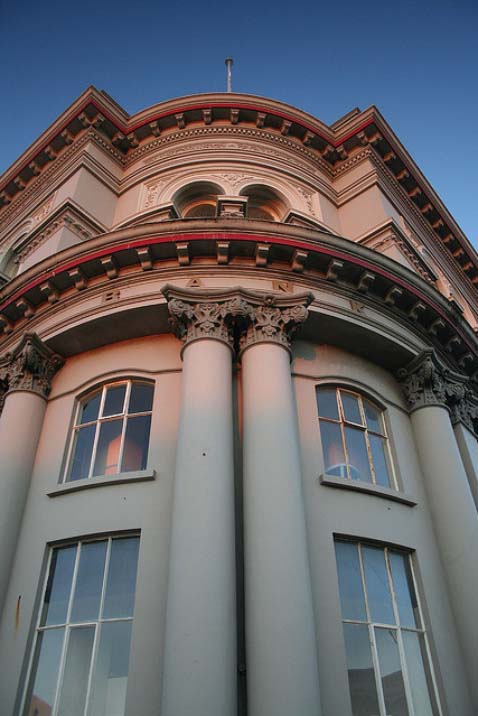
ARCHITECTURAL DESCRIPTION: This two-storeyed ornate Classical building occupies a corner site in central Invercargill. The principal feature of the building is the repeated but varied use of arched windows surrounded by decorative relief work above the springing line. The top storey windows are arranged in pairs or triples separated by columns. An elaborate string course defines the springing line. The ground floor windows are larger but retain the prominent arched motif. The present entrances on both elevations are defined by small triangular pediments and flanked by composite columns. Above the pediments are recessed bays containing a single arched window. The Dee Street entrance is obscured somewhat by an unfortunate verandah addition. The rounded corner is defined, on the ground floor, by the employment of a pair of composite columns between two pairs of columns and pilasters and on the upper storey by a recessed bay and balcony. The building is capped by a decorative parapet with a circular motif. MODIFICATIONS: 1954 - Main entrance on the corner removed and replaced by glazing. - Verandah added on Dee Street entrance. - Some interior alterations. 1968 - Further interior alterations - installation of mezzanine floor, new ceilings and concrete columns.
ARCHITECTURAL DESCRIPTION: This two-storeyed ornate Classical building occupies a corner site in central Invercargill. The principal feature of the building is the repeated but varied use of arched windows surrounded by decorative relief work above the springing line. The top storey windows are arranged in pairs or triples separated by columns. An elaborate string course defines the springing line. The ground floor windows are larger but retain the prominent arched motif. The present entrances on both elevations are defined by small triangular pediments and flanked by composite columns. Above the pediments are recessed bays containing a single arched window. The Dee Street entrance is obscured somewhat by an unfortunate verandah addition. The rounded corner is defined, on the ground floor, by the employment of a pair of composite columns between two pairs of columns and pilasters and on the upper storey by a recessed bay and balcony. The building is capped by a decorative parapet with a circular motif. MODIFICATIONS: 1954 - Main entrance on the corner removed and replaced by glazing. - Verandah added on Dee Street entrance. - Some interior alterations. 1968 - Further interior alterations - installation of mezzanine floor, new ceilings and concrete columns.
Historical and Associated Iwi / Hapū / Whānau
Information Sources
Chappell, 1961
N.M. Chappell, New Zealand Banker's Hundred: Bank of New Zealand 1861-1961, Wellington, 1961
Deaker, 1960
A.J. Deaker, Centenary of First Church: The Story of First Presbyterian Church, Invercargill, New Zealand, Invercargill, 1960
Otago Daily Times
Otago Daily Times, 1 Jun 1915, p.10.
Sinclair, 1987
Keith Sinclair (ed.), Tasman Relations: New Zealand and Australia, 1788-1988, Auckland, 1987
Southland Daily News
Southland Daily News
Southland Times
Southland Times
Harnetts Official Dictionary, 1864
Harnetts Official Dictionary of 1864, Dunedin and Invercargill
Butlin, 1961
S T Butlin, History of Australian and New Zealand Banking Group, 1961
Watt, 1963
J O P Watt, Invercargill Fire Brigade Centennial Booklet 1863-1963, Invercargill, 1963
Watt, 1971
J O P Watt. Centenary Invercargill Municipality 1871 - 1971. Southland Times Printing Service, Invercargill, 1971.
Hall-Jones, 1946
F G Hall-Jones, Invercargill Pioneers. 1946
Reed, 1956
A H Reed. The Story of Early Dunedin. 1956
Ministry of Works and Development
Ministry of Works and Development
Other Information
Please note that entry on the New Zealand Heritage List/Rarangi Korero identifies only the heritage values of the property concerned, and should not be construed as advice on the state of the property, or as a comment of its soundness or safety, including in regard to earthquake risk, safety in the event of fire, or insanitary conditions.
Historical and Associated Iwi / Hapū / Whānau
Information Sources
Chappell, 1961
N.M. Chappell, New Zealand Banker's Hundred: Bank of New Zealand 1861-1961, Wellington, 1961
Deaker, 1960
A.J. Deaker, Centenary of First Church: The Story of First Presbyterian Church, Invercargill, New Zealand, Invercargill, 1960
Otago Daily Times
Otago Daily Times, 1 Jun 1915, p.10.
Sinclair, 1987
Keith Sinclair (ed.), Tasman Relations: New Zealand and Australia, 1788-1988, Auckland, 1987
Southland Daily News
Southland Daily News
Southland Times
Southland Times
Harnetts Official Dictionary, 1864
Harnetts Official Dictionary of 1864, Dunedin and Invercargill
Butlin, 1961
S T Butlin, History of Australian and New Zealand Banking Group, 1961
Watt, 1963
J O P Watt, Invercargill Fire Brigade Centennial Booklet 1863-1963, Invercargill, 1963
Watt, 1971
J O P Watt. Centenary Invercargill Municipality 1871 - 1971. Southland Times Printing Service, Invercargill, 1971.
Hall-Jones, 1946
F G Hall-Jones, Invercargill Pioneers. 1946
Reed, 1956
A H Reed. The Story of Early Dunedin. 1956
Ministry of Works and Development
Ministry of Works and Development
Other Information
Please note that entry on the New Zealand Heritage List/Rarangi Korero identifies only the heritage values of the property concerned, and should not be construed as advice on the state of the property, or as a comment of its soundness or safety, including in regard to earthquake risk, safety in the event of fire, or insanitary conditions.
Former Usages
General Usage: Finance
Specific Usage: Bank
Former Usages
General Usage: Finance
Specific Usage: Bank
Location
Stay up to date with Heritage this month
