

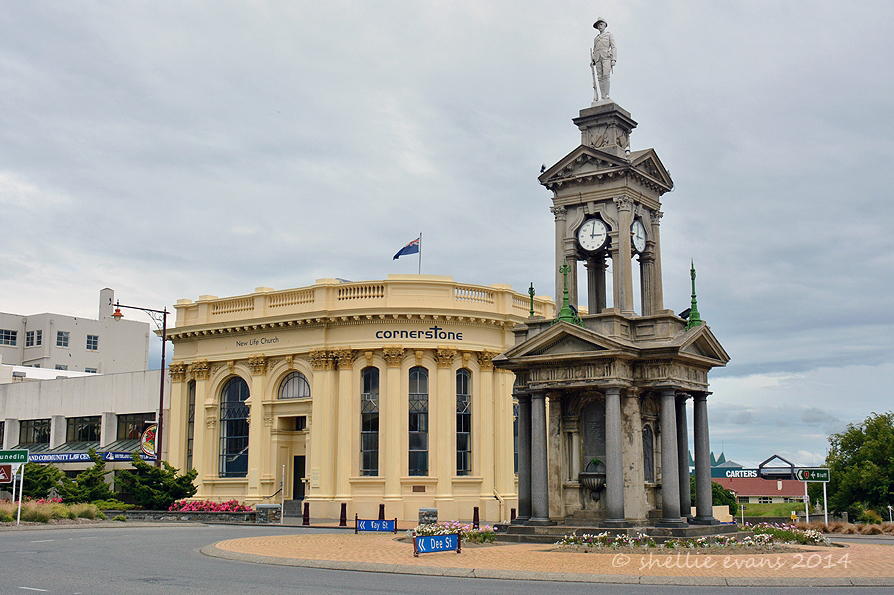
In June 1908 the memorial was unveiled by the Prime Minister Sir Joseph Ward before a crowd of four to five thousand people. Apart from the addition of a four sided clock to the upper level in the early 1950s the monument has remained unaltered, proposals in the early 1970s to move it to another site having come to nothing.

List Entry Information
Status
Listed
List Entry Status
Historic Place Category 1
Access
Able to Visit
List Number
2445
Date Entered
28th June 1990
Date of Effect
28th June 1990
City/District Council
Invercargill City
Region
Southland Region
Status
Listed
List Entry Status
Historic Place Category 1
Access
Able to Visit
List Number
2445
Date Entered
28th June 1990
Date of Effect
28th June 1990
City/District Council
Invercargill City
Region
Southland Region
Why is this place significant?
Historic Significance
Historical Significance or Value This historic place was registered under the Historic Places Act 1980. This report includes the text from the original Building Classification Committee report considered by the NZHPT Board at the time of registration. The Trooper's Memorial stands as a permanent reminder of New Zealand's role in the Boer War and particularly of those Southland soldiers who were killed on active service.
Physical Significance
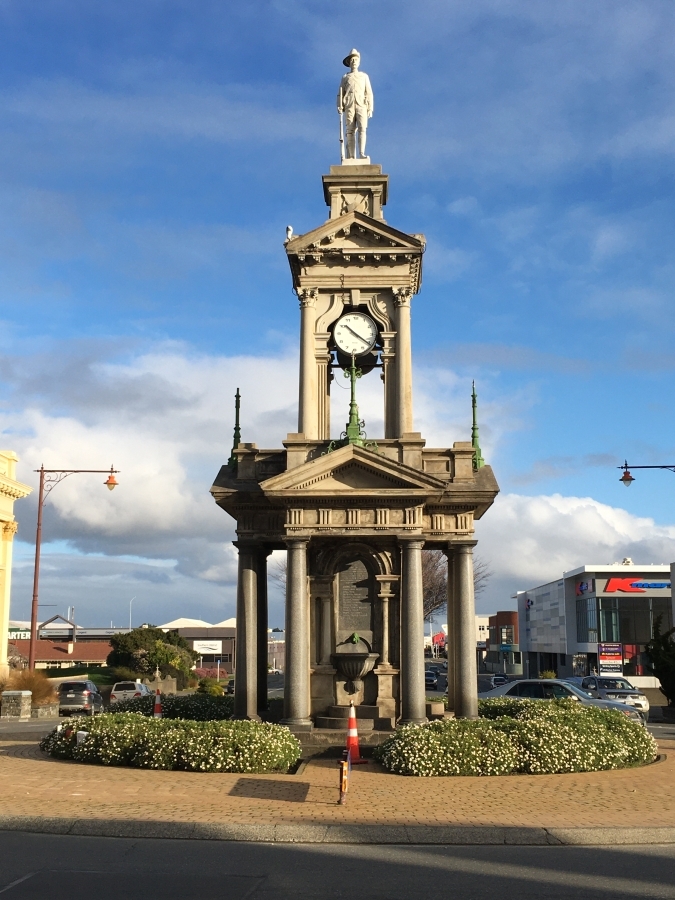
This historic place was registered under the Historic Places Act 1980. This report includes the text from the original Building Classification Committee report considered by the NZHPT Board at the time of registration. ARCHITECTURAL QUALITY: The monument is an elaborate example of a war memorial designed along classical lines, with all four sides the same because of its site in the middle of an intersection. The use of reinforced concrete as the basic construction material was innovative for the time. TOWNSCAPE/LANDMARK VALUE: It is a prominent landmark on the intersection of Dee and Tay Streets, one of the most important intersections in Invercargill's central business area.
Why is this place significant?
Historic Significance
Historical Significance or Value This historic place was registered under the Historic Places Act 1980. This report includes the text from the original Building Classification Committee report considered by the NZHPT Board at the time of registration. The Trooper's Memorial stands as a permanent reminder of New Zealand's role in the Boer War and particularly of those Southland soldiers who were killed on active service.
Physical Significance
This historic place was registered under the Historic Places Act 1980. This report includes the text from the original Building Classification Committee report considered by the NZHPT Board at the time of registration. ARCHITECTURAL QUALITY: The monument is an elaborate example of a war memorial designed along classical lines, with all four sides the same because of its site in the middle of an intersection. The use of reinforced concrete as the basic construction material was innovative for the time. TOWNSCAPE/LANDMARK VALUE: It is a prominent landmark on the intersection of Dee and Tay Streets, one of the most important intersections in Invercargill's central business area.
Construction Professional
Name
Vanes, Newton
Type
Architect
Biography
Robert Newton Vanes (1883-1961) Robert Newton Vanes was born on 20 October 1883 in Pancras London. He emigrated with his parents (Robert Newton and Mary) to New Zealand in 1886, arriving in Wellington on the Cowan. Vanes was a pupil of J.L. Salmond in Dunedin but during this time is known to have also engaged in work with other architects, like Basil Hooper. In 1903 his design for the South African War memorial in Invercargill was commissioned. In 1907 Vanes travelled overseas for three years where he studied design in London. Whilst there he worked for a number of architects before travelling and sketching on the continent. In 1910 Vanes returned to Dunedin a newly qualified A.R.I.B.A architect. He became a partner in the company which was renamed Salmond and Vanes (1910-1933). Vanes was regularly involved in the judging of architectural students work. In 1914 in addition to his practice, he became principal lecturer at the Dunedin School of Art and Art Crafts teaching the new subjects of architectural design, and history of architecture. This was a role which he held until he resigned to enlist in the New Zealand Expeditionary Force in 1917. Vanes was 2nd Lieutenant, Wellington Infantry Regiment where he was an instructor. While on discharge in 1919 he enrolled in postgraduate study at London University from 1920-21 where he took papers in town planning. Back in Dunedin he returned to Salmond and Vanes. In 1929 Vanes married Harriet Elizabeth Milsom. Vanes returned to London in the early 1930s. He died aged in 1961 in Surbiton aged 78. From 2020 Summary Upgrade Report Glenaven Methodist Church, DUNEDIN (List No. 3371, Category 2 historic place), Sarah Gallagher
Construction Details
Type
Addition
Description
Clock installed in upper level with faces on all four sides
Period
1950s
Start Year
1902
Finish Year
1908
Type
Original Construction
Construction Materials
Reinforced concrete construction. Aberdeen granite columns. Statue of Carrara marble.
Notable Features
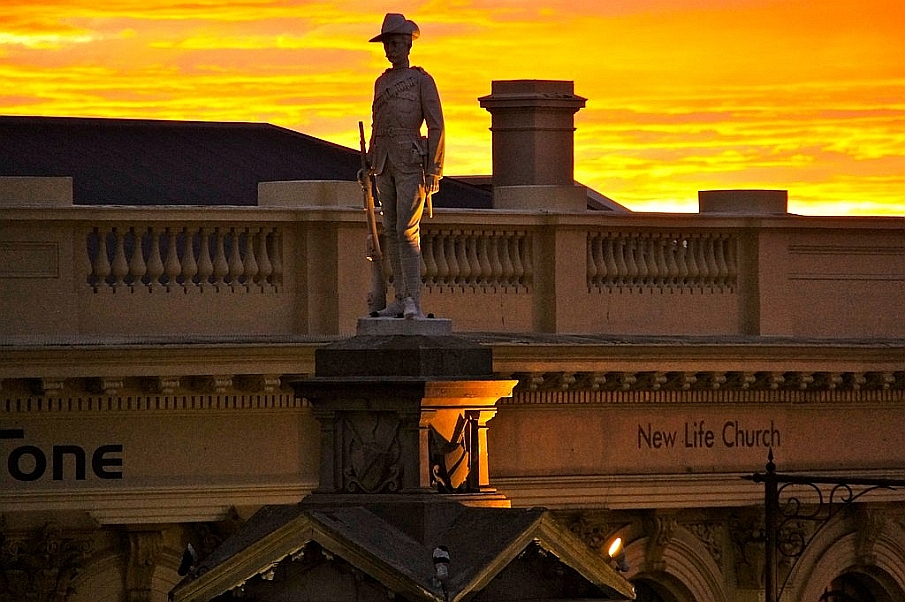
Aberdeen granite columns. Marble statue of a trooper.
Construction Professional
Name
Vanes, Newton
Type
Architect
Biography
Robert Newton Vanes (1883-1961) Robert Newton Vanes was born on 20 October 1883 in Pancras London. He emigrated with his parents (Robert Newton and Mary) to New Zealand in 1886, arriving in Wellington on the Cowan. Vanes was a pupil of J.L. Salmond in Dunedin but during this time is known to have also engaged in work with other architects, like Basil Hooper. In 1903 his design for the South African War memorial in Invercargill was commissioned. In 1907 Vanes travelled overseas for three years where he studied design in London. Whilst there he worked for a number of architects before travelling and sketching on the continent. In 1910 Vanes returned to Dunedin a newly qualified A.R.I.B.A architect. He became a partner in the company which was renamed Salmond and Vanes (1910-1933). Vanes was regularly involved in the judging of architectural students work. In 1914 in addition to his practice, he became principal lecturer at the Dunedin School of Art and Art Crafts teaching the new subjects of architectural design, and history of architecture. This was a role which he held until he resigned to enlist in the New Zealand Expeditionary Force in 1917. Vanes was 2nd Lieutenant, Wellington Infantry Regiment where he was an instructor. While on discharge in 1919 he enrolled in postgraduate study at London University from 1920-21 where he took papers in town planning. Back in Dunedin he returned to Salmond and Vanes. In 1929 Vanes married Harriet Elizabeth Milsom. Vanes returned to London in the early 1930s. He died aged in 1961 in Surbiton aged 78. From 2020 Summary Upgrade Report Glenaven Methodist Church, DUNEDIN (List No. 3371, Category 2 historic place), Sarah Gallagher
Construction Details
Type
Addition
Description
Clock installed in upper level with faces on all four sides
Period
1950s
Start Year
1902
Finish Year
1908
Type
Original Construction
Construction Materials
Reinforced concrete construction. Aberdeen granite columns. Statue of Carrara marble.
Notable Features
Aberdeen granite columns. Marble statue of a trooper.
This historic place was registered under the Historic Places Act 1980. This report includes the text from the original Building Classification Committee report considered by the NZHPT Board at the time of registration. ARCHITECTURAL DESCRIPTION: This substantial monument is classical in style and is the same on all four sides. At street level each side has Doric columns supporting a simple entablature and triangular pediments with a cast iron finial at its apex. In the middle is a central shaft which bears panels and inscriptions relating to the memory of the Southlanders who fought in the Boer War. A stairway housed inside the shaft leads to the upper level. This features Corinthian columns, entabulatures and bracketed pediments. The statue of a trooper stands on a panelled plinth at the top of the memorial.
This historic place was registered under the Historic Places Act 1980. This report includes the text from the original Building Classification Committee report considered by the NZHPT Board at the time of registration. ARCHITECTURAL DESCRIPTION: This substantial monument is classical in style and is the same on all four sides. At street level each side has Doric columns supporting a simple entablature and triangular pediments with a cast iron finial at its apex. In the middle is a central shaft which bears panels and inscriptions relating to the memory of the Southlanders who fought in the Boer War. A stairway housed inside the shaft leads to the upper level. This features Corinthian columns, entabulatures and bracketed pediments. The statue of a trooper stands on a panelled plinth at the top of the memorial.
Historical and Associated Iwi / Hapū / Whānau
Completion Date
5th February 1990
Information Sources
Natt, 1971
J Natt, Centenary of Invercargill Municipality 1871-1971, Invercargill 1971
Other Information
A copy of this report is available from the NZHPT Southern Region office Please note that entry on the New Zealand Heritage List/Rarangi Korero identifies only the heritage values of the property concerned, and should not be construed as advice on the state of the property, or as a comment of its soundness or safety, including in regard to earthquake risk, safety in the event of fire, or insanitary conditions. This historic place was registered under the Historic Places Act 1980. This report includes the text from the original Building Classification Committee report considered by the NZHPT Board at the time of registration.
Historical and Associated Iwi / Hapū / Whānau
Completion Date
5th February 1990
Information Sources
Natt, 1971
J Natt, Centenary of Invercargill Municipality 1871-1971, Invercargill 1971
Other Information
A copy of this report is available from the NZHPT Southern Region office Please note that entry on the New Zealand Heritage List/Rarangi Korero identifies only the heritage values of the property concerned, and should not be construed as advice on the state of the property, or as a comment of its soundness or safety, including in regard to earthquake risk, safety in the event of fire, or insanitary conditions. This historic place was registered under the Historic Places Act 1980. This report includes the text from the original Building Classification Committee report considered by the NZHPT Board at the time of registration.
Current Usages
Uses: Commemoration
Specific Usage: Memorial - South African War
Former Usages
General Usage: Commemoration
Specific Usage: Memorial - South African War
Themes
War Memorial
Current Usages
Uses: Commemoration
Specific Usage: Memorial - South African War
Former Usages
General Usage: Commemoration
Specific Usage: Memorial - South African War
Themes
War Memorial
