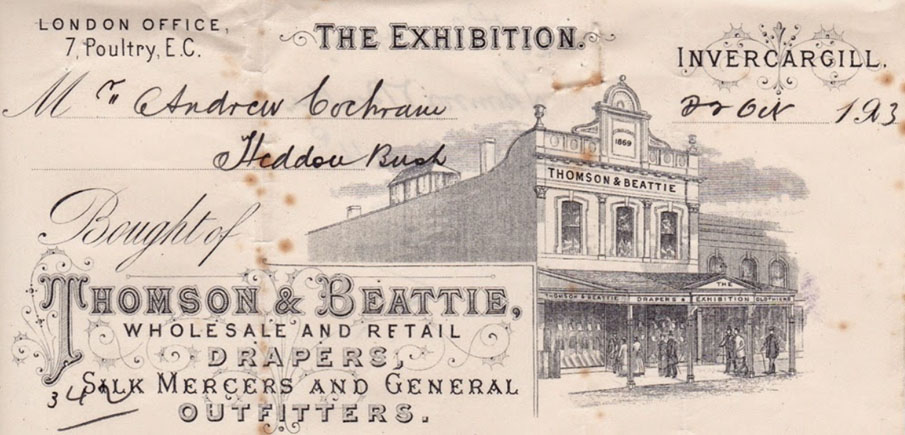
Section 15 was first granted to sailmaker Nicholas Burrows in 1875. In October 1877, Burrows transferred the title drapers James Beattie and John Thomson. Thomson and Beattie began their enterprise with a store in the small Southland town of Flint’s Bush (1869). Hearing that Winton was more go-ahead, they sold up and opened in Winton (1871). They opened a store in Invercargill (1875) next to the Colonial Bank, then on the south side of the Athenaeum, and then on Tay Street – their building known as ‘The Exhibition’. They also opened Gore (1876) and Otautau (1902) branches. Thomson died in 1916, and Beattie in 1935.
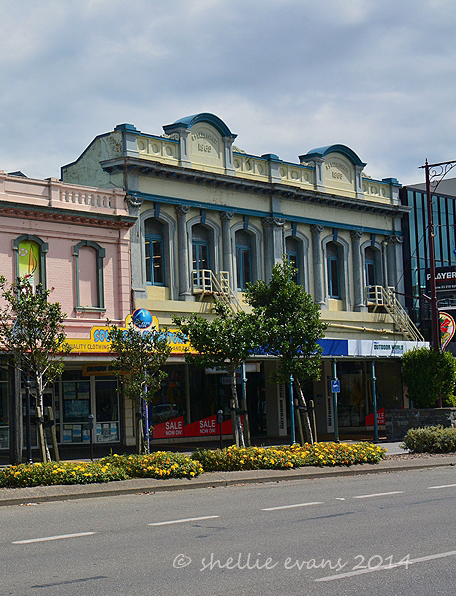
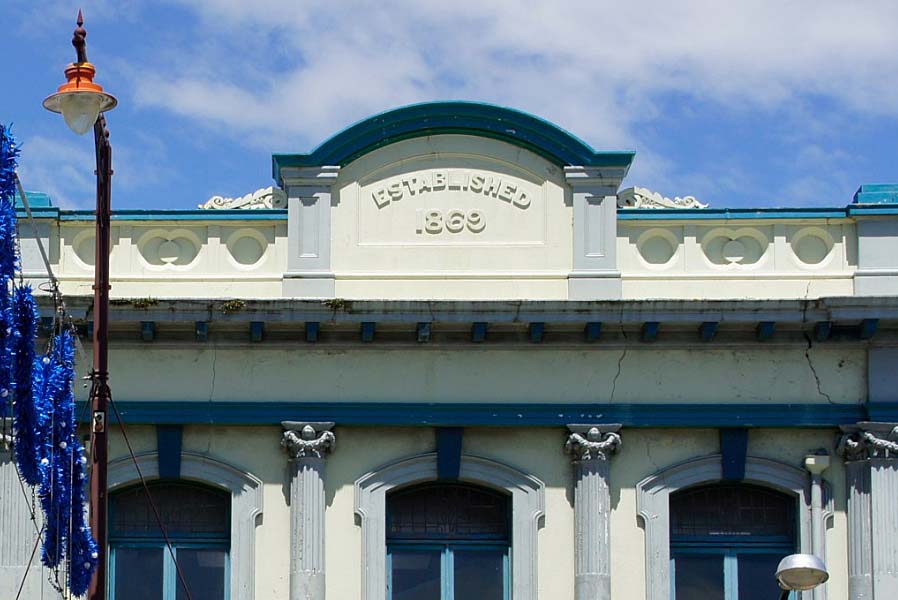
Architect Frederick Burwell invited tenders for Thomson and Beattie’s ‘warehouse’ in late 1880. Contractor David Stewart won the tender. The Southland Times described the progress on the building ‘now beginning to show its proportions above the footpath on the south side of Tay street’ in March 1881. The main elevation was designed in ‘New Queen Anne’ style, ‘the first of its kind here.’ The basement was 120 feet long, providing a dray entrance to Wood Street. The basement was lit by footpath level windows on Tay Street. The ground floor had a sixteen foot stud, and was to be occupied by the sales department at the street front and by the fitting rooms and office at the rear. A five foot wide ‘semi-circular’ staircase provided access to the first floor and its ‘handsome showrooms and dressmakers’ workrooms’ and a 12 foot stud. The centre of the building was lit by a large cupola, constructed as a gallery, allowing light to penetrate to the ground floor. Employee access through the building was provided by a secondary stair. The reporter concluded that the building ‘marks an era in the business importance of the south side of Tay street such as it has not known since the great fire in 1864.’ Six months later, a reporter described the warehouse as a ‘sight of itself and excites astonishment that it should be designed for the accommodation of one class of good only in a town of the dimensions of Invercargill.’ Of course, the article continued, ‘it has been built for the future, and we have little doubt that the future will justify the sagacious anticipations of the owners.’
Thomson and Beattie further extended their premises in 1891. They purchased the adjacent property – Ramsay’s Hall and converted it for their own purposes. Contractor John Ramsay had built the hall in 1877. Nearly complete in October of that year, the building was two-storeys and built of brick and stone. Facilities consisted of a main hall with stage, side wings and rooms to the rear. There was a gallery with a raked floor and a shop with a double front below the gallery on the street front. Access to the main hall was by two front doors at either corner of the building. The hall accommodated some 500 people. The hall had been a venue for concerts and public talks.
Thomson and Beattie’s closed in the late 1960s, and the building saw various commercial tenants. Sections 14 and 15 were owned by Thomson and Beattie Limited until 1993, when both sections were sold to H and J Smiths Limited. In 2017, the building is home to Classic Motorcycle Mecca.

List Entry Information
Status
Listed
List Entry Status
Historic Place Category 2
Access
Private/No Public Access
List Number
2472
Date Entered
24th November 1983
Date of Effect
24th November 1983
City/District Council
Invercargill City
Region
Southland Region
Extent of List Entry
Extent includes the land described as Sec 14 Blk LXXV Town of Invercargill (RT SLA3/497) and Sec 15 Blk LXXV Town of Invercargill (SL165/213), Southland Land District and the building known as Thomson and Beattie Drapery (Former) thereon.
Legal description
Sec 14 Blk LXXV Town of Invercargill (RT SLA3/497) and Sec 15 Blk LXXV Town of Invercargill (SL165/213), Southland Land District
Status
Listed
List Entry Status
Historic Place Category 2
Access
Private/No Public Access
List Number
2472
Date Entered
24th November 1983
Date of Effect
24th November 1983
City/District Council
Invercargill City
Region
Southland Region
Extent of List Entry
Extent includes the land described as Sec 14 Blk LXXV Town of Invercargill (RT SLA3/497) and Sec 15 Blk LXXV Town of Invercargill (SL165/213), Southland Land District and the building known as Thomson and Beattie Drapery (Former) thereon.
Legal description
Sec 14 Blk LXXV Town of Invercargill (RT SLA3/497) and Sec 15 Blk LXXV Town of Invercargill (SL165/213), Southland Land District
Construction Professional
Name
David Stewart
Type
Builder
Biography
Glasgow-born Stewart (c.1835-1920) came to New Zealand in the 1860s, settling in Invercargill. He began work as a monumental mason before joining the gold rush to the West Coast. He returned to Invercargill and set up business as a building contractor. He was contractor for many significant buildings including Southland Boys’ High School (first used for both boys and girls), the Athenaeum, the Bank of New Zealand, Central School, Thomson and Beattie’s Invercargill premises and Thomson and Co.’s Leven Street factory, and the Awarua radio station.
Name
Burwell, F. W.
Type
Architect
Biography
F.W. Burwell (1846-1915) is noted for designing many buildings in Invercargill, transforming the centre of the town between 1874 and the mid-1880s. Born in Scotland, Burwell served his articles with the architect John Matthews and immigrated to New Zealand in the late 1860s. By 1873, he had established his practice in Queenstown. He moved to Invercargill the following year. Once established there, he began designing elegant two and three-storey buildings in the Renaissance style. He designed almost all the buildings in Dee Street, including the hospital. 'The Crescent' was another notable Invercargill streetscape created by Burwell. In recognition of his work, he was elected a Fellow of the Royal Institute of British Architects in 1880. The depression in the 1880s saw his commissions decline and he moved to Australia in 1887 where he practised in Melbourne, Perth and then Fremantle. He was particularly successful in the last, as Western Australia was in the middle of a building boom, and a number of his commercial buildings in central Fremantle are now classified by the Australian Heritage Commission. Burwell returned to Melbourne in 1910, and died there five years later. (Jonathan Mane-Wheoki, 'Burwell, Frederick William (1846-1915)' in Jane Thomson (ed.), Southern People: a dictionary of Otago Southland biography, Dunedin, 1998, p. 74.)
Name
Ramsay, John
Type
Designer
Biography
Scottish-born Ramsay (c.1835-1919) arrived in Auckland in 1859. Hearing about the gold rushes in the South, he journeyed to Dunedin before joining the hopefuls at the Tuapeka goldfields. After his marriage to Elizabeth Allen he took up residence at Longbush where he set up as a sawmiller in conjunction with John Laidlaw and James Strang. After that partnership was dissolved he moved to Invercargill and worked as a builder, active from the mid 1870s. He was the builder for F.W. Burwell’s St Paul’s Church (Presbyterian) and the Bank of New Zealand building in Invercargill, as well as building additions to the Fleming and Company Flourmill in 1881. He worked on many significant buildings including the AMP buildings, the first government buildings, the first part of St Paul’s Presbyterian Church, the race and turbine of the Mataura freezing works, as well as his own Ramsay’s Hall on Tay Street, later incorporated into the Thomson and Beattie’s drapery concern. However, bankruptcy in 1887 seems to have ended his contracting career.
Name
Sharp, William
Type
Architect
Biography
Yorkshire born Sharp (1847-1936) was educated in England as an engineer and surveyor before going to Japan as assistant engineer on the Imperial Government railway until 1877. After returning to England he then came to New Zealand in October 1878. He was appointed assistant engineer in the Public Works Department. Retrenched in the 1880s, he started in private practice and was part time engineer to the Invercargill Borough Council and the Bluff Harbour Board. He retired in 1914 and died in Timaru in 1936.
Construction Details
Start Year
1877
Type
Original Construction
Description
Ramsay’s Hall constructed
Start Year
1881
Type
Addition
Description
Thomson and Beattie’s ‘Exhibition Hall’ drapery constructed
Start Year
1891
Type
Modification
Description
Thomson and Beattie extend their premises and convert Ramsay’s Hall for that purpose.
Construction Professional
Name
David Stewart
Type
Builder
Biography
Glasgow-born Stewart (c.1835-1920) came to New Zealand in the 1860s, settling in Invercargill. He began work as a monumental mason before joining the gold rush to the West Coast. He returned to Invercargill and set up business as a building contractor. He was contractor for many significant buildings including Southland Boys’ High School (first used for both boys and girls), the Athenaeum, the Bank of New Zealand, Central School, Thomson and Beattie’s Invercargill premises and Thomson and Co.’s Leven Street factory, and the Awarua radio station.
Name
Burwell, F. W.
Type
Architect
Biography
F.W. Burwell (1846-1915) is noted for designing many buildings in Invercargill, transforming the centre of the town between 1874 and the mid-1880s. Born in Scotland, Burwell served his articles with the architect John Matthews and immigrated to New Zealand in the late 1860s. By 1873, he had established his practice in Queenstown. He moved to Invercargill the following year. Once established there, he began designing elegant two and three-storey buildings in the Renaissance style. He designed almost all the buildings in Dee Street, including the hospital. 'The Crescent' was another notable Invercargill streetscape created by Burwell. In recognition of his work, he was elected a Fellow of the Royal Institute of British Architects in 1880. The depression in the 1880s saw his commissions decline and he moved to Australia in 1887 where he practised in Melbourne, Perth and then Fremantle. He was particularly successful in the last, as Western Australia was in the middle of a building boom, and a number of his commercial buildings in central Fremantle are now classified by the Australian Heritage Commission. Burwell returned to Melbourne in 1910, and died there five years later. (Jonathan Mane-Wheoki, 'Burwell, Frederick William (1846-1915)' in Jane Thomson (ed.), Southern People: a dictionary of Otago Southland biography, Dunedin, 1998, p. 74.)
Name
Ramsay, John
Type
Designer
Biography
Scottish-born Ramsay (c.1835-1919) arrived in Auckland in 1859. Hearing about the gold rushes in the South, he journeyed to Dunedin before joining the hopefuls at the Tuapeka goldfields. After his marriage to Elizabeth Allen he took up residence at Longbush where he set up as a sawmiller in conjunction with John Laidlaw and James Strang. After that partnership was dissolved he moved to Invercargill and worked as a builder, active from the mid 1870s. He was the builder for F.W. Burwell’s St Paul’s Church (Presbyterian) and the Bank of New Zealand building in Invercargill, as well as building additions to the Fleming and Company Flourmill in 1881. He worked on many significant buildings including the AMP buildings, the first government buildings, the first part of St Paul’s Presbyterian Church, the race and turbine of the Mataura freezing works, as well as his own Ramsay’s Hall on Tay Street, later incorporated into the Thomson and Beattie’s drapery concern. However, bankruptcy in 1887 seems to have ended his contracting career.
Name
Sharp, William
Type
Architect
Biography
Yorkshire born Sharp (1847-1936) was educated in England as an engineer and surveyor before going to Japan as assistant engineer on the Imperial Government railway until 1877. After returning to England he then came to New Zealand in October 1878. He was appointed assistant engineer in the Public Works Department. Retrenched in the 1880s, he started in private practice and was part time engineer to the Invercargill Borough Council and the Bluff Harbour Board. He retired in 1914 and died in Timaru in 1936.
Construction Details
Start Year
1877
Type
Original Construction
Description
Ramsay’s Hall constructed
Start Year
1881
Type
Addition
Description
Thomson and Beattie’s ‘Exhibition Hall’ drapery constructed
Start Year
1891
Type
Modification
Description
Thomson and Beattie extend their premises and convert Ramsay’s Hall for that purpose.
Historical and Associated Iwi / Hapū / Whānau
Completion Date
22nd January 2018
Report Written By
Heather Bauchop
Other Information
This place was identified as significant under previous legislation with different information requirements. It remains significant under the current legislation. There is opportunity under our legislation and policies to add to this information. Further information about this place may be available from the Otago/Southland Office of Heritage New Zealand Pouhere Taonga. Please note that entry on the New Zealand Heritage List/Rarangi Korero identifies only the heritage values of the property concerned, and should not be construed as advice on the state of the property, or as a comment of its soundness or safety, including in regard to earthquake risk, safety in the event of fire, or insanitary conditions. A fully referenced upgrade report is available on request from the Otago/Southland Area Office of Heritage New Zealand
Historical and Associated Iwi / Hapū / Whānau
Completion Date
22nd January 2018
Report Written By
Heather Bauchop
Other Information
This place was identified as significant under previous legislation with different information requirements. It remains significant under the current legislation. There is opportunity under our legislation and policies to add to this information. Further information about this place may be available from the Otago/Southland Office of Heritage New Zealand Pouhere Taonga. Please note that entry on the New Zealand Heritage List/Rarangi Korero identifies only the heritage values of the property concerned, and should not be construed as advice on the state of the property, or as a comment of its soundness or safety, including in regard to earthquake risk, safety in the event of fire, or insanitary conditions. A fully referenced upgrade report is available on request from the Otago/Southland Area Office of Heritage New Zealand
Current Usages
Uses: Trade
Specific Usage: Shop
Former Usages
General Usage: Civic Facilities
Specific Usage: Hall, Community
General Usage: Trade
Specific Usage: Shop
Current Usages
Uses: Trade
Specific Usage: Shop
Former Usages
General Usage: Civic Facilities
Specific Usage: Hall, Community
General Usage: Trade
Specific Usage: Shop
Location
Stay up to date with Heritage this month

