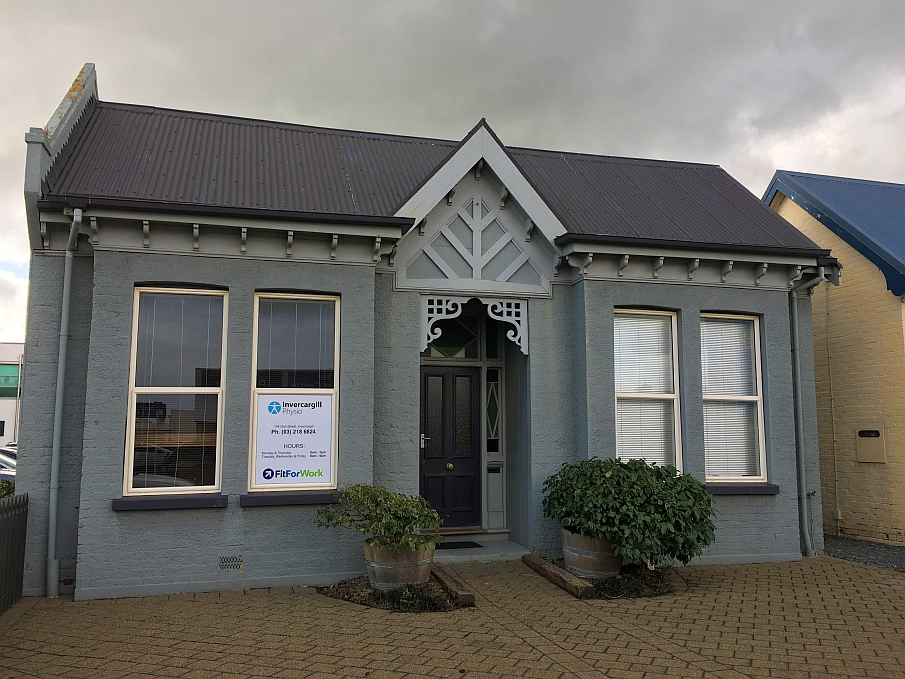
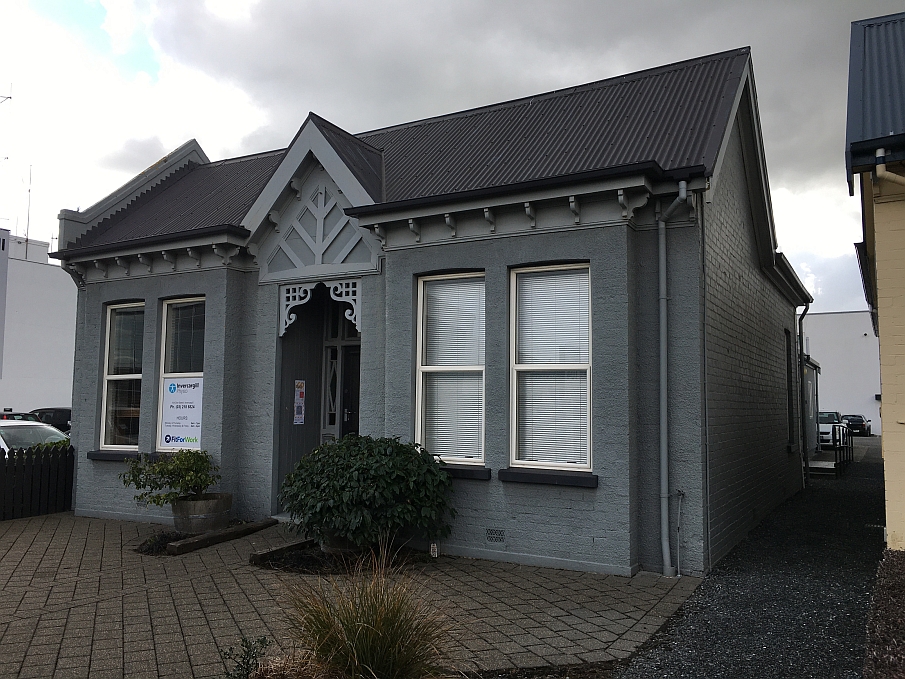
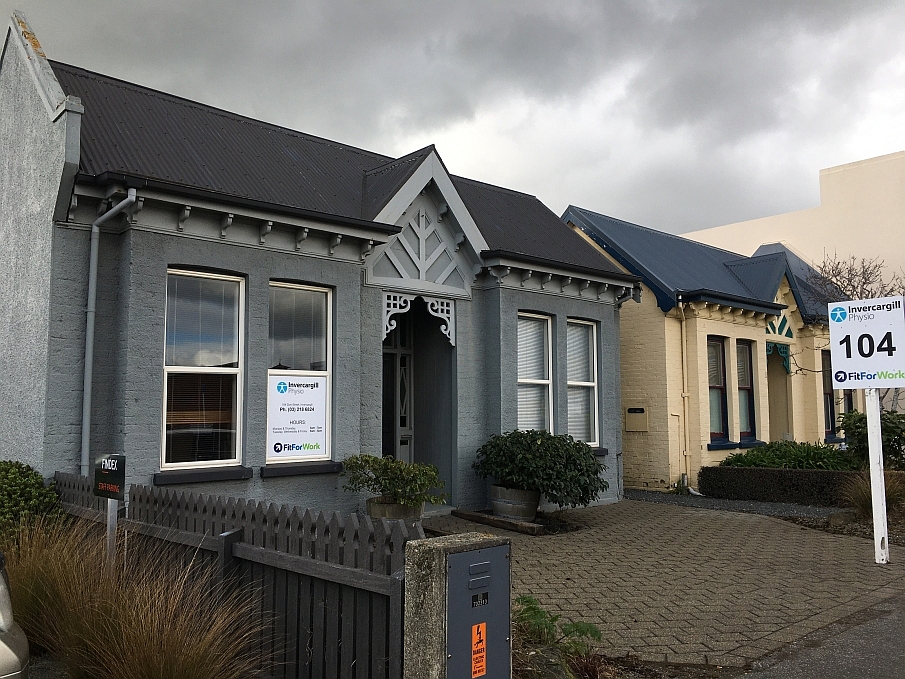
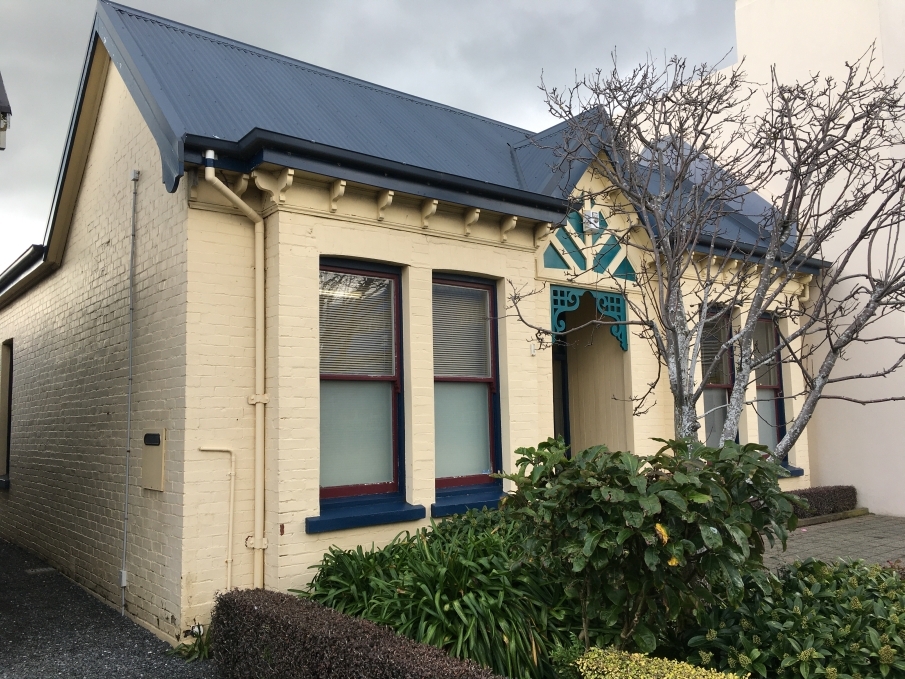
One of a pair of matching houses probably built in the early twentieth century on Don Street in Invercargill, this small brick residence stands as a reminder of the residential development in this now predominantly commercial area, and has architectural and historical significance.
The land on which this pair of houses is built was first granted to Robert Millar in November 1869. The first mention of buildings on Section 20 is a real estate advertisement in May 1879 offering for sale the fenced quarter acre section on which was erected ‘ONE Four-roomed COTTAGE , and ONE Three-roomed COTTAGE.’ Robert Millar (1826?-1911) had arrived aboard the Rajah in 1853 settling in Dunedin before moving to Invercargill in 1859, working as a sawyer and contractor. Millar developed several properties in Invercargill, one of which he sold in 1875 had a single section and two cottages built on it – so developing and selling is consistent with Millar’s property portfolio. He was also a city councillor. A nearby section also had two residences built on it, so this density of development was typical of this part of Don Street.
Invercargill stationer Aaron Blacke bought the property in 1880, and appears to have lived there from that period, possible letting the adjoining cottage. Belfast-born Blacke landed in Dunedin in 1876 and moved to Invercargill shortly thereafter. After some years as a book keeper, he went into business on his own account in Dee Street. He was involved in local body politics, being mayor and councillor for a period, and was also active in civic causes. He and wife Elizabeth had one son. When Blacke died in 1900, his wife Elizabeth took over his business, and rented out one of the houses. She advertises a ‘six-roomed house’ on Don Street’ to let in July 1914. Electoral rolls show that their son James Joseph lived next door.
A catalogue of dwellings designed by The Property & Finance Co., an Invercargill company formed by architects Invercargill architects William Bremner and Charles Lambeth around 1910, has a picture of the two cottages. The catalogue shows photographs of the pair of houses, and a plan showing their layout. The plan is ‘Design No. 21’ and is described as ‘a design specially prepared to suit a town site of 68 feet frontage for two houses.’ The walls were cavity brick veneer. Plans show three bedrooms, dining room, kitchen, bathroom, pantry and scullery. The estimated cost for the two houses was £850. Bremner and Lambeth dissolved their partnership in June 1914.
It is not until 1916 that the street directories give street numbers, at which time Elizabeth and her son are living at 104 Don Street, and electrician Robert Millard is living at 106 Don Street. In 1920, Elizabeth and James still reside in 104 while Mrs May Logan lives in 106. In 1923, James has moved next door. Elizabeth owned the property until 1945 and died in 1946.
In 1949 Section 20 was subdivided into two separate titles – with one house on each title. In later years, the houses have been converted for commercial use, with additions to the rear. In 2018, they are home to a physiotherapy clinic and medical centre.
The land on which this pair of houses is built was first granted to Robert Millar in November 1869. The first mention of buildings on Section 20 is a real estate advertisement in May 1879 offering for sale the fenced quarter acre section on which was erected ‘ONE Four-roomed COTTAGE , and ONE Three-roomed COTTAGE.’ Robert Millar (1826?-1911) had arrived aboard the Rajah in 1853 settling in Dunedin before moving to Invercargill in 1859, working as a sawyer and contractor. Millar developed several properties in Invercargill, one of which he sold in 1875 had a single section and two cottages built on it – so developing and selling is consistent with Millar’s property portfolio. He was also a city councillor. A nearby section also had two residences built on it, so this density of development was typical of this part of Don Street.
Invercargill stationer Aaron Blacke bought the property in 1880, and appears to have lived there from that period, possible letting the adjoining cottage. Belfast-born Blacke landed in Dunedin in 1876 and moved to Invercargill shortly thereafter. After some years as a book keeper, he went into business on his own account in Dee Street. He was involved in local body politics, being mayor and councillor for a period, and was also active in civic causes. He and wife Elizabeth had one son. When Blacke died in 1900, his wife Elizabeth took over his business, and rented out one of the houses. She advertises a ‘six-roomed house’ on Don Street’ to let in July 1914. Electoral rolls show that their son James Joseph lived next door.
A catalogue of dwellings designed by The Property & Finance Co., an Invercargill company formed by architects Invercargill architects William Bremner and Charles Lambeth around 1910, has a picture of the two cottages. The catalogue shows photographs of the pair of houses, and a plan showing their layout. The plan is ‘Design No. 21’ and is described as ‘a design specially prepared to suit a town site of 68 feet frontage for two houses.’ The walls were cavity brick veneer. Plans show three bedrooms, dining room, kitchen, bathroom, pantry and scullery. The estimated cost for the two houses was £850. Bremner and Lambeth dissolved their partnership in June 1914.
It is not until 1916 that the street directories give street numbers, at which time Elizabeth and her son are living at 104 Don Street, and electrician Robert Millard is living at 106 Don Street. In 1920, Elizabeth and James still reside in 104 while Mrs May Logan lives in 106. In 1923, James has moved next door. Elizabeth owned the property until 1945 and died in 1946.
In 1949 Section 20 was subdivided into two separate titles – with one house on each title. In later years, the houses have been converted for commercial use, with additions to the rear. In 2018, they are home to a physiotherapy clinic and medical centre.