Maori History
Ancient stories tell the origins of southern Maori, with the waka of Aoraki becoming Te Wai Pounamu (the South Island), and its sternpost, Te Taurapa a Te Waka o Aoraki becoming Bluff Hill (also known as Motupohue). The Maui traditions are told in the south, with Maui arriving in his waka Maahunui, and pulling up the stone to be used as an anchor - Te Puka o Te Waka a Maui (Rakiura). Maui's achievements are recognised in place names in the south, including Omaui near Bluff, and Te Tapuwae o Maui and Te Rereka o Maui in Fiordland (Maui's footstep and Maui's leap).
Stories of the original explorers of the south are also told. The explorer Rakaihautu journeyed through the south with place names recalling his journey.
After Rakaihautu came the Takitimu waka with Tamatea Pokai Whenua. The waka was overcome by three waves O-te-wao, O-roko and O-kaka, coming to rest near the mouth of the Waiau (Waimeha). The three waves continued across the low lying lands and ended up as features of the landscape.
The early generations learnt about the land and its resources: stone sources were found, and stone (especially pounamu) became an important trading item. Kaika were established close to resources. Rights and resources and places were established, and traditions established which protected the manawhenua.
When traditions were written down Kati Mamoe and Kai Tahu dominate the history after Waitaha, with stories of war and peace, and intermarriage that spread through the south. In the early 1820s there was further fighting, with muskets first being used at this time, with major sieges in the more northern area of the South Island leading a retreat to the south. Ruapuke Island became the centre of leadership in the south, its isolation giving a measure of security. The final fight with the northern taua of Te Puoho and his followers at Tuturau in 1835-1836, where Te Puoho was defeated, saw the end of warfare in the region.
According to the Ngai Tahu Statutory acknowledgments in the settlement important villages along the south coast included: Te Wae Wae (Waiau), Taunoa (Orepuki), Kawakaputaputa (Wakapatu), Oraka (Colac bay), Aparima, Turangiteuaru, Awarua (Bluff), Te Whera, Toe Toe (mouth of the Mataura River) and Waikawa. Mokamoka (also known as Mokemoke or Mokomoko) was a settlement at the Invercargill estuary sustained by the rich resources found there. Tauranga waka occur up and down the coast linking land and sea trails with mahinga kai resources. Whaling boats plied the waters from the 1820s leading to changes in settlement patterns and resource use.
1853 saw the Murihiku purchase which left Maori south of the Waitaki (excluding the Otakou Block) with only 4,630 acres, the start of a long quest by southern Maori for justice questioning the legality of the purchase as well as the inadequacy of the land reserved.
Invercargill Township was laid out by chief surveyor John Turnbull Thomson in 1856, Thomson choosing the location for its centrality for both sea-based and land-based traffic, though the surrounding low lying swampy ground made the new settlement practically inaccessible. As with Dunedin further north, the development of the town was given an enormous boost with the gold rushes of the early 1860s.
The Establishment of the Southland Times
By the 1860s Invercargill’s population numbered around 1000, and continued to flourish reaching 2400 over the next 15 years, by which time Invercargill had overtaken Riverton as the main town in Southland. As elsewhere in the world, in mid to late nineteenth century New Zealand newspapers were an essential communication medium and the main source for dissemination of news and views locally, nationally and internationally. This demand was demonstrated in Southland, which despite its relatively meagre population featured a number of newspapers from early in its period of European settlement, although many did not last very long. It was not until 1861 with the first editions of The Southern News and Foveaux Straits’ Herald, later becoming the Southland Daily News that this demand began to be satisfied. Although Invercargill’s population was burgeoning at this point, it was not uncommon for communities of around 1000 to have one or two firmly established newspapers founded by or in the 1860s. Indeed, it has been said that although New Zealand’s ‘cultural topsoil was deficient in monographs, it was enriched by the newspaper printing press from the very beginnings of European settlement.’
Soon a rival to the News was founded in November 1862: The Invercargill Times shortly to become known as The Southland Times. This meant that Invercargill now had both morning publication and evening papers. The Times was set-up and run by editor G. C. Fitzgerald who was the brother J. E. Fitzgerald (1818-1896) the first Premier of New Zealand and founder of The Christchurch Press (1861), office manager C. H. Reynolds and printer John T. Downes. For the first few years these men operated the newspaper with only one staff reporter. The Times grew out of the opinion that Invercargill should have its own distinct voice, but the early continuance of the newspaper greatly relied on the generosity of its competitor, because when the Times’ building was burnt down on two separate occasions, the News allowed them to use their presses. It was following a brief respite in production in 1864 after the first fire that the newspaper was renamed The Southland Times for its 2 June 1864 edition.
Like the News, the Times officially became a daily newspaper in 1875 under the ownership of James Walker Bain (1841-1899). This followed the establishment of daily newspapers in the main centres of Dunedin, Auckland, and Wellington in the 1860s. Bain sold the newspaper in 1878 and in 1879 a share of the Southland Times Company was acquired by Robert Gilmour (c.1831-1902). It was around this time that the New Zealand Press Association was established and the Times was amongst the initial group of members. Gilmour, who was a talented journalist and manager, retained his share in the Times for only a brief period before buying into its competitor. However, he soon after sold that interest and returned to Scotland upon the death of his wife. He later returned to New Zealand and in 1896 Gilmour became the owner of the Times, commencing the long involvement of the Gilmour family in the newspaper.
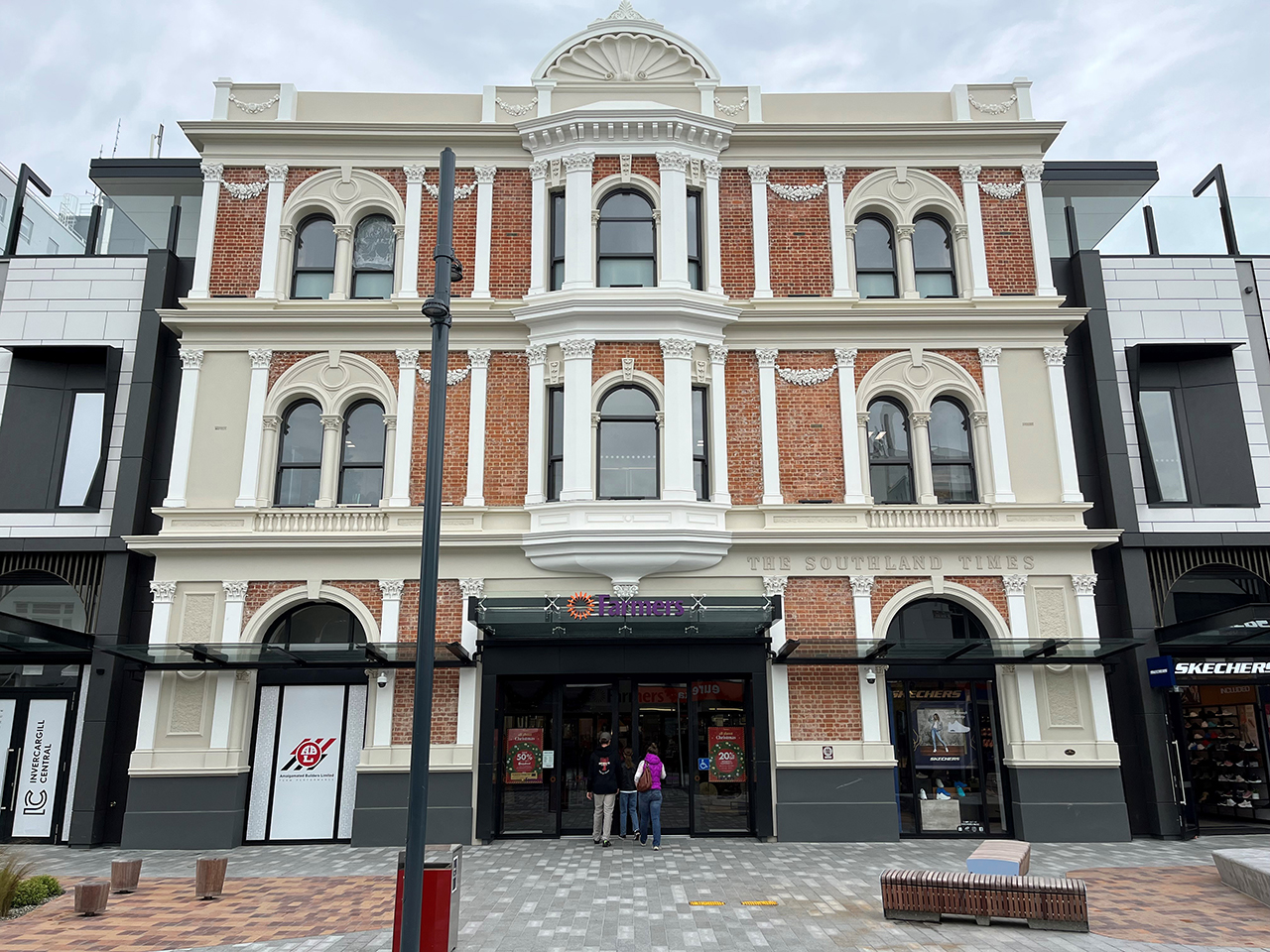
The Southland Times Building
From its inception the Times had been based at various locations in the vicinity of Esk Street and in 1908 it moved into its large new Southland Times Building. On a site towards the Kelvin Street end of Esk Street, this grand building was the work of Dunedin-trained architect, Charles H Roberts (1869-1942). Roberts had established his Invercargill practice in 1895 and was responsible for a range of buildings in the area including the Waipahi Presbyterian Church (1896), the Y.M.C.A Hall (1896), Southland H. and C.A. Board Home (1898), Victoria Memorial Home in Tweed Street (1903), as well as the Royal Arcade between Tay and Esk Streets (1904). The builder of the Southland Times Building was A. Bain, and construction began in late 1907, being completed late the following year.
There were a variety of styles popularly in use for buildings the scale of the Southland Times Building at the time of its construction in the first decade of the twentieth century. For example, Edwardian Baroque buildings were being constructed in Invercargill, such as the Invercargill Town Hall and Civic Theatre (1905-06), and other examples also include Wellington’s Public Trust Building (1909). The civic and governmental characteristic of many Edwardian Baroque buildings may explain why the Italianate style, which is traditionally associated with commercial buildings, was preferred by the Southland Times Building’s architect, Charles H. Roberts. This style had been dominant in New Zealand’s commercial buildings, especially banks, from the late nineteenth century because of the associations that this style had with the grand residences of successful Renaissance merchants.
An example of a contemporary newspaper building is the Press Building (1907-1909) in Christchurch, a multi-storey building with Gothic features, perhaps inspired by its site opposite Christchurch Cathedral. The Chicago Style influenced the architects responsible for the Lyttelton Times Building (1902-04) in Christchurch. However, Roberts seems to have been perfectly comfortable using the Italianate architectural vocabulary and well established building construction methods, such as brick, and was not tempted to try innovative styles, like the Chicago Style, which at the time were just being introduced into New Zealand.
The need for the new, much larger, premises reflected the expansion of the newspaper. The newspaper’s press was upgraded from a flatbed to a rotary press, which allowed for greater speed in the printing process, and also meant the Times could become an eight page daily. This technology was still in use at the Times in the 1960s, but at the time of its first edition on 9 January 1909 it was the only newspaper outside of the four main centres which was using a rotary press. With this publication date, the Times narrowly pre-empted the first edition of the Christchurch Press from its new building on 2 February 1909, and therefore the Southland Times Building has the longest history of consecutive use by the newspaper which originally inhabited it, and which is still doing so today.
The early use of this press technology by the Times is evidence of the popularity of newspapers in the early twentieth century. The new technology facilitated further growth in the coming decades. Newspaper historian, G. H. Scholfield, states that: ‘…fast rotary printing machines enabled the stronger papers to increase their size and extend their circulation over the wider radius made available by improved transport.’ Indeed, soon after the move into the Southland Times Building the development of the business meant that it was necessary for it to become a limited liability company.
The more than a century old competition between the News and the Times only ceased when the Times purchased its counterpart in 1967, with the News publishing its last edition in the subsequent year. The Times also inherited ‘iconic Southland journalists,’ including Fred Miller (1904-1996), who was famous for the witty verse he wrote in every edition of the News, and then the Times, between 1945 and 1976. The Times continued the separate tradition established between it and the News, producing both a morning and evening edition. However, by the 1970s the increase in viewership of the evening television news meant that the evening edition’s circulation dropped to the point where it was uneconomic to continue.
From 1972 the Times again underwent a series of innovative modernisation measures under Ian Gilmour (1927-1994), the grandson of Robert, who had become one of the newspaper’s managing directors in 1964. This programme effectively brought the newspaper into the computer age and Gilmour’s ‘commitment to the new technology was years ahead of his contemporaries.’ Indeed, the installation of digital computers, software, and phototypesetters meant that the Times ran ‘New Zealand’s first fully-computerised newspaper production system’, a significant moment in the history of New Zealand publishing.
The changes at the newspaper continued with the construction of a new building to the east side of the existing Southland Times Building in 1981. This building was designed by L. F. Simpson and expanded the available office space, as well as created a new press hall. A Goss Urbanite offset press was bought for the new building, costing $2.2 million, and installed in 1982. At the time this was the largest offset press in New Zealand, and greatly increased the Times’ print-run capacity, as well as giving it full-colour capability. These two buildings were connected with a two storey glass roofed structure in 1986.
This building and modernisation programme was substantially completed by 1984 when the newspaper was sold to Independent Newspapers Limited (INL). The gradual consolidation of New Zealand’s newspapers into the ownership of a few companies began after World War Two. Indeed the Times merger with the News was symptomatic of this trend. Under INL several free weekly community newspapers were developed which are still printed at the Southland Times Building, including The Mirror and Newslink distributed in Central Otago and the area from Balclutha through to Edendale, respectively. The newspaper seems to have gone from strength to strength in this period because in the 1990s the Southland Times Building’s PABX was described by its service provider as ‘the busiest telephone exchange in Southland.’
Gilmour stayed on as a local director of the Times until his death in 1994, which was also the end of the family’s 115 years of unbroken involvement in the newspaper. Later, INL, with its group of publications which included the Times, was sold to the Australian media empire, John Fairfax Holdings, in 2003. The newspaper remained a standout performer during this period because, while most other newspapers lost revenue and circulation dropped in the face of internet competition, the Times actually increased its sales. The Times has also continued to be one of the area’s largest employers and can boast a readership which encompasses 75 per cent of all Southlanders 15 years old and over.
The nature of the newspaper business has meant that the Times has been associated with many events through its reporting of them. One of the biggest stories to appear the newspaper was coverage of the 1881 sinking of the SS Tararua off of the coast. This tragic event caused the deaths of 131 people, and was described as ‘the most terrible maritime disaster this colony has known…’ because of the ‘appalling loss of life.’ Into the twentieth century the newspaper reported on key events such as royal tours, floods, and wars. In the pre-radio period, the public relied heavily on newspaper coverage of the events in Europe during World War One. At the Times the difficult task of interpreting events on the other side of the world during this period fell to R. J. Gilmour (c.1876-1954). Described as ‘probably the finest journalist Southland has produced,’ the quality of Gilmour’s coverage and his intelligent comment is said to have been widely acknowledged, even outside of Southland.
Indeed, the Times has a strong journalistic tradition. Among the prominent journalists who gained experience working for the newspaper are: Monte Holcroft (1902-1993), who served as editor from 1936 before moving onto become the editor of the New Zealand Listener for 18 years; Tom Butson, later the owner of New York’s The Villager and responsible for turning that publication into an award-winner; and Peter Arnett (b.1934), who went on to win a Pulitzer Prize in 1966 for his coverage of the Vietnam War.
In 2011 the Southland Times Building remains the base for the production and staff of the Southland Times.