DonateMembershipVisit Heritage
  • Tūrangawaewae
    Places
  • Tira Māori
    Māori Heritage
  • Poutairangahia
    Archaeology
  • Rauemi
    Resources
  • Mō Tātou
    About Us
  • New Zealand Heritage List
  • Nominate and submit
  • Explore the List
  • National Historic Landmarks
  • Plaques
  • Rainbow List Project
  • Lost heritage
  • Visit Heritage
  • Our properties
  • Turnbull House Project
  • Collections
  • Shop
  • Tohu Whenua
  • Tira Māori
  • Conserving Māori heritage
  • Marae built heritage
  • Māori heritage on the List
  • Hinemihi—Te Hokinga Mai
  • What is archaeology?
  • Is there a site on my property?
  • What are my legal requirements?
  • Affecting an archaeological site
  • Declaring an archaeological site
  • Archaeology FAQs
  • Archaeology Digital Library
  • Archaeology guidelines and templates
  • Resources
  • Funding
  • Publications
  • Sustainable management guides
  • Disaster recovery
  • Podcasts & digital resources
  • Education Hub
  • Conservation plans
  • About
  • Board
  • Māori Heritage Council
  • Senior Staff
  • Offices
  • Contact us
  • Careers
  • Covenants
  • Fast-track
  • Corporate documents
  • Currently consulting on
  • Our submissions
  • News
  • Covid-19 response
Quick links
Rārangi Kōrero | The List
Explore the List
National Historic Landmarks
Ngā Manawhenua o Aotearoa me ōna Kōrero Tūturu
Quick links
Tapuwae
A Vision for Places of Māori Heritage
Funding for Māori Heritage
Resources
Quick links
Archaeological Authority Portal
Applying for an archaeological authority
Archaeology FAQs
Browse the most frequently asked questions about archaeological authorities and the archaeological process.
Quick links
Quick links
News
News Keep up to date with Heritage New Zealand Pouhere Taonga
Membership
Membership Find out more and sign up today
DonateMembershipVisit Heritage
  • Tūrangawaewae
    Places
  • Tira Māori
    Māori Heritage
  • Poutairangahia
    Archaeology
  • Rauemi
    Resources
  • Mō Tātou
    About Us
  • New Zealand Heritage List
  • Nominate and submit
  • Explore the List
  • National Historic Landmarks
  • Plaques
  • Rainbow List Project
  • Lost heritage
  • Visit Heritage
  • Our properties
  • Turnbull House Project
  • Collections
  • Shop
  • Tohu Whenua
  • Tira Māori
  • Conserving Māori heritage
  • Marae built heritage
  • Māori heritage on the List
  • Hinemihi—Te Hokinga Mai
  • What is archaeology?
  • Is there a site on my property?
  • What are my legal requirements?
  • Affecting an archaeological site
  • Declaring an archaeological site
  • Archaeology FAQs
  • Archaeology Digital Library
  • Archaeology guidelines and templates
  • Resources
  • Funding
  • Publications
  • Sustainable management guides
  • Disaster recovery
  • Podcasts & digital resources
  • Education Hub
  • Conservation plans
  • About
  • Board
  • Māori Heritage Council
  • Senior Staff
  • Offices
  • Contact us
  • Careers
  • Covenants
  • Fast-track
  • Corporate documents
  • Currently consulting on
  • Our submissions
  • News
  • Covid-19 response
Quick links
Rārangi Kōrero | The List
Explore the List
National Historic Landmarks
Ngā Manawhenua o Aotearoa me ōna Kōrero Tūturu
Quick links
Tapuwae
A Vision for Places of Māori Heritage
Funding for Māori Heritage
Resources
Quick links
Archaeological Authority Portal
Applying for an archaeological authority
Archaeology FAQs
Browse the most frequently asked questions about archaeological authorities and the archaeological process.
Quick links
Quick links
News
News Keep up to date with Heritage New Zealand Pouhere Taonga
Membership
Membership Find out more and sign up today
  • Places
  • Nominate and submit
  • National Historic Landmarks
  • Places
  • Nominate and submit
  • National Historic Landmarks
  • Tira Māori
  • Conserving Māori heritage
  • Marae built heritage
  • Tira Māori
  • Conserving Māori heritage
  • Marae built heritage
  • Archaeological authorities
  • Archaeology Digital Library
  • Archaeological authorities
  • Archaeology Digital Library
  • All resources
  • Publications
  • Funding
  • All resources
  • Publications
  • Funding
  • FAQs
  • FAQs
Follow us on:
Places
  • Places
  • Nominate and submit
  • National Historic Landmarks
Tira Māori
  • Tira Māori
  • Conserving Māori heritage
  • Marae built heritage
Archaeology
  • Archaeological authorities
  • Archaeology Digital Library
Resources
  • All resources
  • Publications
  • Funding
FAQs
  • FAQs
Follow us on
HomePrivacyTerms and conditionsAbout this site
© Heritage New Zealand Pouhere Taonga 2026.
 
Church Steps

Pikimai / Church Hill, Selwyn Place, NELSON

Public

Historic Place Category 1

List No. 253

Quick links:
List GalleryLocationDetails
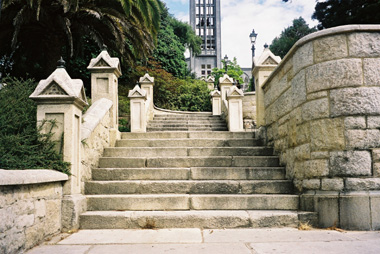
Gifted to the city of Nelson in 1913, the Church Steps are one of just two surviving structures made from Tonga Bay granite, New Zealand's only true granite.

Built on the northern face of Cathedral Hill, the steps are situated in the heart of Nelson. The hill, also known as Pikimai by the local iwi, was originally occupied by a fortified pa. In 1841 the hill was selected by Captain Arthur Wakefield as the centre of the new town of Nelson and administrative buildings were erected upon it. In 1843 it was fortified against a Maori attack after 20 settlers were killed during a dispute over land between New Zealand Company Surveyors and local iwi. During this period, people scaling the hill to enter the fortress created a dirt path now covered by the Church Steps. The anticipated attack failed to materialise and in 1848 Cathedral Hill was transferred to the Church of England. Ten years later, in 1858, the Nelson Board of Works constructed three flights of wooden steps over the site of the original dirt path. The steps were intended to provide access to 'Christ Church', the first Nelson Cathedral, which was completed two years later. Concerns were raised in 1905 about the safety of the 47-year-old steps. The following year it was suggested that new steps be erected in honour of the memory of Albert Pitt, a Nelson Member of Parliament and former Attorney General. Funds were raised for the project but it was eventually abandoned in favour of a memorial gate. In 1912, local businessman and noted philanthropist Thomas Cawthron [1833?-1915] made an unsolicited offer to the Nelson City Council to provide the funding necessary to enable the steps to be constructed.

Cawthron selected granite as the appropriate material for the steps and noted that he wanted the steps to be 'a real good job, massive and ornamental'. While the majority of the granite used in New Zealand buildings is imported, at the time the new steps were commissioned a quarry had recently opened in nearby Tonga Bay, part of what is now the Abel Tasman National Park. The quarry contained New Zealand's only true granite and was used experimentally in a number of buildings throughout the country. The granite, which features large crystals of transparent quartz, does not weather well and, apart from the Former Public Trust Building in Wellington, all of these buildings have now been demolished. When Cawthron employed Wellington contractors to supply the light, cream-coloured granite for the Church Steps, he was under the impression that the material tended to harden upon exposure to the sun.

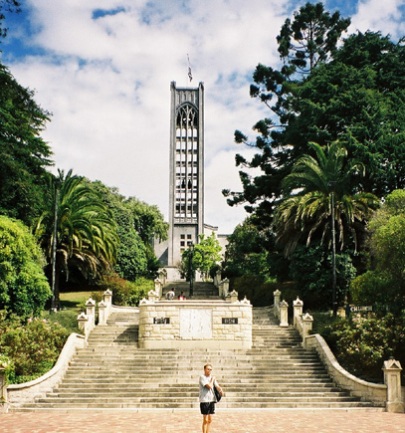
The City Engineer, J. G. Littlejohn, and local architect Arthur R. Griffin prepared plans for a bold and ornate set of civic steps in 1912. Constructed by labourers employed on a daily basis, the Church Steps consisted of six, formal flights of steps that rose to a height of 11.5 metres up Cathedral Hill and led towards the Cathedral. The first flight of stairs swept up from two ornamental pillars and tapered in towards the first landing. To break the stiffness of the structure, the steps were divided twice into two flights on the ascent towards the Cathedral by decorative gardens. The upper balcony featured a plaque of grey, Aberdeen granite that commemorated Thomas Cawthron's donation to the city. Low walls of rusticated granite formed a barrier on either side of the steps. These walls featured decorated pillars that rose 1.5 metres at the corner of each flight.

Completed in 1913, the steps cost £1887 and were formally opened by the Governor, Lord Liverpool, later that year. The Church Steps became an immediate focus for Nelson's civic and public activities. In 1942 they formed an integral part of the Centenary Celebrations. To mark the Celebrations the decorative gardens were replaced with viewing balconies. The lower balcony was adorned with a marble relief plaque depicting early settlers and included an inscription that noted that the hill was dedicated in memory of the settlers one hundred years after the founding of Nelson. The strength of public feeling for the Church Steps was reconfirmed in the early 1990s when they were protected from a proposed alteration by a publicly voiced protest and petition.

The Church Steps in Nelson have national significance as a rare remaining example of a structure built from New Zealand's only true granite. Created almost entirely from the material, the steps are a highly public illustration of the colour, quality and properties of Tonga Bay granite. The granite enhances the aesthetic value of the steps, which were skilfully constructed and serve as an excellent example of stone masonry. The steps serve as a memorial to Thomas Cawthron, a notable Nelson resident, and have considerable significance as the site chosen to commemorate the centennial of Nelson. The site on which the steps are built add to the wider historical significance of the structure, which serves to symbolise the use of Pikimai, Cathedral Hill by Maori and Pakeha.
Church Steps, Nelson. CC BY 3.0 Image courtesy of commons.wikimedia.org | Mattinbgn | 27/11/2011 | Mattinbgn - Wikimedia Commons
Church Steps, Nelson. CC BY-ND 2.0 Image courtesy of www.flickr.com | Steven dos Remedios | 05/03/2018 | Steven dos Remedios
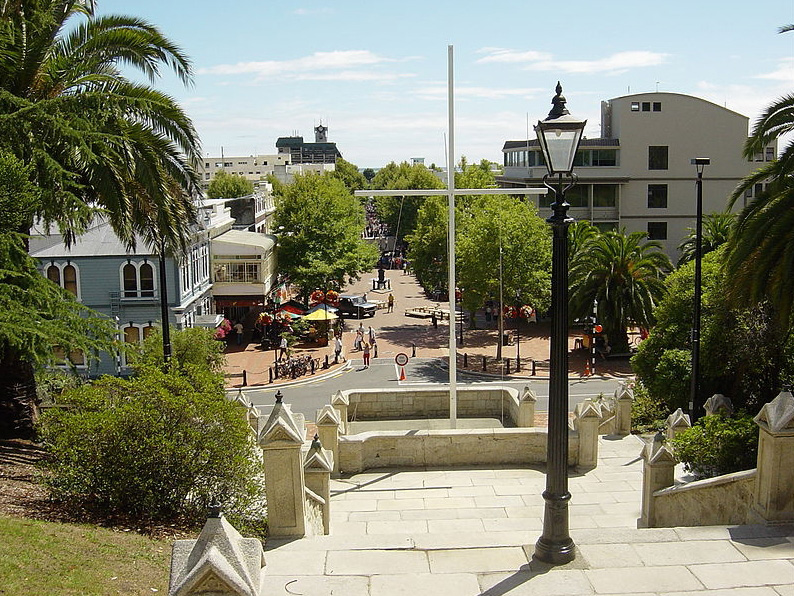
Church Steps, Nelson. View of Trafalgar Street from Christ Church Cathedral CC BY-NC-ND 2.0 Licence. Image courtesy of www.flickr.com | Christine Riggle | 05/12/2014 | Christine Riggle
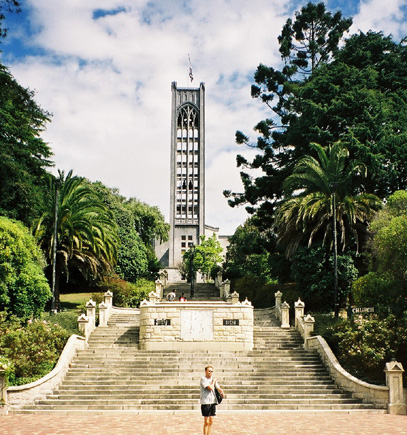
Church Steps, Nelson. CC BY 3.0 Image courtesy of commons.wikimedia.org | Mattinbgn | 27/11/2011 | Mattinbgn - Wikimedia Commons
Church Steps, Nelson. CC BY-ND 2.0 Image courtesy of www.flickr.com | Steven dos Remedios | 05/03/2018 | Steven dos Remedios
Church Steps, Nelson. View of Trafalgar Street from Christ Church Cathedral CC BY-NC-ND 2.0 Licence. Image courtesy of www.flickr.com | Christine Riggle | 05/12/2014 | Christine Riggle

List Entry Information

Overview

Status
Listed

List Entry Status
Historic Place Category 1

Access
Able to Visit

List Number
253

Date Entered
21st September 1989

Date of Effect
21st September 1989

City/District Council
Nelson City

Region
Nelson Region

Extent of List Entry

Extent includes part of the land known as Legal Road, Nelson Land District, and the structure known as Church Steps thereon. Refer to the extent map tabled at the Heritage List/ Rārangi Kōrero Committee meeting on 29 October 2020.

Legal description

Legal Road, Nelson Land District

Location Description

Located on the north side of Cathedral Hill at the end of Trafalgar Street

Detailed List Entry

Construction Professional

Name

Griffin, Arthur Reynolds

Type

Architect

Biography

Griffin practised architecture in Nelson from the early 1900s to about 1960. Arthur Reynolds Griffin was the grandson of John Griffin the founder of Griffin & Sons Ltd, the Nelson-based biscuit company. Born and raised in Nelson, A.R. Griffin trained in architecture via the International Correspondence School based in Pennsylvania in the United States. Simultaneously, he worked as a draughtsman in the offices of JD and L Robertson before setting up his own offices in the Norwich Union Chambers. His work in Nelson was diverse and prolific including the Nelson Institute (1911, List No. 1603), the former Nelson Hospital (1925) and Nurses Home (1916), and the Church Steps (1913; List No. 253), funded by Griffin’s patron, Thomas Cawthron. He designed Nelson’s Plunket and Rest Rooms (1936; List No. 5169), and a host of commercial buildings including the Ritz Kerr Building (c.1930; List No. 3027), and the former Dalgety and Co Ltd Building (c.1930; List No. 1621). He was also successful in winning a number of design competitions, notably Hokitika’s Carnegie Free Public Library (List No. 1702) completed in 1908. It was noted in the local press that Griffin made trips to Australia and brought ideas back with him both for his commercial work, and for the hospital, illustrating the architectural connection between the two countries. FROM: Summary Report Anchor Shipping & Foundry Co Building, NELSON (List No. 1554) by M. Katz March 2020

Name

Littlejohn, J.G.

Type

Engineer

Biography

Littlejohn was the Nelson City Engineer from 1911 to World War II.

Construction Details

Type

Modification

Description

Lower garden plot and two pillars removed

Type

Modification

Description

Lower balcony extended forward and built up in granite

Type

Other

Description

Plaque commemorating the Nelson Centennial installed on the new extended balcony

Type

Modification

Description

Upper garden plot covered over with concrete

Start Year

1912

Finish Year

1913

Type

Original Construction

Start Year

1941

Type

Addition

Description

6 gas lamps replaced with three electric lamp stands

Start Year

1941

Type

Modification

Description

Plaque commemorating Cawthron moved to the face of the second landing

Construction Materials

Consists of Tonga Bay granite cut into four single flights of stpes laid without mortar, two double flights around granite balconies and side walls with pillars of rubble laid with mortar.

Notable Features

Nelson Centenary Memorial Plaque Thomas Cawthron Memorial Plaque

Reference

Completion Date

28th February 2003

Report Written By

Rebecca O'Brien

Information Sources

Hayward, 1987

Bruce W. Hayward, 'Granite and Marble: a guide to building stones in New Zealand', Geological Society of New Zealand Guidebook, No.8

Millar, 1963

D. Millar, Thomas Cawthron and the Cawthron Institute, Nelson, 1963

Stade, 2013

Stade, Karen, Meet You At The Church Steps - A Social History of a Nelson Landmark, Nelson, Karen Stade.

Report Written By

This place was identified as significant under previous legislation with different information requirements. It remains significant under the current legislation. There is opportunity under our legislation and policies to add to this information. Further information about this place may be available from the Central Regional Office of Heritage New Zealand Pouhere Taonga. A fully referenced version of this report is available from the NZHPT Central Region Office Heritage Precinct Please note that entry on the New Zealand Heritage List/Rarangi Korero identifies only the heritage values of the property concerned, and should not be construed as advice on the state of the property, or as a comment of its soundness or safety, including in regard to earthquake risk, safety in the event of fire, or insanitary conditions.

Further Information

Current Usages

Uses: Transport

Specific Usage: Staircases/steps

Former Usages

Themes

Web Links

Overview

Status

Listed

List Entry Status

Historic Place Category 1

Access

Able to Visit

List Number

253

Date Entered

21st September 1989

Date of Effect

21st September 1989

City/District Council

Nelson City

Region

Nelson Region

Extent of List Entry

Extent includes part of the land known as Legal Road, Nelson Land District, and the structure known as Church Steps thereon. Refer to the extent map tabled at the Heritage List/ Rārangi Kōrero Committee meeting on 29 October 2020.

Legal description

Legal Road, Nelson Land District

Location Description

Located on the north side of Cathedral Hill at the end of Trafalgar Street

Status

Listed

List Entry Status

Historic Place Category 1

Access

Able to Visit

List Number

253

Date Entered

21st September 1989

Date of Effect

21st September 1989

City/District Council

Nelson City

Region

Nelson Region

Extent of List Entry

Extent includes part of the land known as Legal Road, Nelson Land District, and the structure known as Church Steps thereon. Refer to the extent map tabled at the Heritage List/ Rārangi Kōrero Committee meeting on 29 October 2020.

Legal description

Legal Road, Nelson Land District

Location Description

Located on the north side of Cathedral Hill at the end of Trafalgar Street

Construction Information

Construction Professional

Name

Griffin, Arthur Reynolds

Type

Architect

Biography

Griffin practised architecture in Nelson from the early 1900s to about 1960. Arthur Reynolds Griffin was the grandson of John Griffin the founder of Griffin & Sons Ltd, the Nelson-based biscuit company. Born and raised in Nelson, A.R. Griffin trained in architecture via the International Correspondence School based in Pennsylvania in the United States. Simultaneously, he worked as a draughtsman in the offices of JD and L Robertson before setting up his own offices in the Norwich Union Chambers. His work in Nelson was diverse and prolific including the Nelson Institute (1911, List No. 1603), the former Nelson Hospital (1925) and Nurses Home (1916), and the Church Steps (1913; List No. 253), funded by Griffin’s patron, Thomas Cawthron. He designed Nelson’s Plunket and Rest Rooms (1936; List No. 5169), and a host of commercial buildings including the Ritz Kerr Building (c.1930; List No. 3027), and the former Dalgety and Co Ltd Building (c.1930; List No. 1621). He was also successful in winning a number of design competitions, notably Hokitika’s Carnegie Free Public Library (List No. 1702) completed in 1908. It was noted in the local press that Griffin made trips to Australia and brought ideas back with him both for his commercial work, and for the hospital, illustrating the architectural connection between the two countries. FROM: Summary Report Anchor Shipping & Foundry Co Building, NELSON (List No. 1554) by M. Katz March 2020

Name

Littlejohn, J.G.

Type

Engineer

Biography

Littlejohn was the Nelson City Engineer from 1911 to World War II.

Construction Details

Type

Modification

Description

Lower garden plot and two pillars removed

Type

Modification

Description

Lower balcony extended forward and built up in granite

Type

Other

Description

Plaque commemorating the Nelson Centennial installed on the new extended balcony

Type

Modification

Description

Upper garden plot covered over with concrete

Start Year

1912

Finish Year

1913

Type

Original Construction

Start Year

1941

Type

Addition

Description

6 gas lamps replaced with three electric lamp stands

Start Year

1941

Type

Modification

Description

Plaque commemorating Cawthron moved to the face of the second landing

Construction Materials

Consists of Tonga Bay granite cut into four single flights of stpes laid without mortar, two double flights around granite balconies and side walls with pillars of rubble laid with mortar.

Notable Features

Nelson Centenary Memorial Plaque Thomas Cawthron Memorial Plaque

Construction Professional

Name

Griffin, Arthur Reynolds

Type

Architect

Biography

Griffin practised architecture in Nelson from the early 1900s to about 1960. Arthur Reynolds Griffin was the grandson of John Griffin the founder of Griffin & Sons Ltd, the Nelson-based biscuit company. Born and raised in Nelson, A.R. Griffin trained in architecture via the International Correspondence School based in Pennsylvania in the United States. Simultaneously, he worked as a draughtsman in the offices of JD and L Robertson before setting up his own offices in the Norwich Union Chambers. His work in Nelson was diverse and prolific including the Nelson Institute (1911, List No. 1603), the former Nelson Hospital (1925) and Nurses Home (1916), and the Church Steps (1913; List No. 253), funded by Griffin’s patron, Thomas Cawthron. He designed Nelson’s Plunket and Rest Rooms (1936; List No. 5169), and a host of commercial buildings including the Ritz Kerr Building (c.1930; List No. 3027), and the former Dalgety and Co Ltd Building (c.1930; List No. 1621). He was also successful in winning a number of design competitions, notably Hokitika’s Carnegie Free Public Library (List No. 1702) completed in 1908. It was noted in the local press that Griffin made trips to Australia and brought ideas back with him both for his commercial work, and for the hospital, illustrating the architectural connection between the two countries. FROM: Summary Report Anchor Shipping & Foundry Co Building, NELSON (List No. 1554) by M. Katz March 2020

Name

Littlejohn, J.G.

Type

Engineer

Biography

Littlejohn was the Nelson City Engineer from 1911 to World War II.

Construction Details

Type

Modification

Description

Lower garden plot and two pillars removed

Type

Modification

Description

Lower balcony extended forward and built up in granite

Type

Other

Description

Plaque commemorating the Nelson Centennial installed on the new extended balcony

Type

Modification

Description

Upper garden plot covered over with concrete

Start Year

1912

Finish Year

1913

Type

Original Construction

Start Year

1941

Type

Addition

Description

6 gas lamps replaced with three electric lamp stands

Start Year

1941

Type

Modification

Description

Plaque commemorating Cawthron moved to the face of the second landing

Construction Materials

Consists of Tonga Bay granite cut into four single flights of stpes laid without mortar, two double flights around granite balconies and side walls with pillars of rubble laid with mortar.

Notable Features

Nelson Centenary Memorial Plaque Thomas Cawthron Memorial Plaque

Reference

Historical and Associated Iwi / Hapū / Whānau

Completion Date

28th February 2003

Report Written By

Rebecca O'Brien

Information Sources

Hayward, 1987

Bruce W. Hayward, 'Granite and Marble: a guide to building stones in New Zealand', Geological Society of New Zealand Guidebook, No.8

Millar, 1963

D. Millar, Thomas Cawthron and the Cawthron Institute, Nelson, 1963

Stade, 2013

Stade, Karen, Meet You At The Church Steps - A Social History of a Nelson Landmark, Nelson, Karen Stade.

Other Information

This place was identified as significant under previous legislation with different information requirements. It remains significant under the current legislation. There is opportunity under our legislation and policies to add to this information. Further information about this place may be available from the Central Regional Office of Heritage New Zealand Pouhere Taonga. A fully referenced version of this report is available from the NZHPT Central Region Office Heritage Precinct Please note that entry on the New Zealand Heritage List/Rarangi Korero identifies only the heritage values of the property concerned, and should not be construed as advice on the state of the property, or as a comment of its soundness or safety, including in regard to earthquake risk, safety in the event of fire, or insanitary conditions.

Historical and Associated Iwi / Hapū / Whānau

Completion Date

28th February 2003

Report Written By

Rebecca O'Brien

Information Sources

Hayward, 1987

Bruce W. Hayward, 'Granite and Marble: a guide to building stones in New Zealand', Geological Society of New Zealand Guidebook, No.8

Millar, 1963

D. Millar, Thomas Cawthron and the Cawthron Institute, Nelson, 1963

Stade, 2013

Stade, Karen, Meet You At The Church Steps - A Social History of a Nelson Landmark, Nelson, Karen Stade.

Other Information

This place was identified as significant under previous legislation with different information requirements. It remains significant under the current legislation. There is opportunity under our legislation and policies to add to this information. Further information about this place may be available from the Central Regional Office of Heritage New Zealand Pouhere Taonga. A fully referenced version of this report is available from the NZHPT Central Region Office Heritage Precinct Please note that entry on the New Zealand Heritage List/Rarangi Korero identifies only the heritage values of the property concerned, and should not be construed as advice on the state of the property, or as a comment of its soundness or safety, including in regard to earthquake risk, safety in the event of fire, or insanitary conditions.

Further Information

Current Usages

Uses: Transport

Specific Usage: Staircases/steps

Current Usages

Uses: Transport

Specific Usage: Staircases/steps

Location

Loading
Related listings
Trafalgar Street Historic Area, Nelson. Fountain CC BY 3.0 Image courtesy of commons.wikimedia.org
Trafalgar Street Historic Area
Trafalgar Street Historic Area, Nelson. Fountain CC BY 3.0 Image courtesy of commons.wikimedia.org
Trafalgar Street Historic Area
Stay up to date with Heritage this month