DonateMembershipVisit Heritage
  • Tūrangawaewae
    Places
  • Tira Māori
    Māori Heritage
  • Poutairangahia
    Archaeology
  • Rauemi
    Resources
  • Mō Tātou
    About Us
  • New Zealand Heritage List
  • Nominate and submit
  • Explore the List
  • National Historic Landmarks
  • Plaques
  • Rainbow List Project
  • Lost heritage
  • Visit Heritage
  • Our properties
  • Turnbull House Project
  • Collections
  • Shop
  • Tohu Whenua
  • Tira Māori
  • Conserving Māori heritage
  • Marae built heritage
  • Māori heritage on the List
  • Hinemihi—Te Hokinga Mai
  • What is archaeology?
  • Is there a site on my property?
  • What are my legal requirements?
  • Affecting an archaeological site
  • Declaring an archaeological site
  • Archaeology FAQs
  • Archaeology Digital Library
  • Archaeology guidelines and templates
  • Resources
  • Funding
  • Publications
  • Sustainable management guides
  • Disaster recovery
  • Podcasts & digital resources
  • Education Hub
  • Conservation plans
  • About
  • Board
  • Māori Heritage Council
  • Senior Staff
  • Offices
  • Contact us
  • Careers
  • Covenants
  • Fast-track
  • Corporate documents
  • Currently consulting on
  • Our submissions
  • News
  • Covid-19 response
Quick links
Rārangi Kōrero | The List
Explore the List
National Historic Landmarks
Ngā Manawhenua o Aotearoa me ōna Kōrero Tūturu
Quick links
Tapuwae
A Vision for Places of Māori Heritage
Funding for Māori Heritage
Resources
Quick links
Archaeological Authority Portal
Applying for an archaeological authority
Archaeology FAQs
Browse the most frequently asked questions about archaeological authorities and the archaeological process.
Quick links
Quick links
News
News Keep up to date with Heritage New Zealand Pouhere Taonga
Membership
Membership Find out more and sign up today
DonateMembershipVisit Heritage
  • Tūrangawaewae
    Places
  • Tira Māori
    Māori Heritage
  • Poutairangahia
    Archaeology
  • Rauemi
    Resources
  • Mō Tātou
    About Us
  • New Zealand Heritage List
  • Nominate and submit
  • Explore the List
  • National Historic Landmarks
  • Plaques
  • Rainbow List Project
  • Lost heritage
  • Visit Heritage
  • Our properties
  • Turnbull House Project
  • Collections
  • Shop
  • Tohu Whenua
  • Tira Māori
  • Conserving Māori heritage
  • Marae built heritage
  • Māori heritage on the List
  • Hinemihi—Te Hokinga Mai
  • What is archaeology?
  • Is there a site on my property?
  • What are my legal requirements?
  • Affecting an archaeological site
  • Declaring an archaeological site
  • Archaeology FAQs
  • Archaeology Digital Library
  • Archaeology guidelines and templates
  • Resources
  • Funding
  • Publications
  • Sustainable management guides
  • Disaster recovery
  • Podcasts & digital resources
  • Education Hub
  • Conservation plans
  • About
  • Board
  • Māori Heritage Council
  • Senior Staff
  • Offices
  • Contact us
  • Careers
  • Covenants
  • Fast-track
  • Corporate documents
  • Currently consulting on
  • Our submissions
  • News
  • Covid-19 response
Quick links
Rārangi Kōrero | The List
Explore the List
National Historic Landmarks
Ngā Manawhenua o Aotearoa me ōna Kōrero Tūturu
Quick links
Tapuwae
A Vision for Places of Māori Heritage
Funding for Māori Heritage
Resources
Quick links
Archaeological Authority Portal
Applying for an archaeological authority
Archaeology FAQs
Browse the most frequently asked questions about archaeological authorities and the archaeological process.
Quick links
Quick links
News
News Keep up to date with Heritage New Zealand Pouhere Taonga
Membership
Membership Find out more and sign up today
  • Places
  • Nominate and submit
  • National Historic Landmarks
  • Places
  • Nominate and submit
  • National Historic Landmarks
  • Tira Māori
  • Conserving Māori heritage
  • Marae built heritage
  • Tira Māori
  • Conserving Māori heritage
  • Marae built heritage
  • Archaeological authorities
  • Archaeology Digital Library
  • Archaeological authorities
  • Archaeology Digital Library
  • All resources
  • Publications
  • Funding
  • All resources
  • Publications
  • Funding
  • FAQs
  • FAQs
Follow us on:
Places
  • Places
  • Nominate and submit
  • National Historic Landmarks
Tira Māori
  • Tira Māori
  • Conserving Māori heritage
  • Marae built heritage
Archaeology
  • Archaeological authorities
  • Archaeology Digital Library
Resources
  • All resources
  • Publications
  • Funding
FAQs
  • FAQs
Follow us on
HomePrivacyTerms and conditionsAbout this site
© Heritage New Zealand Pouhere Taonga 2026.
 
Gore Presbyterian Church (Former)

6 Rock Street, East Gore, GORE

Private

Historic Place Category 2

List No. 2530

Quick links:
List GalleryLocationDetails
A kirk on the hill to call the faithful to worship, the Gore Presbyterian Church designed by pre-eminent Dunedin architect Robert Arthur Lawson, was built in 1880 and served its congregation until its closure in 1995.

This simple timber church is significant as one of Lawson’s few surviving timber churches. It is historically significant as the home of the Presbyterian congregation in Gore for over 115 years. Its reincarnation as a print making studio for the town’s significant art scene gives the building cultural significance.

Opened in October 1881 on its prominent site above the town, the Gore Presbyterian Church seated 200. A growing congregation saw civil engineer William Sharp design significant additions in 1892 - the Reverend Ramsay, speaking at the re-opening congratulated the congregation on their new church though ‘he could hardly call it altogether a new church, but it reminded him of the gun which had a new lock, stock and barrel.’ The church served its congregation for more than one hundred years, its centenary celebration was held in 1981. The centennial history recalled the landmark status of the building, erected on a prominent site where its visibility was a testament of the importance of faith to the Gore Presbyterian community. The renowned Eastern Southland Art Gallery Incorporated acquired the church after its closure and is in the process of converting the building to a print making studio and artist’s residency.

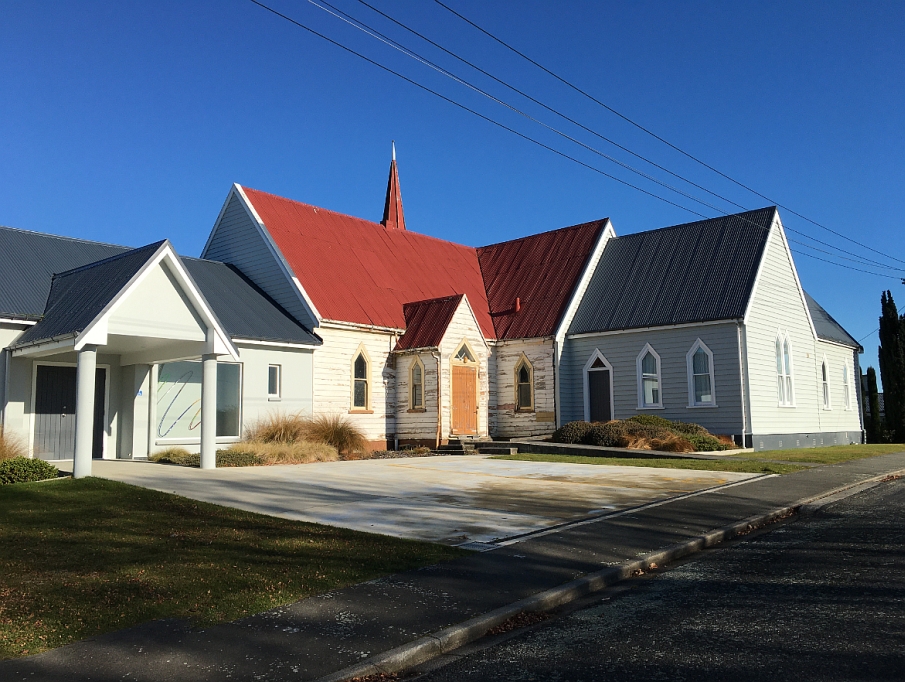
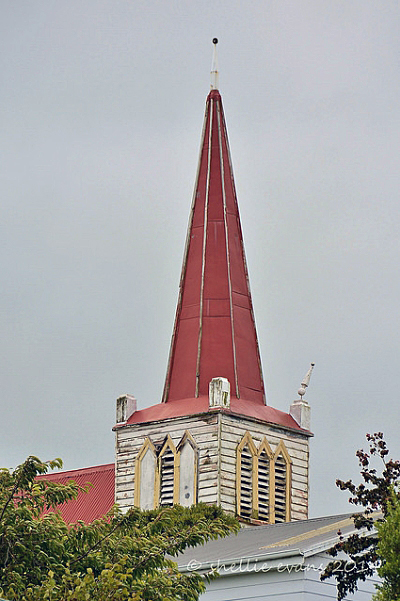
East Gore sits on the true left of the Mataura River in Southland, on the opposite bank of the main Gore township. The church is located on a rise overlooking the river. The orientation of the church runs parallel to Rock Street. It is cruciform in plan. The Church is constructed of timber, clad in weatherboard, with a corrugated iron roof. The spire is on the south elevation and only partially visible from Rock Street. There is little decoration. The spire has paired Lancet windows on the ground floor, and a set of triple Lancet windows with louvres on the first floor level. There is a porch and door on the south elevation providing access to the grassed area to the rear of the church. The main interior detailing comes from the King Post trusses that run across the nave.

In 2012 the former Gore Presbyterian Church is undergoing restoration in preparation for its new role as a printmaking studio and accommodation for an artist in residence.
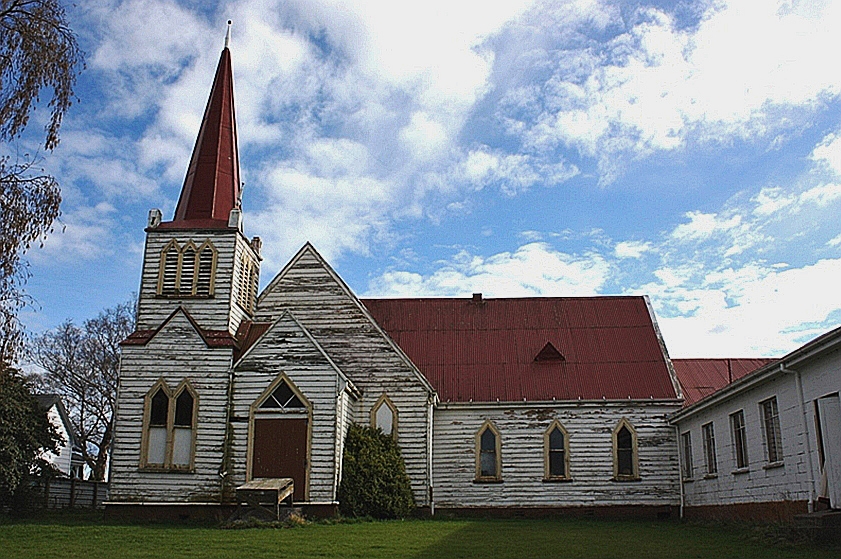
Gore Presbyterian Church (Former), Gore | Heather Bauchop | 25/09/2012 | Heritage New Zealand
Gore Presbyterian Church (Former), Gore | Sarah Gallagher | 25/06/2020 | Heritage New Zealand
Gore Presbyterian Church (Former), Gore. Image courtesy of www.flickr.com | Shellie Evans - flyingkiwigirl | 14/02/2014 | Shellie Evans

Gore Presbyterian Church (Former), Gore | Heather Bauchop | 25/09/2012 | Heritage New Zealand
Gore Presbyterian Church (Former), Gore | Sarah Gallagher | 25/06/2020 | Heritage New Zealand
Gore Presbyterian Church (Former), Gore. Image courtesy of www.flickr.com | Shellie Evans - flyingkiwigirl | 14/02/2014 | Shellie Evans

List Entry Information

Overview

Status
Listed

List Entry Status
Historic Place Category 2

Access
Private/No Public Access

List Number
2530

Date Entered
2nd May 2013

Date of Effect
2nd May 2013

City/District Council
Gore District

Region
Southland Region

Extent of List Entry

Extent includes the land described as Secs 3-4 Blk XI Town of East Gore (RT SL19/275 and SL14/9) Southland Land District, and the building known as Gore Presbyterian Church (Former) thereon. The registration excludes the hall to the rear of the church. (Refer to map in Appendix 1 of the registration report for further information).

Legal description

Secs 3-4 Blk XI Town of East Gore (RT SL19/275 and SL14/9) Southland Land District.

Location Description

Scheduled on Proposed Gore District Plan HH-1

Detailed List Entry
Significance

Cultural Significance

Cultural Significance or Value The former Gore Presbyterian Church’s reincarnation as a home for Gore’s significant art scene gives the building cultural significance. Its association with the Eastern Southland Gallery is important, the gallery being nationally recognised for its important collection.

Historic Significance

Historical Significance or Value Gore Presbyterian Church (Former) has historical significance representing the importance of religion, and particularly of the Presbyterian Church in the Gore community. The development of the church reflects the period of consolidation of settlement and the building of permanent places of worship by the Presbyterian Church. The history of community support evident in the construction of the first church, and its subsequent alterations to fit the growing congregation show its significance.

Physical Significance

Architectural Significance or Value Gore Presbyterian Church (Former) has architectural significance as an example of the work of prominent Dunedin architect Robert Arthur Lawson. Lawson was notable for his designs for church buildings in Otago. It is also a representative example of a modest Presbyterian church designed in Gothic style. It is one of only two remaining timber Presbyterian churches designed by Lawson.

Detail Of Assessed Criteria

a) The extent to which the place reflects important or representative aspects of New Zealand history The development of a community of worship in Gore is a representative aspect of New Zealand history which illustrates the importance of the Presbyterian Church in this area. It represents the period of development in the Presbyterian Church which saw the consolidation of communities. Its subsequent closure and adaption to a new purpose is also representative of the decline of organised religion at the close of the twentieth century. (b) The association of the place with events, persons, or ideas of importance in New Zealand history The Gore Presbyterian Church (Former) is associated with pre-eminent and nationally significant Dunedin architect Robert Arthur Lawson. Lawson was known for his work for the Presbyterian Church in Otago in particular. (e) The community association with, or public esteem for the place The purchase of the former Gore Presbyterian Church’s by Eastern Southland Gallery Incorporated as a home a printmaking studio and artist in residence shows the building’s importance to the community.

Construction Professional

Name

Latham, Thomas

Type

Builder

Biography

Thomas Latham (1830-1891) came from Burnley in Lancashire, arriving in Auckland in 1858 before moving to Dunedin where he worked for ten years as a builder, largely in the employment of Johnny Jones. After farming at Waikouaiti for some years he purchased a farm at Waikaka Siding in Southland, supplemented with building work in and around Gore. He died in 1891. Source: Registration Report for Gore Presbyterian Church (Former) (Register No. 2530)

Name

Brown, H.

Type

Builder

Biography

No biography is currently available for this construction professional

Name

Lawson, Robert Arthur

Type

Architect

Biography

Born in Scotland, Lawson (1833-1902) began his professional career in Perth. At the age of 25 he moved to Melbourne and was engaged in goldmining and journalism before resuming architectural practice. In 1862 Lawson sailed for Dunedin, where his sketch plans had won the competition for the design of First Church. This was built 1867-73. Lawson went on to become one of the most important architects in New Zealand. First Church is regarded as his masterpiece and one of the finest nineteenth century churches in New Zealand. He was also responsible for the design of the Trinity Church (now Fortune Theatre), Dunedin (1869-70), the East Taieri Presbyterian Church (1870), and Knox Church, Dunedin (1874). He designed Park's School (1864) and the ANZ Bank (originally Union Bank, 1874). In Oamaru he designed the Bank of Otago (later National Bank building, 1870) and the adjoining Bank of New South Wales (now Forrester Gallery, 1881). See also: Ledgerwood, Norman, 2013. 'R.A. Lawson: Victorian Architect of Dunedin'. Historic Cemeteries Conservation NZ.

Name

Sharp, William

Type

Architect

Biography

Yorkshire born Sharp (1847-1936) was educated in England as an engineer and surveyor before going to Japan as assistant engineer on the Imperial Government railway until 1877. After returning to England he then came to New Zealand in October 1878. He was appointed assistant engineer in the Public Works Department. Retrenched in the 1880s, he started in private practice and was part time engineer to the Invercargill Borough Council and the Bluff Harbour Board. He retired in 1914 and died in Timaru in 1936.

Construction Details

Finish Year

1881

Type

Original Construction

Description

Church opened 16 October 1881

Start Year

1892

Type

Addition

Description

Church extended and session house added

Start Year

1962

Type

Modification

Description

Major repiling, painting and roughcast to foundation cover boards

Start Year

1964

Type

Addition

Description

Hall added

Construction Materials

Rimu, Kahikatea, concrete, corrugated iron.

Historical Narrative

Early History The Mataura and Waimea plains were known to Kai Tahu with eeling camps in the summer months, at places like Wharekorokio close to the confluence of the Mataura and the Whakaea (Waikaia) Rivers, and Waikakahi close to the Waikakahi (Waikaka) River. Moa were also an important resource for early Kai Tahu in the Waikaia area. The river was the route of an inland trail to the interior and on to the West Coast. Established settlements such as Tuturau were further down the Mataura River. It was via this route that Te Puoho and his Ngatitama taua from Golden Bay to raid the Kai Tahu settlements in the southern South Island in 1836-37. Northern raiders were not the only threat, by the 1850s there was pressure from European settlers for good pastoral land, the Waimea plains were included in the 6,900,000 acre Murihiku purchase in 1853 and alienated from Kai Tahu. A settlement grew up on the west bank of the Mataura River known as “the Long Ford”, or Longford. In 1862 the settlement was surveyed and renamed Gore after Sir Thomas Gore Browne, an early Governor of New Zealand. Across the river a settlement named Gordon after Governor Sir Arthur Gordon was established – now known as East Gore. Church services were high in the minds of the pioneering settlers. The Presbyterian Church in Southland Following on the heels of the establishment of a Free Church settlement in Dunedin, the Presbyterian Church expanded its mantle into southern districts. In 1854 the Reverend William Bannerman took charge of settled districts south of Milton ‘as far south as he cared to go.’ In 1859 Bannerman presented the Presbytery of Otago with a petition from Southland residents that they should be able to form a separate parish with their own minister in Invercargill. Reverend Stobo visited the Gore district to attend to the spiritual needs of pastoralists in the early 1860s. In 1862 the residents of the Mataura Valley and Tapanui petitioned the Presbytery regarding a minister for their district. In due course Reverend James Urie was indicted into the Pomahaka-Mataura Valley charge. By the early 1870s the Mataura Valley was given a separate charge under Reverend James Henry. The parish was extensive – sixty miles long and at its widest 30 miles broad, with work centred on establishing mission stations. In 1877 Rev J.M. Davidson was inducted at Mataura and conducted services on alternate Sundays at Gordon in a private house, and later in Mackay’s Hall, where Sunday School was also held. More people came to the district with the subdivision of Knapdale Station and the services for a settled population became established. East Gore was surveyed in 1877, with sections auctioned in October 1878. There was a flurry of building – three stores, two hotels, and a bank opened in quick succession. Businesses followed – wheelwrights, blacksmith, baker, fellmongery and a Town Hall. A congregational meeting to discuss the construction of a church was held in Mackay’s Hall in June 1880. The meeting agreed that a church be built on Rock Street, and that the committee procure plans for a church to seat 200. The elevated section was described as ‘the finest site for a church edifice in the neighbourhood’ and ‘one of the finest sites in Otago’ – where a ‘visible church may be seen nearly from Riversdale to Invercargill.’ Clerk David Dun wrote to architect Robert Arthur Lawson that ‘an idea exists that the purse strings may be taxed to the tune of, say 300 pounds, a sum you will doubtless set down as small, but mind you, we are as yet a ‘feeble folk’ among the hills, and if we can now make room for 200, should more come by and by and think of putting an ‘eek’ (extension) on the hive they will just have to bring the money with them.’ He continued ‘I think they would all like to see a bit of a steeple and to hear ‘clinkum bell wi’ rattling tow’ call them up on Sabbath Morning; my only fear is that the sum named will not allow you to go further than something severely Presbyterian in style, but not so much so I hope as our early acquaintances of Burgher and anti-Burgher, Relief Secession and Kirk specimens of architecture still visible in some parts of our native country.’ Lawson replied that the design ‘exactly comes up to your requirements as to interior accommodation being arranged for 200 people. The seats might, however, be arranged differently, that is, having a passage in the centre on place of at the side, and so a few more could be accommodated.’ Lawson’s plans were adopted with some alterations. It was agreed that the vestry should be cut off from one end and a belfry added at the other. Specifications were for seasoned red and white pine with the piles and bottom plates of Totara. Art historian Jonathan Mane Wheoki writes that most of Lawson’s churches are ‘Gothic in style and Puginian in character, except that long chancels have been dispensed with as superfluous to the requirements of Presbyterian worship.’ East Gore is one of two of Lawson’s timber Presbyterian churches to survive. After some months of wrangling with the factor for the Presbyterian Church in Dunedin funding disputes were smoothed over and tenders were called for construction. That of the lowest tenderer Thomas Latham of Gore (£465) was accepted. During construction a severe storm caused structural damage. As a result Lawson agreed to erect four buttresses and iron cross rods with extra timber and bracing in the tower. Gore’s first Presbyterian church service was held in the church on 16 October, 1881. The Southland Times reported on the opening with the service read by Reverend John Ferguson of Invercargill’s First Church. After some debate about the morality of singing, an organ was installed in the church in 1887. The congregation turned to the need for their own minister, starting a Sustentation Fund in the event of Gore district becoming a separate charge. The call was issued in 1884 and the Reverend Andrew Mackay was inducted in September of that year. His tenure was short and there was dissension within the congregation, with some parishioners choosing to leave rather than have him as a minister. Reverend Mackay answered a call to Sydney in 1890. In 1891 the Presbyterian Synod of Otago created a new presbytery district – the Presbytery of Mataura, with Gore as its centre. Almost straight away the new body was confronted with demands from the Gore congregation – to purchase the adjoining section to the church, to provide extensions to the existing church and to acquire land on the west side of the river with a view to establishing another church (which would lead ultimately to a secession within the congregation and the creation of a new church on the west of the Mataura). Plans were drawn up for 108 additional seatings and a session house to seat 60-70 people. This plan required the land from the adjoining section. The plans cut through the church, turning it into transepts and building a new nave, with a session house at the end where the pulpit stood. The architect was Invercargill civil engineer and architect, William Sharp. William Sharp (1847-1936) was born in Yorkshire. Sharp arrived in New Zealand in October 1878, and was appointed assistant engineer in the Invercargill Public Works Department. He was responsible for the design of the Invercargill Water Tower (Category 1, Register No. 394). He entered private practice as an engineer, architect and surveyor in 1888, where he undertook a wide range of architectural and engineering commissions. For the Presbyterian Church he also designed the manse for First Church in Invercargill and the Dipton Presbyterian Church. The official re-opening took place on 7 February 1892. The Reverend Ramsay, speaking at the opening congratulated the congregation on their new church though ‘he could hardly call it altogether a new church, but it reminded him of the gun which had a new lock, stock and barrel.’ With the opening of the Gore railway-road bridge in 1875, the western part of Gore became more populated. Presbyterian worship was centralised at St Andrew’s Church Hall in 1928 and in 1959 the St Andrew’s Church in Gore township. East Gore was established as a second charge in November 1952, combining East Gore with Waimumu and Te Tipua, and the Church was named the East Gore Presbyterian Church. In 1960 the boundaries changed again, the old parish of East Gore-Waimumu was divided, the country portion going to West Gore. This put East Gore in a difficult position with a declining congregation to look after the church. Much needed repair and maintenance was completed by volunteers. A hall was erected next door in April 1964 and a manse was built in the same year. Centenary services were held in the East Gore Church in 1981 and a centenary history was published. The history recalled the landmark status of the building, erected on a prominent site where its visibility was a testament of the importance of faith to the Gore Presbyterian community. A special service to mark its closing was held in 1995. After its closure the building was leased to the Gore Apostolic Church. The Eastern Southland Gallery Incorporated purchased the Church and its attached Community Hall in 2001. An offer from Frans Baetens and Magda van Gils of Auckland's Muka Studio upon their future retirement, saw the gift of lithography presses and equipment from Muka Studio to the Gallery for the purpose of establishing a non-profit lithographic studio for visiting artists to be housed in the church. Muka Studio has made a significant contribution to New Zealand’s art scene since 1984 in the field of printmaking and the promotion of New Zealand artists internationally, as well as encouraging children’s involvement in art. The project will see the church restored and redeveloped into a studio facility for professional artists working in the media of lithography, print making and painting, with the conversion of the old Sunday School / Vestry into a high quality accommodation unit for an artist in residence, and the conversion of the kitchen and meeting room into a working studio space and the building of a strengthened floor structure in the hall for the installation of the large lithography presses. In 2012 the former Presbyterian Church continues to develop its new life as the East Gore Arts Centre, an extension of the Eastern Southland Gallery.

Physical Description

Current Description Setting The Gore Presbyterian Church (Former) is located on a rise overlooking the Mataura River and Gore township. It sits in a mix of light industrial and residential buildings on Rock Street in East Gore. The Church is built relatively close to the street and is tightly framed by its 1964 hall and an adjoining residence. The Church The Church runs parallel to Rock Street. It is cruciform in plan. The Church is constructed of timber, clad in weatherboard, with a corrugated iron roof. The spire is on the south elevation and only partially visible from Rock Street. There is little decoration – with the Lancet windows, the spire and the steep roof pitch being the main visual elements. The spire has paired Lancet windows on the ground floor, and a set of triple Lancet windows with louvres on the first floor level. There is a porch and door on the south elevation providing access to the grassed area to the rear of the church. The building stages are evident from the street with the 1892 extension projecting from the 1880 building toward Rock Street. The extension is in a similar style to Lawson’s original, with its Lancet windows and simple detailing. The interior of the nave is lined with wallboard. The main interior detailing comes from the King Post trusses that run across the nave. The pews are still in place.

Reference

Public NZAA Number

F45/16

Completion Date

26th February 2013

Report Written By

Heather Bauchop

Information Sources

McArthur, 1981

J.F. McArthur, From The Kirk On The Hill 1881-1981: A History Of The Presbyterian Church In Gore, [np, 1981]

Mataura Ensign

Mataura Ensign

Report Written By

A fully referenced registration report is available from the Otago/Southland Office of the NZHPT. Please note that entry on the New Zealand Heritage List/Rarangi Korero identifies only the heritage values of the property concerned, and should not be construed as advice on the state of the property, or as a comment of its soundness or safety, including in regard to earthquake risk, safety in the event of fire, or insanitary conditions.

Further Information

Current Usages

Uses: Civic Facilities

Specific Usage: Art Centre

Former Usages

General Usage:: Religion

Specific Usage: Church

Themes

Web Links

Overview

Status

Listed

List Entry Status

Historic Place Category 2

Access

Private/No Public Access

List Number

2530

Date Entered

2nd May 2013

Date of Effect

2nd May 2013

City/District Council

Gore District

Region

Southland Region

Extent of List Entry

Extent includes the land described as Secs 3-4 Blk XI Town of East Gore (RT SL19/275 and SL14/9) Southland Land District, and the building known as Gore Presbyterian Church (Former) thereon. The registration excludes the hall to the rear of the church. (Refer to map in Appendix 1 of the registration report for further information).

Legal description

Secs 3-4 Blk XI Town of East Gore (RT SL19/275 and SL14/9) Southland Land District.

Location Description

Scheduled on Proposed Gore District Plan HH-1

Status

Listed

List Entry Status

Historic Place Category 2

Access

Private/No Public Access

List Number

2530

Date Entered

2nd May 2013

Date of Effect

2nd May 2013

City/District Council

Gore District

Region

Southland Region

Extent of List Entry

Extent includes the land described as Secs 3-4 Blk XI Town of East Gore (RT SL19/275 and SL14/9) Southland Land District, and the building known as Gore Presbyterian Church (Former) thereon. The registration excludes the hall to the rear of the church. (Refer to map in Appendix 1 of the registration report for further information).

Legal description

Secs 3-4 Blk XI Town of East Gore (RT SL19/275 and SL14/9) Southland Land District.

Location Description

Scheduled on Proposed Gore District Plan HH-1

Significance

Why is this place significant?

Cultural Significance

Cultural Significance or Value The former Gore Presbyterian Church’s reincarnation as a home for Gore’s significant art scene gives the building cultural significance. Its association with the Eastern Southland Gallery is important, the gallery being nationally recognised for its important collection.

Historic Significance

Historical Significance or Value Gore Presbyterian Church (Former) has historical significance representing the importance of religion, and particularly of the Presbyterian Church in the Gore community. The development of the church reflects the period of consolidation of settlement and the building of permanent places of worship by the Presbyterian Church. The history of community support evident in the construction of the first church, and its subsequent alterations to fit the growing congregation show its significance.

Physical Significance

Architectural Significance or Value Gore Presbyterian Church (Former) has architectural significance as an example of the work of prominent Dunedin architect Robert Arthur Lawson. Lawson was notable for his designs for church buildings in Otago. It is also a representative example of a modest Presbyterian church designed in Gothic style. It is one of only two remaining timber Presbyterian churches designed by Lawson.

Why is this place Category 1 / Category 2?

Detail Of Assessed Criteria

a) The extent to which the place reflects important or representative aspects of New Zealand history The development of a community of worship in Gore is a representative aspect of New Zealand history which illustrates the importance of the Presbyterian Church in this area. It represents the period of development in the Presbyterian Church which saw the consolidation of communities. Its subsequent closure and adaption to a new purpose is also representative of the decline of organised religion at the close of the twentieth century. (b) The association of the place with events, persons, or ideas of importance in New Zealand history The Gore Presbyterian Church (Former) is associated with pre-eminent and nationally significant Dunedin architect Robert Arthur Lawson. Lawson was known for his work for the Presbyterian Church in Otago in particular. (e) The community association with, or public esteem for the place The purchase of the former Gore Presbyterian Church’s by Eastern Southland Gallery Incorporated as a home a printmaking studio and artist in residence shows the building’s importance to the community.

Why is this place significant?

Cultural Significance

Cultural Significance or Value The former Gore Presbyterian Church’s reincarnation as a home for Gore’s significant art scene gives the building cultural significance. Its association with the Eastern Southland Gallery is important, the gallery being nationally recognised for its important collection.

Historic Significance

Historical Significance or Value Gore Presbyterian Church (Former) has historical significance representing the importance of religion, and particularly of the Presbyterian Church in the Gore community. The development of the church reflects the period of consolidation of settlement and the building of permanent places of worship by the Presbyterian Church. The history of community support evident in the construction of the first church, and its subsequent alterations to fit the growing congregation show its significance.

Physical Significance

Architectural Significance or Value Gore Presbyterian Church (Former) has architectural significance as an example of the work of prominent Dunedin architect Robert Arthur Lawson. Lawson was notable for his designs for church buildings in Otago. It is also a representative example of a modest Presbyterian church designed in Gothic style. It is one of only two remaining timber Presbyterian churches designed by Lawson.

Why is this place Category 1 / Category 2?

Detail Of Assessed Criteria

a) The extent to which the place reflects important or representative aspects of New Zealand history The development of a community of worship in Gore is a representative aspect of New Zealand history which illustrates the importance of the Presbyterian Church in this area. It represents the period of development in the Presbyterian Church which saw the consolidation of communities. Its subsequent closure and adaption to a new purpose is also representative of the decline of organised religion at the close of the twentieth century. (b) The association of the place with events, persons, or ideas of importance in New Zealand history The Gore Presbyterian Church (Former) is associated with pre-eminent and nationally significant Dunedin architect Robert Arthur Lawson. Lawson was known for his work for the Presbyterian Church in Otago in particular. (e) The community association with, or public esteem for the place The purchase of the former Gore Presbyterian Church’s by Eastern Southland Gallery Incorporated as a home a printmaking studio and artist in residence shows the building’s importance to the community.

Construction Information

Construction Professional

Name

Latham, Thomas

Type

Builder

Biography

Thomas Latham (1830-1891) came from Burnley in Lancashire, arriving in Auckland in 1858 before moving to Dunedin where he worked for ten years as a builder, largely in the employment of Johnny Jones. After farming at Waikouaiti for some years he purchased a farm at Waikaka Siding in Southland, supplemented with building work in and around Gore. He died in 1891. Source: Registration Report for Gore Presbyterian Church (Former) (Register No. 2530)

Name

Brown, H.

Type

Builder

Biography

No biography is currently available for this construction professional

Name

Lawson, Robert Arthur

Type

Architect

Biography

Born in Scotland, Lawson (1833-1902) began his professional career in Perth. At the age of 25 he moved to Melbourne and was engaged in goldmining and journalism before resuming architectural practice. In 1862 Lawson sailed for Dunedin, where his sketch plans had won the competition for the design of First Church. This was built 1867-73. Lawson went on to become one of the most important architects in New Zealand. First Church is regarded as his masterpiece and one of the finest nineteenth century churches in New Zealand. He was also responsible for the design of the Trinity Church (now Fortune Theatre), Dunedin (1869-70), the East Taieri Presbyterian Church (1870), and Knox Church, Dunedin (1874). He designed Park's School (1864) and the ANZ Bank (originally Union Bank, 1874). In Oamaru he designed the Bank of Otago (later National Bank building, 1870) and the adjoining Bank of New South Wales (now Forrester Gallery, 1881). See also: Ledgerwood, Norman, 2013. 'R.A. Lawson: Victorian Architect of Dunedin'. Historic Cemeteries Conservation NZ.

Name

Sharp, William

Type

Architect

Biography

Yorkshire born Sharp (1847-1936) was educated in England as an engineer and surveyor before going to Japan as assistant engineer on the Imperial Government railway until 1877. After returning to England he then came to New Zealand in October 1878. He was appointed assistant engineer in the Public Works Department. Retrenched in the 1880s, he started in private practice and was part time engineer to the Invercargill Borough Council and the Bluff Harbour Board. He retired in 1914 and died in Timaru in 1936.

Construction Details

Finish Year

1881

Type

Original Construction

Description

Church opened 16 October 1881

Start Year

1892

Type

Addition

Description

Church extended and session house added

Start Year

1962

Type

Modification

Description

Major repiling, painting and roughcast to foundation cover boards

Start Year

1964

Type

Addition

Description

Hall added

Construction Materials

Rimu, Kahikatea, concrete, corrugated iron.

Construction Professional

Name

Latham, Thomas

Type

Builder

Biography

Thomas Latham (1830-1891) came from Burnley in Lancashire, arriving in Auckland in 1858 before moving to Dunedin where he worked for ten years as a builder, largely in the employment of Johnny Jones. After farming at Waikouaiti for some years he purchased a farm at Waikaka Siding in Southland, supplemented with building work in and around Gore. He died in 1891. Source: Registration Report for Gore Presbyterian Church (Former) (Register No. 2530)

Name

Brown, H.

Type

Builder

Biography

No biography is currently available for this construction professional

Name

Lawson, Robert Arthur

Type

Architect

Biography

Born in Scotland, Lawson (1833-1902) began his professional career in Perth. At the age of 25 he moved to Melbourne and was engaged in goldmining and journalism before resuming architectural practice. In 1862 Lawson sailed for Dunedin, where his sketch plans had won the competition for the design of First Church. This was built 1867-73. Lawson went on to become one of the most important architects in New Zealand. First Church is regarded as his masterpiece and one of the finest nineteenth century churches in New Zealand. He was also responsible for the design of the Trinity Church (now Fortune Theatre), Dunedin (1869-70), the East Taieri Presbyterian Church (1870), and Knox Church, Dunedin (1874). He designed Park's School (1864) and the ANZ Bank (originally Union Bank, 1874). In Oamaru he designed the Bank of Otago (later National Bank building, 1870) and the adjoining Bank of New South Wales (now Forrester Gallery, 1881). See also: Ledgerwood, Norman, 2013. 'R.A. Lawson: Victorian Architect of Dunedin'. Historic Cemeteries Conservation NZ.

Name

Sharp, William

Type

Architect

Biography

Yorkshire born Sharp (1847-1936) was educated in England as an engineer and surveyor before going to Japan as assistant engineer on the Imperial Government railway until 1877. After returning to England he then came to New Zealand in October 1878. He was appointed assistant engineer in the Public Works Department. Retrenched in the 1880s, he started in private practice and was part time engineer to the Invercargill Borough Council and the Bluff Harbour Board. He retired in 1914 and died in Timaru in 1936.

Construction Details

Finish Year

1881

Type

Original Construction

Description

Church opened 16 October 1881

Start Year

1892

Type

Addition

Description

Church extended and session house added

Start Year

1962

Type

Modification

Description

Major repiling, painting and roughcast to foundation cover boards

Start Year

1964

Type

Addition

Description

Hall added

Construction Materials

Rimu, Kahikatea, concrete, corrugated iron.

Historical Narrative

Early History The Mataura and Waimea plains were known to Kai Tahu with eeling camps in the summer months, at places like Wharekorokio close to the confluence of the Mataura and the Whakaea (Waikaia) Rivers, and Waikakahi close to the Waikakahi (Waikaka) River. Moa were also an important resource for early Kai Tahu in the Waikaia area. The river was the route of an inland trail to the interior and on to the West Coast. Established settlements such as Tuturau were further down the Mataura River. It was via this route that Te Puoho and his Ngatitama taua from Golden Bay to raid the Kai Tahu settlements in the southern South Island in 1836-37. Northern raiders were not the only threat, by the 1850s there was pressure from European settlers for good pastoral land, the Waimea plains were included in the 6,900,000 acre Murihiku purchase in 1853 and alienated from Kai Tahu. A settlement grew up on the west bank of the Mataura River known as “the Long Ford”, or Longford. In 1862 the settlement was surveyed and renamed Gore after Sir Thomas Gore Browne, an early Governor of New Zealand. Across the river a settlement named Gordon after Governor Sir Arthur Gordon was established – now known as East Gore. Church services were high in the minds of the pioneering settlers. The Presbyterian Church in Southland Following on the heels of the establishment of a Free Church settlement in Dunedin, the Presbyterian Church expanded its mantle into southern districts. In 1854 the Reverend William Bannerman took charge of settled districts south of Milton ‘as far south as he cared to go.’ In 1859 Bannerman presented the Presbytery of Otago with a petition from Southland residents that they should be able to form a separate parish with their own minister in Invercargill. Reverend Stobo visited the Gore district to attend to the spiritual needs of pastoralists in the early 1860s. In 1862 the residents of the Mataura Valley and Tapanui petitioned the Presbytery regarding a minister for their district. In due course Reverend James Urie was indicted into the Pomahaka-Mataura Valley charge. By the early 1870s the Mataura Valley was given a separate charge under Reverend James Henry. The parish was extensive – sixty miles long and at its widest 30 miles broad, with work centred on establishing mission stations. In 1877 Rev J.M. Davidson was inducted at Mataura and conducted services on alternate Sundays at Gordon in a private house, and later in Mackay’s Hall, where Sunday School was also held. More people came to the district with the subdivision of Knapdale Station and the services for a settled population became established. East Gore was surveyed in 1877, with sections auctioned in October 1878. There was a flurry of building – three stores, two hotels, and a bank opened in quick succession. Businesses followed – wheelwrights, blacksmith, baker, fellmongery and a Town Hall. A congregational meeting to discuss the construction of a church was held in Mackay’s Hall in June 1880. The meeting agreed that a church be built on Rock Street, and that the committee procure plans for a church to seat 200. The elevated section was described as ‘the finest site for a church edifice in the neighbourhood’ and ‘one of the finest sites in Otago’ – where a ‘visible church may be seen nearly from Riversdale to Invercargill.’ Clerk David Dun wrote to architect Robert Arthur Lawson that ‘an idea exists that the purse strings may be taxed to the tune of, say 300 pounds, a sum you will doubtless set down as small, but mind you, we are as yet a ‘feeble folk’ among the hills, and if we can now make room for 200, should more come by and by and think of putting an ‘eek’ (extension) on the hive they will just have to bring the money with them.’ He continued ‘I think they would all like to see a bit of a steeple and to hear ‘clinkum bell wi’ rattling tow’ call them up on Sabbath Morning; my only fear is that the sum named will not allow you to go further than something severely Presbyterian in style, but not so much so I hope as our early acquaintances of Burgher and anti-Burgher, Relief Secession and Kirk specimens of architecture still visible in some parts of our native country.’ Lawson replied that the design ‘exactly comes up to your requirements as to interior accommodation being arranged for 200 people. The seats might, however, be arranged differently, that is, having a passage in the centre on place of at the side, and so a few more could be accommodated.’ Lawson’s plans were adopted with some alterations. It was agreed that the vestry should be cut off from one end and a belfry added at the other. Specifications were for seasoned red and white pine with the piles and bottom plates of Totara. Art historian Jonathan Mane Wheoki writes that most of Lawson’s churches are ‘Gothic in style and Puginian in character, except that long chancels have been dispensed with as superfluous to the requirements of Presbyterian worship.’ East Gore is one of two of Lawson’s timber Presbyterian churches to survive. After some months of wrangling with the factor for the Presbyterian Church in Dunedin funding disputes were smoothed over and tenders were called for construction. That of the lowest tenderer Thomas Latham of Gore (£465) was accepted. During construction a severe storm caused structural damage. As a result Lawson agreed to erect four buttresses and iron cross rods with extra timber and bracing in the tower. Gore’s first Presbyterian church service was held in the church on 16 October, 1881. The Southland Times reported on the opening with the service read by Reverend John Ferguson of Invercargill’s First Church. After some debate about the morality of singing, an organ was installed in the church in 1887. The congregation turned to the need for their own minister, starting a Sustentation Fund in the event of Gore district becoming a separate charge. The call was issued in 1884 and the Reverend Andrew Mackay was inducted in September of that year. His tenure was short and there was dissension within the congregation, with some parishioners choosing to leave rather than have him as a minister. Reverend Mackay answered a call to Sydney in 1890. In 1891 the Presbyterian Synod of Otago created a new presbytery district – the Presbytery of Mataura, with Gore as its centre. Almost straight away the new body was confronted with demands from the Gore congregation – to purchase the adjoining section to the church, to provide extensions to the existing church and to acquire land on the west side of the river with a view to establishing another church (which would lead ultimately to a secession within the congregation and the creation of a new church on the west of the Mataura). Plans were drawn up for 108 additional seatings and a session house to seat 60-70 people. This plan required the land from the adjoining section. The plans cut through the church, turning it into transepts and building a new nave, with a session house at the end where the pulpit stood. The architect was Invercargill civil engineer and architect, William Sharp. William Sharp (1847-1936) was born in Yorkshire. Sharp arrived in New Zealand in October 1878, and was appointed assistant engineer in the Invercargill Public Works Department. He was responsible for the design of the Invercargill Water Tower (Category 1, Register No. 394). He entered private practice as an engineer, architect and surveyor in 1888, where he undertook a wide range of architectural and engineering commissions. For the Presbyterian Church he also designed the manse for First Church in Invercargill and the Dipton Presbyterian Church. The official re-opening took place on 7 February 1892. The Reverend Ramsay, speaking at the opening congratulated the congregation on their new church though ‘he could hardly call it altogether a new church, but it reminded him of the gun which had a new lock, stock and barrel.’ With the opening of the Gore railway-road bridge in 1875, the western part of Gore became more populated. Presbyterian worship was centralised at St Andrew’s Church Hall in 1928 and in 1959 the St Andrew’s Church in Gore township. East Gore was established as a second charge in November 1952, combining East Gore with Waimumu and Te Tipua, and the Church was named the East Gore Presbyterian Church. In 1960 the boundaries changed again, the old parish of East Gore-Waimumu was divided, the country portion going to West Gore. This put East Gore in a difficult position with a declining congregation to look after the church. Much needed repair and maintenance was completed by volunteers. A hall was erected next door in April 1964 and a manse was built in the same year. Centenary services were held in the East Gore Church in 1981 and a centenary history was published. The history recalled the landmark status of the building, erected on a prominent site where its visibility was a testament of the importance of faith to the Gore Presbyterian community. A special service to mark its closing was held in 1995. After its closure the building was leased to the Gore Apostolic Church. The Eastern Southland Gallery Incorporated purchased the Church and its attached Community Hall in 2001. An offer from Frans Baetens and Magda van Gils of Auckland's Muka Studio upon their future retirement, saw the gift of lithography presses and equipment from Muka Studio to the Gallery for the purpose of establishing a non-profit lithographic studio for visiting artists to be housed in the church. Muka Studio has made a significant contribution to New Zealand’s art scene since 1984 in the field of printmaking and the promotion of New Zealand artists internationally, as well as encouraging children’s involvement in art. The project will see the church restored and redeveloped into a studio facility for professional artists working in the media of lithography, print making and painting, with the conversion of the old Sunday School / Vestry into a high quality accommodation unit for an artist in residence, and the conversion of the kitchen and meeting room into a working studio space and the building of a strengthened floor structure in the hall for the installation of the large lithography presses. In 2012 the former Presbyterian Church continues to develop its new life as the East Gore Arts Centre, an extension of the Eastern Southland Gallery.

Early History The Mataura and Waimea plains were known to Kai Tahu with eeling camps in the summer months, at places like Wharekorokio close to the confluence of the Mataura and the Whakaea (Waikaia) Rivers, and Waikakahi close to the Waikakahi (Waikaka) River. Moa were also an important resource for early Kai Tahu in the Waikaia area. The river was the route of an inland trail to the interior and on to the West Coast. Established settlements such as Tuturau were further down the Mataura River. It was via this route that Te Puoho and his Ngatitama taua from Golden Bay to raid the Kai Tahu settlements in the southern South Island in 1836-37. Northern raiders were not the only threat, by the 1850s there was pressure from European settlers for good pastoral land, the Waimea plains were included in the 6,900,000 acre Murihiku purchase in 1853 and alienated from Kai Tahu. A settlement grew up on the west bank of the Mataura River known as “the Long Ford”, or Longford. In 1862 the settlement was surveyed and renamed Gore after Sir Thomas Gore Browne, an early Governor of New Zealand. Across the river a settlement named Gordon after Governor Sir Arthur Gordon was established – now known as East Gore. Church services were high in the minds of the pioneering settlers. The Presbyterian Church in Southland Following on the heels of the establishment of a Free Church settlement in Dunedin, the Presbyterian Church expanded its mantle into southern districts. In 1854 the Reverend William Bannerman took charge of settled districts south of Milton ‘as far south as he cared to go.’ In 1859 Bannerman presented the Presbytery of Otago with a petition from Southland residents that they should be able to form a separate parish with their own minister in Invercargill. Reverend Stobo visited the Gore district to attend to the spiritual needs of pastoralists in the early 1860s. In 1862 the residents of the Mataura Valley and Tapanui petitioned the Presbytery regarding a minister for their district. In due course Reverend James Urie was indicted into the Pomahaka-Mataura Valley charge. By the early 1870s the Mataura Valley was given a separate charge under Reverend James Henry. The parish was extensive – sixty miles long and at its widest 30 miles broad, with work centred on establishing mission stations. In 1877 Rev J.M. Davidson was inducted at Mataura and conducted services on alternate Sundays at Gordon in a private house, and later in Mackay’s Hall, where Sunday School was also held. More people came to the district with the subdivision of Knapdale Station and the services for a settled population became established. East Gore was surveyed in 1877, with sections auctioned in October 1878. There was a flurry of building – three stores, two hotels, and a bank opened in quick succession. Businesses followed – wheelwrights, blacksmith, baker, fellmongery and a Town Hall. A congregational meeting to discuss the construction of a church was held in Mackay’s Hall in June 1880. The meeting agreed that a church be built on Rock Street, and that the committee procure plans for a church to seat 200. The elevated section was described as ‘the finest site for a church edifice in the neighbourhood’ and ‘one of the finest sites in Otago’ – where a ‘visible church may be seen nearly from Riversdale to Invercargill.’ Clerk David Dun wrote to architect Robert Arthur Lawson that ‘an idea exists that the purse strings may be taxed to the tune of, say 300 pounds, a sum you will doubtless set down as small, but mind you, we are as yet a ‘feeble folk’ among the hills, and if we can now make room for 200, should more come by and by and think of putting an ‘eek’ (extension) on the hive they will just have to bring the money with them.’ He continued ‘I think they would all like to see a bit of a steeple and to hear ‘clinkum bell wi’ rattling tow’ call them up on Sabbath Morning; my only fear is that the sum named will not allow you to go further than something severely Presbyterian in style, but not so much so I hope as our early acquaintances of Burgher and anti-Burgher, Relief Secession and Kirk specimens of architecture still visible in some parts of our native country.’ Lawson replied that the design ‘exactly comes up to your requirements as to interior accommodation being arranged for 200 people. The seats might, however, be arranged differently, that is, having a passage in the centre on place of at the side, and so a few more could be accommodated.’ Lawson’s plans were adopted with some alterations. It was agreed that the vestry should be cut off from one end and a belfry added at the other. Specifications were for seasoned red and white pine with the piles and bottom plates of Totara. Art historian Jonathan Mane Wheoki writes that most of Lawson’s churches are ‘Gothic in style and Puginian in character, except that long chancels have been dispensed with as superfluous to the requirements of Presbyterian worship.’ East Gore is one of two of Lawson’s timber Presbyterian churches to survive. After some months of wrangling with the factor for the Presbyterian Church in Dunedin funding disputes were smoothed over and tenders were called for construction. That of the lowest tenderer Thomas Latham of Gore (£465) was accepted. During construction a severe storm caused structural damage. As a result Lawson agreed to erect four buttresses and iron cross rods with extra timber and bracing in the tower. Gore’s first Presbyterian church service was held in the church on 16 October, 1881. The Southland Times reported on the opening with the service read by Reverend John Ferguson of Invercargill’s First Church. After some debate about the morality of singing, an organ was installed in the church in 1887. The congregation turned to the need for their own minister, starting a Sustentation Fund in the event of Gore district becoming a separate charge. The call was issued in 1884 and the Reverend Andrew Mackay was inducted in September of that year. His tenure was short and there was dissension within the congregation, with some parishioners choosing to leave rather than have him as a minister. Reverend Mackay answered a call to Sydney in 1890. In 1891 the Presbyterian Synod of Otago created a new presbytery district – the Presbytery of Mataura, with Gore as its centre. Almost straight away the new body was confronted with demands from the Gore congregation – to purchase the adjoining section to the church, to provide extensions to the existing church and to acquire land on the west side of the river with a view to establishing another church (which would lead ultimately to a secession within the congregation and the creation of a new church on the west of the Mataura). Plans were drawn up for 108 additional seatings and a session house to seat 60-70 people. This plan required the land from the adjoining section. The plans cut through the church, turning it into transepts and building a new nave, with a session house at the end where the pulpit stood. The architect was Invercargill civil engineer and architect, William Sharp. William Sharp (1847-1936) was born in Yorkshire. Sharp arrived in New Zealand in October 1878, and was appointed assistant engineer in the Invercargill Public Works Department. He was responsible for the design of the Invercargill Water Tower (Category 1, Register No. 394). He entered private practice as an engineer, architect and surveyor in 1888, where he undertook a wide range of architectural and engineering commissions. For the Presbyterian Church he also designed the manse for First Church in Invercargill and the Dipton Presbyterian Church. The official re-opening took place on 7 February 1892. The Reverend Ramsay, speaking at the opening congratulated the congregation on their new church though ‘he could hardly call it altogether a new church, but it reminded him of the gun which had a new lock, stock and barrel.’ With the opening of the Gore railway-road bridge in 1875, the western part of Gore became more populated. Presbyterian worship was centralised at St Andrew’s Church Hall in 1928 and in 1959 the St Andrew’s Church in Gore township. East Gore was established as a second charge in November 1952, combining East Gore with Waimumu and Te Tipua, and the Church was named the East Gore Presbyterian Church. In 1960 the boundaries changed again, the old parish of East Gore-Waimumu was divided, the country portion going to West Gore. This put East Gore in a difficult position with a declining congregation to look after the church. Much needed repair and maintenance was completed by volunteers. A hall was erected next door in April 1964 and a manse was built in the same year. Centenary services were held in the East Gore Church in 1981 and a centenary history was published. The history recalled the landmark status of the building, erected on a prominent site where its visibility was a testament of the importance of faith to the Gore Presbyterian community. A special service to mark its closing was held in 1995. After its closure the building was leased to the Gore Apostolic Church. The Eastern Southland Gallery Incorporated purchased the Church and its attached Community Hall in 2001. An offer from Frans Baetens and Magda van Gils of Auckland's Muka Studio upon their future retirement, saw the gift of lithography presses and equipment from Muka Studio to the Gallery for the purpose of establishing a non-profit lithographic studio for visiting artists to be housed in the church. Muka Studio has made a significant contribution to New Zealand’s art scene since 1984 in the field of printmaking and the promotion of New Zealand artists internationally, as well as encouraging children’s involvement in art. The project will see the church restored and redeveloped into a studio facility for professional artists working in the media of lithography, print making and painting, with the conversion of the old Sunday School / Vestry into a high quality accommodation unit for an artist in residence, and the conversion of the kitchen and meeting room into a working studio space and the building of a strengthened floor structure in the hall for the installation of the large lithography presses. In 2012 the former Presbyterian Church continues to develop its new life as the East Gore Arts Centre, an extension of the Eastern Southland Gallery.

Physical Description

Current Description Setting The Gore Presbyterian Church (Former) is located on a rise overlooking the Mataura River and Gore township. It sits in a mix of light industrial and residential buildings on Rock Street in East Gore. The Church is built relatively close to the street and is tightly framed by its 1964 hall and an adjoining residence. The Church The Church runs parallel to Rock Street. It is cruciform in plan. The Church is constructed of timber, clad in weatherboard, with a corrugated iron roof. The spire is on the south elevation and only partially visible from Rock Street. There is little decoration – with the Lancet windows, the spire and the steep roof pitch being the main visual elements. The spire has paired Lancet windows on the ground floor, and a set of triple Lancet windows with louvres on the first floor level. There is a porch and door on the south elevation providing access to the grassed area to the rear of the church. The building stages are evident from the street with the 1892 extension projecting from the 1880 building toward Rock Street. The extension is in a similar style to Lawson’s original, with its Lancet windows and simple detailing. The interior of the nave is lined with wallboard. The main interior detailing comes from the King Post trusses that run across the nave. The pews are still in place.

Current Description Setting The Gore Presbyterian Church (Former) is located on a rise overlooking the Mataura River and Gore township. It sits in a mix of light industrial and residential buildings on Rock Street in East Gore. The Church is built relatively close to the street and is tightly framed by its 1964 hall and an adjoining residence. The Church The Church runs parallel to Rock Street. It is cruciform in plan. The Church is constructed of timber, clad in weatherboard, with a corrugated iron roof. The spire is on the south elevation and only partially visible from Rock Street. There is little decoration – with the Lancet windows, the spire and the steep roof pitch being the main visual elements. The spire has paired Lancet windows on the ground floor, and a set of triple Lancet windows with louvres on the first floor level. There is a porch and door on the south elevation providing access to the grassed area to the rear of the church. The building stages are evident from the street with the 1892 extension projecting from the 1880 building toward Rock Street. The extension is in a similar style to Lawson’s original, with its Lancet windows and simple detailing. The interior of the nave is lined with wallboard. The main interior detailing comes from the King Post trusses that run across the nave. The pews are still in place.

Reference

Historical and Associated Iwi / Hapū / Whānau

Public NZAA Number

F45/16

Completion Date

26th February 2013

Report Written By

Heather Bauchop

Information Sources

McArthur, 1981

J.F. McArthur, From The Kirk On The Hill 1881-1981: A History Of The Presbyterian Church In Gore, [np, 1981]

Mataura Ensign

Mataura Ensign

Other Information

A fully referenced registration report is available from the Otago/Southland Office of the NZHPT. Please note that entry on the New Zealand Heritage List/Rarangi Korero identifies only the heritage values of the property concerned, and should not be construed as advice on the state of the property, or as a comment of its soundness or safety, including in regard to earthquake risk, safety in the event of fire, or insanitary conditions.

Historical and Associated Iwi / Hapū / Whānau

Public NZAA Number

F45/16

Completion Date

26th February 2013

Report Written By

Heather Bauchop

Information Sources

McArthur, 1981

J.F. McArthur, From The Kirk On The Hill 1881-1981: A History Of The Presbyterian Church In Gore, [np, 1981]

Mataura Ensign

Mataura Ensign

Other Information

A fully referenced registration report is available from the Otago/Southland Office of the NZHPT. Please note that entry on the New Zealand Heritage List/Rarangi Korero identifies only the heritage values of the property concerned, and should not be construed as advice on the state of the property, or as a comment of its soundness or safety, including in regard to earthquake risk, safety in the event of fire, or insanitary conditions.

Further Information

Current Usages

Uses: Civic Facilities

Specific Usage: Art Centre

Former Usages

General Usage: Religion

Specific Usage: Church

Current Usages

Uses: Civic Facilities

Specific Usage: Art Centre

Former Usages

General Usage: Religion

Specific Usage: Church

Location

Loading
Stay up to date with Heritage this month