Ancient stories tell the origins of southern Maori, with the waka of Aoraki becoming Te Wai Pounamu (the South Island), and its sternpost, Te Taurapa a Te Waka o Aoraki becoming Bluff Hill (also known as Motupohue). The Maui traditions are also told in the south, with Maui arriving in his waka Maahunui, and throwing out the anchor Te Puka o Te Waka a Maui (Rakiura). Maui’s achievements are recognised in place names in the south, including Omaui near Bluff, and Te Tapuwae o Maui and Te Rereka o Maui in Fiordland (Maui’s footstep and Maui’s leap).
The early generations learnt about the land and its resources: stone sources were found, and stone (especially pounamu) became an important trading item. Whanau moved throughout the southern area to take advantage of seasonal resources and trade, and also for reasons of intermarriage and war. Kaika were established close to resources. Rights and resources and places were established, and traditions established which protected the manawhenua.
According to the Ngai Tahu Statutory acknowledgments in the settlement important villages along the south coast included: ‘Te Wae Wae (Waiau), Taunoa (Orepuki), Kawakaputaputa (Wakapatu), Oraka (Colac bay), Aparima (Riverton named Aparima after the daughter of the noted southern rangatira Hekeia, to whom he bequeathed all of the land which his eye could see as he stood on a spot at Otaitai, just north of Riverton), Turangiteuaru, Awarua (Bluff), Te Whera, Toe Toe (mouth of the Mataura River) and Waikawa.’
In the 1830s shore based whaling was established, including a station at Aparima (Riverton). Tuhawaiki established his own whaling station. Strategic intermarriage of Maori women to whalers strengthened relationships. Flax and timber as well as other commodities were traded.
1853 saw the Murihiku purchase which left Maori south of the Waitaki (excluding the Otakou Block) with only 4,630 acres, the start of a long quest by southern Maori for justice questioning the legality of the purchase as well as the inadequacy of the land reserved. The major settlements on the southern coast near modern day Riverton in the mid nineteenth century included Pahia, Ngawhakaputaputa, Oraka and Aparima (established probably in the 1820s), although the largest settlement was on Ruapuke Island.
A reserve was set aside at Aparima (Riverton) but was inadequate. A 200 acre reserve promised at Waimatuku was not allocated. The Aparima reserve was the site of the main kaika and included an urupa and a tauranga waka. The majority of the reserve was later taken by the Public Works Act for a secondary school, with only the tauranga waka remaining as reserve, a source of continued grievance. The area of North Beach from Otaitai to the mouth of the Aparima River, inland and back to Otaitaia Stream is considered a traditional strong hold of Ngai Tahu as a site of the kaika and urupa.
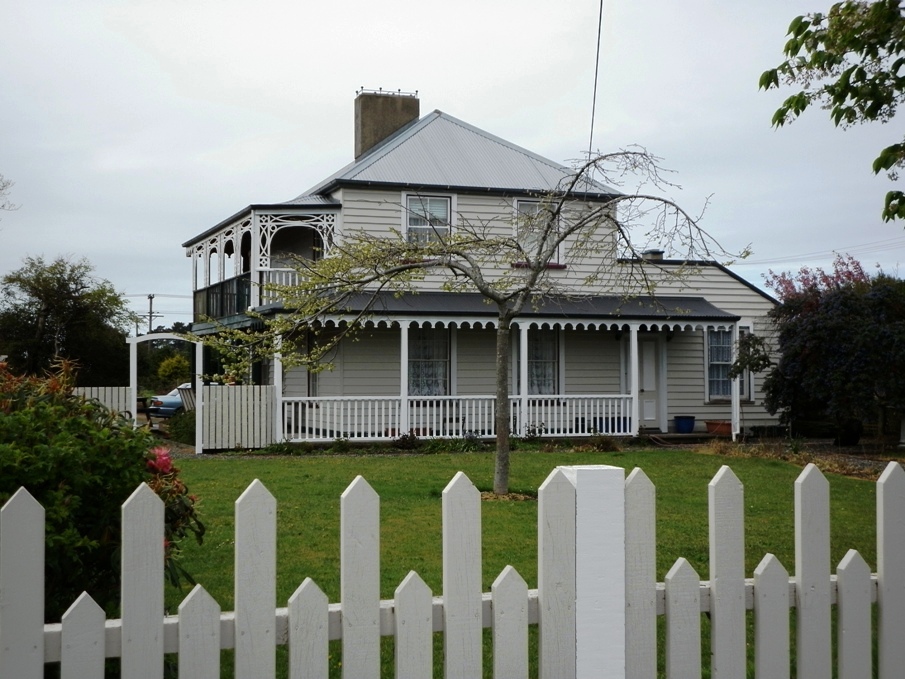
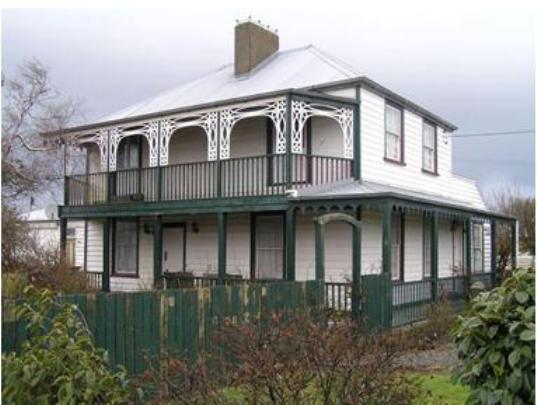
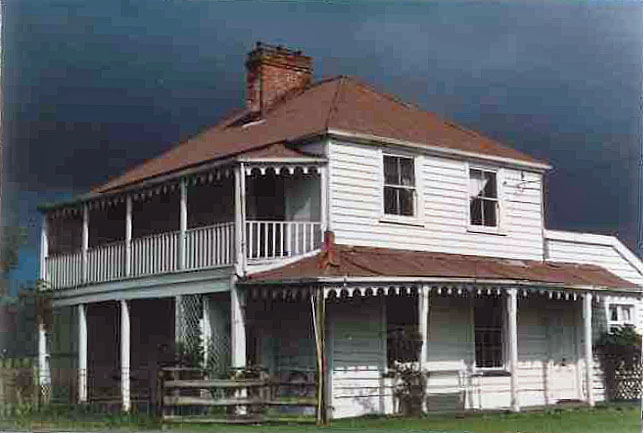
Riverton is the site of the oldest permanent European settlement in Southland, but the town was only surveyed in 1858. The sections occupied by Daniel House were defined through this process. It is unclear when the house was constructed. It may date from around 1858-59 when the area was surveyed, however, some sources believe it was constructed as early as 1851. From the available records it is difficult to pinpoint an accurate date, but its architectural features suggest it could have been constructed in the 1850s. From physical evidence it appears that the orientation of the building was initially to the north-east as there are, what appear to be, original French doors in the upper level, as well as an entrance door on this side. This could be another indicator that it was constructed before the completion of the town survey. This supposition is strengthened by Daniel House being located within what was referred to as the ‘Old Settlement.’ As such, the inference is that the house was built for the family of Theophilus Alfred James (1817-1893) and Elizabeth (1832-1892) Daniel in the 1850s. The Daniels appear to have been based in this area of Riverton even prior to obtaining the Deed for the land in April 1865. The building is thought to have been constructed by a shipwright due to the fact that cedar cladding was used and there is evidence of caulking between upper level weatherboards.
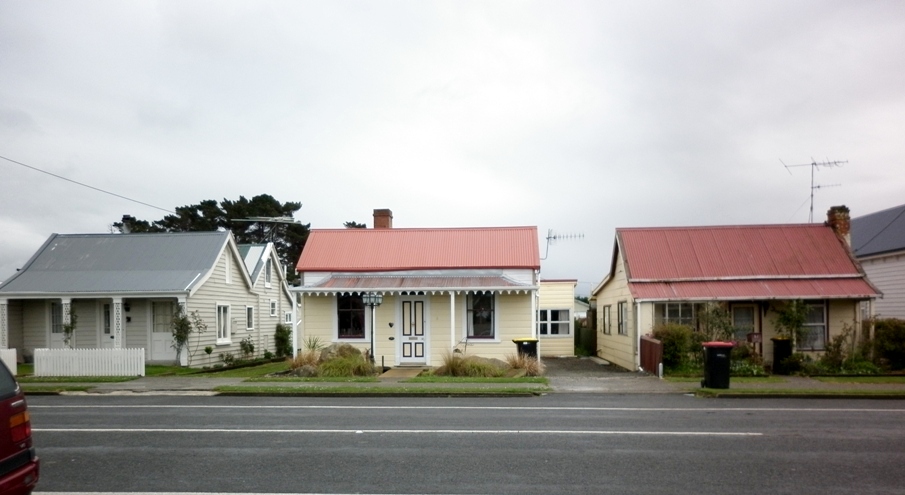
Daniel House dates from a seminal period in Riverton, and wider Southland, history. Several years later, in 1864, a settlement south of the Jacobs River estuary became known as ‘Village of South Riverton.’ Riverton was constituted as a Borough in 1871 and the settlements either side of the estuary only then became collectively known as Riverton. Theophilus was mayor of the district on two occasions; in 1879 followed by another short term between 1880 and 1881. It was in his first term that Theophilus oversaw the fresh constitution of the Borough, which incorporated a substantially larger district and remained the scope of the Borough well into the twentieth century.
Theophilus’ role in Riverton began humbly, with him squatting and running a drapers shop in Riverton from 1851. This had followed a period of whaling around the Otago and Southland coasts in the late 1830s and working in Australia in the 1840s. Later, Theophilus went onto become a member of the Southland Provincial Council from 1862, as well as the Otago Provincial Council when the two provinces re-amalgamated. After the centralised system of government was instigated Theophilus was the Member of Parliament for Wallace on two occasions: 1876-79 and 1882-84. By the end of his life he had also accumulated considerable property holdings in an around Riverton.
Elizabeth Daniels (nee Stevens), who Theophilus married in 1853, was also notable in Riverton history because she was related to John Howell (1810?-1874), regarded as the founder of Riverton. Howell, a whaler, set up a station in the Riverton area in the mid to late 1830s, and soon after built a cottage. By 1843 Howell’s mother and step-siblings, Elizabeth among them, had moved from England to Australia. Howell convinced the family to move to Riverton after his mother’s death. This meant that Elizabeth and her married sister were the first European women to settle in Southland. Elizabeth is said to have been well-known locally for her knowledge of medicinal foods. Later she developed fluency in Maori, which became an advantage in the family commercial enterprises.
Because of their association with the development of Riverton, their status as an early European Southland settler family, and Theophilus’ public profile, the Daniels were a prominent local family. Correspondingly, their residence seems to have been the site of many social gatherings. Theophilus in particular is said to have been very fond of entertaining, and the family are thought to have hosted Governor George Grey (1812-1898) at the house. Theophilus and Governor Grey had met by 1867 and reportedly became friends. It is perhaps not surprising that the house was used for such events because it must have been one of, if not the, largest dwelling in the town at the time.
Following the example of Howell, in the 1850s and 1860s the whaler settlers of Riverton began to diversify into farming, sawmilling, and other industries. The town continued to grow and it was in this period that the first formal school lessons were given. In the late 1860s James Fullarton (1828-1917), who owned Daniel House from 1890, was the first teacher at Gummies Bush School. However, Fullarton had a career shift in the late 1870s upon moving into Riverton, although he remained interested in education, being a member of the Riverton School Committee in the late 1870s and early 1880s. Fullarton seems to have been quite community minded, and because he had been trained for the Presbyterian ministry, he understandably was also a committed member of the local church.
By the time that Fullarton took up residence at Daniel House he was employed as the Wallace County Council Clerk and Treasurer. He retained this position for 34 years, until his retirement in 1915, at which time a large portrait of Fullarton was hung in Council Chamber in recognition of his great contribution to the county. He seems to have been very committed to his job, becoming ‘a byword for his meticulous attention to detail,’ and when the County offices were moved from Riverton to Otautau in the closing years of the nineteenth century, he went with them. As such, the Fullarton family resided at Daniel House for less than a decade, although they seem to have retained the property into the twentieth century. It is likely, given the time period, that the Art Nouveau inspired fretwork on the upper balcony was added during the residence of the Fullartons.
Daniel House then became the retirement residence of Thomas Helm (1860-1924). Helm had previously farmed at Grove Bush and Glencoe before ill-health prompted him and his wife to move to Riverton. Helm’s obituary describes him as having ‘a very quiet and retiring disposition, and [being] a man of the highest integrity.’ Soon after his death it seems that his wife, Annie Elizabeth (nee Miller, d.1947), moved elsewhere because the property changed hands. Incidentally, one of the couple’s grandsons, Arthur Stanley Helm (b.1914), later made a name for himself through publishing several books. He was also heavily involved with the New Zealand Antarctic Society, working closely with Sir Edmund Hilary (1919-2008). Helm Point, and Helm Glacier, on that continent are named after Arthur. Arthur was born, and grew up, in Riverton, so it is highly probable that he had a close association with Daniel House in his youth.
Through the middle of the twentieth century Daniel House had a succession of owners, and interestingly many seem to have been widows. However, amongst the owners were also men whose listed occupations show they were involved in some of the key local industries in this period, including farming and sawmilling. In 1962 the property was owned by Mary Dickson, who is listed as the wife of a farmer. The house remained in her possession until 1988, when a trio of Daniel family descendants purchased it in order to save it from degrading further.
The new owners were Marie Stewart Daniel-Mannan, Christine Ellen Daniel-Henderson, and John William Daniel. The plan of this group, the closest of who lived in Invercargill, seems to have been to work on the restoration of the property during weekends and holiday periods. By the mid 1990s this process had progressed to the point where the house was weather-tight. The degree of work which was required on the run-down building is perhaps best shown by the fact that before the family could restore the street front veranda; it fell down in a storm due to its dilapidated state.
The reconstruction of this late nineteenth century feature would have to wait until the property was taken on by yet another Daniel descendant, Brent McFelin, and his family at the beginning of the twenty-first century. With this change of ownership, a more concerted restoration effort was instigated in order for the building to be habitable and become the family residence. As such, one of the first projects was to reline much of the interior because the timber was riddled by borer, which made many areas of the floor unsafe to walk to on. This restoration process has been gradual but most of the larger scale projects have now been completed.