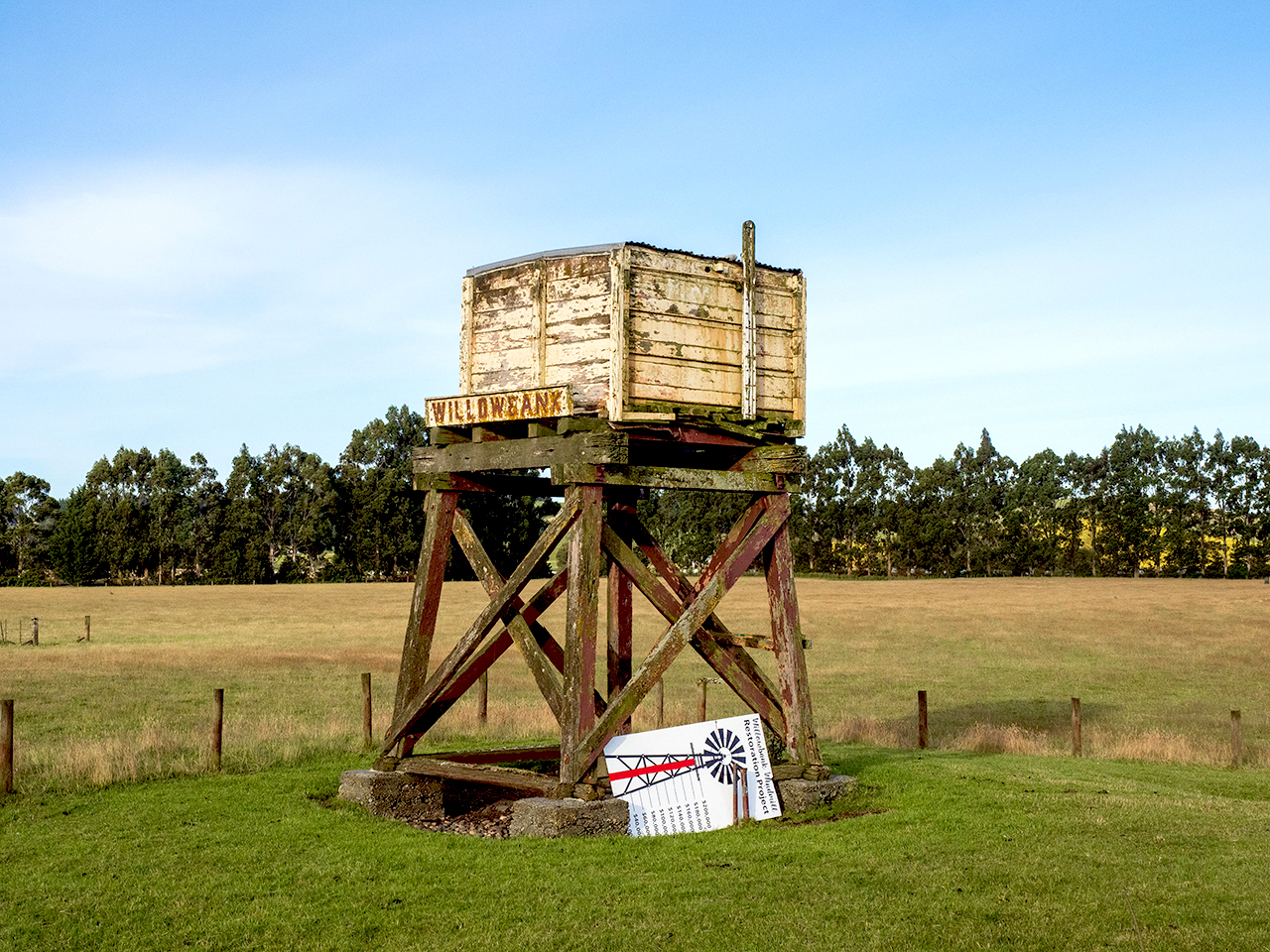
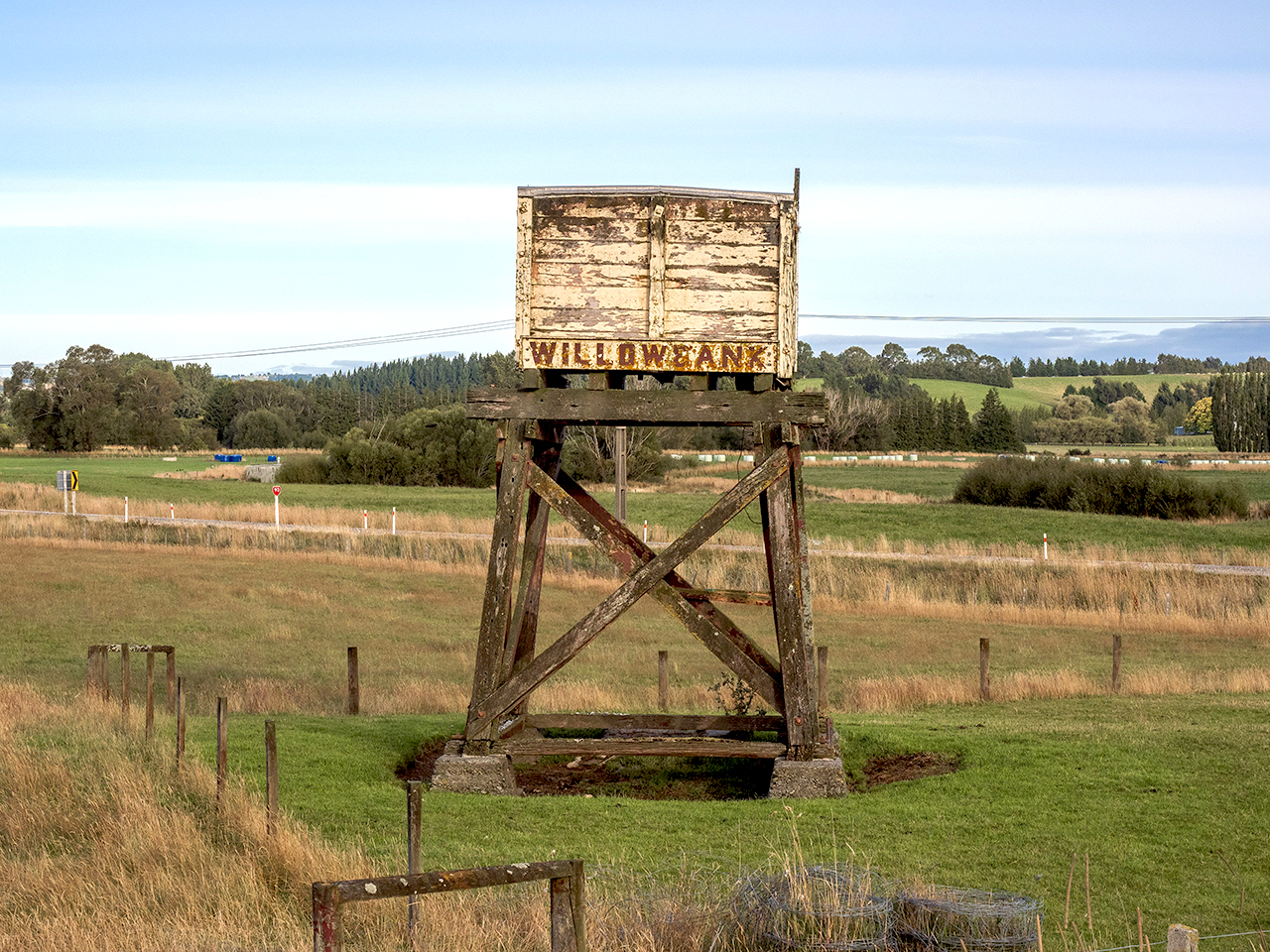
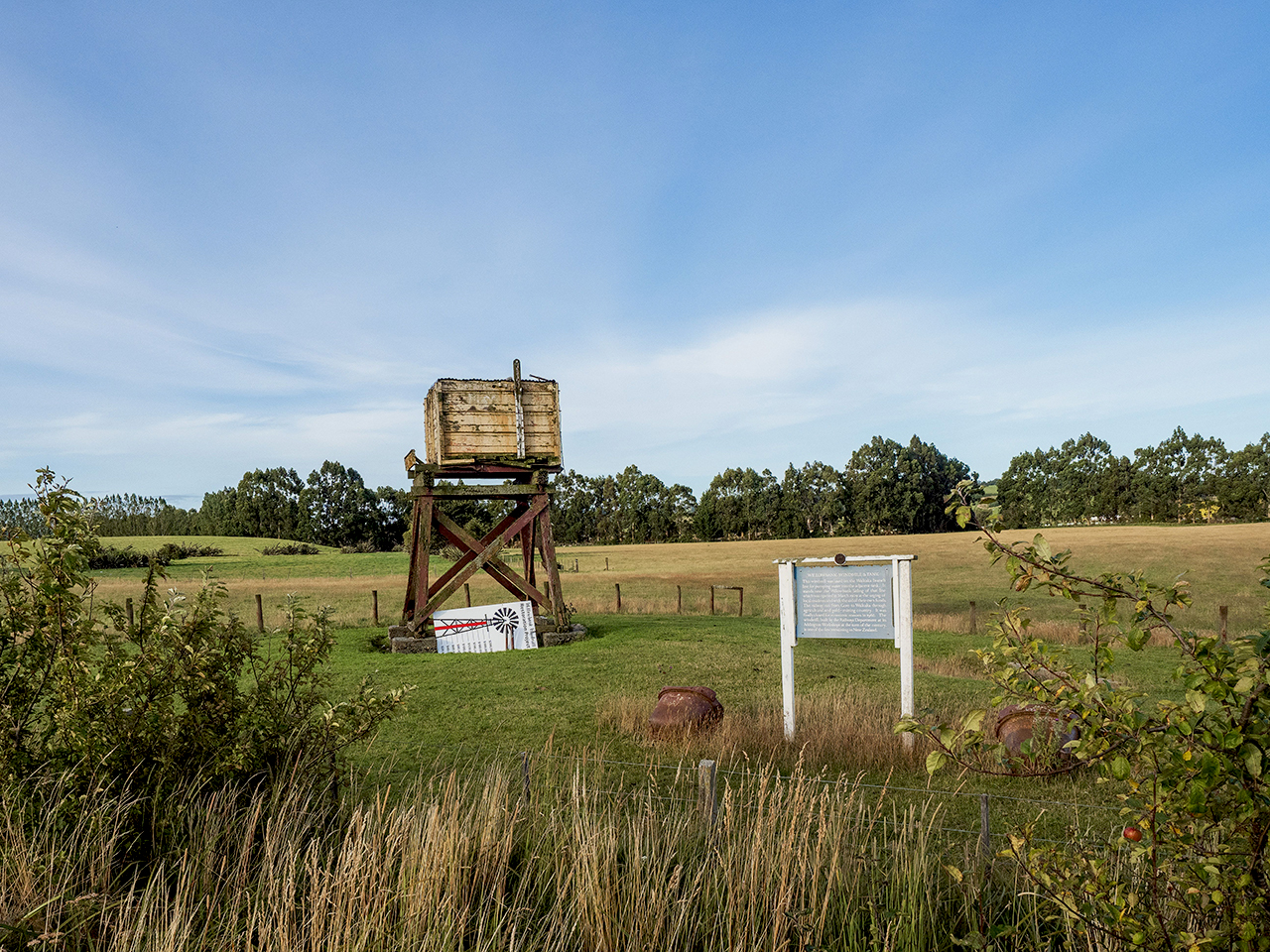
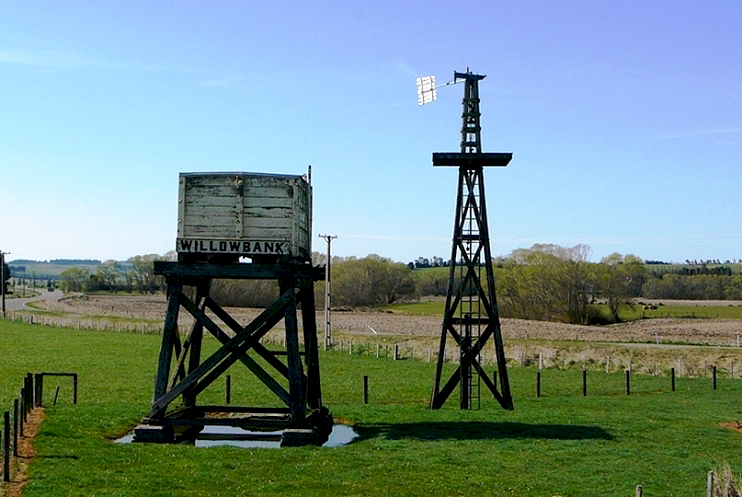
The Willowbank Windmill was built to supply water for the steam locomotives on the McNab to Waikaka line. Agitation for a railway line to Waikaka began as early as 1877, when it was suggested as the route to connect Gore and Kelso. With the cutting up of the big estates, and the consequent growth in population and farms in the area, local voices clamoured for a local line. Settlers bought land on the strength of maps which showed the proposed line. Once the land was sold the push for a railway faltered for a time however farmers in the North Chatton, Waikaka and Greenvale districts continued to apply pressure for another thirty years. Railways on a national and local scale were the ‘first of the complex, large-scale technological systems that would dominate the industrial-capitalist age, helping to kickstart more than 170 years of ceaseless ever-accelerating change’, and a key state tool for economic development.
Locals petitioned Parliament, and the Mayor of Gore put his weight behind the campaign. In 1904 eight miles of railway was authorised from McNab towards Waikaka. The Member of the House of Representatives for Wakatipu suggested that settlers float a company and raise money to construct the line, and lend it to the Government on the security of Government debentures, and this scheme was adopted. In 1905 the line from Waikaka Siding (now known as McNab) to the township of Waikaka was authorised. The first sod was turned in April 1907 by the Hon. W. Hall-Jones, Minister of Public Works.
The Waikaka line, all twelve miles and fifty seven chains of it, opened in March 1909. The total cost of the line was £70,000 (with £50,000 subscribed by debentures).. The line had seven stations - McNab, Howe, Willowbank, Maitland, Fleming, Pullar and Waikaka. The branch line was the community’s link with the outside world before the widespread use of cars and telephones. Residents had a strong sense of ownership, and those who worked the line were important members of their community.
By 1909 the railway infrastructure was established at Willowbank. Willowbank Station had a waiting room (including a ladies waiting room in the shelter shed) platform, good shed and loading bank, cattle yard and urinals.
The Waikaka Branch line had problems with water supply for locomotives from the beginning. The permanent water supply (a windmill pump and tank) at Waikaka was insufficient as the well ran dry regularly. There was a temporary hand pump at Willowbank.
The water supply issues were still unresolved in 1910 so the District Engineer wrote to the Public Works Department in August enquiring if it was still intended to erect a windmill and vat at Willowbank, indicating that providing a suitable water supply for locomotives was a requirement of the original line construction contract. Initially a discouraging response was received. After investigating siting a well at Maitland and erecting another temporary supply there it was decided that the best location for a permanent water supply was at Willowbank where the engines were likely to need more water with heavier trains.. On 27 October 1911 it was reported that a permanent water service had been erected at Willowbank, with a 6000 gallon vat (£112-12-5) and a 16 foot (4.8 metre) windmill (£141-12-9).
As railway routes were extended in the late nineteenth and early twentieth century, windmills and tanks were strategically placed along New Zealand's railway lines to supply steam engines with water, and were therefore a vital part of the rail network. Water tanks or ‘vats’ were a significant structure associated with the steam era. Originally steam locomotives were small with little capacity to carry water with them. Vats were therefore required at regular intervals along the lines. As larger locomotives were brought into use, smaller vats were phased out in favour of larger vats at key locations. Connected to pumps often powered by windmills, the vats supplied the considerable amounts of water required to power steam locomotives. As steam engines were phased out the water vats that had supplied them were largely redundant. Many vats have since been demolished, or have simply deteriorated through lack of maintenance. A few remained on their original locations because they still serviced the local community water supply, for example Edendale which was finally demolished in 2010. Some were acquired by farmers or industry for water storage.
Some like those at Paekakariki (Category I Record No. 4705), near Wellington (though relocated from their original sites on the main trunk line in the Central North Island - Waiouru and Ohakune), and the tank at Willowbank on its original site, are rare survivors. The tanks are rare relics of a once common system of water supply on New Zealand railways. Both vats are typical examples of the water vats used in the early twentieth century and they provide a visible link with the steam locomotive era. The Willowbank Railway Windmill and Tank form part of the wider historical railway complex that was the Waikaka Branch line and have potential to increase public awareness about the networks that enabled steam locomotives to operate throughout the country.
Windmills were built at the Railway Department workshop at Addington.The 14 foot mills were supplied out of the Hillside Workshops in Dunedin, and the 16 foot mills out of Addington Workshops in Christchurch.
Gravity water supply systems were preferred but hydraulic systems and windmill pumps were used where necessary. Hand pumping was also a backup at most windmill sites. New Zealand Railways built windmills to pump water to fill the water tanks (or vats) which supplied the considerable amount of water needed for the steam engines. Windmill pumps were also used for railway housing water supply and fire fighting. Where the only water available was below ground, windmills were built to pump the water up and into the holding tanks.
NZR windmills were built to standard sizes of 14 feet (4.2 metres) or 16 feet (4.8 metres), which was the measurement of the diameter of the main fan, although records show smaller sizes were used at some locations. They were built with wooden fans and vane, unlike other New Zealand windmill pumps tended to be constructed of metal. The design was effectively a copy of two American models produced by Fairbanks Morse & Co. The 14 foot was known by them as an Eclipse Form Mill and the 16 foot as an Eclipse Railroad Mill.
The Willowbank Windmill is a 16 foot mill, built to the standard plan. The NZHPT citation for the Belgrove Windmill indicates that its design was based on a standard plan designed in 1892 by the Railways Department Acting Resident Engineer Daniel McIntosh (1860-1926), and draughtsman George Alexander Troup (1863-1941). The Belgrove Windmill structure consists of a 4.8 metre (16 foot) wooden fan that was set on a 12.2 metre (40 foot) wooden tower.
The mill's operation was automated and controlled by a valve fitted to the delivery pipes that were connected to the holding tanks. Hollow metal balls, which rose with the water level, blocked the supply off when the tank was full, preventing more water from entering. Some of the overflow water was piped back to the windmill where it filled a wooden bucket connected to the mill head. When the bucket was full its weight pulled the tail into line with the fan, forcing the fan out of the face of the wind, effectively stopping the mill. The bucket emptied after an hour through a drip cock so it would empty, it would rise up the tower, moving the fan back into the wind. If the tanks remained full, the bucket would refill quickly and stop the mill again. The system required little maintenance and was protected from damage by a side vane that turned the sail out of high winds. The well was located immediately below the windmill structure, and was connecting to the pumping mechanism.
The Railroad Eclipse was produced in turn by three companies: the Eclipse Wind Mill Company, the Eclipse Wind Engine Company, and Fairbanks, Morse, and Company. Their name recalls their use as early as 1870 in supplying water for steam locomotives. Produced in styles for either pumping or power purposed, they were manufactured in sizes ranging from 16 inches up to 35 inches in diameter, and were marketed throughout America. They were still in production until the First World War. Pumping-pattern Railroad Eclipse mills were used primarily where water was available only at considerable depth or where large amounts of water was needed, such as for steam locomotive, for municipal water works, or for watering large numbers of livestock.
In New Zealand, at least 116 railway windmills were built. Molinologist Ian Jonson, who has compiled a record of New Zealand railway windmills, shows that windmills were installed at on locations as early as 1875 (at Waitaki Bridge South End) and as late as 1919 (Morrinsville, Papatoetoe and Otamarakau Bluff Siding). The transition from steam to electric and diesel locomotives eventually rendered the railway windmills obsolete. Some were demolished, others dismantled and others abandoned when no longer servicable. Only two remain - the Willowbank Windmill and one at Belgrove, both managed by the Department of Conservation. In their history of New Zealand’s ‘ghost railways’ David Leitch and Brian Scott write that the survival of the depot structures at Willowbank illustrate ‘just how essential the railway was in Victorian and Edwardian times for its rural role alone.’
The Belgrove Windmill, on State Highway 6, south of Nelson (Category 1 historic place, Register no. 244) serviced the Nelson line and was built in 1898. It was used to pump water to supply engines beginning the steep climb to Spooners tunnel. When the line closed, amid much protest in 1955, the windmill was left in place because it was also being used to supply domestic water for the houses there.
In the early 1930s the Waikaka Line was threatened with closure for economic reasons. Evidence was presented to the Royal Commission investigating the on-going economy of branch lines, defending the service. Locals argued that the financial loss on the line was practically the lowest of any branch in the country (bar a couple of exceptions). Local farmers were keen to protect their interests, but it was agreed that the district recognised the difficulties of the Railway Department and agreed that a ‘reasonable curtailment’ of the services on the Waikaka line was required, but would oppose the suggestion that the line be closed or that the price of freight be increased but offered to strike a levy to defray expenses.
In August 1933 the 6000 gallon (22,712 litre) vat was removed to Balclutha and replaced with a 2000 gallon (15,142 litre) tank. The early 1950s saw a problem with the water supply at Willowbank as the water was muddy and the Waikaka supply was out of order. The well was cleaned and reported as being 4 ft 8 inches by 3 ft (1.4 by .9m) and 11ft 6 inches (3.45m) deep from ground level. It was timber lined from top to bottom.
Since 1936 competition from road transport for freight alongside a railway had been limited to 30 miles (48 kilometres) so railways were obliged to service the small rural communities and farming areas. These lines had small stations handling freight where consignments could be handled from a small shelter shed. A photograph from 1962 shows Willowbank with its windmill and tank and in the background a railway shed with a loading bank where goods could be transferred to and from railway wagons. The windmill was on one side of the main line and the vat on the other.
Until the 1960s New Zealand’s railway network was relatively stable. It reached a maximum length in 1953 (5689 kilometres), but declined thereafter as branch lines were progressively closed. At that time, rail was still oriented to meeting local and rural needs as much as long haulage. As rail gave way to road for the transport of freight over shorter distances, the Waikaka Line was no longer able to pay its way, and closed in September 1962. The Willowbank Windmill is, in the words of Euan McQueen ‘a vestigial remnant’ recalling ‘a different pace of life, different transport technologies, an intimacy between rural areas and their railway, which was still the only truly national transport organisation and operator until probably the 1980s.’
With the closure of the line the Gore and District Historical Society were concerned about the fate of the Willowbank Windmill and were keen that it remain on its original site, as a memorial to the branch line. The Southland Regional Committee of the New Zealand Historic Places Trust became involved in the project in 1974. The Mataura Ensign reported that the preservation of the windmill and tank was now in the hands of the Committee who had handed over the work of preserving the Windmill and Tank to the Historical Society as a memorial to the line and to the pioneers of the district. The newspaper was clearly ‘jumping the gun’, as the plan was for the Commissioner of Works to recommend transferring the site to the New Zealand Historic Places Trust as the final stage of disposal of Railway assets, was yet to happen.
Locals set to work looking after the two structures. In 1975 the Maitland Young Farmers Club repainted the Windmill and Tank. The Women’s Division of Federated Farmers supported the erection of a sign ‘Willowbank.’ NZHPT agreed to meet the costs of maintenance and repair, still anticipating the formal vesting of the site. Vesting was delayed because of pending decisions about improving road alignment, and title issues. The Commissioner of Crown Lands reported that the land had been sold to a private individual on freehold title and could not therefore be reserved. Subsequent investigations found the windmill and tank to be on road reserve. Meanwhile NZHPT worked with the Ministry of Works on repairs and maintenance which included replacement and repair of deteriorating timbers in the tank stand and the superstructure of the Windmill, as well as to the bearings, shafts, and vanes, with the Southland County Council donating materials.
The Willowbank Windmill underwent a more major overhaul in 1984, the work carried out by the Ministry of Works with the support of the Gore District Council. High winds had caused the Windmill fan to fly apart (the speed making the noise of a jet engine) and pieces of the wheel were found up to 120 metres (394 feet) away, showing the force of the movement and wind. It was recommended that the fan be dismantled to prevent further damage, as the central mechanism that turned the fan out of the wind was no longer working and had contributed to the damage.
In 1988 the Windmill suffered further storm damage and the much of the top workings were removed to prevent further damage, and allow repair of the fan. The repairs were delayed and locals wrote expressing concern that the fan was lying in a Ministry of Works yard in Invercargill awaiting attention, and offered their own services, being keen to have the landmark restored.
The reserve was finally gazetted for conservation purposes in 1989. The gazettal as a historic reserve was never completed. NZHPT continued to manage the Windmill, with input from the Gore Council and local groups, and restoration work was carried out in 1989 enabling the Mill to switch in and out of the wind. This mimicked the automatic operation that enabled the fan to turn parallel with the wind direction and protect the fan), including work to the tank stand, though it was thought too costly to restore it to the condition that it could hold water again.
In 1992 the Windmill was again damaged in high winds and needed repairs - the main shaft had sheared and the side vane was broken. Southland District Council objected with vigour to a suggestion that the Windmill be relocated to Middlemarch. The fan was reinstated by the beginning of 1995 but the Windmill was damaged yet again in a storm in June 1997. Responsibility for repairs was taken by Gore District Council (which replaced the Southland County Council.
Railway historian Euan McQueen writes that there is ‘something of a mythology about the rural branch line. One is inclined to forget that there were many small stations, served by local trains, on main lines as well. But the folklore is well established, and there were certainly local characteristics on branches that were hard to replicate on a main line.’ The physical and visual traces of these lines are examples of historical geography. The rural atmosphere was a significant setting - the underlying pattern of traffic for livestock, fertiliser, lime and farm supplies, which has all changed with modern transport patterns, equipment and freight handling methods. This all supports the plea of local residents who consider the Windmill a landmark and symbol of the bygone era of rail travel.
In 2011 restoration work has once more begun on the Windmill with the Gore District Council working with community groups, including Rural Women NZ and the Community Trust of Southland as well as personal donations, to fund the project. The fan had been in storage for many years awaiting money and experienced restorers. The restoration work is being undertaken by the Croydon Aircraft Company, renowned for its work on vintage aircraft. The project is expected to take a couple of years as work is also needed on the pump and the windmill’s control mechanism and tower as well as on the water tank and stand. The whole project is expected to cost $60,000 over five stages. The restoration work has involved going back to the original Railroad Eclipse Windmill plans, and specifications rebuilding individual components and making intricate jigs to build replacement parts.