Rakiura (Stewart Island) features prominently in the Ngai Tahu legends relating to the Murihiku area. Maui first named the island Te Puka O Te Waka O Maui, (the anchor stone of Maui's canoe). An ancestor named Kiwa travelled up and down the coastline and grew tired of crossing the isthmus that joined Murihiku and Rakiura. He asked Kewa the whale to chew through the isthmus, the resulting passage named Te Ara a Kewa. Crumbs fell from his teeth while he was chewing, and these became the islands of Ruapuke, Rakiura and the Titi Islands. The island was also named Motu Nui (Big Island). Waitaha were the first occupants, intermarrying with the later arriving Kati Mamoe, and still later with Ngai Tahu people. Later Rakiura became a refuge for people fleeing from warfare and tribal battles in the northern regions. This area is great cultural significance to Ngai Tahu whanui, as recognised by the Ngai Tahu Claims Settlement Act (1998) which includes the coastal area around Rakiura as a Statutory Acknowledgement.
First contact with the Pakeha is estimated around 1792 when there were sealers based on the mainland at Dusky Sound. During the first decade of the 1800s there were sealing depots on South Cape, Whenua Hou (Codfish Island), Port William and Southport (Pegasus).
In 1840 the HMS Herald visited Stewart Island, with Major Thomas Burbury landing at Pegasus. He made a declaration of 'sovereignty', claiming the island for the British Crown by right of Cook's discovery. He deemed Pegasus Bay, and therefore the Island as a whole, uninhabited, although only thirty miles away there was a large population of Pakeha and Maori. Once the declaration was made the Herald sailed to Ruapuke Island. At Ruapuke chiefs appended their signatures to the Treaty of Waitangi.
In 1864 Commissioner George Clarke negotiated with the Maori owners on behalf of the Crown. On 29 June 1864 the Rakiura Purchase Deed ceded Stewart Island to the Crown. According to Ngai Tahu, which holds manawhenua today, this was not a willing sale and only a few benefited. Harold Ashwell states that for the majority the sale was a disaster: their identity as a people vanished; their turangawaewae was pulled from beneath their feet. Their source of mahinga kai was alienated from them, leaving them destitute. The so-called 'half castes' with no other home faced eviction by Pakeha.
By the close of the 1860s settlement at Halfmoon Bay was a small outpost clinging to the land. The Otago Witness recorded that at Halfmoon and Horseshoe Bays, and at Paterson Inlet the 'bush is extremely dense, although in the high grounds, the undergrowth is far from being tangled.' There were only small areas under cultivation with only a few patches of potatoes reared for local consumption at Paterson Inlet. The settlement was dependent on sea-going vessels for supplies with 'one of the more serious contingencies to which the place is exposed is a short supply of food, when craft trading to the island do not happen to arrive punctually.'
James Harrold had moved to Stewart Island in 1861, settling above Lewis Acker's land in what would become known as Harrolds Bay. Harrold was a native of the Orkney Islands, who had worked in Canada for the Hudson Bay Company in the 1830s and 1840s. While there he met and married Agnes Grieve, the daughter of a Hudson Bay Company bowsman and his Native American wife. The Harrolds arrived in Port Chalmers on the Bernica in 1848. Until the 1860s James Harrold ran the Taieri Ferry and his wife the associated hotel. Harrold also ran a large open boat in the early coastal trade between Dunedin and Taieri Mouth, supplying the Tokomairiro settlers.
By 1870 Halfmoon Bay was a 'busy, though tiny, village.' The livelihood of the majority was however, linked to the sea, rather than the clearing of the forest. Economic development linked to forestry or fish curing waxed and waned at this time, dependent on the economies on the mainland.
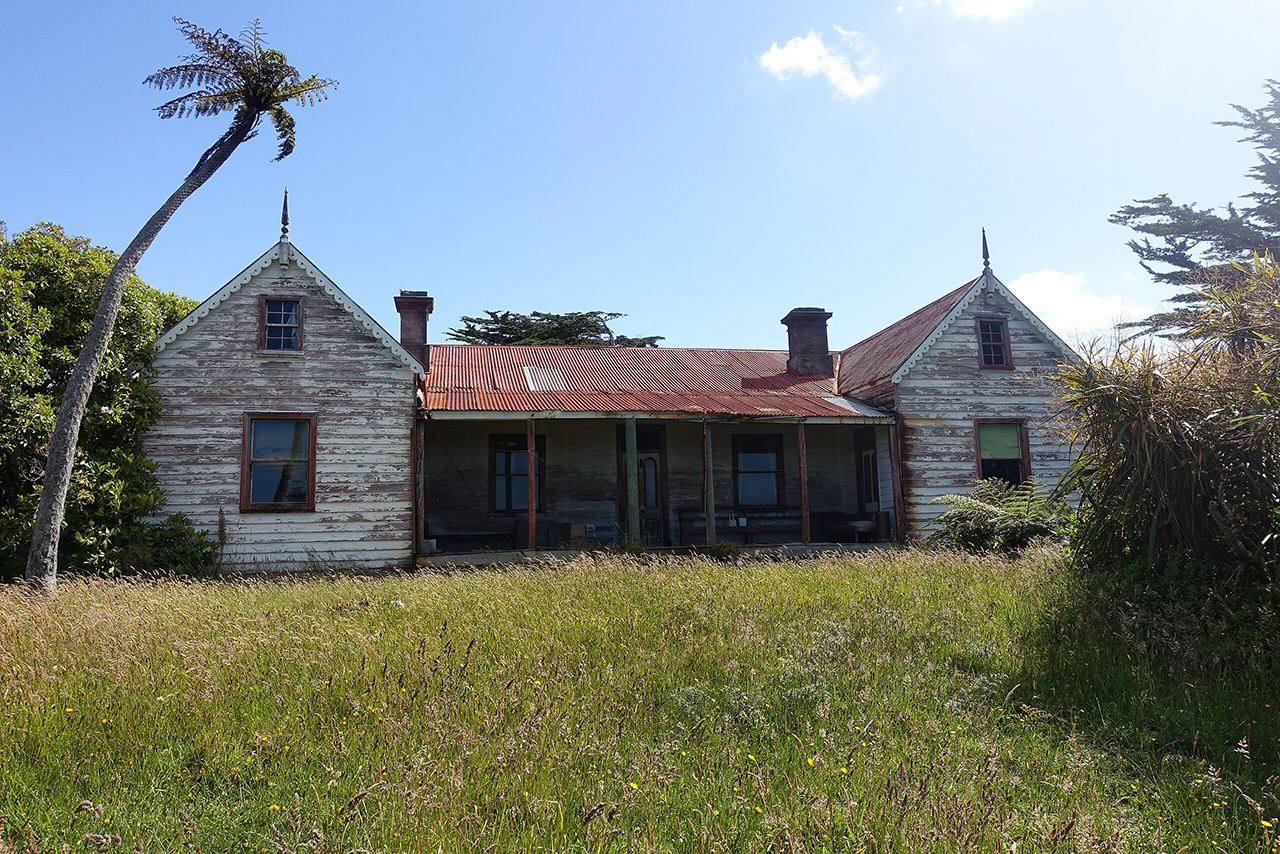
James Harrold shifted to Stewart Island where he was involved in the fishing industry, bought a schooner, and became involved in the coastal trade, ran a shop (one of the first on the Island, on a ridge above Harrolds Bay) and, when visitors began to come to Stewart Island, he and his wife Agnes commissioned the construction of the Travellers Rest. The Travellers Rest was built by shipwright Robert Harvey (called elsewhere John Harvey) for the Harrolds in the 1870s. Robert Harvey had been an assistant shipwright at Sawmill Bay at Kaipipi in the early 1860s. Harrold along with another Orkney-Islander Tom Leask also built a boatshed, smoke-house, slipway and wharf in the northern corner of Harrold Bay.
The construction of Travellers Rest tapped into the nascent tourism industry which was developing in the South Island in the 1870s. The Queenstown area, promoted as the Cold Lakes and Glacial District of Otago, became part of the wider national and international tourist circuit both in the nineteenth and twentieth centuries. It was the rather colder equivalent of the Hot Lakes District in the North Island. By 1875 tourists from Europe and the United States, as well as Australia, visited New Zealand. Status oriented classes were looking for more distant and less public resorts. Generally tourists were wealthy, and in the 1880s were characterised by health and pleasure seekers.
Accommodation houses were built in some isolated areas to provide for tourists. Other significant local examples include Paradise House (1881 west of Glenorchy), Glade House (built 1896 at the Head of Lake Te Anau), and the Hermitage Accommodation House (the first building constructed 1884 at Mt Cook). The latter two were taken over by the Government. The Travellers Rest was also to become part of the tourist circuit.
Stewart Islanders made money from the scenic beauty of the place 'inviting tourists and holiday-makers from far and wide to spend their leisure in its sylvan glades and bush-girt bays.' According to historian Basil Howard, tourist visitation began before 1880, and by the end of the century had 'so far developed that the Government, which had by then realised that agricultural expansion was impossible, took steps to ensure that the Island scenery should be preserved intact in certain areas accessible to visitors.'
By the beginning of the twentieth century there was recognition that 'historic and beautiful places should be preserved'. This philosophy was recognised in legislation by the 1903 Scenery Preservation Act which looked beyond economic value, to scenic, scientific, and historic values, which were to be preserved for posterity. Stewart Island's values were recognised, including the Scenic Reserve established on Ulva Island in 1922.
Boarding houses were prominent buildings of the Island's history. The Cyclopaedia of New Zealand mentions three private guest houses: Greenvale House (1886, destroyed by fire 1942), Oban House (1899, pulled down and rebuilt 1926 as South Seas Hotel) and Seafield House (1900, burned down 1906 and replaced with another structure). These buildings were generally large villa-style two-storied timber structures, and as can be seen above, were vulnerable to fire.
The special visual quality of the Island was noted by the New Zealand Government Publicity Office. The bush and snugly nestled cottages were a vital part of the Stewart Island experience - with the forest walks 'along well-kept pathways' being one of the chief delights. 'For a complete holiday and rest from the everyday cares of modern life no more delightful resort exists than that of Stewart Island.' The island was considered such an attraction that the Government Publicity Office made a film about it in 1925, shooting 1400 ft of cinematographic film, and some eighty still photographs. The film was to show at the up-coming South Seas Exhibition. Travellers Rest is part of that special visual appeal.
James Harrold ran a cutter in connection with the boarding house providing transport across Foveaux Strait for guests. The cutter also provided excursions to sights around the island, taking guests to Paterson Inlet, Lord's River and Pegasus 'thus enhancing the pleasure of their sojourn.' Guests also took in the land-based attractions, walking around the bays and climbing Mount Anglem.
James Harrold transferred his land holdings to his wife Agnes in 1887. Agnes was a significant figure on Stewart Island. A biographer describes her as 'an intrepid woman of forceful character, with a hawk-like nose and a patrician bearing.' She was the unofficial 'doctor' on the island, with the call for 'Granny Harrold' going out when basic first aid was not enough. She walked miles to visit patients, eased the pain of dying for some, and welcomed babies into the world from 1863 to 1903. Her impact was such that those she cared for stated that 'if anyone deserves a monument on this island, it's Granny Harrold.'
In 1887 the New Zealand Tablet described the hospitality of Stewart Island and the Harrolds:
'The steamer's flag lately hoisted is a signal to Mr. Harrold some of the passengers desire to become his guests. A small boat is rowed out from a cosy little cove, Mr. Harrold's guests are shipped, and five minutes later the voyage is completed at the end of the Bay. Whilst enjoying the warm unaffected hospitality of the Island (the writer speaks from personal experience of the Harrold's), as well as its scenery, the every-day life of the island will be observed with interest.' [Harrold was advertising his accommodations by the late 1880s as 'The Travellers Home', the 'sanatorium of the south.' His advertisement gives a description of the facilities:
'the large and commodious house has just been finished in first-class style, and offers unrivalled accommodation to tourists and others seeking health and enjoyment. It contains five private sitting rooms, two dining rooms, and twenty-two bedrooms. The facilities for recreation on land or water including sea bathing are unsurpassed. Special attention is paid to the cuisine, and to the comfort of visitors in every respect.']
According to a Stewart Island museum curator E.A. Willa writing in the 1980s, the Harrolds also looked after 'state' children, an example of the informal welfare provisions typical of the nineteenth century, and indicating the wider social role the boarding house played. The boys slept in a dormitory on the hill behind the Travellers Rest. The girls slept at the Travellers Rest. Sansom confirms this writing that the orphaned children slept in what had been the shop, and what became known as The Dormitory, presided over by Captain Harrold, with the girls in the Traveller's Rest. Archival sources based on oral histories record that the Harrolds took in 12 state wards, although they do not indicate the date the children lived with the Harrolds.
An 1892 Otago Witness article reported that the Harrold's boarding operation could accommodate 50 guests. The Travellers Rest was a busy and interesting place: the Harrolds kept cows, pigs, horses, pheasants, turkeys, peacocks, a hundred hens, geese, parrots and parakeets, a number of dogs, and the pet monkey (who suffered from the cold and wore a red woolly jersey) which James Harrold brought back from his travels for Agnes. Guests were picked up by the boat just off the point. Permanent guests had rooms; one Englishman named Ogle who planned to settle in the area was one such individual, providing a point of contact with local residents. Sansom remembers the visitor's book being full of lively compliments and of adventures had by guests on the island.
Visitors found the place memorable and it was popular with honeymooners: 'Big double bed, feather mattress, wash-stand, rag mat and not another inch of room in this tiny upstairs bedroom. Bed's the only place.' Like other isolated boarding houses, such as Paradise close to Glenorchy, getting there was part of the adventure.
To Traveller's Rest we struggled in
Through tracks dark, wet and muddy
A certain sign that making roads
Is not this people's study.
Like Paradise, at the Head of Lake Wakatipu, the experience of the wilderness was important, with guests travelling to the nearby bays and inlets aboard Captain Harrold's cutter, and taking themselves off to climb Mt Anglem.
James Harrold died at the end of May 1898, the guest house operation closing shortly after.
Shortly before her death Agnes Harrold sold Travellers Rest to Louise (known as Laura) Charlton. Louise Charlton was married to titled Englishman Welles Orton Charlton, the owner of the pastoral run Island Hill at Mason Bay since 1893. Travellers Rest was the Charlton's home on the Island. The big house, with the cooks and maids was an echo to Mr Charlton's upper class English background. Olga Sansom remembers visiting Mrs Charlton at Travellers Rest as a child:
'I can see the room still, the maid in starched white apron and cap, the silver tea service on a big silver tray and Mrs Charlton dressed in a lavender gown, tight-waisted and with a cascade of frills at the back...On the white lace curtains of the window there were pinned imitation butterflies with gay wings, and insects with jewelled bodies. They may have been made of glass but to me they were jewels. The mantelpiece was crowded with pretty and unusual things, rose-pink glass vases, pale green fluted china baskets, little carved figures of ivory, monkeys carved from nuts, and a row of ebony elephants.'
Mrs Charlton died in 1904, aged fifty nine, but was remembered for her elegant gowns and capes which she wore walking alone on the isolated beaches of Mason Bay.
After another couple of quick changes of ownership the house became the home of Mary (nee Leask, 1871-1949) and Newton (Hans) Jensen (1870-1921) in 1912 (whose children Granny Harrold had brought into the world). Their daughter Olga Sansom would become one of the historians for the island, and remembers the important landmark that the house was, visible from Foveaux Strait and Bluff Hill. Carrying on the link with tourism Newton Jensen ran a charter boat for visitors, with his yacht Lena available for hire by the day or by the week.
Olga Sansom is a significant figure in her own right, and her upbringing at Travellers Rest on Stewart Island was a formative experience and one she recalls with great affection. Olga Sansom would become a teacher and educator, the director of the Southland Museum, and an outstanding botanist and naturalist, being a life member of the Royal Society of New Zealand. She retired to Stewart Island in the late 1960s and became one of the Island's most affectionate historians writing two books which evoke the intimate and intertwined nature of life on the Island, one which for her started at Travellers Rest.
Travellers Rest has since that time remained a private residence, still providing a landmark on the headland overlooking Oban, fitting into the intimate landscape of the small settlement. Travellers Rest remained Edgar Jensen's home until his death in 1967. Jensen was a prominent Island figure. He was a fisherman all his life, also running a general store and carrier business. He was also involved in local politics, serving for a time on the Stewart Island County Council.
The Island went through development surges and declines. In the early 1950s there was concern that the island's population was declining rapidly. Families were moving away - in the previous few months five families (twenty people) had moved, and a further seven families (forty people) were intending to shift.
The interest in Stewart Island as a holiday destination has waxed and waned. Purey-Cust, writing in the 1970s, notes that the rise of the car led to a decline in visitors. Along with that decline came 'a withering away of accommodation as guest houses closed or burnt down and were not replaced, until now there is only the hotel remaining.' Purey-Cust considered that interest in the Island was again on the increase, with the prices of sections and cribs increasing accordingly. New accommodation facilities took the form of motels or motor camp types. He argued that commercial tourism was not a major force at that time, largely due to the lack of 'easily secured family accommodation and a change in holiday habits away from the seaside.' Other amenities were also run down, such as the café. From this information it would seem that Travellers Rest is the only boarding or accommodation house still standing on Stewart Island dating back to the early period of tourism on the Island, and is therefore a special survivor from this early period of tourism on the island.
In 1993 Invercargill architect Peter Baxter (of Baxter McDowell Architects) prepared a condition report and maintenance plan for the Travellers Rest. His inspection described the house little altered, but in poor condition, and he recommended a programme of maintenance, but noted the importance of doing this as unobtrusively as possible as the house showed a high degree of integrity.
In 2008 descendents of the Jensens still own the Travellers Rest, although it has not been lived in for some decades, with the link to providing accommodation on Stewart Island still evident in their boutique bed and breakfast operations continuing in new buildings nearby.