Quick links


Quick links
Quick links
Quick links
Quick links
Quick links
Jamieson's Restaurant (Former)
206-210 Great North Road, WINTON
Private
Historic Place Category 2
List No. 2566
Quick links:
List GalleryLocationDetails
206-210 Great North Road, WINTON
Private
Historic Place Category 2
List No. 2566
List Entry Information
Status
Listed
List Entry Status
Historic Place Category 2
Access
Private/No Public Access
List Number
2566
Date Entered
28th June 2012
Date of Effect
28th June 2012
City/District Council
Southland District
Region
Southland Region
Extent of List Entry
Extent includes the land described as Lot 2 DP 4532 (RT SL179/63), Southland Land District, and the building known as Jamieson's Restaurant (Former) thereon, and its fittings and fittings thereon. (Refer to map in Appendix 1 of the registration report for further information).
Legal description
Lot 2 DP 4532 (RT SL179/63), Southland Land District
Location Description
Located south of the corner of Great North Road and Brandon Street, Winton.
Status
Listed
List Entry Status
Historic Place Category 2
Access
Private/No Public Access
List Number
2566
Date Entered
28th June 2012
Date of Effect
28th June 2012
City/District Council
Southland District
Region
Southland Region
Extent of List Entry
Extent includes the land described as Lot 2 DP 4532 (RT SL179/63), Southland Land District, and the building known as Jamieson's Restaurant (Former) thereon, and its fittings and fittings thereon. (Refer to map in Appendix 1 of the registration report for further information).
Legal description
Lot 2 DP 4532 (RT SL179/63), Southland Land District
Location Description
Located south of the corner of Great North Road and Brandon Street, Winton.
Why is this place significant?
Historic Significance
Historical Significance or Value Jamieson’s Building has historical significance, representing the consolidation of Winton’s business community in the late nineteenth century and the development of businesses such as restaurants and bakeries which reflect the growth of the local community and the needs of a mobile population. Places to eat away from home grew with a modernising, mobile society, and provided a respectable place for women to dine away from the reputation tainting of hotels.
Physical Significance
Aesthetic Significance or Value Sitting in a prominent site in Winton’s main street, the former Jamieson’s Restaurant makes a considerable aesthetic contribution to the recognised historic streetscape in Winton. Architectural Significance or Value As a nineteenth century commercial building which began life as a bakery and restaurant, Jamieson’s Restaurant (Former) is a significant architectural survivor of Winton’s nineteenth century streetscape. The prominent building survived three fires which altered Winton’s streetscape and makes structures which survived the conflagrations even more important. As an example of a purpose built bakery/restaurant Jamieson’s premises are an interesting survivor.
Why is this place Category 1 / Category 2?
Detail Of Assessed Criteria
(a) The extent to which the place reflects important or representative aspects of New Zealand history The history of Jamieson’s Restaurant in Winton recalls the consolidation of the commercial heart of the town in the late nineteenth and early twentieth centuries, particularly the construction of buildings from permanent materials in the wake of the destruction of the town centre by fire. Bakeries were important businesses in every town – most small towns had their own bakery and bakehouse, with the associated tearooms reflecting Winton’s position as a transit stop on the way to Queenstown. (e) The community association with, or public esteem for the place The architecture and heritage of Winton in general is valued highly by its community, as reflected in the community-coordination of a heritage trail brochure (2001) describing heritage features of the town, street landscaping, and the presentation and continual use of many of the historic places in the main street. The Winton community appears to value its heritage features which clearly contribute to the community identity of this rural Southland town. (g) The technical accomplishment or value, or design of the place Jamieson’s Restaurant, with its interesting form and decorative detailing shows a degree of technical accomplishment in its design. The design indicates the then owner’s intention to run a notable establishment in this small town. (k) The extent to which the place forms part of a wider historical and cultural complex or historical and cultural landscape Winton has a strong sense of community and has acted as an important meeting place and rural service centre for a significant proportion of Southland’s farming population for over a hundred years, the surviving townscape, of which Jamieson’s Restaurant is an essential element, recognises this significance. The historic townscape is recognised by the Winton Great North Road Historic Area.
Why is this place significant?
Historic Significance
Historical Significance or Value Jamieson’s Building has historical significance, representing the consolidation of Winton’s business community in the late nineteenth century and the development of businesses such as restaurants and bakeries which reflect the growth of the local community and the needs of a mobile population. Places to eat away from home grew with a modernising, mobile society, and provided a respectable place for women to dine away from the reputation tainting of hotels.
Physical Significance
Aesthetic Significance or Value Sitting in a prominent site in Winton’s main street, the former Jamieson’s Restaurant makes a considerable aesthetic contribution to the recognised historic streetscape in Winton. Architectural Significance or Value As a nineteenth century commercial building which began life as a bakery and restaurant, Jamieson’s Restaurant (Former) is a significant architectural survivor of Winton’s nineteenth century streetscape. The prominent building survived three fires which altered Winton’s streetscape and makes structures which survived the conflagrations even more important. As an example of a purpose built bakery/restaurant Jamieson’s premises are an interesting survivor.
Why is this place Category 1 / Category 2?
Detail Of Assessed Criteria
(a) The extent to which the place reflects important or representative aspects of New Zealand history The history of Jamieson’s Restaurant in Winton recalls the consolidation of the commercial heart of the town in the late nineteenth and early twentieth centuries, particularly the construction of buildings from permanent materials in the wake of the destruction of the town centre by fire. Bakeries were important businesses in every town – most small towns had their own bakery and bakehouse, with the associated tearooms reflecting Winton’s position as a transit stop on the way to Queenstown. (e) The community association with, or public esteem for the place The architecture and heritage of Winton in general is valued highly by its community, as reflected in the community-coordination of a heritage trail brochure (2001) describing heritage features of the town, street landscaping, and the presentation and continual use of many of the historic places in the main street. The Winton community appears to value its heritage features which clearly contribute to the community identity of this rural Southland town. (g) The technical accomplishment or value, or design of the place Jamieson’s Restaurant, with its interesting form and decorative detailing shows a degree of technical accomplishment in its design. The design indicates the then owner’s intention to run a notable establishment in this small town. (k) The extent to which the place forms part of a wider historical and cultural complex or historical and cultural landscape Winton has a strong sense of community and has acted as an important meeting place and rural service centre for a significant proportion of Southland’s farming population for over a hundred years, the surviving townscape, of which Jamieson’s Restaurant is an essential element, recognises this significance. The historic townscape is recognised by the Winton Great North Road Historic Area.
Construction Professional
Name
Young, W
Type
Builder
Biography
No biography is currently available for this construction professional
Construction Details
Start Year
1894
Type
Original Construction
Start Year
1901
Type
Other
Description
Badly damaged by fire
Start Year
1904
Type
Other
Description
Damaged by fire
Start Year
1957
Type
Other
Description
Oct: Permit 308 Application to build two shops for Winton Buildings Ltd.
Start Year
1973
Type
Other
Description
Aug: Permit E49753 Erect concrete block toilet for Lizette Beauty Salon.
Start Year
1993
Type
Modification
Description
Aug: Toilet, potato storage and freezer shed for shop
Start Year
1985
Type
Other
Description
Mar: Permit C23003 Beauty salon, delete partition wall, and more to rear of shop.
Start Year
1987
Type
Other
Description
May: Permit D22496 Alcove lined with Formica, and vinyl on floor for 'Stables Takeaway'.
Construction Materials
Brick, timber, corrugated iron
Construction Professional
Name
Young, W
Type
Builder
Biography
No biography is currently available for this construction professional
Construction Details
Start Year
1894
Type
Original Construction
Start Year
1901
Type
Other
Description
Badly damaged by fire
Start Year
1904
Type
Other
Description
Damaged by fire
Start Year
1957
Type
Other
Description
Oct: Permit 308 Application to build two shops for Winton Buildings Ltd.
Start Year
1973
Type
Other
Description
Aug: Permit E49753 Erect concrete block toilet for Lizette Beauty Salon.
Start Year
1993
Type
Modification
Description
Aug: Toilet, potato storage and freezer shed for shop
Start Year
1985
Type
Other
Description
Mar: Permit C23003 Beauty salon, delete partition wall, and more to rear of shop.
Start Year
1987
Type
Other
Description
May: Permit D22496 Alcove lined with Formica, and vinyl on floor for 'Stables Takeaway'.
Construction Materials
Brick, timber, corrugated iron
Ancient stories tell the origins of southern Maori, with the waka of Aoraki becoming Te Wai Pounamu (the South Island), and its sternpost, Te Taurapa a Te Waka o Aoraki becoming Bluff Hill (also known as Motupohue). The Maui traditions are told in the south, with Maui arriving in his waka Maahunui, and pulling up the stone to be used as an anchor - Te Puka o Te Waka a Maui (Rakiura). Rights and resources and places were established, and traditions established which protected the manawhenua. When traditions were written down Kati Mamoe and Kai Tahu dominate the history after Waitaha, with stories of war and peace, and intermarriage that spread through the south. In the early 1820s there was further fighting, with muskets first being used at this time, with major sieges in the more northern area of the South Island leading a retreat to the south. The final fight with the northern taua of Te Puoho and his followers at Tuturau in 1835-1836, where Te Puoho was defeated, saw the end of warfare in the region. 1853 saw the Murihiku purchase which left Maori south of the Waitaki (excluding the Otakou Block) with only 4,630 acres, the start of a long quest by southern Maori for justice questioning the legality of the purchase as well as the inadequacy of the land reserved. Winton The bush covered land that became the site of Winton was initially surveyed in the 1860s. These first surveys were contemporaneous with the turning of the first sod of the railway stretching north, from Invercargill, though construction halted shortly after. Construction resumed in 1871 and in 1876 Winton became a municipality and a key rural service centre. The town centre grew, but suffered the fate of many nineteenth century towns, where fire posed a serious risk. There were major fires in 1878, 1901 and 1921. After the fire an ordinance was passed declaring that all rebuilding had to be done in brick rather than wood, and this is reflected in the surviving buildings. Winton was a stopping place on the journey between Invercargill and Kingston. Businesses sprung up to service travellers, hotels were among the early buildings, three by the mid-1870s. The commercial centre was built on the west side of the street, opposite the railway. An early settler, James Welsh, noted that if you went up the west side of the road, you would pass “nearly all the dwellings and shops in Winton at the time.” It was on the west side of Great North Road that Robert Jamieson started his business. Robert Jamieson (1854-1929) The land on which Robert Jamieson was later to build his bakery was first granted to James Laing in 1874, but advertised it for sale even before he was issued the title. The land was eventually bought by Winton Plains farmer James Thomson in 1886. It has not been established what, if any, structures were on the land at this time, but by the time Robert Jamieson built his new bakery in 1894, the bakehouse and oven were already standing. Irish born Robert Jamieson was a prominent businessman and civic leader in Winton, being mayor and councillor on several occasions. He landed in Bluff in 1875, working at Nightcaps for a short period before settling in Winton. He was on the school committee in the 1880s and was elected mayor in the 1880s. When Jamieson arrived in Winton he worked for baker and butcher C.D. Moore. Jamieson was involved in the Master Bakers of Southland (as evidenced by his name in a list of employers cited by the Dunedin Bakers and Pastrycooks’ Union in an employment dispute in 1901). In 1892 Jamieson went into business as a baker and confectioner, advertising his intentions to Winton and the surrounding neighbourhood, and announcing he would sell ‘only the best articles’ to secure their custom. On the side he also ran a saw mill. When Jamieson left to start his own bakery it was agreed that the west of Oreti River be served by Jamieson’s bakery and the east by Moore. The restaurant was run in conjunction with the bakery, with entertainment as an accompaniment: the Jamiesons were excellent musicians and performed in the restaurant and at local functions. He prospered to the extent that in 1894 he built his own substantial premises. In 1894 the Winton correspondent to the Southland Times reported with pride that there were new developments in their town: ‘in our own quiet way some of our business people have been doing better than some in even your city [Invercargill]. At present a two storey brick building, 28ft by 40ft, is in course of erection for Mr Robert Jamieson.’ The contractor was W. Young. The oven and bakehouse were already standing. The correspondent expected that ‘the building when finished will add greatly to the appearance of the town as well as affording most comfortable refreshment rooms.’ The appearance of businesses built up around the need for people to eat away from home (such as restaurants and refreshment rooms) was a reflection of the ‘modernizing society.’ Architectural historian Robert Thorne writes that such places provided a socially acceptable place for women to eat when away from home without the stigma of entering a public house or a hotel, and such places developed with a more mobile society. Perrin Rowland in her history of restaurants in New Zealand writes that the restaurant was an ‘urban, commercial enterprise designed to capitalise on the desire for entertainment by often wealthy consumers.’ Perhaps in the urban centres, where Rowland’s focus lies this is true, but in isolated places like Winton the concept of restaurant was aspirational, more glamorous than a mere bakery, but not necessarily an elite place. Rowlands writes that the 1870s saw the expansion of the number of restaurants, particularly in urban area, catering for workers, businessmen and women customers. Following the recovery from the depression of the 1880s, the close of the nineteenth century, was writes Rowland, the Golden Age of restaurants, following growing prosperity and optimism. Jamieson’s premises were a lucky survivor of the September 1901 fire which destroyed a block of buildings to the north as far as the Bank of New Zealand. This made an ‘ugly gap’ in the main street of the town, burning down a billiards saloon, hall, shops, stables and a hairdressers, among other properties. The Southland Times reported in 1904 on another fire on the main street. The early morning fire was in Mair Street, and reportedly destroyed Jamieson’s premises, and those of a storekeeper, saddler, hairdresser and jeweller. Mr Jamieson discovered the fire and raised the alarm. Jamieson’s buildings, built of brick, were gutted but still standing. In 1921 there was a further serious fire. The fire destroyed Jamieson’s stables, and Mrs Jamieson, whose residence was threatened, apparently died from shock. Robert Jamieson died in 1929. The property passed to his sons William Oliver Jamieson (d1969) and Oliver David Jamieson (d1966) who had followed their father into the baking profession. The two families lived upstairs, with a passage down the middle of the upstairs quarters separating the two families. The land was sold to Winton Buildings Ltd in 1949, and was subdivided, with Jamieson’s Building on a single section. The building has had a regular procession of owners since that time, with the current owners buying the property in 1991. Plans show that the ground floor has commercial tenants and is partitioned into commercial space, and kitchen and storage areas. Modern additions have been made to the rear of the building. In 1985 the ground floor houses a beauty salon. The architecture and heritage of Winton in general is valued highly by its community, as reflected in the community-coordination of a heritage trail brochure (2001) describing heritage features of the town, street landscaping, and the presentation and continual use of many of the historic places in the main street. The Winton community appears to value its heritage features which clearly contribute to the community identity of this rural Southland town. In 2011 Jamieson’s Building remains a landmark on Great North Road in Winton, and houses commercial tenants on the ground floor.
Ancient stories tell the origins of southern Maori, with the waka of Aoraki becoming Te Wai Pounamu (the South Island), and its sternpost, Te Taurapa a Te Waka o Aoraki becoming Bluff Hill (also known as Motupohue). The Maui traditions are told in the south, with Maui arriving in his waka Maahunui, and pulling up the stone to be used as an anchor - Te Puka o Te Waka a Maui (Rakiura). Rights and resources and places were established, and traditions established which protected the manawhenua. When traditions were written down Kati Mamoe and Kai Tahu dominate the history after Waitaha, with stories of war and peace, and intermarriage that spread through the south. In the early 1820s there was further fighting, with muskets first being used at this time, with major sieges in the more northern area of the South Island leading a retreat to the south. The final fight with the northern taua of Te Puoho and his followers at Tuturau in 1835-1836, where Te Puoho was defeated, saw the end of warfare in the region. 1853 saw the Murihiku purchase which left Maori south of the Waitaki (excluding the Otakou Block) with only 4,630 acres, the start of a long quest by southern Maori for justice questioning the legality of the purchase as well as the inadequacy of the land reserved. Winton The bush covered land that became the site of Winton was initially surveyed in the 1860s. These first surveys were contemporaneous with the turning of the first sod of the railway stretching north, from Invercargill, though construction halted shortly after. Construction resumed in 1871 and in 1876 Winton became a municipality and a key rural service centre. The town centre grew, but suffered the fate of many nineteenth century towns, where fire posed a serious risk. There were major fires in 1878, 1901 and 1921. After the fire an ordinance was passed declaring that all rebuilding had to be done in brick rather than wood, and this is reflected in the surviving buildings. Winton was a stopping place on the journey between Invercargill and Kingston. Businesses sprung up to service travellers, hotels were among the early buildings, three by the mid-1870s. The commercial centre was built on the west side of the street, opposite the railway. An early settler, James Welsh, noted that if you went up the west side of the road, you would pass “nearly all the dwellings and shops in Winton at the time.” It was on the west side of Great North Road that Robert Jamieson started his business. Robert Jamieson (1854-1929) The land on which Robert Jamieson was later to build his bakery was first granted to James Laing in 1874, but advertised it for sale even before he was issued the title. The land was eventually bought by Winton Plains farmer James Thomson in 1886. It has not been established what, if any, structures were on the land at this time, but by the time Robert Jamieson built his new bakery in 1894, the bakehouse and oven were already standing. Irish born Robert Jamieson was a prominent businessman and civic leader in Winton, being mayor and councillor on several occasions. He landed in Bluff in 1875, working at Nightcaps for a short period before settling in Winton. He was on the school committee in the 1880s and was elected mayor in the 1880s. When Jamieson arrived in Winton he worked for baker and butcher C.D. Moore. Jamieson was involved in the Master Bakers of Southland (as evidenced by his name in a list of employers cited by the Dunedin Bakers and Pastrycooks’ Union in an employment dispute in 1901). In 1892 Jamieson went into business as a baker and confectioner, advertising his intentions to Winton and the surrounding neighbourhood, and announcing he would sell ‘only the best articles’ to secure their custom. On the side he also ran a saw mill. When Jamieson left to start his own bakery it was agreed that the west of Oreti River be served by Jamieson’s bakery and the east by Moore. The restaurant was run in conjunction with the bakery, with entertainment as an accompaniment: the Jamiesons were excellent musicians and performed in the restaurant and at local functions. He prospered to the extent that in 1894 he built his own substantial premises. In 1894 the Winton correspondent to the Southland Times reported with pride that there were new developments in their town: ‘in our own quiet way some of our business people have been doing better than some in even your city [Invercargill]. At present a two storey brick building, 28ft by 40ft, is in course of erection for Mr Robert Jamieson.’ The contractor was W. Young. The oven and bakehouse were already standing. The correspondent expected that ‘the building when finished will add greatly to the appearance of the town as well as affording most comfortable refreshment rooms.’ The appearance of businesses built up around the need for people to eat away from home (such as restaurants and refreshment rooms) was a reflection of the ‘modernizing society.’ Architectural historian Robert Thorne writes that such places provided a socially acceptable place for women to eat when away from home without the stigma of entering a public house or a hotel, and such places developed with a more mobile society. Perrin Rowland in her history of restaurants in New Zealand writes that the restaurant was an ‘urban, commercial enterprise designed to capitalise on the desire for entertainment by often wealthy consumers.’ Perhaps in the urban centres, where Rowland’s focus lies this is true, but in isolated places like Winton the concept of restaurant was aspirational, more glamorous than a mere bakery, but not necessarily an elite place. Rowlands writes that the 1870s saw the expansion of the number of restaurants, particularly in urban area, catering for workers, businessmen and women customers. Following the recovery from the depression of the 1880s, the close of the nineteenth century, was writes Rowland, the Golden Age of restaurants, following growing prosperity and optimism. Jamieson’s premises were a lucky survivor of the September 1901 fire which destroyed a block of buildings to the north as far as the Bank of New Zealand. This made an ‘ugly gap’ in the main street of the town, burning down a billiards saloon, hall, shops, stables and a hairdressers, among other properties. The Southland Times reported in 1904 on another fire on the main street. The early morning fire was in Mair Street, and reportedly destroyed Jamieson’s premises, and those of a storekeeper, saddler, hairdresser and jeweller. Mr Jamieson discovered the fire and raised the alarm. Jamieson’s buildings, built of brick, were gutted but still standing. In 1921 there was a further serious fire. The fire destroyed Jamieson’s stables, and Mrs Jamieson, whose residence was threatened, apparently died from shock. Robert Jamieson died in 1929. The property passed to his sons William Oliver Jamieson (d1969) and Oliver David Jamieson (d1966) who had followed their father into the baking profession. The two families lived upstairs, with a passage down the middle of the upstairs quarters separating the two families. The land was sold to Winton Buildings Ltd in 1949, and was subdivided, with Jamieson’s Building on a single section. The building has had a regular procession of owners since that time, with the current owners buying the property in 1991. Plans show that the ground floor has commercial tenants and is partitioned into commercial space, and kitchen and storage areas. Modern additions have been made to the rear of the building. In 1985 the ground floor houses a beauty salon. The architecture and heritage of Winton in general is valued highly by its community, as reflected in the community-coordination of a heritage trail brochure (2001) describing heritage features of the town, street landscaping, and the presentation and continual use of many of the historic places in the main street. The Winton community appears to value its heritage features which clearly contribute to the community identity of this rural Southland town. In 2011 Jamieson’s Building remains a landmark on Great North Road in Winton, and houses commercial tenants on the ground floor.
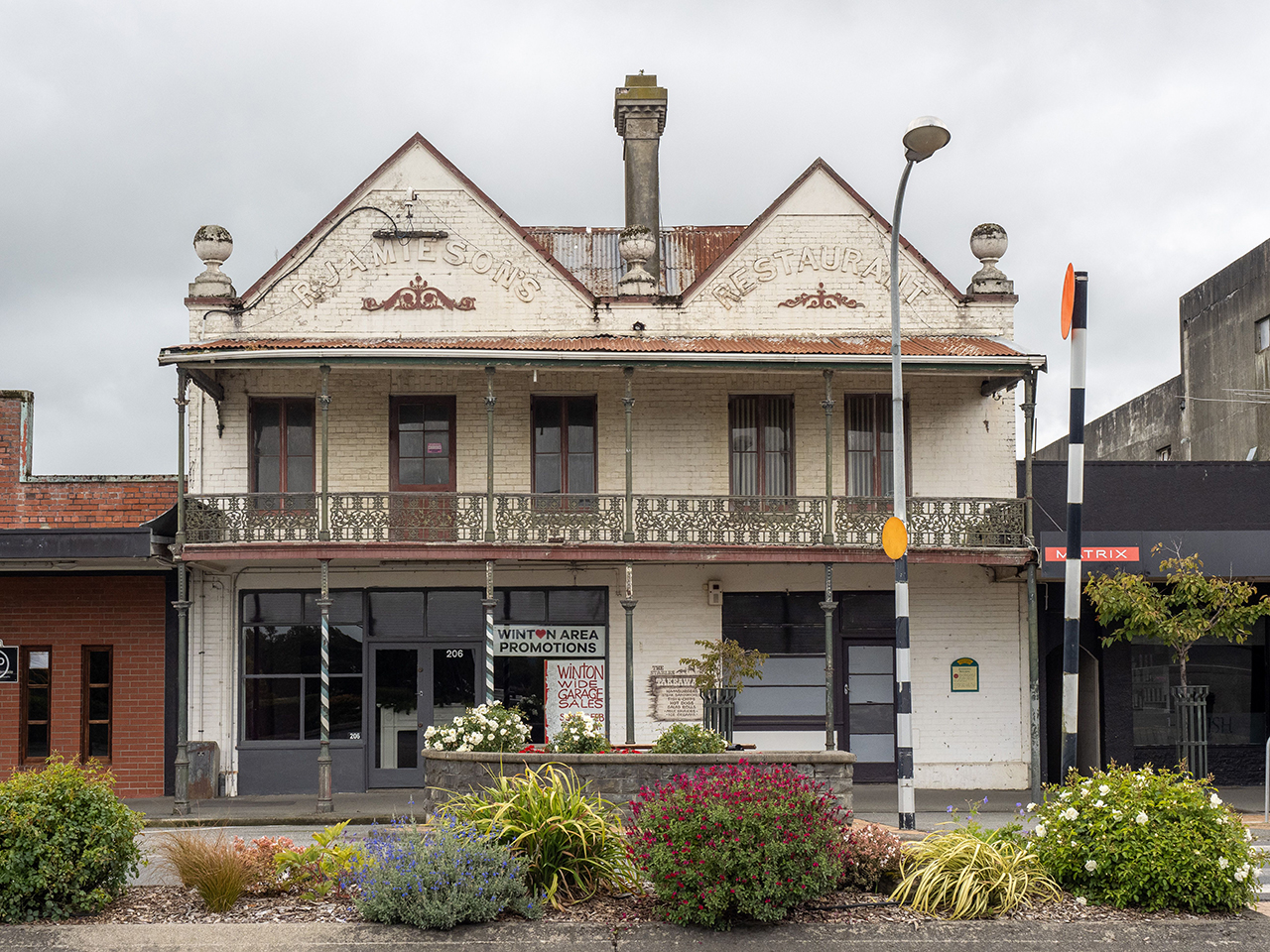
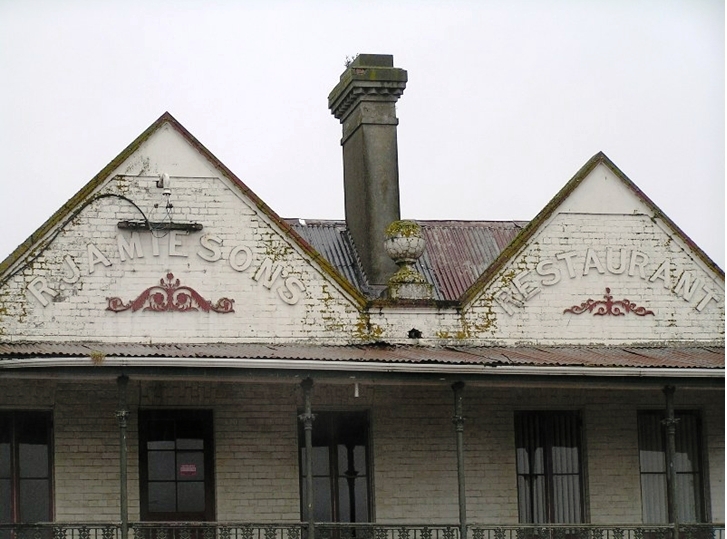
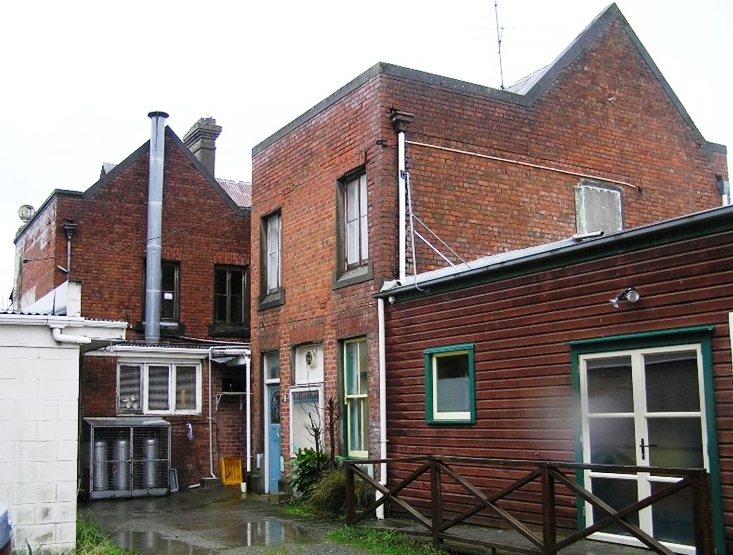
Setting Jamieson’s Restaurant (Former) sits on Great North Road, the main thoroughfare through the small rural service town of Winton. The town is notable for its intact Victorian and Edwardian streetscape, recognised by the Winton Great North Road Historic Area. Jamieson’s Restaurant is a significant element in this streetscape. Exterior Jamieson’s Restaurant (Former) is a two-storeyed colonial commercial building with painted brick veneer. The striking façade has two triangular pediments at the roofline, concealing the gabled roof behind. The roof form has parallel gables, with a transecting gable between them, from which a tall chimney protrudes. The façade is decorated with decorative plaster scrolls in the centre of each pediment and spherical ‘urns’ punctuate the parapets. The name of the business ‘R.Jamieson’s Restaurant’ is spelled out in relief. The building has a double-height, iron-roofed verandah with decorated cast-iron posts extending through both levels. There is a cast iron lace running across the first floor verandah. The commercial premises were originally on the ground floor, while the top floor was the home of the owners and operators of the bakery/restaurant business. The ground floor has commercial shop fronts which have modified windows, entry doors and doorways. The first floor openings on the front façade are four double hung sash windows and a French door. The rear of the building repeats the parapet form of the front elevation, but without the decorative elements. A modern timber addition is evident at the rear of the building. Interior The interior of the building was not inspected in the preparation of this report.
Setting Jamieson’s Restaurant (Former) sits on Great North Road, the main thoroughfare through the small rural service town of Winton. The town is notable for its intact Victorian and Edwardian streetscape, recognised by the Winton Great North Road Historic Area. Jamieson’s Restaurant is a significant element in this streetscape. Exterior Jamieson’s Restaurant (Former) is a two-storeyed colonial commercial building with painted brick veneer. The striking façade has two triangular pediments at the roofline, concealing the gabled roof behind. The roof form has parallel gables, with a transecting gable between them, from which a tall chimney protrudes. The façade is decorated with decorative plaster scrolls in the centre of each pediment and spherical ‘urns’ punctuate the parapets. The name of the business ‘R.Jamieson’s Restaurant’ is spelled out in relief. The building has a double-height, iron-roofed verandah with decorated cast-iron posts extending through both levels. There is a cast iron lace running across the first floor verandah. The commercial premises were originally on the ground floor, while the top floor was the home of the owners and operators of the bakery/restaurant business. The ground floor has commercial shop fronts which have modified windows, entry doors and doorways. The first floor openings on the front façade are four double hung sash windows and a French door. The rear of the building repeats the parapet form of the front elevation, but without the decorative elements. A modern timber addition is evident at the rear of the building. Interior The interior of the building was not inspected in the preparation of this report.
Historical and Associated Iwi / Hapū / Whānau
Completion Date
15th September 2011
Report Written By
Karen Astwood/Heather Bauchop
Information Sources
Southland District Council
Southland District Council
Thorne 1980
Robert Thorne, ‘Places of refreshment in the nineteenth century city’ in Anthony D. King, Buildings and Society: Essays on the Social Development of the Built Environment, Routledge Kegan Paul, London, 1980
Rowland 2010
Perrin Rowland, Dining Out: A History of the Restaurant in New Zealand, Auckland University Press, Auckland, 2010
Other Information
A fully referenced registration report is available from the NZHPT Otago/Southland Area Office. Please note that entry on the New Zealand Heritage List/Rarangi Korero identifies only the heritage values of the property concerned, and should not be construed as advice on the state of the property, or as a comment of its soundness or safety, including in regard to earthquake risk, safety in the event of fire, or insanitary conditions.
Historical and Associated Iwi / Hapū / Whānau
Completion Date
15th September 2011
Report Written By
Karen Astwood/Heather Bauchop
Information Sources
Southland District Council
Southland District Council
Thorne 1980
Robert Thorne, ‘Places of refreshment in the nineteenth century city’ in Anthony D. King, Buildings and Society: Essays on the Social Development of the Built Environment, Routledge Kegan Paul, London, 1980
Rowland 2010
Perrin Rowland, Dining Out: A History of the Restaurant in New Zealand, Auckland University Press, Auckland, 2010
Other Information
A fully referenced registration report is available from the NZHPT Otago/Southland Area Office. Please note that entry on the New Zealand Heritage List/Rarangi Korero identifies only the heritage values of the property concerned, and should not be construed as advice on the state of the property, or as a comment of its soundness or safety, including in regard to earthquake risk, safety in the event of fire, or insanitary conditions.
Current Usages
Uses: Trade
Specific Usage: Retail and Commercial - other
Former Usages
General Usage: Accommodation
Specific Usage: House
General Usage: Manufacturing
Specific Usage: Bakery
General Usage: Trade
Specific Usage: Restaurant/cafe/tearoom
Current Usages
Uses: Trade
Specific Usage: Retail and Commercial - other
Former Usages
General Usage: Accommodation
Specific Usage: House
General Usage: Manufacturing
Specific Usage: Bakery
General Usage: Trade
Specific Usage: Restaurant/cafe/tearoom
Get the latest heritage news, features and events delivered
straight to your inbox.