DonateMembershipVisit Heritage
  • Tūrangawaewae
    Places
  • Tira Māori
    Māori Heritage
  • Poutairangahia
    Archaeology
  • Rauemi
    Resources
  • Mō Tātou
    About Us
  • New Zealand Heritage List
  • Nominate and submit
  • Explore the List
  • National Historic Landmarks
  • Plaques
  • Rainbow List Project
  • Lost heritage
  • Visit Heritage
  • Our properties
  • Turnbull House Project
  • Collections
  • Shop
  • Tohu Whenua
  • Tira Māori
  • Conserving Māori heritage
  • Marae built heritage
  • Māori heritage on the List
  • Hinemihi—Te Hokinga Mai
  • What is archaeology?
  • Is there a site on my property?
  • What are my legal requirements?
  • Affecting an archaeological site
  • Declaring an archaeological site
  • Archaeology FAQs
  • Archaeology Digital Library
  • Archaeology guidelines and templates
  • Resources
  • Funding
  • Publications
  • Sustainable management guides
  • Disaster recovery
  • Podcasts & digital resources
  • Education Hub
  • Conservation plans
  • About
  • Board
  • Māori Heritage Council
  • Senior Staff
  • Offices
  • Contact us
  • Careers
  • Covenants
  • Fast-track
  • Corporate documents
  • Currently consulting on
  • Our submissions
  • News
  • Covid-19 response
Quick links
Rārangi Kōrero | The List
Explore the List
National Historic Landmarks
Ngā Manawhenua o Aotearoa me ōna Kōrero Tūturu
Quick links
Tapuwae
A Vision for Places of Māori Heritage
Funding for Māori Heritage
Resources
Quick links
Archaeological Authority Portal
Applying for an archaeological authority
Archaeology FAQs
Browse the most frequently asked questions about archaeological authorities and the archaeological process.
Quick links
Quick links
News
News Keep up to date with Heritage New Zealand Pouhere Taonga
Membership
Membership Find out more and sign up today
DonateMembershipVisit Heritage
  • Tūrangawaewae
    Places
  • Tira Māori
    Māori Heritage
  • Poutairangahia
    Archaeology
  • Rauemi
    Resources
  • Mō Tātou
    About Us
  • New Zealand Heritage List
  • Nominate and submit
  • Explore the List
  • National Historic Landmarks
  • Plaques
  • Rainbow List Project
  • Lost heritage
  • Visit Heritage
  • Our properties
  • Turnbull House Project
  • Collections
  • Shop
  • Tohu Whenua
  • Tira Māori
  • Conserving Māori heritage
  • Marae built heritage
  • Māori heritage on the List
  • Hinemihi—Te Hokinga Mai
  • What is archaeology?
  • Is there a site on my property?
  • What are my legal requirements?
  • Affecting an archaeological site
  • Declaring an archaeological site
  • Archaeology FAQs
  • Archaeology Digital Library
  • Archaeology guidelines and templates
  • Resources
  • Funding
  • Publications
  • Sustainable management guides
  • Disaster recovery
  • Podcasts & digital resources
  • Education Hub
  • Conservation plans
  • About
  • Board
  • Māori Heritage Council
  • Senior Staff
  • Offices
  • Contact us
  • Careers
  • Covenants
  • Fast-track
  • Corporate documents
  • Currently consulting on
  • Our submissions
  • News
  • Covid-19 response
Quick links
Rārangi Kōrero | The List
Explore the List
National Historic Landmarks
Ngā Manawhenua o Aotearoa me ōna Kōrero Tūturu
Quick links
Tapuwae
A Vision for Places of Māori Heritage
Funding for Māori Heritage
Resources
Quick links
Archaeological Authority Portal
Applying for an archaeological authority
Archaeology FAQs
Browse the most frequently asked questions about archaeological authorities and the archaeological process.
Quick links
Quick links
News
News Keep up to date with Heritage New Zealand Pouhere Taonga
Membership
Membership Find out more and sign up today
  • Places
  • Nominate and submit
  • National Historic Landmarks
  • Places
  • Nominate and submit
  • National Historic Landmarks
  • Tira Māori
  • Conserving Māori heritage
  • Marae built heritage
  • Tira Māori
  • Conserving Māori heritage
  • Marae built heritage
  • Archaeological authorities
  • Archaeology Digital Library
  • Archaeological authorities
  • Archaeology Digital Library
  • All resources
  • Publications
  • Funding
  • All resources
  • Publications
  • Funding
  • FAQs
  • FAQs
Follow us on:
Places
  • Places
  • Nominate and submit
  • National Historic Landmarks
Tira Māori
  • Tira Māori
  • Conserving Māori heritage
  • Marae built heritage
Archaeology
  • Archaeological authorities
  • Archaeology Digital Library
Resources
  • All resources
  • Publications
  • Funding
FAQs
  • FAQs
Follow us on
HomePrivacyTerms and conditionsAbout this site
© Heritage New Zealand Pouhere Taonga 2026.
 
Milne and Choyce Department Store (Former)

131 Queen Street, AUCKLAND

Private

Historic Place Category 2

List No. 2620

Quick links:
List GalleryLocationDetails
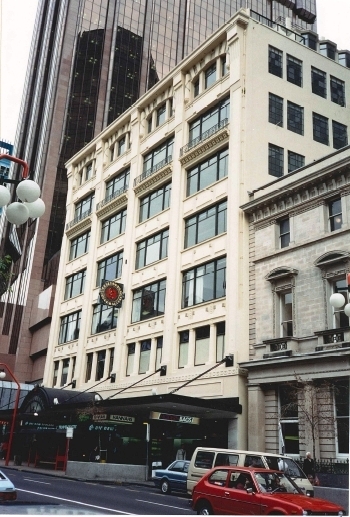
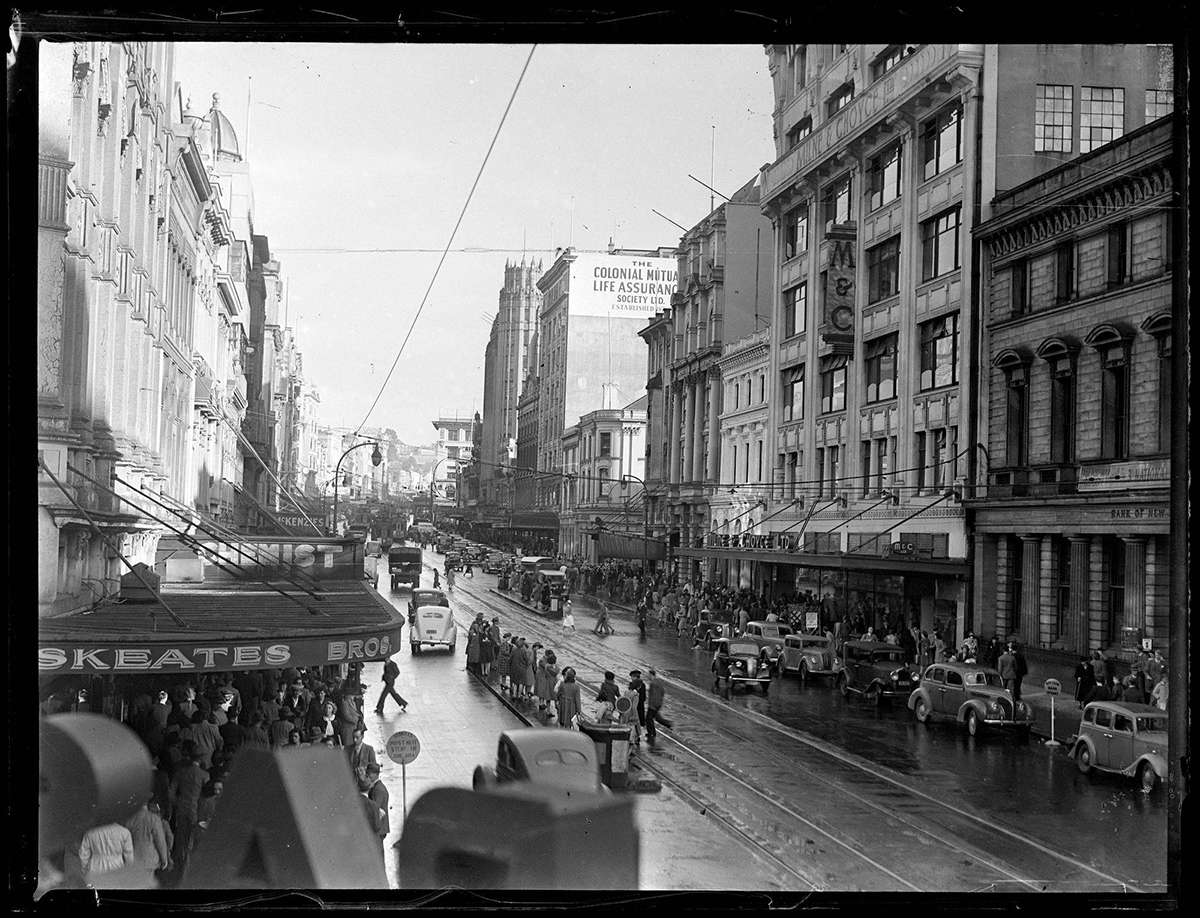
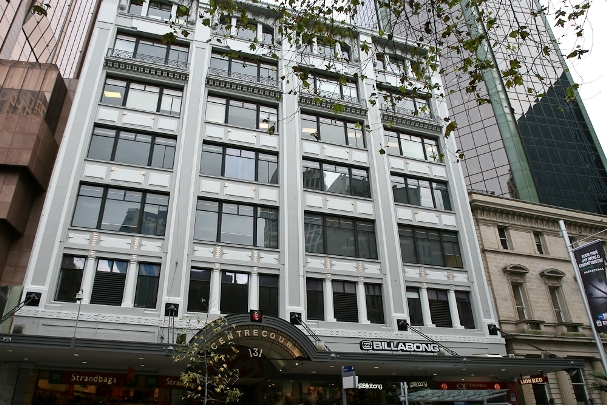
The concrete nine-storey Milne and Choyce (former) building, in Queen Street, built at the beginning of the 1920s, once housed one of the largest and most modern department stores in New Zealand: ‘a town in itself’. Like many such stores, it grew from a small drapery store started by women in the second half of the nineteenth century. The store was significant as a leader in the New Zealand retail practice, was a major employer, and for 50 years was an important social space. Its design, by engineer Eric Rhodes and architect Llewellyn Piper, is significant as an early example of then-new earthquake-resistant design. It also has a long connection with the Milne and Choyce families, who were involved for several generations, and with Fletcher Construction.

In 1866 two sisters, Mary Jane and Charlotte Milne, established a millinery and drapery in Auckland. Charlotte later married Henry Choyce who entered into a partnership with Mary Jane, and the store flourished. In 1909, the store took over a substantial 1870s building on Queen Street, originally built for New Zealand Loan and Mercantile. It operated in this building until it replaced it with a new 9-storey store on the same site, constructed in 1921-4. James Fletcher of Fletcher Construction had seen early plans for the new building, and boldly offered to come up with improved plans. Fletchers’ soon had a contract for an enormous new store, designed by their new structural engineer Eric Rhodes and architect Llewellyn Piper, who went on to have a notable career designing many Auckland modern buildings. In contrast to the reinforced concrete beam and column construction commonly used in multi-storey buildings at the time, the building employed flat-slab construction with mushroom-headed columns, recently developed in the United States to be earthquake resistant. This allowed unobstructed ceilings and floor spaces, ‘lending to the monolithic strength of the work an attractive appearance of lightness’. The building was built in five sections, allowing the store to continue business during construction. The eighth floor was topped with a mansard roof containing the Tudor Tearooms, the ‘most up-to-date tearooms in Auckland’, seating 600 and opening into an open-air roof garden, with a distinctive pergola. This roof garden was glassed in by 1927.

The store was highly successful, leading the way in many modern retail techniques, providing additional services such as barbershops, hosting community events, and becoming an important part of the social sphere and a major employer. Its tearoom alone hosted a quarter of a million people in one year. To accommodate their large clothing factory and to create yet more retail space, a new seven-storey building, known as the Annex, was erected at the rear, facing Mills Lane, in 1929-30, containing a highly decorated Art Deco Reception Hall, and with its lower floors connected to the existing shop, and a mezzanine floor added. During the Second World War (1939-45), the building had air raid shelters installed, removed two years later. In 1955, a home appliance department and food court was added to the lower ground floor.

From the 1960s, the company attempted to diversify into suburbs and towns, but like many department stores it struggled to adjust to changing retail climates. Looking to anchor their new Downtown mall development, Fletchers acquired control of the company, and moved the store there, and sold this building. Since then, the building has had numerous internal alterations for many retail and commercial clients. The annex was demolished to make way for a neighbouring tower block in the 1980s. Today the building contains a mix of retail, on the lower floors, and commercial tenants above, and remains an important part of the Queen Street streetscape.
Milne and Choyce Department Store (Former), Auckland. CC0 Image courtesy of commons.wikimedia.org | Paora | 22/12/2025 | Public Domain
Milne and Choyce Department Store (Former), Auckland. CC BY-SA 4.0 Image courtesy of commons.wikimedia.org | Itineris55 | 07/12/2022 | Itineris55 - Wikimedia Commons
Milne and Choyce Department Store (Former), Auckland. c.1940s-50's Image courtesy of Auckland Libraries Heritage Collections 1370-040-04 | New Zealand Herald | Auckland Libraries
Milne and Choyce Department Store (Former), Auckland. CC0 Image courtesy of commons.wikimedia.org | Paora | 22/12/2025 | Public Domain
Milne and Choyce Department Store (Former), Auckland. CC BY-SA 4.0 Image courtesy of commons.wikimedia.org | Itineris55 | 07/12/2022 | Itineris55 - Wikimedia Commons
Milne and Choyce Department Store (Former), Auckland. c.1940s-50's Image courtesy of Auckland Libraries Heritage Collections 1370-040-04 | New Zealand Herald | Auckland Libraries

List Entry Information

Overview

Status
Listed

List Entry Status
Historic Place Category 2

Access
Private/No Public Access

List Number
2620

Date Entered
26th November 1981

Date of Effect
26th November 1981

City/District Council
Auckland Council

Region
Auckland Council

Extent of List Entry

Extent includes the land described as Lot 1 DP 77767 (RT NA50B/716), North Auckland Land District, and the building known as Milne and Choyce Department Store (Former) thereon

Legal description

Lot 1 DP 77767 (RT NA50B/716), North Auckland Land District

Detailed List Entry

Construction Professional

Name

Piper, Llewellyn

Type

Architect

Biography

No biography is currently available for this construction professional

Name

Eric Rhodes

Type

Engineer

Biography

No biography is currently available for this construction professional

Name

Fletcher Construction Company

Type

Builder

Biography

Fletcher Construction Company was founded by Scottish-born James Fletcher (1886 - 1974), the son of a builder. Six months after his arrival in Dunedin in 1908, Fletcher formed a house-building partnership with Bert Morris. They soon moved into larger-scale construction work, building the St Kilda Town Hall (1911), and the main dormitory block and Ross Chapel at Knox College (1912). Fletcher's brothers, William, Andrew and John joined the business in 1911, which then became known as Fletcher Brothers. A branch was opened in Invercargill. While holidaying in Auckland in 1916, James tendered for the construction of the the Auckland City Markets. By 1919 the company, then known as Fletcher Construction, was firmly established in Auckland and Wellington. Notable landmarks constructed by the company during the Depression included the Auckland University College Arts Building (completed 1926); Landmark House (the former Auckland Electric Power Board Building, 1927); Auckland Civic Theatre (1929); the Chateau Tongariro (1929); and the Dominion Museum, Wellington (1934). Prior to the election of the first Labour Government, Fletcher (a Reform supporter) had advised the Labour Party on housing policy as hbe believed in large-scale planning and in the inter-dependence of government and business. However, he declined an approach by Prime Minister Michael Joseph Savage in December 1935 to sell the company to the government, when the latter wanted to ensure the large-scale production of rental state housing. Although Fletchers ultimately went on to build many of New Zealand's state houses, for several years Residential Construction Ltd (the subsidiary established to undertake their construction) sustained heavy financial losses. Fletcher Construction became a public company, Fletcher Holdings, in 1940. Already Fletchers' interests were wide ranging: brickyards, engineering shops, joinery factories, marble quarries, structural steel plants and other enterprises had been added the original construction firm. Further expansion could only be undertaken with outside capital. During the Second World War James Fletcher, having retired as chairman of Fletcher Holdings, was seconded to the newly created position of Commissioner of State Construction which he held during 1942 and 1943. Directly responsible to Prime Minister Peter Fraser, Fletcher had almost complete control over the deployment of workers and resources. He also became the Commissioner of the Ministry of Works, set up in 1943, a position he held until December 1945. In 1981 Fletcher Holdings; Tasman Pulp and Paper; and Challenge Corporation amalgamated to form Fletcher Challenge Ltd, at that time New Zealand's largest company. Williamson Construction Company - main contract

Construction Details

Type

Addition

Description

Construction of the Annex, and mezzanine added to the original building

Period

1929-31

Type

Partial Demolition

Description

Annex demolished

Period

1980s

Reference

Completion Date

29th June 2015

Report Written By

Elizabeth Cox

Information Sources

Auckland Star

Auckland Star

Dictionary of New Zealand Biography

Dictionary of New Zealand Biography

Robinson, 1970

Neil Robinson, James Fletcher: Builder, Hodder and Stoughton, London, 1970

Te Ara - The Encyclopedia of New Zealand

www.TeAra.govt.nz

New Zealand Herald

11 Nov 1903, p.6.

Cashmore, 1984

Cashmore, Stephen, ‘Auckland Loses an Art Deco Interior’, Historic Places in New Zealand, June 1984

Goldsmith, 2009

Goldsmith, Paul, Fletchers: A Centennial History of Fletcher Building, Auckland, 2009

Grattan, 1966

Grattan, K. 'A century of fashion: Milne & Choyce, 1866-1966'. Journal of the Auckland Historical Society 8 (1966)

Hunt & Morrow, 2006

Hunt, Ian and Diana Morrow (eds.), City of Enterprise: Perspectives on Auckland Business History, Auckland, 2006.

Laurenson, 2009

Laurenson, Helen, Going Up Going Down: The Rise and Fall of the Department Store, Auckland, 2009.

Tucker, 1968

Tucker, K A, Milne and Choyce: One Hundred Years Business History 1867-1967, Auckland, 1968

Report Written By

This place was identified as significant under previous legislation with different information requirements. It remains significant under the current legislation. There is opportunity under our legislation and policies to add to this information. Further information about this place may be available from the Northern Regional Office of Heritage New Zealand Pouhere Taonga. Please note that entry on the New Zealand Heritage List/Rarangi Korero identifies only the heritage values of the property concerned, and should not be construed as advice on the state of the property, or as a comment of its soundness or safety, including in regard to earthquake risk, safety in the event of fire, or insanitary conditions. A fully referenced upgrade report is available on request from the Northern Region Office of Heritage New Zealand

Further Information

Current Usages

Uses: Trade

Specific Usage: Office building/Offices

Uses: Trade

Specific Usage: Shopping/retail complex

Former Usages

General Usage:: Trade

Specific Usage: Department Store

Themes

Web Links

Overview

Status

Listed

List Entry Status

Historic Place Category 2

Access

Private/No Public Access

List Number

2620

Date Entered

26th November 1981

Date of Effect

26th November 1981

City/District Council

Auckland Council

Region

Auckland Council

Extent of List Entry

Extent includes the land described as Lot 1 DP 77767 (RT NA50B/716), North Auckland Land District, and the building known as Milne and Choyce Department Store (Former) thereon

Legal description

Lot 1 DP 77767 (RT NA50B/716), North Auckland Land District

Status

Listed

List Entry Status

Historic Place Category 2

Access

Private/No Public Access

List Number

2620

Date Entered

26th November 1981

Date of Effect

26th November 1981

City/District Council

Auckland Council

Region

Auckland Council

Extent of List Entry

Extent includes the land described as Lot 1 DP 77767 (RT NA50B/716), North Auckland Land District, and the building known as Milne and Choyce Department Store (Former) thereon

Legal description

Lot 1 DP 77767 (RT NA50B/716), North Auckland Land District

Construction Information

Construction Professional

Name

Piper, Llewellyn

Type

Architect

Biography

No biography is currently available for this construction professional

Name

Eric Rhodes

Type

Engineer

Biography

No biography is currently available for this construction professional

Name

Fletcher Construction Company

Type

Builder

Biography

Fletcher Construction Company was founded by Scottish-born James Fletcher (1886 - 1974), the son of a builder. Six months after his arrival in Dunedin in 1908, Fletcher formed a house-building partnership with Bert Morris. They soon moved into larger-scale construction work, building the St Kilda Town Hall (1911), and the main dormitory block and Ross Chapel at Knox College (1912). Fletcher's brothers, William, Andrew and John joined the business in 1911, which then became known as Fletcher Brothers. A branch was opened in Invercargill. While holidaying in Auckland in 1916, James tendered for the construction of the the Auckland City Markets. By 1919 the company, then known as Fletcher Construction, was firmly established in Auckland and Wellington. Notable landmarks constructed by the company during the Depression included the Auckland University College Arts Building (completed 1926); Landmark House (the former Auckland Electric Power Board Building, 1927); Auckland Civic Theatre (1929); the Chateau Tongariro (1929); and the Dominion Museum, Wellington (1934). Prior to the election of the first Labour Government, Fletcher (a Reform supporter) had advised the Labour Party on housing policy as hbe believed in large-scale planning and in the inter-dependence of government and business. However, he declined an approach by Prime Minister Michael Joseph Savage in December 1935 to sell the company to the government, when the latter wanted to ensure the large-scale production of rental state housing. Although Fletchers ultimately went on to build many of New Zealand's state houses, for several years Residential Construction Ltd (the subsidiary established to undertake their construction) sustained heavy financial losses. Fletcher Construction became a public company, Fletcher Holdings, in 1940. Already Fletchers' interests were wide ranging: brickyards, engineering shops, joinery factories, marble quarries, structural steel plants and other enterprises had been added the original construction firm. Further expansion could only be undertaken with outside capital. During the Second World War James Fletcher, having retired as chairman of Fletcher Holdings, was seconded to the newly created position of Commissioner of State Construction which he held during 1942 and 1943. Directly responsible to Prime Minister Peter Fraser, Fletcher had almost complete control over the deployment of workers and resources. He also became the Commissioner of the Ministry of Works, set up in 1943, a position he held until December 1945. In 1981 Fletcher Holdings; Tasman Pulp and Paper; and Challenge Corporation amalgamated to form Fletcher Challenge Ltd, at that time New Zealand's largest company. Williamson Construction Company - main contract

Construction Details

Type

Addition

Description

Construction of the Annex, and mezzanine added to the original building

Period

1929-31

Type

Partial Demolition

Description

Annex demolished

Period

1980s

Construction Professional

Name

Piper, Llewellyn

Type

Architect

Biography

No biography is currently available for this construction professional

Name

Eric Rhodes

Type

Engineer

Biography

No biography is currently available for this construction professional

Name

Fletcher Construction Company

Type

Builder

Biography

Fletcher Construction Company was founded by Scottish-born James Fletcher (1886 - 1974), the son of a builder. Six months after his arrival in Dunedin in 1908, Fletcher formed a house-building partnership with Bert Morris. They soon moved into larger-scale construction work, building the St Kilda Town Hall (1911), and the main dormitory block and Ross Chapel at Knox College (1912). Fletcher's brothers, William, Andrew and John joined the business in 1911, which then became known as Fletcher Brothers. A branch was opened in Invercargill. While holidaying in Auckland in 1916, James tendered for the construction of the the Auckland City Markets. By 1919 the company, then known as Fletcher Construction, was firmly established in Auckland and Wellington. Notable landmarks constructed by the company during the Depression included the Auckland University College Arts Building (completed 1926); Landmark House (the former Auckland Electric Power Board Building, 1927); Auckland Civic Theatre (1929); the Chateau Tongariro (1929); and the Dominion Museum, Wellington (1934). Prior to the election of the first Labour Government, Fletcher (a Reform supporter) had advised the Labour Party on housing policy as hbe believed in large-scale planning and in the inter-dependence of government and business. However, he declined an approach by Prime Minister Michael Joseph Savage in December 1935 to sell the company to the government, when the latter wanted to ensure the large-scale production of rental state housing. Although Fletchers ultimately went on to build many of New Zealand's state houses, for several years Residential Construction Ltd (the subsidiary established to undertake their construction) sustained heavy financial losses. Fletcher Construction became a public company, Fletcher Holdings, in 1940. Already Fletchers' interests were wide ranging: brickyards, engineering shops, joinery factories, marble quarries, structural steel plants and other enterprises had been added the original construction firm. Further expansion could only be undertaken with outside capital. During the Second World War James Fletcher, having retired as chairman of Fletcher Holdings, was seconded to the newly created position of Commissioner of State Construction which he held during 1942 and 1943. Directly responsible to Prime Minister Peter Fraser, Fletcher had almost complete control over the deployment of workers and resources. He also became the Commissioner of the Ministry of Works, set up in 1943, a position he held until December 1945. In 1981 Fletcher Holdings; Tasman Pulp and Paper; and Challenge Corporation amalgamated to form Fletcher Challenge Ltd, at that time New Zealand's largest company. Williamson Construction Company - main contract

Construction Details

Type

Addition

Description

Construction of the Annex, and mezzanine added to the original building

Period

1929-31

Type

Partial Demolition

Description

Annex demolished

Period

1980s

Reference

Historical and Associated Iwi / Hapū / Whānau

Completion Date

29th June 2015

Report Written By

Elizabeth Cox

Information Sources

Auckland Star

Auckland Star

Dictionary of New Zealand Biography

Dictionary of New Zealand Biography

Robinson, 1970

Neil Robinson, James Fletcher: Builder, Hodder and Stoughton, London, 1970

Te Ara - The Encyclopedia of New Zealand

www.TeAra.govt.nz

New Zealand Herald

11 Nov 1903, p.6.

Cashmore, 1984

Cashmore, Stephen, ‘Auckland Loses an Art Deco Interior’, Historic Places in New Zealand, June 1984

Goldsmith, 2009

Goldsmith, Paul, Fletchers: A Centennial History of Fletcher Building, Auckland, 2009

Grattan, 1966

Grattan, K. 'A century of fashion: Milne & Choyce, 1866-1966'. Journal of the Auckland Historical Society 8 (1966)

Hunt & Morrow, 2006

Hunt, Ian and Diana Morrow (eds.), City of Enterprise: Perspectives on Auckland Business History, Auckland, 2006.

Laurenson, 2009

Laurenson, Helen, Going Up Going Down: The Rise and Fall of the Department Store, Auckland, 2009.

Tucker, 1968

Tucker, K A, Milne and Choyce: One Hundred Years Business History 1867-1967, Auckland, 1968

Other Information

This place was identified as significant under previous legislation with different information requirements. It remains significant under the current legislation. There is opportunity under our legislation and policies to add to this information. Further information about this place may be available from the Northern Regional Office of Heritage New Zealand Pouhere Taonga. Please note that entry on the New Zealand Heritage List/Rarangi Korero identifies only the heritage values of the property concerned, and should not be construed as advice on the state of the property, or as a comment of its soundness or safety, including in regard to earthquake risk, safety in the event of fire, or insanitary conditions. A fully referenced upgrade report is available on request from the Northern Region Office of Heritage New Zealand

Historical and Associated Iwi / Hapū / Whānau

Completion Date

29th June 2015

Report Written By

Elizabeth Cox

Information Sources

Auckland Star

Auckland Star

Dictionary of New Zealand Biography

Dictionary of New Zealand Biography

Robinson, 1970

Neil Robinson, James Fletcher: Builder, Hodder and Stoughton, London, 1970

Te Ara - The Encyclopedia of New Zealand

www.TeAra.govt.nz

New Zealand Herald

11 Nov 1903, p.6.

Cashmore, 1984

Cashmore, Stephen, ‘Auckland Loses an Art Deco Interior’, Historic Places in New Zealand, June 1984

Goldsmith, 2009

Goldsmith, Paul, Fletchers: A Centennial History of Fletcher Building, Auckland, 2009

Grattan, 1966

Grattan, K. 'A century of fashion: Milne & Choyce, 1866-1966'. Journal of the Auckland Historical Society 8 (1966)

Hunt & Morrow, 2006

Hunt, Ian and Diana Morrow (eds.), City of Enterprise: Perspectives on Auckland Business History, Auckland, 2006.

Laurenson, 2009

Laurenson, Helen, Going Up Going Down: The Rise and Fall of the Department Store, Auckland, 2009.

Tucker, 1968

Tucker, K A, Milne and Choyce: One Hundred Years Business History 1867-1967, Auckland, 1968

Other Information

This place was identified as significant under previous legislation with different information requirements. It remains significant under the current legislation. There is opportunity under our legislation and policies to add to this information. Further information about this place may be available from the Northern Regional Office of Heritage New Zealand Pouhere Taonga. Please note that entry on the New Zealand Heritage List/Rarangi Korero identifies only the heritage values of the property concerned, and should not be construed as advice on the state of the property, or as a comment of its soundness or safety, including in regard to earthquake risk, safety in the event of fire, or insanitary conditions. A fully referenced upgrade report is available on request from the Northern Region Office of Heritage New Zealand

Further Information

Current Usages

Uses: Trade

Specific Usage: Office building/Offices

Uses: Trade

Specific Usage: Shopping/retail complex

Former Usages

General Usage: Trade

Specific Usage: Department Store

Current Usages

Uses: Trade

Specific Usage: Office building/Offices

Uses: Trade

Specific Usage: Shopping/retail complex

Former Usages

General Usage: Trade

Specific Usage: Department Store

Location

Loading
Stay up to date with Heritage this month