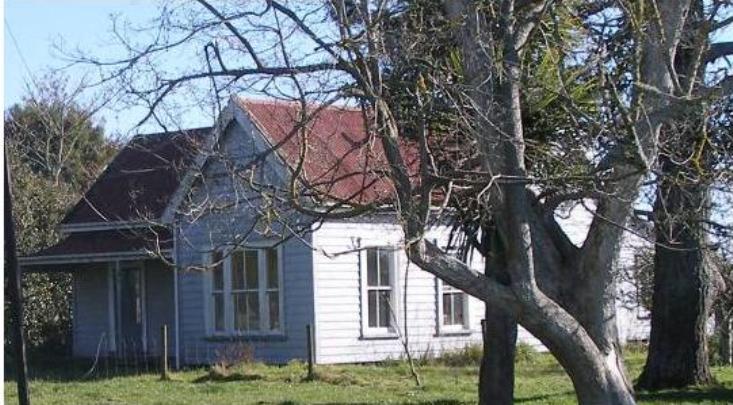
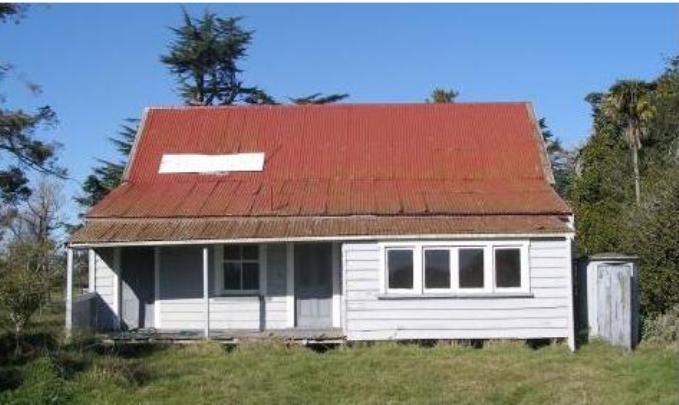
Woodside is a farm house, built in early 1879 (or late 1878) for Charles Crawford Wood (c.1848-1881) in the Tamahere district, now known as Matangi, Waikato. When built it was the homestead for a large farm of over 1680 acres (680 hectares) and continued in its original use for over 100 years. The house straddles the boundary of two parcels of land, Allotments 30 and 32, Parish of Tamahere.
The Tamahere-Matangi district was intensively occupied and cultivated by Ngati Haua until their land was confiscated by the government in 1864. In 1868, 15000 acres (6070 hectares) at Tamahere were subsequently returned as individual holdings to members of Ngati Haua who were considered friendly to the government. Allotment 30 of 70 acres (28.3 hectares) was granted to Mere Winitana, Allotment 32 of 100 acres (40.5 hectares) to Hori Winitana. By 1872, Tamahere Maori had sold nearly 5000 hectares to Europeans. Amongst the purchasers of the land around Woodside in October 1874 was Henry Wood, formerly of Auckland, but at that time residing in India, who acquired title to several allotments in Tamahere Parish, including Allotment 30. The exact date of purchase of Allotment 32 by the Wood family has not been established. Pastoral farming developed in the Tamahere district such that by January 1875 there were crops of wheat, barley and oats being grown by European settlers and ‘grain and potatoes galore’ by Maori. In December 1876 the Tamahere district still had ‘less than a score of settlers’. Henry Wood was an absentee owner; it is probable that his grandson Charles Wood was looking after his land as Charles was active in the Tamahere and Hamilton areas by 1874.
In September 1874 Charles Wood formed a cricket team in Hamilton and played rugby football for Auckland Province; he was described later as being ‘the life and soul of cricket and football in the Waikato’. Charles Wood was a steward for the Hamilton races in January 1875 and in 1876 his prominence in the neighbourhood was shown by his being elected auditor of the Tamahere Highway Board. In 1876 he married Jane Haultain, daughter of Colonel T.M. Haultain of the Waikato Militia who selected Hamilton as the site for a militia settlement. In 1878 Wood stood for Hamilton Borough Council but was unsuccessful. In December 1878 he was listed as a subscriber to a bridge at the Narrows; this would have provided better access to Woodside.
There may have been two houses on Wood’s property, as in December 1876 C.C. Wood’s two-bedroom house, described as ‘occasionally-used only’, burnt down, having been vacated that morning by ‘Mr J. Wood’, possibly Charles’ brother James. Ownership of Allotment 30 transferred to Charles Wood from his grandfather on 9 February 1877. In November 1878 Hamilton architect Thomas Henry White (T.H. White) called for tenders to build a four-roomed house for C.C. Wood at Tamahere; it is inferred that this house became Woodside and therefore that it was built in December 1878 or early 1879.
Thomas Henry White (1843-1923) began architectural work in the Waikato from at least 1875, and was based in Hamilton from 1877 until 1881. He lived on his farm at Taupiri, but maintained an office in Auckland as well. White undertook numerous architectural commissions in the Waikato, Auckland and Opotiki. His work ranged from bridges and substantial brick and plaster commercial buildings to timber shops, churches and dwellings. White was responsible for the design and construction of a concrete flour mill store at Ngaruawahia (1878), Firth Tower, Matamata (1881-82), St Peter’s Hall, Hamilton (1893), the Royal Hotel, Opotiki (1908), and St John's Presbyterian Church, Opotiki (1907). The only other known surviving residence designed by White is Hockin House, Hamilton (1893), which has been relocated. White was a trustee of the Kirikiriroa Highway Board, an elected member of the Kirikiriroa Licensing Committee, Honorary Secretary of the Taupiri Domain Board and a Justice of the Peace. He was also a musician, playing clarinet and violin.
The original house known as Woodside was a simple weatherboard two-storey cottage with a gabled roof and a lean-to along the northern side. The original house appears to have consisted of two rooms with a central hallway on the ground floor, two rooms in the lean-to and two attics in the gabled roof space above. There may have been an additional lean-to verandah structure to the north, with its floor at ground level, and another lean-to on the south side. The two rooms upstairs were accessed by a steep narrow staircase leading from one of the downstairs rooms or perhaps from the central hallway. The stairs now begin from the northwest bedroom but a change in the flooring in the hallway may indicate a previous location for the stairs. The tender advertisement’s ‘four-roomed’ description either did not include the two attic rooms or the rooms in the lean-to; alternatively, the house was built larger than that advertised. There may have been only two rooms in the lean-to: a large scullery, bedroom and no bathroom. The lean-to now has three rooms: bedroom on one side of the hall, bathroom and scullery on the other.
By 1880 other members of the Wood family were living at Tamahere, either in Woodside or in an additional cottage on the farm. Although ownership is attributed in newspaper advertisements variously to Browne Wood (Charles Wood’s father) and Charles Wood, the Certificates of Title remained in Charles Wood’s name. On the 1880 Electoral Roll, Browne Wood is listed as having freehold entitlement, whilst C.C. Wood and James W.H. Wood were listed as only residential farmers at Tamahere. Both Charles and Browne were elected to the board of the Tamahere Highway District in 1880 and an 1880 meeting of this board met at C.C. Wood’s ‘Old Farm Residence’ at Tamahere, again implying two residences.
One of the primary concerns of the Tamahere Board was the lack of roading, bridges and the generally poor condition of existing roads in the district. The Woods are recorded as having contributed to the establishment and improvement of roads and bridges at their own expense in order to provide better access to Hamilton and wider markets for farmers.
After Charles Wood’s early death in 1881, ownership of the now 1686 acres (682.3 hectares) property passed to Browne Wood. Browne Wood (circa 1822-1905) supported the Railway Reform League along with many other local farmers. He was one of several local men who set up the Waikato Cheese and Bacon Factory in 1882 and was one of its directors; this factory was one of the first to export cheese to the London markets. The factory closed in 1886; however the assets were transferred to the Waikato Dairy Company which was quickly established in its stead. These companies were the forerunners of the successful Glaxo Factory in Matangi.
Browne Wood farmed sheep, cattle, a dairy herd and grain crops and in 1882 he diversified the range of produce from the property, offering carrots for sale. In September 1883 Browne Wood advertised his property for sale; at that stage the property had a house and a cottage. However despite it being ‘well known’, desirable and close to railway stations on the Rotorua line, the sale was unsuccessful.
Two tragic accidents resulted in the deaths at Woodside of Charles Wood’s six year-old son Athol in 1886 and another of Browne Wood’s sons, Robert, in August 1887; these may have been factors in the Woods’ decision to finally leave the farm. In September 1887 Woodside was again for sale with livestock that included 40 dairy cows. The sale was again unsuccessful, but Browne Wood and his wife Elizabeth left to live in Nelson. The farm was then leased.
At some time the house was expanded with the addition of two large rooms and central hallway on the south side of the ground floor, and verandahs on the front (south) and west sides. There was no door from the house onto the west verandah. The chimney from the new south-eastern room emerged from the ridge of the new gabled roof.
In 1890 the New Zealand Loan and Mercantile Agency Company Limited exercised their Power of Sale through the mortgage and bought the land at a public auction in Hamilton. The advertisement for the auction described the property as having a seven-roomed house, two cottages, large cowshed and stable, and a ‘large proportion’ of the farm as being of first-class quality. The company employed an experienced farmer, John James Graham, to manage the property, running 2000 to 3000 sheep. Graham was ‘an energetic member of various local bodies’, ‘well-known’, ‘deservedly popular’ and a ‘conspicuous figure in all the principal football matches in Waikato’.
The New Zealand Loan and Mercantile Agency Limited, founded in 1865 and incorporated in 1894, had a close relationship with the Bank of New Zealand and other large financial bodies and land associations in the Auckland Province in the 1880s-90s. The company was heavily involved with land development schemes in the Waikato and had a major influence on its development. Besides Woodside, other properties such as Josiah Firth’s Matamata Estate and Morrin and Studholm’s Lockerbie Estate were also taken over by the company during the late 1880s and early 1890s. The breaking up of these estates changed the nature of farming practice in the Waikato to embrace smaller properties.
The company sold Woodside in 1899 to John Knight. Edward, William and Arthur Goodwin held the title from 1906 to 1913 and had the property re-surveyed such that the house was then situated on new Lot 7 of 195 acres (78.9 hectares). The Goodwin family also owned Briarley, another property in the district. Edward Goodwin was well-known and held in high esteem in the community; he was a founder and chair of directors of the Frankton Sale yards Company and strongly associated with the Waikato Trotting Club and Waikato Racing Club. Edward Goodwin farmed in the Matangi area for several years.
In 1913 the Woodside Land Settlement Association, a conglomerate of twelve local farmers and businessmen owned the Woodside property, but it was promptly divided amongst them and Job Hinton received Lot 7 with the house and outbuildings. Job Hinton (1863-1938) came to the Waikato as a baby with his father Henry Hinton, a member of the Fourth Regiment of the Waikato Militia. After selling Woodside in 1918 Job and his wife Millicent continued to farm in the Matangi district. In August 1920 Lot 7 was transferred to Joseph Reyburn Webster and since then the farm has remained in the ownership of the Webster family.
Joseph Webster (circa 1862-1939) came to New Zealand in 1901. He was involved with work for the Methodist Church ‘in the backblocks of the Auckland Province’ and prominent in the local Methodist churches at Hamilton and Matangi. He was involved with the gasworks in Hamilton. His son Arthur (?-1968) took over the property in 1928. Arthur Webster served with the Home Guard during the Second World War. He was heavily involved with the local Methodist church; his wife Sylvia was involved with the Anglican Church, where she played the organ for about 50 years. She was also a music teacher. They were both well known in the district.
Arthur and Sylvia Webster made some changes to the house: in 1928-29 the low floored lean-to was removed from the back (north) of the house and replaced with the present lean-to verandah; the verandah on the west side was removed as it was never used; in 1947 the water tank that had been at the northwest corner was removed and part of the back verandah was enclosed and used as the bedroom for their son; the decorative fretwork was removed from the front verandah and a toilet was installed in the bathroom. An additional flush toilet was installed at the northwest corner of the house in a free-standing circular concrete structure.
Ian Webster (circa 1933-2007) took over ownership in 1966 and with his wife Dorothy built a new house to the south. He continued to farm the property until his death. Sylvia Webster continued to live in Woodside house after Arthur’s death, using the larger front room as her bedroom. She died in 1983, and the house was then let to tenants. Woodside house is currently unoccupied (2010) but is undergoing restoration. The house has been re-piled and the chimneys removed.