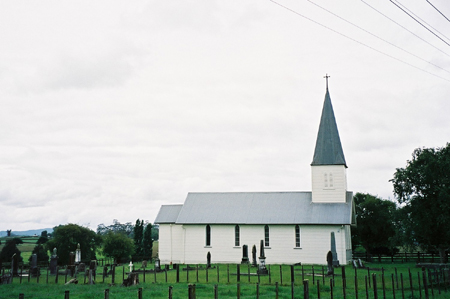
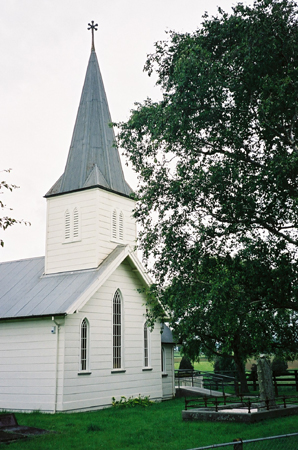
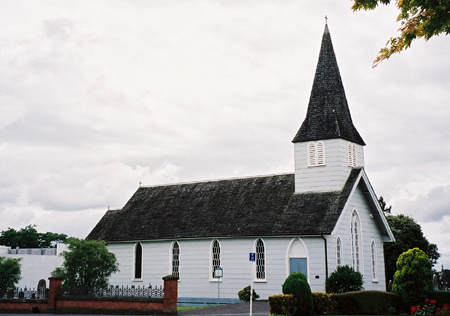
St Paul's Church, Hairini, is one of the two oldest surviving buildings in the Waikato, and one of a unique pair of Gothic Revival mission churches in the region (see 'St John's Church, Te Awamutu'). The timber building was constructed in 1852-1856 as part of the Church Missionary Society (CMS) station at Rangiaowhia, which had been founded from the nearby CMS mission at Otawhao prior to 1844. The station provided education as well as agricultural expertise and materials to local Ngati Hinetu and Ngati Apakura in what was one of the largest Maori settlements in the Waikato. By 1859 Rangiaowhia was described as a Maori town, with a racecourse and courthouse, growing wheat and other produce for the Auckland market. The church replaced earlier raupo chapels in the settlement and was a prominent landmark on the Rangiaowhia horizon. It was erected as a beacon of Protestant Anglo-Saxon culture, countering the influence of an adjacent Catholic mission and bolstering the mana of CMS missionaries as the town expanded.
Erected from timber donated by local Maori, the structure was built in a similar Gothic Revival style to that of its sister church at St John's, Te Awamutu. It initially consisted of a bell tower, nave and chancel, with the latter containing elaborate stained glass windows probably imported from Britain. Two of the windows depict St Paul's encounter with a magician, which may reflect hopes for Christian victory over the perceived 'supernatural' traditional beliefs of the church's predominantly Maori congregation. The richly decorative character of the windows contrasts with the spartan nature of the rest of the interior, where no pews were originally provided. Local skills were fostered, with a missionary teacher, Taati Te Waru, being commissioned to add a steeple in around 1857-1858. This occurred at the same time as the Kingite movement began to emerge, with King Potatau Te Wherowhero (?-1860) being proclaimed in Rangiaowhia in 1857. Abandoned by Pakeha missionaries in 1863, the church sheltered Maori during an attack on Rangiaowhia by British and colonial forces during the third New Zealand - or Waikato - War (1863-1864). With the settlement subsequently abandoned, the building remained empty until it was repaired by the Anglican Diocese in the 1870s. St Paul's, as it became known, was then used as a parish church and briefly as a government school. It continues to be used for religious services, although now surrounded by fields.
St Paul's Church is of national significance for its association with the colonisation of the Waikato, and its links with important events during the third New Zealand War. It is valuable for its connections to numerous aspects of nineteenth-century Maori history, including the development of urbanisation and new forms of agricultural production at Rangiaowhia. It is particularly important for its association with the arrival of Christianity in the Waikato, and the prominent role played by religion in early cross-cultural contact. Along with St John's, Te Awamutu, it is one of a unique pair of churches in the region, illustrating the activities of the CMS and its early members. The building is one of few CMS churches to survive in New Zealand, and reflects architectural and religious changes in the movement during the 1850s. Its fabric provides valuable information about social attitudes to race as well as techniques of colonial construction, including those carried out by Maori. It contains fixtures of national importance, such as its stained glass windows, which are among the earliest surviving and most unique examples in the country. The building reflects the later development of the Anglican church in the region, including its association with rural schooling. It is a prominent local landmark and has made a significant contribution to the social and spiritual life of its rural parish. The church is the only remaining building from a unique early colonial and Maori landscape at Rangiaowhia, and is closely associated with buried archaeological deposits in its graveyard and surrounding land.
Erected from timber donated by local Maori, the structure was built in a similar Gothic Revival style to that of its sister church at St John's, Te Awamutu. It initially consisted of a bell tower, nave and chancel, with the latter containing elaborate stained glass windows probably imported from Britain. Two of the windows depict St Paul's encounter with a magician, which may reflect hopes for Christian victory over the perceived 'supernatural' traditional beliefs of the church's predominantly Maori congregation. The richly decorative character of the windows contrasts with the spartan nature of the rest of the interior, where no pews were originally provided. Local skills were fostered, with a missionary teacher, Taati Te Waru, being commissioned to add a steeple in around 1857-1858. This occurred at the same time as the Kingite movement began to emerge, with King Potatau Te Wherowhero (?-1860) being proclaimed in Rangiaowhia in 1857. Abandoned by Pakeha missionaries in 1863, the church sheltered Maori during an attack on Rangiaowhia by British and colonial forces during the third New Zealand - or Waikato - War (1863-1864). With the settlement subsequently abandoned, the building remained empty until it was repaired by the Anglican Diocese in the 1870s. St Paul's, as it became known, was then used as a parish church and briefly as a government school. It continues to be used for religious services, although now surrounded by fields.
St Paul's Church is of national significance for its association with the colonisation of the Waikato, and its links with important events during the third New Zealand War. It is valuable for its connections to numerous aspects of nineteenth-century Maori history, including the development of urbanisation and new forms of agricultural production at Rangiaowhia. It is particularly important for its association with the arrival of Christianity in the Waikato, and the prominent role played by religion in early cross-cultural contact. Along with St John's, Te Awamutu, it is one of a unique pair of churches in the region, illustrating the activities of the CMS and its early members. The building is one of few CMS churches to survive in New Zealand, and reflects architectural and religious changes in the movement during the 1850s. Its fabric provides valuable information about social attitudes to race as well as techniques of colonial construction, including those carried out by Maori. It contains fixtures of national importance, such as its stained glass windows, which are among the earliest surviving and most unique examples in the country. The building reflects the later development of the Anglican church in the region, including its association with rural schooling. It is a prominent local landmark and has made a significant contribution to the social and spiritual life of its rural parish. The church is the only remaining building from a unique early colonial and Maori landscape at Rangiaowhia, and is closely associated with buried archaeological deposits in its graveyard and surrounding land.