This historic place was registered under the Historic Places Act 1993. Information in square brackets indicates modifications made after the paper was considered by the NZHPT Board.
Lake House was built in circa 1873 for James Williamson's Rukuhia Estate for his partner and manager Alfred Cox, on land surveyed in 1864 immediately following the colonial government's confiscation of vast tracts of Tainui land. Lake House is situated on gently sloping ground overlooking the west side of Lake Rotoroa, Hamilton. The eastern shore of the lake formed part of Hamilton West's western boundary with Lake House, at that time, being in Waipa County. When Lake House was built, Hamilton was still a very small town of fewer than 666 people. The land surrounding Hamilton had been mostly subdivided into 50- to 400-acre allotments for the 4th Waikato militiamen to settle, but some allotments such as those connected with Lake House were held by the government for sale.
Auckland businessman and politician, James Williamson and Alfred Cox together owned several thousand hectares south and west of Lake Rotoroa, much of that area known as the Rukuhia Swamp.The house is situated on Allotments variously acquired by them between 1865 and 1877.
James Williamson (1814-1888) was based in Auckland from 1841 when he established a store with Thomas Crummer. Williamson and Crummer made astute land purchases that saw Williamson a man of considerable wealth by the early 1860s; he won commissariat contracts during the Waikato wars. Williamson was a member of the House of Representatives (1862-67) and the Legislative Council (1870-88), a founder of the New Zealand Insurance Company (1859), the Bank of New Zealand (1861) and the New Zealand Loan and Mercantile Agency Company (1865). On his land at Onehunga he built the palatial house called The Pah (Monte Cecilia, Record No. 89) in 1879. Williamson speculated heavily in Waikato land that became available, initially by himself, then in partnership with Alfred Cox in the Rukuhia Estate, and in 1881 as one of the four main shareholders of the Auckland Agricultural Company. This company was insolvent by 1887, as was Williamson, who died soon after in March 1888.
Alfred Cox (1825-1911) was a prominent landowner in the South Canterbury and Waikato districts. He was elected to the House of Representatives in 1876, but retired because of ill-health and deafness in 1878. Cox helped finance a flour mill on Ohaupo Road, not far from Lake House, in 1872. He and Williamson were influential in the development of the Main Trunk Railway Line, as they provided land through the Rukuhia swamp for this purpose in 1872. Cox was described as well educated, an accomplished musician and a well-established farmer from Canterbury. He became a member of the Auckland Institute in April, 1873. He was considered to have 'done much to advance the material and social welfare of the district' being 'closely and zealously' identified with social enterprise. Cox was the editor of a book of biographies and author of a personal memoir.
Up until the mid-1860s 'the provincial pattern of Waikato farming had been small-scale', but access to large tracts of land confiscated from Tainui, changed this pattern. The first speculator to see the opportunities from acquisition of these lands was J.C. Firth with his lease of the Matamata Estate in 1866. Some formed land companies that played an important part in the development of the agricultural industry in New Zealand, particularly where major capital was required as was the case in the Waikato. Others associated in land deals in the Waikato were Thomas Russell, Henry Reynolds, Josiah Firth, Frederick Whittaker, William Steele and Every McLean. The Auckland Agricultural Company was in the same league as the Waikato Land Association and the Thames Valley Land Company and Williamson had partnerships with some of these men in relation to other properties.
The ground had to be cleared, ploughed and re-worked to maintain fertility, and vast areas of swamp drained, and it was only after this development work and preparation that the dairy industry was able to be established. Williamson's investments in draining and developing the Rukuhia land contributed greatly to the development of the agricultural industry in the Waikato; he would also have been a major employer subsidising farmers of small-holdings with casual or additional work. Williamson is also credited with being the first to import bumble bees to pollinate red clover.
Williamson and Cox were in the House of Representatives at the same time and in 1865 were reported to have 'paired off'. In 1871 Cox accompanied his 'friend' Williamson to the Waikato, reporting: 'I had often heard him speak of the block of land that he had purchased from the Government..'
Williamson and Cox's Rukuhia Estate lay south of Lake House and to the west of Ohaupo Road; Williamson bought up to 15,000 acres [6070 hectares] directly from the government, but subsequently acquired a further 8,000 acres [3238 hectares] from sections allocated to the militia. Williamson has been described as 'one of the leading landowners' and an 'Auckland carpet-bagger'.
Williamson and Cox poured money into draining the swamp. They introduced the first recreational amenity to the district in 1874, when they set aside land for a racecourse and show grounds.
The exact dates of design and construction of Lake House are not known, but by 6 June 1873, it was occupied by Alfred Cox and family. Described as a 'magnificent mansion' its architect, Vialou was Hamilton's first residential architect setting up business in Victoria Street in approximately June 1872. After shifting to Hamilton, Vialou set up a multi pronged business as architect, builder, decorator, supplier of building materials, carriage works, blacksmith etcetera from a workshop adjacent to the house he designed and built in southern Victoria Street. By January 1873 he was already involved with local affairs. Vialou was elected onto the Hamilton West Town Board and then became Hamilton Borough's first mayor in February 1878. He continued as a councillor, being 'ever distinguished for the active part he took in municipal matters'. He was considered to have contributed to Hamilton's development 'in no small degree'. Ill-health caused Vialou to sell various parts of his business in 1881 prior to leaving Hamilton in 1882 when he moved back to Auckland, and then to Rotorua where he managed the hotel Lake House until his death on 31 October 1884.
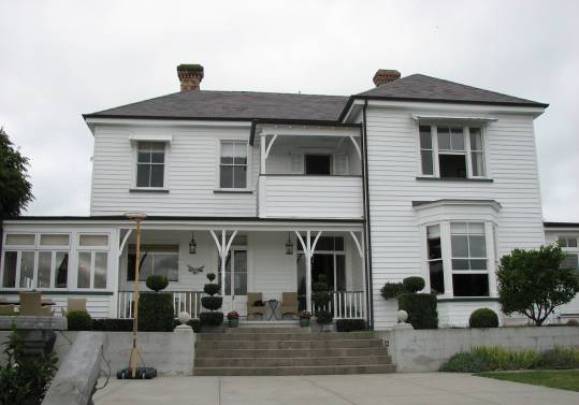
Built as a two-storey house, it had a total of eight main rooms with at least four bedrooms upstairs, and three rooms plus kitchen downstairs. There were wide arched hallways on each floor. On the ground floor a verandah extended along the eastern part of the front, which faced approximately north to Lake Rotoroa, and along the east side. It is possible that the lean to conservatory along the west side of the house was an addition after 1886. The materials were kauri with totara piles, and the roof was Welsh slate. The house originally had four chimneys, the two at the rear being situated against the exterior wall, the other two being interior; the southeast chimney was much taller than the others, and may have had an extension. An under-floor space accessed by steps leading down from the kitchen may have been intended as a hiding place in the event of attack by Maori. Another fully-subterranean room was constructed approximately 4 to 5 metres to the rear of the house, off set from its southeast corner.
Alfred and Mary Cox and family lived at Lake House until 18 April 1879 when after 'nearly six years' the partnership with Williamson was dissolved and they returned to Canterbury. When they left Cox was given an illustrated address by the Vestry of St Peter's Church for his 'valuable help of the last six years'; one of the signatories was I.R. Vialou. He was also given a silver inkstand from the children of Hamilton, in gratitude for 'kindness and exertion' in organising musical entertainments for them. The mayor described him as one our 'most useful and influential settlers' and that he would be remembered as 'one of the pioneers of reclamation and agriculture on a large scale'.
In 1880 the house was described as 'a good country house and some prettily planted grounds at the Hamilton end of the estate', the estate being described as 23,000 acres [9308 hectares]. Another large house existed on the Rukuhia Estate approximately 15 kilometres to the south from Lake House. This was apparently the hands-on farm manager's house, associated with a complex of farm buildings including a large wool shed which still exists but relocated to McGregor Road, Rukuhia close to the former manager's house. There were also stables, implement and carriage sheds, a granary, smithy and forge, shearers' quarters and a cookhouse.
In May 1882 James Williamson took Harry Bullock-Webster to Rukuhia. Bullock-Webster describes his first view of the property:
we passed the Lake property, which was a part of Rukuhia, but had been managed at one time by Mr Cox, of Canterbury. They had spent a lot of money on this end of the estate, having built a beautiful house and stables; and the trees, plantations, and orchards gave it a most homelike look, while the ground sloping down to the lake made a pretty picture...Mr Williamson [said] what a pity it was to see such a delightful place empty, with only a caretaker and stockman in charge.
In 1884 Bullock-Webster married Williamson's daughter Maud and moved into Lake House, his 'beautiful Dream-House' to manage the estate.
In early 1885 the size of the property was reduced through land sale and at this stage was only 700 acres [283 hectares], 'a great part of it swamp'. The property at this time was referred to by Bullock-Webster as 'the Lake Property' rather than Rukuhia Estate. Bullock-Webster's diaries include a large number of sketches and watercolours depicting places, events and livestock, often in caricature form.
In 1886 the Bullock-Websters advertised for a servant to work at the house. Accounts for 1886 show that at any one time at least six servants, including a nurse, were employed. Improvements at the property in 1886 included various repairs and the erection of cottages at the stables. At this time the farm was running cattle, sheep and draughthorses and growing hay, turnips and oats. In 1887 the Bullock-Websters went to England for three years, leasing Lake House to Colonel W.E. Forbes.
Bullock-Webster was involved to a small degree in local affairs. He was appointed on the committee for the proposed Waikato Meat-tinning Works in 1885 and in 1893 he was on the committee appointed to canvass for suppliers for a butter factory, which resulted in the establishment of the Frankton butter factory in 1894. However his main contributions were in horse sports. He was steward at the Waikato Steeplechase meetings, raced his own horses, hosted the Pakuranga Hunt Club at Lake House and in the early 1890s he established the Waikato Hunt Club, with kennels at the Lake for the hounds. In 1894 the Bullock-Websters shifted to 'Riverlea', a Category II registered house on the outskirts of Hamilton in what is now the suburb of Hillcrest. Lake House's occupants enjoyed recreational activities on the lake, as evidenced by sailing dinghies, a small jetty and by the early twentieth century, a small gable-roofed structure at the edge of the lake.
In 1895 Allotments changed hands again and on 15 May 1905 ownership of Lake House was brought under one title when further land was sold. The large property was further subdivided in 1906, 1907 and 1908, with some parcels being sold off and another being taken by the Crown as road reserve, this being the beginning of the formation of Lake Crescent which gives access from Ohaupo Road. The parcel surrounding Lake House remained as a 10-acre [4 hectares] plot and was transferred to Bessie Graham Holden, wife of Thomas Holden, on 4 May 1908.
Bessie and Thomas Holden had owned and farmed the 4000 acre [1619 hectares] farm 'Braemore' at Hunterville and came to Hamilton partly to retire, but also to give the children better opportunities for employment.
The land was further subdivided in 1928 with each of the children receiving a plot of land. Bessie Holden retained the house parcel, driveway and land between the house and the lake edge. Bessie Holden died on 2 September 1943 aged 87 and the property was passed to two of her children, Norman J. Holden and Isabella Bessie Jordan, who in turn sold to their niece Shirley Jean Sanson on 15 August 1944.
In 1949 the land was brought within the boundaries of Hamilton City as by this time subdivision had spread around to the south of the lake. In1956 and 1957 further land was sold off reducing the garden surrounds and removing the direct link between the lake and the house. On 20 June 1958 ownership of Lake transferred to architect, Robert Alfred Heaney, who 'modernised' the house's interior. Further reconfiguration of the land around Lake House occurred by 1960 and further changes of ownership occurred in the 1960s-70s.
Late in 2003 the property was bought by the current owners John Patrick and Jillian Barbara Shaskey. The sale of the house prompted media interest for achieving 'the second-highest residential price fetched in the city'. [Between 2004 and 2009, and again in 2010, the Shaskeys undertook renovation works at the house].
The house once had outstanding aesthetic significance with its lake front setting. For many decades after European settlement of the Waikato it was the only point of interest on the west side of the lake. It's imposing size and prominence on a gently-sloping lawn or pasture with scattered trees made an idyllic scene, captured by professional and skilled amateur photographers such as Henry Gaze, A.G. Tibbutt, Lawrence Cussen and James Reid. Since subdivision and the erection of houses between it and the lake and to its sides and rear, the picturesque aesthetic value has been significantly diminished. Lake House is recognised in publications on Hamilton's history and numerous newspaper articles attest to it being 'one of the oldest and most notable landmarks of Hamilton'. It is recognised as one of Hamilton's 'treasures' and is scheduled in the Hamilton City Council's District Plan. A recent publication on Hamilton's historic buildings cites the house as 'one of the grandest' around the lake.
Lake House is associated with Waikato Hospital and the medical profession through various owners and families. Lake House had a similar history and status in the rural community as does Woodlands, the house built for the New Zealand Land Association.
Lake House is no longer in its rural setting, but retains its original function as a residence. It is the oldest surviving residence of those built for the owners or managers of the great Waikato estates. Lake House is distinctive also because of its elite style reminiscent of Regency England, the other estate houses being in colonial styles, and often only single-storey.