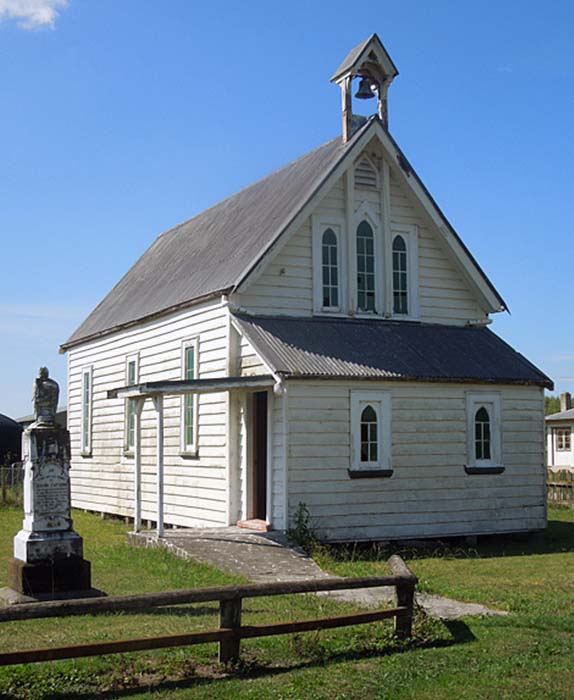
All Saints’ Church, Waituhi, has a long connection with the education and training of Maori clergy and children by the Anglican Church Missionary Society (CMS), having been built in 1903 as the chapel of Te Rau Maori Theological College in Gisborne; then relocated for use as the chapel of the Waerenga-a-Hika Native Boys’ School in 1923. In 1956, it was relocated again for employment as a church in the Pakowhai marae complex in Waituhi.
The Anglican Church began its mission in New Zealand in 1814 in the Bay of Islands; however, by the time Henry Williams (1792-1867), a prominent early missionary for the London-based CMS, assumed leadership of the mission in 1823 there had been no Maori converts to the faith. The talented linguist William Williams (1800-1878) joined his brother in 1826. Both brothers emphasised the importance of teaching in the Maori language if there were to be successes in converting Maori to the Anglican faith. In the following 20 years there were inroads made in these conversions. By the 1840s, over 3,000 Maori in the Bay of Islands had been baptised. Missionaries increasingly spread from the Bay of Islands, and by 1853 there were 440 ‘native agents’ working with Pakeha missionaries across the country, due in no small part to William and Henry Williams’ efforts in learning the language and teaching in Maori.
William Williams’ son, William Leonard Williams (1829-1916) (known as Leonard to Pakeha and Mita Renata to Maori), returned to New Zealand with his wife Sarah (nee Wanklyn) in 1853 after completing his degree at Oxford University. He joined his father at Whakato, the Turanga mission station, in 1854, and then moved, with his wife and parents, to Waeranga-a-Hika (inland of Gisborne) to establish a new mission station and school there in 1857. The work of the mission station was disrupted by the sudden incursion of the Pai Marire faith into Poverty Bay in 1865, and the mission station was abandoned. The Williams family over a number of generations worked tirelessly for the Waiapu Diocese, which was largely formed to be a mission diocese to Maori.
Throughout the 1870s Leonard continued his aim of improving Maori education; from 1877 he began instructing Maori theological students at his home in Cobden Street, Gisborne, Te Rau Kahikatea. As a result of his work, Te Rau Maori Theological College was established and new college buildings were built across the road. Students began their instruction at the new college in 1885. Te Rau was the first, and for forty years the only Anglican training college for Maori clergy in New Zealand.
The college was run by Leonard Williams until his election as the third Bishop of Waiapu in 1895, at which point his son Herbert Williams (1860-1937), later the Bishop of Waiapu, became the principal of the college. Herbert was a noted linguist who, while at Te Rau, worked on an enlarged edition of the first substantial Maori-to-English dictionary, which had been initially published by William Williams in 1844 and revised by Leonard Williams in 1871 and 1892. Soon after Herbert Williams took charge at Te Rau, Reweti Kohere (Ngati Porou, 1871-1954) became a tutor at the institution. Kohere was a first class student at Te Aute College who, after studying at Canterbury College, was assistant tutor at Te Rau College for thirteen years until 1908, during which time he also became a clergyman. During this time at the College, Kohere tutored many young Maori men who would go on to become leaders in the Anglican faith. After a varied career that included journalism, farming and campaigning for the rights of Maori over their land and language, he wrote:
‘I considered the work at Te Rau important and even today I look back on my thirteen years at the college as the best work in my life. Today, in many parts of New Zealand, there are clergymen who were once my pupils. The first and
only Maori Archdeacon, and one of the two Maori Canons, are both old pupils of mine.’
Herbert Williams remained principal of the college until 1902, when Rev. F. W. Chatterton became principal. Soon after his arrival, fundraising began in earnest for a chapel at the college. As Chatterton eloquently put it, a chapel was very important to the training of the ordinands:
‘it is of the utmost importance that the Maori clergy who go forth to lead the devotions and guide the thoughts of their people should themselves, as part of their College training, have become accustomed to a more reverent and orderly conduct of Divine service than can be provided in a bare lecture-room.’
The Chapel was originally known as the Bishop Williams Memorial Chapel, in remembrance of Leonard Williams’ work in training Maori ordinands. Reports from the time suggest that between £200 and £300 were required for the construction of the chapel, and that ‘friends of the Bishop in all parts of the Colony subscribed liberally to the cost of the building, and the Natives also contributed substantially towards the good object.’
The church was designed by architect Frederick de Jersey Clere (1856-1952), who designed many remarkable homes, commercial buildings and churches in New Zealand. As the diocesan architect for the Wellington Anglican diocese from 1883, he designed more than 100 churches for North Island urban and rural parishes, of which around 85 still stand. As his biographer Susan McLean has written: ‘Almost without exception Clere’s churches were an economical and unostentatious adaption of the contemporary Gothic Revival style’, as is the case in this church. Similarities between the Te Rau chapel and other of Clere’s churches are certainly evident, for example with St Mary’s Church in Matawai, St Paul’s in Motu, and St Aidan’s in Alfredton. The construction of the chapel falls within the time period that Clere was still designing and constructing timber churches, but not long after this he began to focus more on brick churches. The supervision of the work for the Te Rau Chapel was carried out by the principal of the college, Rev. Chatterton.
On completion, the chapel was described in the Poverty Bay Herald as a ‘handsome and tastefully-finished little structure’ and ‘the best church of its size in the district. The motto from its commencement seems to have been that what is worth doing is worth doing well, and with the best of material to work on.’ The church was 38 feet long by 17 feet wide, with a 12 foot stud (11 metres x 5 metres, with a 3.5 metre stud). The frame of the building was totara, clad with kauri on the exterior and with rimu finishings in the interior, on a brick foundation. The roof was clad in red Marseilles tiles. The lean-to section, at the rear, served as both a vestry and a porch was ‘neatly roofed with French shingle tiles, used for the first time here.’ The open bell tower was also shingle tiled. The windows were green Muranese glass and the newspaper noted that they were very pretty.
Construction was carried out by Messrs. Mackrell and Colley, a Gisborne firm founded in 1899, and the newspaper notes that the ‘contractors have evidently delighted in erecting an edifice which speaks to all who visit it of a happy combination of ideas and skilful workmanship in their carrying out’. Mr Williams, of the same firm, carved the communion table, with kauri panels and puriri centre shield, inlaid with a monogram in kauri, which remains in the church, and other articles to furnish the church. A ‘finely carved book rest, the work of Mrs Sampson’ was placed on the communion table.
Construction of the chapel proceeded quickly. The building was consecrated by Bishop Leonard Williams on 2 June 1903, and finished the next month. Present at the consecration of the church were the Revs. F. W. Chatterton and Herbert Williams, and Rewiti Kohere, among many others, most of whom were Maori. The service was carried out completely in Te Reo, with a communion service to follow. A collection for the chapel held during and after the service raised a further £32 for the building, including Apirana Ngata’s promise of another £10 from his iwi.
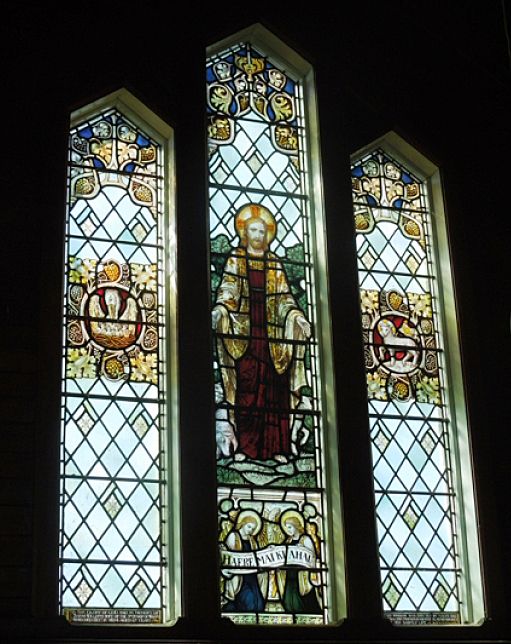
Collections were also later raised for the construction of a stained glass window in the chapel’s chancel in 1905 dedicated to the memory of Sarah Williams, the late wife of Bishop Leonard Williams, who had died in 1894. The inscription on the right hand side of the triangle-topped lancet states that it was ‘erected by Maori and English friends in grateful remembrance of her saintly life.’ The central window features an image of Christ, above two angels holding a scroll saying ‘Haere Mai Ki Ahua’; the left window features an image of a pelican, often association with motherhood in Christian iconography. It has been reported that the window was made by the famous English firm James Powell & Sons, also known as Whitefriars. The firm was certainly a major source of stained glass windows imported into New Zealand, and the window is of a high quality, so it is certainly possible, but a contemporary confirmation of this attribution has yet to be found.
Te Rau Theological College trained many young Maori men who would later become leaders in the Anglican faith, for example the second bishop of Aotearoa Rt. Rev. Wiremu Natana Panapa, Canon Poihipi Mokena Kohere, the Rev. Henare Wepiha Te Wainohu, who was chaplain to the Maori troops during the First World War (1914-18), and Te Paraone Turei, son of the prominent Mohi Turei, himself the first vicar of Waiapu. In 1918, however, the decision was made by the Bishops to close the College, and the students were transferred to St. John's College, Auckland, which since 1846 had been training Pakeha ordinands. This was not a popular decision at the time. While it was ostensibly made so that pupils could be taught in English, and receive a broader education, Maori argued strongly that it would separate Maori ordinands from their communities, and they would lose the opportunity to lead worship in their rural parishes while they were training. Despite these protests, the school closed in 1920 and with the exception of the chapel, the buildings sold.
In 1923 the chapel was moved 13 kilometres to Waerenga-a-Hika to be a chapel at the Anglican Maori Boys’ School there. The Waerenga-a-Hika mission had been established by CMS missionaries in 1857 when the CMS mission station and missionaries, including William Williams and Leonard Williams, moved there from Whakato. The mission station was an important part of the Anglican mission in New Zealand, but was destroyed after fighting broke out between factions of Ngati Porou in 1865. The missionaries were forced to flee and the mission closed. The land was farmed until 1890 when a Maori boarding school was established on the Anglican-owned property. The school provided both primary and secondary schooling, particularly technical training and farming.
When Te Rau closed down and a new home for the chapel was being searched for, Waerenga-a-Hika Native (later Maori) Boys’ School was considered a very appropriate destination as both the school and the chapel had had a long association with the Williams family; given the chapel was built in memory of Leonard Williams ‘it was fitting that it should continue to be associated with his work among the Maoris’. At the time it was moved it was one of three Maori Anglican boarding schools, along with Te Atue (for boys) and Hukarere (for girls) in the Waiapu Diocese. The chapel was once again to be a school chapel; as noted by the Bishop of Waiapu, it was considered crucial that the church schools included chapels. Little is known of the process of moving the church, or any changes made to the church at this time. However, it is clear that the chapel was moved with its chattels intact, including the communion table.
The school was closed after the main building, which contained classrooms and accommodation for 50 pupils, was completely destroyed in a 1937 fire. The chapel escaped any damage. The chapel was then unused for 18 years (the town already having its own church), until it was offered to the Turanga Pastorate of the Waiapu Diocese to use on the Pakowhai marae complex in Waituhi.
Waituhi is a small township 20 kilometres north west of Gisborne; it is the setting for many stories by the author Witi Ihimaera, who grew up there. The area stretching along Lavenham Road, can be divided into distinct areas – the Pakowhai area containing the Pakowhai Marae and All Saints’ Church; the Rongopai area, in which is located the exuberantly painted Rongopai Marae, built in 1888 to honour and welcome home Te Kooti (?-1893), who however never saw it; and the Takitimu area, which contains the Takitimu Marae and village graveyard. Nearby is also the Ngatapa Marae, which was given by Te Whanau a Kai to the Tuhoe people who follow a branch of the Ringatu faith known as Te Hahi o Te Wairua Tapu. Wi Pere, the Te Aitanga-a-Mahaki and Rongowhakaata leader and well-known Member of Parliament from the 1880s to 1900s, who along with the Te Whanau a Kai people, closely aligned to the Anglican religion, had his home very close to Waituhi.
Pakowhai Marae lies between Lavenham Road and the sacred Waipaoa River. It is the principal marae of Te Whanau-a-Kai, an independent iwi group with connections to Kahungungu and Ruapani. The marae complex includes the wharenui Te Poho o Haraina, named after Haraina Pouaru, the daughter of Heni Te Auraki, who in turn was the daughter of Matenga Ruta Kerekere. Haraina died as a young woman, and in her memory her mother built Te Poho o Haraina. Heni Te Auraki and her family once owned much of the land in the area, but in an attempt to protect the land from further sales, she vested her land to her second husband, Te Make of Tuhoe. This resulted in the marae becoming for a time a meeting place for the Ringatu Church and for Te Kooti’s followers in the area. Heni’s family demanded the return of the land, and the marae instead became the centre for the followers of the Tuhoe prophet Rua Kenana Hepetipa (1868/9-1937). After Te Kooti’s death in 1893, Eria Raukura, a tohunga of the Ringatu faith, baptised Rua as the successor of Te Kooti at Pakowhai in the Waipaoa River, in a very significant ceremony for the Ringatu faith. Eria Raukura later set up a separate branch of Ringatu,Te Hahi o Te Wairua Tapu, to which there are many Te Whanau a Kai adherents today. Heni Te Auraki eventually vested all her land in the trusteeship of Te Whanai a Kai, including the block where the Pakowhai marae complex, All Saints’ Church and urupa now stand.
The chapel, having been unused for almost two decades, was given to the Anglican Turanga Pastorate to be placed at Pakowhai Marae. Although the faith of many people in the surrounding area, including many at Pakowhai Marae, is Ringatu, there were a number of dedicated Anglicans, particularly women, who organised the move, and it was financed in particular through fundraising by the local Mothers’ Union.
The new foundations for the church were installed some time before the move went ahead. The distance between the two places was only approximately 2.5 kilometres, but between them lay the Waipaoa River. The bridges across the river were found to be too narrow for the church, so the move was delayed for two years until the river was low enough to allow the structure to be floated across a ford.
Before it was relocated, the tiles were removed from the roof of the church, as was the bell tower, and the stained glass window. On the day it was moved, in February 1956, lorries were driven across the river multiple times in order to harden the river bed, and power lines taken down. Early in the morning the church was removed from the college site; by mid-afternoon it entered the river, dragged by two haulers. Halfway across, the cables snapped and images show the church precariously balanced in the river, leaning to one side. The riverbank was levelled and the church spent a night there, before being hauled the rest of the distance. On arrival at Pakowhai Marae the church was re-roofed and redecorated, before being opened for worship in 1958 with the new name of All Saints’.
Unusually, this meant that the church has been dedicated, then re-hallowed two times in its short history. This final re-hallowing was conducted by the Bishop of Waiapu, the Right Rev. N.A. Lesser. Canon Poihipi Mokena Kohere, the oldest surviving student from the Te Rau Theological College (and brother of Rewiti Kohere discussed above) aged around 80, was present at the service.
The church was placed next to the urupa of the marae. Within the fenced area containing the church is a large marble memorial to Hiraina Kapuaroa, installed in 1902.
The church still sits on the concrete foundations built at the time of its last move. The roof is now corrugated iron rather than the original Marseilles tiles; it is not clear whether the tiles were ever placed back onto the church after it was moved the second time, or whether they were removed later. Aside from these changes, the church is very much as it was when it was built, and the memorial window remains in the church.
Since its rededication, All Saints’ Church has been used by the community for weddings, funerals, baptisms and confirmations, continuing its role as a place of Anglican worship in the rural area of Waituhi. In 1992, the Anglican Church split into Pakeha and Maori Dioceses; accordingly the ownership of the land was transferred from the Waiapu Diocese to Te Hui Amorangi Ki Te Tairawhiti, the Maori Diocese of the Anglican Church on the East Coast. In 2014, it was being used once a month for services.
It is a testament to the superior materials and workmanship employed in the construction of the church that it has survived through the uncertainty of two school closures and two movements, one across a river, to where it stands today.