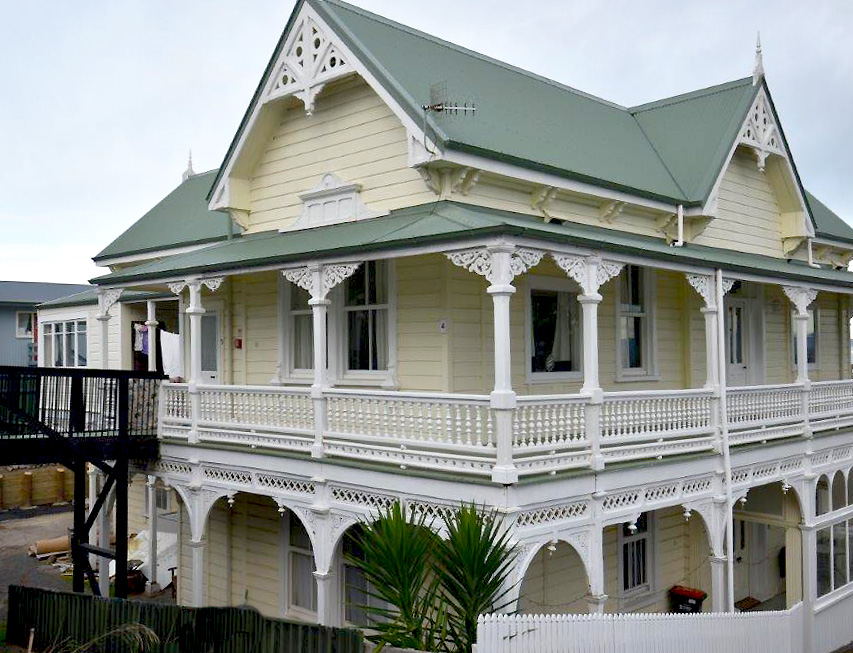
Cluden Bank is an imposing, two-storey, timber villa built for prominent Napier merchant John Close, of the firm Neal and Close, and it reflects the prosperity and confidence of the Hawke’s Bay economy during the 1880s. Constructed in the high Victorian period, probably between 1878 and 1884, the house exemplifies the Queen Anne style adapted to New Zealand conditions. Originally set within expansive, landscaped grounds overlooking Napier and the sweep of Hawke Bay, Cluden Bank was a conspicuous symbol of mercantile success. Its subsequent use as a bishop’s residence – and its name change to Bishopscourt – added ecclesiastical associations, with Anglican Bishop Averill residing there between 1910 and 1921.
Māori settlement in Hawke’s Bay began between 1250 and 1300 AD, with kāinga and pā established along the coast between Māhia to the north and Pōrangahau to the south, and along the rivers and inland waterways. Ancestors of Ngāti Kuhungunu settled in Heretaunga in the sixteenth century, becoming the predominant iwi through a combination of occupation, conflict and marriage alliances. The rohe surrounding Te Whanganui-a-Orotū (Napier’s inner harbour) was an area of early and sustained occupation, its diverse environment of wetlands, lagoons, lakes, coastline, and extensive forest providing a rich food source and many natural resources including materials and medicine plants. The rocky outcrop of Mataruahou (Bluff Hill) dominated the extensive Ahuriri lagoon, with pā established on two nearby islands. One of these, Te Pakeke, was the site of a tribal battle in the early nineteenth century, resulting in significant loss of life and leaving the area tapu. From the 1830s Pākehā whalers established whaling and trading stations along the coast, and by the 1850s, the colonial government began acquiring large areas of land for European settlement and pastoral development. By the early 1860s nearly 1.5 million acres of land in Hawke’s Bay had transferred from Ngāti Kahungunu to the British Crown. In 1855 Mataruahou (Bluff Hill) was renamed Scinde Island, and sections were offered for sale to European settlers, including the former pā site of Hukarere.
John Close, a Yorkshire emigrant who arrived in New Zealand with his parents in 1860, settled in Napier by 1864 and formed a successful grocery and fancy goods partnership with John Wainhouse Neal, which later expanded into a significant department store. Close married at St John’s Church in Napier, in December 1865, and by the 1870s was active in community and volunteer affairs. The substantial timber villa known as Cluden Bank was constructed for Close between 1874 and 1884 on Clyde Road. The origins of the name are unknown, as is whether it was known as Cluden Bank in Close’s time. Its elaborate Queen Anne style features steeply pitched gabled roofs adorned with decorative bargeboards and finials, and wraparound two-storey verandahs enriched with turned balusters, pierced friezes, and fretwork brackets. Tall, vertically proportioned sash windows, horizontal weatherboard cladding, and decorative gable ornaments accentuate the asymmetrical massing. The complex roofline and overall scale convey the prestige of a prosperous merchant residence and reflect the colonial adaptation of Queen Anne architecture, widely employed in New Zealand towns in the 1880s.
Close died in 1907, and the house was purchased in 1910 by the Anglican Diocese as the residence of Bishop Averill. Archival accounts record that ‘… necessary alterations and additions …’ were made, including the erection of a cruciform Bishop’s Chapel in the garden, at which time the house became known as Bishopscourt. The Diocese sold the house in 1923, and in the late 1920s the house was leased to Mrs A. C. Marrett, who operated it as a hotel/boarding house under the name of the Chequers Hotel. In 1933 the lease was taken by Miss M. Galbraith of Dannevirke who established the Langsyde Private Hospital, which operated at Cluden Bank until 1948. The building was ‘thoroughly renovated and modernised’ and was equipped with an operating theatre. In 1948 the hospital moved to Lincoln Road, and Cluden Bank was converted into five flats. The building has remained as flats, with the most recent renovations modifying the property into six flats. Subsequent owners since 1948 have subdivided the land so that the original, expansive, mature gardens surrounding the house, once a key feature of the place, have been absorbed into neighbouring properties. The property remains in private ownership.