

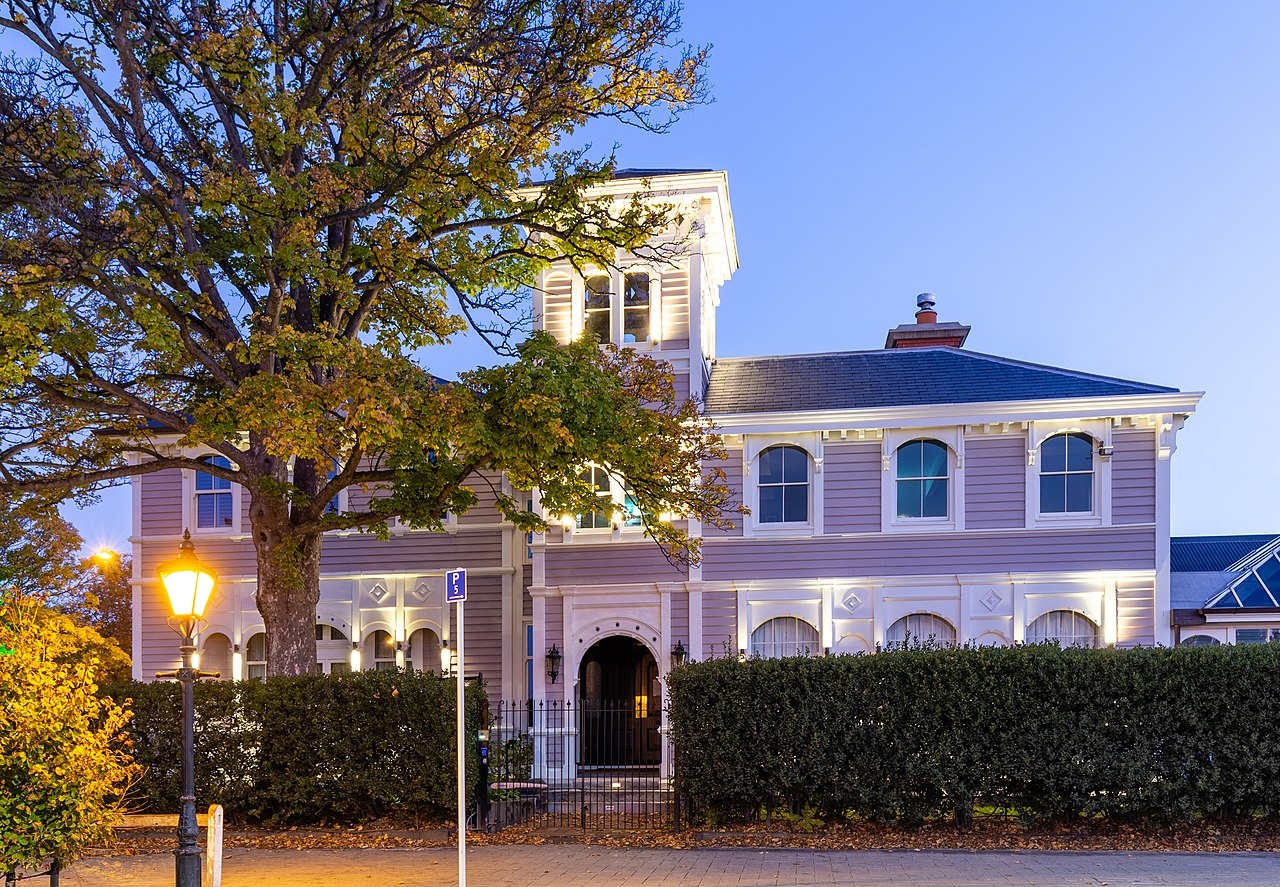
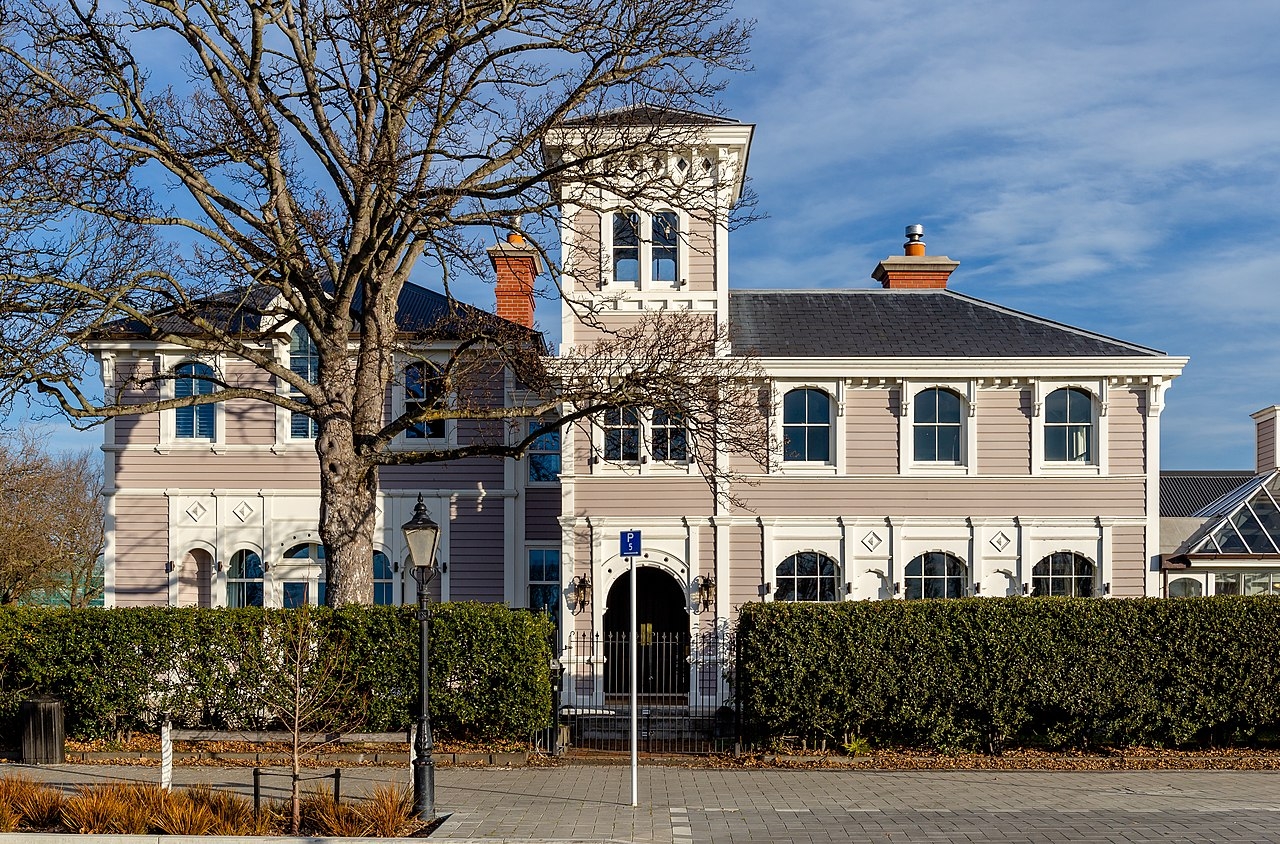
Mountfort's design was based on the Italian Villa style, which had been introduced to England in the early nineteenth century and which, by the 1850s, had become an accepted style for middle-class housing. Ian Lochhead, in his monograph on Mountfort, points out that this style was probably chosen for the Christchurch Club as a compromise between the Italian Palazzo style associated with the two London gentlemen's clubs, the Travellers' and the Reform, (which the members of the club preferred) and Mountfort's predilection for Gothic. The Italian villa style was seen as comparatively informal and as both elegant yet rural, a suitable combination for a club basing itself on English upper-class institutions but establishing itself in the middle of what was still a swamp. The use of timber rather than stone also reflects Mountfort's adaptation of European styles to the vernacular building materials of colonial New Zealand. The building erected for the Christchurch Club has a central tower around which the two main wings are arranged. The arcades on the ground floor are notable and were later referred to by Samuel Hurst Seager in his design for the addition to his house in Armagh Street.
Some of the prominent members of the Christchurch Club included J.B.A. Acland (1823-1904), the owner of Mount Peel Station; Samuel Butler (1835-1902), runholder, explorer and author; Sir Charles Bowen (1836-1917), resident magistrate and politician who introduced the 1877 Education Act; Sir Julius von Haast (1822-1887), explorer, geologist and driving force behind the development of the Canterbury Museum; Sir John Hall (1824-1907), runholder, politician and premier; and Sir Edward Stafford (1819-1901), another runholder and twice Premier, from 1856 to 1861 and 1865 to 1869. While the Christchurch Club attracted many runholders, the members of the Canterbury Club (established in 1872) were, by comparison, predominantly businessmen or professionals.
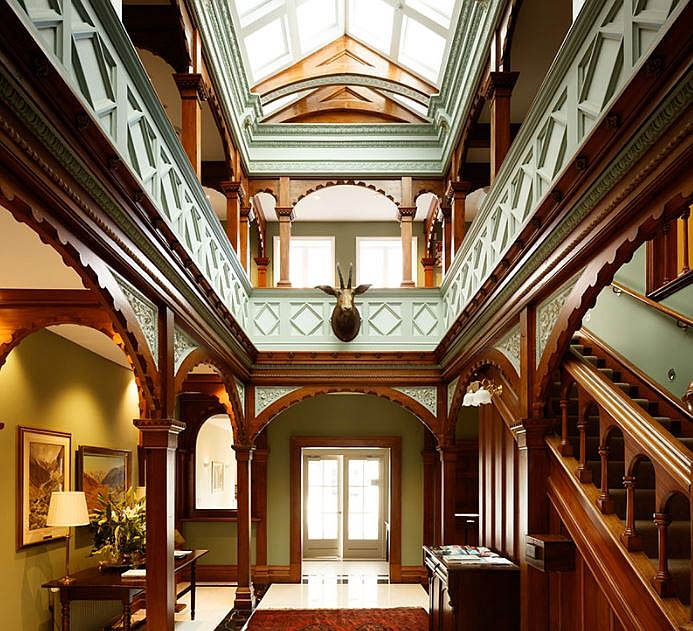
Following the Second World War the government notified its intention to take the club's land for further government buildings. Consequently the club let the maintenance of the building slip. The government abandoned its plans some years later but by then the building was in such a state of disrepair that the club decided to demolish it. It was, however, reprieved and the building was eventually refurbished and extended.
The Christchurch Club is significant as an example of the transplanting of British institutions to New Zealand, and as one of the oldest gentlemen's clubs in the country. Its membership ensured that the Club was an informal seat of power in nineteenth century Canterbury. Architecturally it is significant as an unusual example of Mountfort's work, who is more commonly known for his use of the Gothic Revival style. This commission was also important to Mountfort personally, as it put him in touch with many prominent and influential men, who, no doubt, influenced his subsequent career as the leading architect of public buildings in Canterbury.
List Entry Information
Status
Listed
List Entry Status
Historic Place Category 1
Access
Private/No Public Access
List Number
292
Date Entered
2nd April 1985
Date of Effect
2nd April 1985
City/District Council
Christchurch City
Region
Canterbury Region
Extent of List Entry
Extent includes the land described as Town Secs 761, 763-765 and Pt Town Sec 759 City of Christchurch (RT CB368/36), Canterbury Land District and the buildings known as The Christchurch Club thereon.
Legal description
Town Secs 761, 763-765 and Pt Town Sec 759 City of Christchurch (RT CB368/36), Canterbury Land District
Status
Listed
List Entry Status
Historic Place Category 1
Access
Private/No Public Access
List Number
292
Date Entered
2nd April 1985
Date of Effect
2nd April 1985
City/District Council
Christchurch City
Region
Canterbury Region
Extent of List Entry
Extent includes the land described as Town Secs 761, 763-765 and Pt Town Sec 759 City of Christchurch (RT CB368/36), Canterbury Land District and the buildings known as The Christchurch Club thereon.
Legal description
Town Secs 761, 763-765 and Pt Town Sec 759 City of Christchurch (RT CB368/36), Canterbury Land District
Construction Professional
Name
Mountfort, Benjamin Woolfield
Type
Architect
Biography
Benjamin Woolfield Mountfort (1825-98) trained as an architect in England, in the office of Richard Cromwell Carpenter, a member of the Cambridge Camden Society (later the Ecclesiological Society). He arrived in Canterbury in 1850. Mountfort was New Zealand's pre-eminent Gothic Revival architect and, according to architectural historian Ian Lochhead, 'did most to shape the architectural character of nineteenth-century Christchurch.' The buildings he designed were almost exclusively in the Gothic Revival style. During his career he designed many churches and additions to churches; those still standing include the Trinity Congregational Church in Christchurch (1874), St Mary's Church in Parnell, Auckland and the Church of the Good Shepherd in Phillipstown, Christchurch (1884). In 1857 he became the first architect to the province of Canterbury. He designed the Canterbury Provincial Council Buildings in three stages from 1858 to 1865. The stone chamber of this building can be considered the greatest accomplishment of his career. He was involved in many important commissions from the 1870s, including the Canterbury Museum (1869-82) and the Clock-tower Block on the Canterbury College campus (1876-77). He was also involved in the construction of Christchurch's Cathedral and made several major modifications to the original design. Mountfort introduced a number of High Victorian elements to New Zealand architecture, such as the use of constructional polychromy, probably first used in New Zealand in the stone tower of the Canterbury Provincial Government Buildings (1859). Overall, his oeuvre reveals a consistent and virtually unerring application of Puginian principles including a commitment to the Gothic style, honest use of materials and picturesque utility. The result was the construction of inventive and impressive buildings of outstanding quality. He died in Christchurch in 1898. A belfry at the Church of the Good Shepherd in Phillipstown, the church he attended for the last ten years of his life, was erected in his honour.
Construction Details
Start Year
1859
Type
Designed
Start Year
1966
startYearCirca
Type
Modification
Description
All service rooms etc demolished. New service block built in U shape around enclosed garden
Construction Professional
Name
Mountfort, Benjamin Woolfield
Type
Architect
Biography
Benjamin Woolfield Mountfort (1825-98) trained as an architect in England, in the office of Richard Cromwell Carpenter, a member of the Cambridge Camden Society (later the Ecclesiological Society). He arrived in Canterbury in 1850. Mountfort was New Zealand's pre-eminent Gothic Revival architect and, according to architectural historian Ian Lochhead, 'did most to shape the architectural character of nineteenth-century Christchurch.' The buildings he designed were almost exclusively in the Gothic Revival style. During his career he designed many churches and additions to churches; those still standing include the Trinity Congregational Church in Christchurch (1874), St Mary's Church in Parnell, Auckland and the Church of the Good Shepherd in Phillipstown, Christchurch (1884). In 1857 he became the first architect to the province of Canterbury. He designed the Canterbury Provincial Council Buildings in three stages from 1858 to 1865. The stone chamber of this building can be considered the greatest accomplishment of his career. He was involved in many important commissions from the 1870s, including the Canterbury Museum (1869-82) and the Clock-tower Block on the Canterbury College campus (1876-77). He was also involved in the construction of Christchurch's Cathedral and made several major modifications to the original design. Mountfort introduced a number of High Victorian elements to New Zealand architecture, such as the use of constructional polychromy, probably first used in New Zealand in the stone tower of the Canterbury Provincial Government Buildings (1859). Overall, his oeuvre reveals a consistent and virtually unerring application of Puginian principles including a commitment to the Gothic style, honest use of materials and picturesque utility. The result was the construction of inventive and impressive buildings of outstanding quality. He died in Christchurch in 1898. A belfry at the Church of the Good Shepherd in Phillipstown, the church he attended for the last ten years of his life, was erected in his honour.
Construction Details
Start Year
1859
Type
Designed
Start Year
1966
startYearCirca
Type
Modification
Description
All service rooms etc demolished. New service block built in U shape around enclosed garden
Historical and Associated Iwi / Hapū / Whānau
Completion Date
21st December 2006
Report Written By
Melanie Lovell-Smith
Information Sources
Lochhead, 1999
Ian Lochhead, A Dream of Spires: Benjamin Mountfort and the Gothic Revival, Christchurch, 1999
Other Information
This place was identified as significant under previous legislation with different information requirements. It remains significant under the current legislation. There is opportunity under our legislation and policies to add to this information. Further information about this place may be available from the Southern Regional Office of Heritage New Zealand Pouhere Taonga. Please note that entry on the New Zealand Heritage List/Rarangi Korero identifies only the heritage values of the property concerned, and should not be construed as advice on the state of the property, or as a comment of its soundness or safety, including in regard to earthquake risk, safety in the event of fire, or insanitary conditions.
Historical and Associated Iwi / Hapū / Whānau
Completion Date
21st December 2006
Report Written By
Melanie Lovell-Smith
Information Sources
Lochhead, 1999
Ian Lochhead, A Dream of Spires: Benjamin Mountfort and the Gothic Revival, Christchurch, 1999
Other Information
This place was identified as significant under previous legislation with different information requirements. It remains significant under the current legislation. There is opportunity under our legislation and policies to add to this information. Further information about this place may be available from the Southern Regional Office of Heritage New Zealand Pouhere Taonga. Please note that entry on the New Zealand Heritage List/Rarangi Korero identifies only the heritage values of the property concerned, and should not be construed as advice on the state of the property, or as a comment of its soundness or safety, including in regard to earthquake risk, safety in the event of fire, or insanitary conditions.
Current Usages
Uses: Civic Facilities
Specific Usage: Club rooms/building
Former Usages
General Usage: Civic Facilities
Specific Usage: Club rooms/building
Web Links
description:
Current Usages
Uses: Civic Facilities
Specific Usage: Club rooms/building
Former Usages
General Usage: Civic Facilities
Specific Usage: Club rooms/building
Web Links
description:
Location
Stay up to date with Heritage this month
