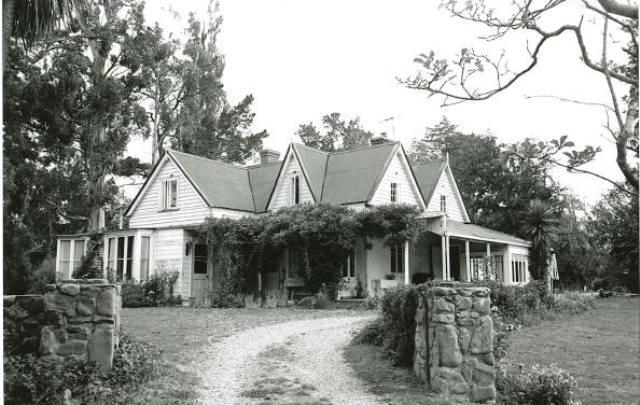
The two-storeyed multi-gabled house at Mount Thomas is one of the earliest Canterbury homesteads still standing. It was built for John Thomas Brown (1816-1888). Brown, who trained as a surveyor in England, immigrated to Christchurch with his family in 1851 and took up part of the land which became Mount Thomas Station in 1853. It is thought that the family initially lived in a small mudbrick cottage, the remains of which still stand at Mount Thomas. Brown added subsequent runs to his holdings in 1854 and 1858 and it is thought the homestead was built sometime between 1857 and 1860.
The lower walls of Mount Thomas Station Homestead were also constructed from sun-dried bricks, while the upper walls were built of timber, with a shingle roof. Clay for the lower walls (and for the earlier cottage) was dug and dried on the property. The use of earth by early Canterbury settlers was reasonably common in the construction of their first homes. Earth construction, in its various forms, was cheap, relatively quick and, on the sparsely treed plains of Canterbury, enabled the early colonists to shelter themselves and their families. The many gables of Mount Thomas, with their plain bargeboards and finials, are a distinctive feature of the homestead. The informal arrangements of the gables and of the windows are typical of the early Canterbury houses. The homestead was extended at various times, which added to its rambling charm. The adobe walls were covered with weatherboards and the roof with corrugated iron.
Although Brown started Mount Thomas as a cattle run, by the 1870s the station was carrying 13,000 sheep. He later reduced this number by around a third and his eldest son, Edward Hatfield Brown (1846-1889), managed the station until his death. The station was then taken over by Edward's brother, Herbert (1860-1928). Herbert's main focus became gardening rather than farming. In 1910 he sold all the Mount Thomas sheep and first leased and then sold the farm. Herbert created, along with his wife, a garden described by garden historian Thelma Leggat as 'truly magnificent' and Mount Thomas became one of North Canterbury's gardening showpieces.
At some stage between 1890 and 1910 half-timbering, in imitation of the Tudor style, was added to the exterior of the upper floor and mock quoins were added to the lower. Both these decorative effects were subsequently removed. The house once included a small chapel but this was removed and the lancet windows from it were installed in the local church, St Matthew's, at Fernside. Mount Thomas is said to be the earliest house in Canterbury to be electrified, although this has proved difficult to verify.
Mount Thomas Station Homestead is one of the earliest houses built on the Canterbury Plains still standing. Typically, such early homesteads were demolished and replaced by more substantial houses as the runholders prospered. However, Mount Thomas survived and it remains as an important reminder of the style of house often built by the early runholders. Mount Thomas is closely associated with the early history of pastoralism in Canterbury and the house was lived in by descendants of Brown for over 100 years. The garden developed by Herbert and Annie Brown was acknowledged as one of the most magnificent in Canterbury at its peak and the bones of it still survive in the mature trees and the lake.